
Self-categorization theory is not a therapy and was never meant to be one. It is a basic social-psychology account of how the self is represented in the mind: sometimes as a unique individual, sometimes as an interchangeable member of a group 1. For clinicians, its value is conceptual. A great deal of clinical suffering is organized around group membership, belonging, exclusion, and the “us versus them” lines people draw, and self-categorization theory gives a precise vocabulary for the cognitive machinery underneath those experiences LLM. One caution before going further: the theory’s central term, depersonalization, means something entirely different here than the dissociative symptom clinicians know, and that collision is addressed directly below LLM.
Type & Discipline
Self-categorization theory is a descriptive cognitive theory drawn from social psychology, specifically the study of how the self-concept is structured and activated in social contexts 1. It describes “the circumstances under which a person will perceive collections of people (including themselves) as a group,” along with the psychological consequences of doing so 1. Its founding claim is that the self can be perceived at varying levels of abstraction rather than as a single fixed entity 1. At one pole sits personal identity, the sense of oneself as a unique individual distinguished from other people; at the other sits social identity, the sense of oneself as a member of a group, sharing attributes with fellow members 2. These levels are context-dependent and fluid rather than permanent traits 1.
The discipline matters for how a clinician should hold the theory. It originated as basic science about ordinary social cognition, not as a model of psychopathology, and it has been applied chiefly to social influence, group cohesion, leadership, the perception of out-groups, crowd behavior, and intergroup conflict 1. Its clinical relevance is therefore downstream and inferential: it explains why group-related phenomena take the shape they do, which can inform formulation and group work, but it does not itself prescribe treatment LLM.
Creators & Lineage
Self-categorization theory was developed by John Turner and colleagues and was formalized in 1987 in the volume Rediscovering the Social Group 1. Turner built it explicitly as a cognitive complement to social identity theory, the earlier framework most associated with Henri Tajfel 1. Where social identity theory described the motivational dynamics of group membership, including the drive for positive distinctiveness, it left the underlying mechanism of identification relatively unspecified; self-categorization theory was designed to supply “the mechanistic underpinnings of social identification” 1.
The relationship between the two is frequently misstated, so it is worth being precise. Turner and Reynolds argued that calling self-categorization theory a replacement for social identity theory is incorrect, because it was “always intended to complement” it 1. Together the two frameworks form what is often called the social identity tradition or social identity approach 1. The lineage runs forward from this base into the study of self-concept, intergroup behavior, and the conditions under which contact between groups reduces or inflames conflict, linking it to intergroup contact theory and to the broader literature on prejudice 1LLM.
Core Principles
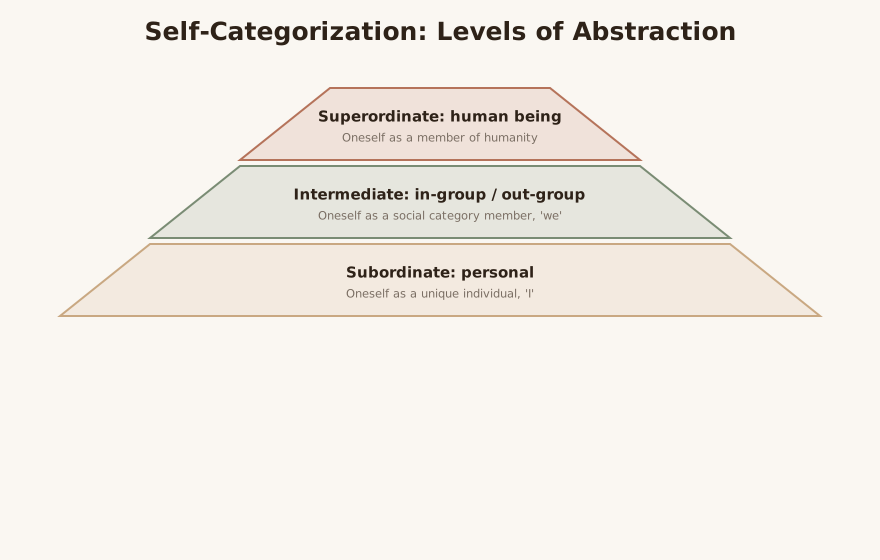
The organizing principle is that self-categorization happens at multiple levels of abstraction. Turner distinguished a superordinate level (oneself as a human being), an intermediate in-group/out-group level (oneself as a member of a social category, “we”), and a subordinate personal level (oneself as a unique individual, “I”) 3. There is generally an inverse relationship between the salience of the personal and the social levels: as one becomes more salient, the other recedes 2. Contemporary theorists increasingly treat these not as discrete boxes but as endpoints on a continuum 2.
The most important and most easily misunderstood mechanism is depersonalization. When a social category becomes salient, “people come to see themselves more as the interchangeable exemplars of a social category than as unique personalities” 1. Critically, the source literature stresses that this is “not pathological” but simply “a change from the personal to the social level of identity” that makes group cohesion possible 2. Depersonalization is paired with self-stereotyping: as people define themselves as members of the same category, they come to see themselves as more alike, taking on the perceived attributes of the group 3.
The content people adopt is the group prototype, the cognitive representation of what is typical or ideal for the category in a given context 1. Prototypes are not fixed; they shift with the comparative context 1. Members are evaluated more positively to the degree they are perceived as prototypical, and those who deviate from the prototype may experience marginalization or alienation 3.
What determines which category becomes salient is governed by an interaction of accessibility and fit 1. Accessibility, also called perceiver readiness, “reflects a person’s past experiences, present expectations, and current motives, values, goals and needs” 1. Comparative fit is captured by the meta-contrast principle: a collection of people is perceived as a single category to the degree that “the differences between those stimuli are less than the differences between that collection of stimuli and other stimuli” 1. Normative fit is the extent to which the perceived behavior of category members matches the perceiver’s knowledge-based expectations of that category 1. When accessibility and fit converge, a category becomes salient, and salience determines whether self-stereotyping occurs and which norms are adopted 1.
Interventions & Techniques
Self-categorization theory does not supply a protocol, but several principles inform recognizable clinical and group-process techniques LLM. The first is deliberate manipulation of category salience. Because identity operates contextually, a clinician or group facilitator can foreground a shared, superordinate category (“we, the people in this room, working on recovery”) to dampen a divisive subordinate one, an application of the principle that the most inclusive salient category shapes self-stereotyping 1LLM.
A second is norm-referenced influence. The theory holds that within a salient in-group, “information is perceived as valid to the extent that it is perceived to be a normative belief of the ingroup,” and the most prototypical member exerts the most influence 1. In group treatment this clarifies why peer-delivered messages and the modeling done by a respected, prototypical group member often outweigh the clinician’s authority 1LLM.
A third technique works through recategorization. Because subjective uncertainty arises when a person observes a difference between themselves and a fellow in-group member, and because that uncertainty is resolved through recategorization or social influence, interventions that redraw category boundaries, emphasizing a common in-group, can reduce out-group derogation 1LLM. This is the conceptual bridge to intergroup contact work and to identity-affirming approaches for marginalized clients 1LLM.
LLM-generated illustrative example (not a guideline): In a heterogeneous support group, members split along an “us versus them” line by diagnosis. The facilitator names and foregrounds a superordinate identity, “everyone here is doing the hard work of staying well,” making that the salient category. As the inclusive identity becomes salient, the previously salient subgroup boundaries soften and members begin to extend the in-group norm of mutual support across the old divide LLM.
Evidence Base
Self-categorization theory is an established theory within social psychology, the product of decades of experimental and theoretical work in the social identity tradition 1. As a theory, its core constructs, depersonalization, self-stereotyping, prototypicality, accessibility, comparative and normative fit, and salience, are well characterized and widely applied to social influence, group polarization, leadership, out-group homogeneity, crowd behavior, and intergroup conflict 1.
The honest caveat for clinicians is the same one that applies to most social-psychology theories imported into the consulting room: an established theory is not an established therapy LLM. Self-categorization theory has no standalone evidence base as a treatment; there are no randomized trials of “self-categorization therapy” because no such modality exists LLM. Its clinical utility is entirely downstream, embedded within group psychotherapy, social-identity and identity-affirming work, intergroup-contact interventions, and anti-oppressive practice, where its constructs help explain mechanism rather than deliver a tested package LLM.
The theory also carries internal limitations a clinician should weigh. Critics have charged that it is overly cognitive and underplays motivational and affective processes, a critique Turner and Reynolds dispute by pointing to the motivations to maintain positive self-categories and achieve in-group consensus that the theory does articulate 1. A second limitation is structural: the theory leans on hierarchically nested categories, but “very few social groups can be described in hierarchical terms,” and overlapping, Venn-like memberships fit reality better 1. A third, drawn from a recent critique, is that the depersonalization model struggles to account for “we-identities” in close relationships, where members experience each other as “non-substitutable” and unique rather than interchangeable 2. These boundaries matter when transferring the model to dyads, couples, or families LLM.
Populations & Indications
The theory is most directly applicable to groups and to anyone whose distress is organized around group membership 1. It is especially apt for teams and organizations, where leadership, cohesion, and norm adoption operate through exactly the prototype and salience mechanisms the theory describes 1. It speaks with particular force to members of marginalized or minority groups, for whom social identity can be both a source of stigma and a powerful resource: a salient, positively valued in-group identity supplies belonging, which is “a basic and nearly universal psychological need” linked to flourishing and well-being 2. And it is centrally relevant to communities in intergroup conflict, where the salience of in-group/out-group categorization drives differentiation and derogation 13.
The clearest indications for invoking the framework are presentations involving belonging and exclusion, identity affirmation for stigmatized clients, group-based polarization, and the interpersonal effects of “us versus them” categorization LLM. It is not indicated as a primary lens for problems that are fundamentally about personal, idiosyncratic identity rather than collective identity, a distinction that becomes important in the cautions below LLM.
Problems-for-Work
Self-categorization concepts give clinicians language for a cluster of group-related presenting problems LLM.
- Intergroup conflict. The salience of in-group/out-group categorization, amplified by meta-contrast, sharpens perceived differences between groups and fuels conflict; recategorization toward a common identity is the theory’s implied lever 1.
- Prejudice and discrimination. The theory accounts for prejudice through categorization and stereotype-consensus processes “rather than individual pathology,” which reframes bias as a normal cognitive product that can be socially modified 1.
- Group polarization. As an in-group identity becomes salient, members converge on and amplify the group prototype, which can push collective attitudes toward the extreme 1.
- In-group/out-group bias. Depersonalization and self-stereotyping lead members to favor the in-group and homogenize the out-group, the cognitive root of out-group homogeneity effects 1.
- Social exclusion. Members who deviate from the group prototype may experience marginalization or alienation, a mechanism for the pain of being on the edge of, or outside, a valued group 3.
- Identity disturbance (with an explicit hedge). The theory is about social rather than personal identity, so it does not directly explain personal-identity disturbance; what it offers is the adjacent insight that a stable, positively valued social identity can serve as a stabilizing resource for a client whose individual sense of self feels diffuse 2LLM.
LLM-generated illustrative example (not a guideline): A client newly out as transgender describes feeling like “no one.” In formulation, the clinician notes that an accessible, positively valued in-group identity can supply belonging and self-continuity. Connecting the client to an affirming community is framed not as a social nicety but as making a stabilizing social identity salient and available LLM.
Contraindications, Cautions & Cultural Humility
The first and most important caution is terminological and is a genuine safety issue. In self-categorization theory, depersonalization denotes the shift to seeing oneself as an interchangeable group exemplar, and the literature is explicit that this is “not pathological” 2. To a clinician, depersonalization almost always means the dissociative symptom of feeling detached from one’s own self or body. These are unrelated phenomena that happen to share a word, and conflating them, for instance reading a client’s healthy group identification as a dissociative sign, would be a clinical error LLM.
A second caution concerns the limits of the model in close relationships. The depersonalization-and-interchangeability account does not transfer cleanly to dyads, where partners experience each other as “non-substitutable” and unique; couple and family “we-ness” can form while members continue “recognizing each other as different” 2. Applying group-level interchangeability logic to intimate bonds risks erasing exactly the individuality those bonds are built on 2LLM.
A third caution is against using the theory to pathologize culturally normative collectivism. The theory’s central claim is that social identity is a normal, often adaptive, basis for the self, and that belonging is a near-universal need 12. A clinician from an individualist orientation should be wary of reading a client’s strong identification with family, faith, or ethnic community as enmeshment or loss of self when it may be a healthy and culturally expected level of self-definition LLM. Finally, because the theory shows that prejudice arises from ordinary categorization rather than individual defect, it should sharpen, not excuse, a clinician’s vigilance about their own in-group/out-group biases entering the formulation 1LLM.
Treatment-Plan Suggestions & SMART Objectives
| Goal | SMART objective (example) | Mechanism |
|---|---|---|
| Strengthen a positively valued social identity as a belonging resource | Within 8 weeks, client will attend an affirming community or peer group at least twice monthly and rate belonging in a log | Salient in-group identity supplies belonging, a near-universal need 2 |
| Reduce out-group derogation in an intergroup-conflict presentation | Over 6 sessions, client will identify one shared superordinate category with the out-group before reacting, recorded weekly | Recategorization toward a common in-group reduces differentiation 1 |
| Soften rigid in-group/out-group bias | By week 6, client will name 2 ways an out-group member differs from the stereotype each week | Counters depersonalized out-group homogeneity 1 |
| Use prototypical peer influence in group treatment | Within 4 group sessions, client will give and receive at least one peer-modeled coping strategy per session | In-group normative information carries disproportionate influence 1 |
| Address pain of social exclusion / prototype deviance | Over 8 weeks, client will identify a group whose prototype fits them and take one step toward it | Reduces marginalization tied to non-prototypicality 3 |
| Build self-continuity through social identity for a client with diffuse personal identity | Within 10 weeks, client will articulate 2 valued group memberships and what each contributes to “who I am” | Social identity as a stabilizing resource for self-concept 2LLM |
| Increase clinician-side cultural humility about collectivism | Each session, clinician will check whether a client’s group identification is being read as enmeshment versus culturally normative self-definition | Distinguishes adaptive social identity from pathology 1LLM |
Common Misconceptions
The most consequential misconception is the one named throughout this article: that depersonalization in self-categorization theory refers to the dissociative symptom. It does not; here it denotes a healthy, non-pathological shift to the social level of identity in which one perceives oneself as an interchangeable group member 2. A second misconception is that self-categorization theory replaced or superseded social identity theory; Turner and Reynolds were explicit that it was “always intended to complement,” not replace, it 1. A third is that depersonalization means “losing yourself” or being psychologically diminished; the theory frames it as a redefinition of self through group membership, not a deficit, and it is what makes coordinated group life possible 12. A fourth is that prejudice in this account reflects individual pathology; the theory locates it in ordinary categorization processes “rather than individual pathology,” which is both its explanatory strength and a reason to treat bias as socially modifiable 1. A final misconception is that social identity is fixed; salience is contextual, so the same person can self-categorize very differently from one situation to the next 1.
Training & Certification
There is no certification in self-categorization theory, and none would be appropriate, because it is a conceptual model rather than a credentialed treatment LLM. Clinicians typically meet it within graduate social-psychology coursework and within training in group psychotherapy, organizational consultation, intergroup-contact and anti-oppressive practice, and identity-affirming approaches, where its constructs are absorbed into how a practitioner thinks about belonging, norms, and group dynamics 1LLM. Competence comes from supervised group and community practice and from familiarity with the broader social identity tradition rather than from a standalone course 1LLM.
Key Terms
- Personal identity: the self perceived as a unique individual, distinguished from others (“I”) 2.
- Social identity: the self perceived as a member of a group, sharing attributes with fellow members (“we”) 2.
- Levels of abstraction: the superordinate (human), intermediate (in-group/out-group), and personal levels at which the self can be categorized 3.
- Depersonalization (SCT sense, NOT the dissociative symptom): perceiving oneself as an interchangeable exemplar of a salient social category; explicitly non-pathological 12.
- Self-stereotyping: taking on the perceived attributes of one’s in-group and seeing oneself as more like fellow members 3.
- Prototype: the context-dependent representation of what is typical or ideal for a category; prototypicality is evaluated positively 13.
- Accessibility (perceiver readiness): the influence of past experience, expectations, motives, values, and goals on which category is used 1.
- Comparative fit (meta-contrast principle): a collection is seen as one category when within-collection differences are smaller than between-collection differences 1.
- Normative fit: the match between a category’s perceived behavior and the perceiver’s expectations of that category 1.
- Salience: the social category currently in psychological use, which governs self-stereotyping and norm adoption 1.
Resources & Further Reading
▶ Watch — a video introduction to this concept:
- Self-categorization theory — Wikipedia
- Being one of us: we-identities and self-categorization theory — León (PMC)
- Understanding Self-Categorization Theory — Psychology Fanatic
Reflective / Supervision Questions
- When this client describes a strong group identification, am I reading it as a healthy, belonging-giving social identity or am I reflexively pathologizing it as enmeshment or loss of self? 2LLM
- Have I been careful not to confuse the self-categorization sense of depersonalization with the dissociative symptom in my notes and formulation? 2LLM
- Which social category is salient for this client right now, and how is that salience shaping the norms they are adopting and the out-group they are derogating? 1
- In a group I run, who functions as the prototypical member, and am I working with that peer’s influence or against it? 1LLM
- Where might my own in-group/out-group categorization be entering this formulation, given that bias arises from ordinary cognition rather than from defect? 1LLM
- For a client whose individual sense of self feels diffuse, could an accessible, valued social identity serve as a stabilizing resource, and what are the limits of that move? 2LLM