
Type & Discipline
The Ryff six-factor model is a construct — a theory-driven, multidimensional definition of what it means to be psychologically well — rather than a standalone treatment modality 5. It sits within developmental and positive psychology and belongs to the eudaimonic tradition of wellbeing, which locates flourishing in meaning, growth, and the realization of human potential rather than in pleasant affect alone 5. The model is operationalized through the Psychological Well-Being Scales (often abbreviated WBS or PWB), a family of self-report instruments 3.
For clinicians, the useful framing is that this is an assessment and case-conceptualization lens, not a manualized therapy LLM. It tells you what a flourishing life looks like across six domains; it does not, by itself, prescribe how to get a client there LLM. That makes it a natural complement to symptom-focused work, where remission of distress can leave a client functional but not actually flourishing LLM.
Creators & Lineage
The model was introduced by Carol Ryff in her 1989 paper “Happiness is everything, or is it?” in the Journal of Personality and Social Psychology 1. Ryff’s central critique was that the wellbeing literature had drifted toward measures that were atheoretical and skewed toward short-term happiness and life satisfaction, neglecting deeper questions about positive functioning 5.
To build a theoretically grounded alternative, Ryff synthesized convergent themes from earlier humanistic and developmental theorists 5. The intellectual lineage runs through humanistic psychology — Maslow’s self-actualization and Rogers’s fully functioning person — through life-span developmental theory, and through clinical and personality theory’s accounts of maturity and positive mental health 5. The Aristotelian concept of eudaimonia — the idea that the aim of life is to live well and virtuously rather than merely to feel good — supplies the model’s philosophical spine 5. The six dimensions represent the points where these otherwise disparate traditions converged on what mature, healthy functioning entails LLM.
Within a broader contemporary map, the model is a close conceptual cousin of Self-Determination Theory — both treat autonomy and growth-related needs as central to wellbeing — and it shares developmental DNA with Erikson’s account of psychosocial maturation across the life course LLM.
Core Principles
The model rests on a few load-bearing commitments. First, wellbeing is multidimensional: a single happiness score conceals meaningful variation, and a person can be high on some dimensions and low on others 5. Second, wellbeing is eudaimonic — anchored in purpose, growth, and self-realization rather than pleasure 5. Third, the dimensions are developmental: they describe trajectories of positive functioning that can shift across the life span 5.
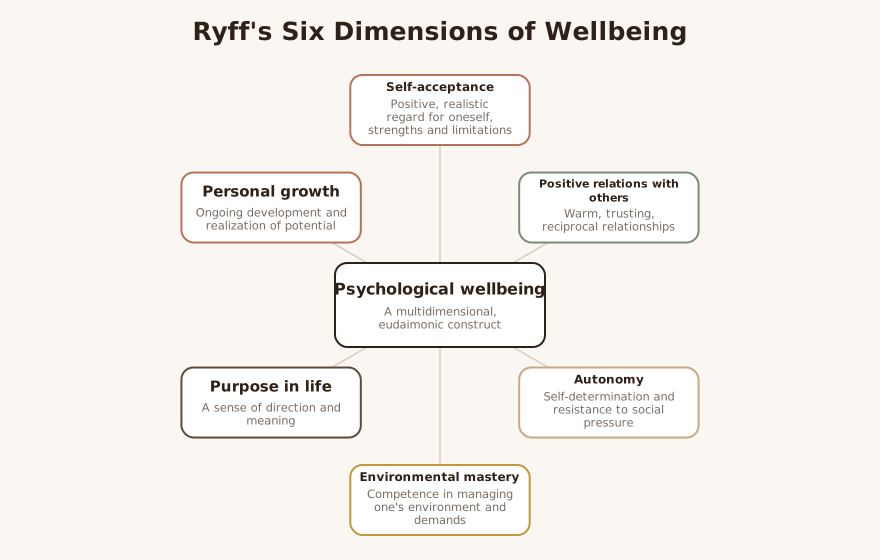
The six dimensions are 4:
- Self-Acceptance — a positive, realistic regard for oneself that acknowledges both strengths and limitations 4. Low scorers feel dissatisfied with themselves and wish they were different 4.
- Positive Relations with Others — warm, trusting, intimate relationships marked by empathy and reciprocity 4. Low scorers are isolated and struggle to form close bonds 4.
- Autonomy — self-determination and independence; the capacity to resist social pressure and evaluate oneself by personal standards 4. Low scorers over-rely on others’ approval and conform 4.
- Environmental Mastery — competence in managing one’s environment and life demands, making effective use of opportunities 4. Low scorers feel unable to change or control their circumstances 4.
- Purpose in Life — a sense of direction, goals, and the conviction that life has meaning 4. Low scorers feel aimless and lack a sense of significance 4.
- Personal Growth — a feeling of continued development, openness to experience, and realization of one’s potential over time 4. Low scorers feel stagnant and closed to new experiences 4.
The recurring clinical theme across all six is the contrast between an engaged, self-directed, developing stance toward life and a stagnant, externally driven, helpless one LLM.
Interventions & Techniques
Because the model is a construct rather than a therapy, its “interventions” are largely the assessment and target-setting activities it enables, plus the therapies built explicitly on it LLM.
The flagship clinical translation is Well-Being Therapy, a structured short-term approach that uses the six dimensions as its explicit treatment targets and was designed to be deployed after acute symptoms have improved LLM. More broadly, positive-psychology interventions and eudaimonic programs have been delivered and evaluated using Ryff’s Scales as the outcome measure, indicating that the dimensions are treated as modifiable rather than fixed traits 2.
In routine practice, the model is typically used in three ways LLM:
- Profiling. Administer the scales (or interview around the six domains) to generate a dimensional profile, identifying which facets are depressed relative to the others 4.
- Targeting. Translate low dimensions into concrete therapeutic goals — e.g., a low purpose score becomes values-clarification and goal-setting work; a low autonomy score becomes work on assertiveness and internal locus of evaluation LLM.
- Tracking. Re-administer to monitor change in positive functioning over the course of treatment, complementing symptom measures 4.
LLM-generated illustrative example (not a guideline): A client in stable remission from depression still reports flat motivation. A Ryff-informed review reveals adequate self-acceptance and relations but very low purpose and personal growth. The clinician shifts from relapse-prevention into values work and graded engagement with novel, meaningful activities — targeting the specific depressed dimensions rather than treating “residual depression” generically LLM.
Evidence Base
Honest appraisal: the construct is well-established; the intervention evidence is real but more modest and still maturing LLM.
On the construct side, the model has generated a large body of research across wellbeing, health, and successful aging, and the scales show strong psychometric performance — high internal consistency and good test-retest reliability, with convergent validity against established life-satisfaction and depression measures 54. The structure has been examined cross-culturally; a Spanish exploration of the model interrogated its factor structure in a non-U.S. sample, part of a broader literature testing how well the six-dimension structure replicates outside its original context 6.
On the intervention side, a meta-analytic review specifically examined interventions designed to enhance eudaimonic wellbeing as measured by Ryff’s Scales, pooling controlled studies of programs intended to move these dimensions 2. This work establishes that the dimensions are responsive to intervention, which is the clinically important point — but effect sizes in this literature are generally in the small-to-moderate range, and questions about durability and active ingredients remain open 2LLM.
The most cited limitation is structural: the proposed six-factor structure has been debated, with some analyses suggesting the dimensions are highly intercorrelated or do not cleanly separate into six independent factors 56. The practical implication is to treat the six dimensions as a useful clinical heuristic rather than as six guaranteed-orthogonal mechanisms LLM.
Populations & Indications
The model was developed and validated across adults of all ages and has a particularly strong evidentiary base in aging research 5. Indicated and well-studied populations include adults across the lifespan, older adults, and people managing chronic illness, where preserved purpose and environmental mastery are protective LLM.
It is especially apt for clients in recovery from depression, where symptom remission has not restored positive functioning, and for individuals seeking personal growth who present without a categorical disorder but report a sense of stagnation or meaninglessness LLM. It also fits caregivers and others facing chronic role strain, where autonomy, mastery, and relational quality are commonly eroded LLM.
Clinically, the model is most useful when the presenting concern is languishing — the absence of flourishing rather than the presence of acute symptoms — or when residual functional deficits persist after standard treatment LLM.
Problems-for-Work
The six dimensions map cleanly onto common problems-for-work LLM:
- Lack of purpose or meaning / languishing — directly targets the purpose in life dimension; work centers on values clarification and meaningful goal-setting LLM.
- Low self-esteem / identity and self-acceptance problems — targets self-acceptance; work addresses self-regard that integrates strengths and limitations 4.
- Low autonomy and self-direction — targets autonomy; work builds an internal locus of evaluation and reduces approval-dependence 4.
- Burnout and adjustment difficulties — often present as collapsed environmental mastery and personal growth; work rebuilds a sense of competence and forward momentum LLM.
- Relationship difficulties — target positive relations; work focuses on trust, empathy, and intimacy capacity 4.
- Major depressive disorder / generalized anxiety disorder — the model is best used here as an adjunct outcome lens after symptom-focused treatment, to detect and address residual deficits in positive functioning 2LLM.
Contraindications, Cautions & Cultural Humility
There are no hard contraindications for using the model as an assessment lens, but several cautions apply LLM.
First, sequencing: well-being approaches built on this model were designed to follow, not replace, acute symptom stabilization; pushing growth and purpose work during an acute crisis can feel invalidating and is not the intended use LLM. Second, the scales have no published clinical cutoffs — researchers often use quartile splits, but there is no validated threshold for “disordered” wellbeing, so scores should inform clinical judgment, not substitute for it 4.
Cultural humility is essential, particularly around autonomy LLM. The dimension reflects an emphasis on independence and resistance to social pressure that maps onto individualist value systems; in collectivist or interdependent cultural contexts, embeddedness in family and community expectations may be a marker of health rather than of low autonomy LLM. Cross-cultural examinations of the factor structure, including the Spanish exploration, underscore that the six-dimension model does not necessarily replicate identically across cultures 6. The dimensions should be discussed with clients in their own value frame, not imposed as a universal definition of the good life LLM.
Treatment-Plan Suggestions & SMART Objectives
| Goal | SMART objective (example) | Mechanism |
|---|---|---|
| Strengthen purpose in life | Within 8 weeks, client will articulate three personally meaningful life values and identify two weekly activities that enact them, logged between sessions | Targets the purpose in life dimension via values clarification 4 |
| Build self-acceptance | Over 6 weeks, client will record one daily self-observation integrating a strength and a limitation without self-criticism, reviewed weekly | Addresses self-acceptance through balanced self-regard 4 |
| Increase autonomy | Within 10 weeks, client will identify and act on three decisions guided by personal standards rather than others’ approval | Builds autonomy and internal locus of evaluation 4 |
| Restore environmental mastery | Over 8 weeks, client will plan and complete one weekly task that exercises control over a previously avoided life demand | Rebuilds environmental mastery and perceived competence 4 |
| Deepen positive relations | Within 12 weeks, client will initiate two acts of reciprocal disclosure or support in a chosen relationship per week | Strengthens positive relations with others 4 |
| Reactivate personal growth | Over 8 weeks, client will engage in one novel, skill-stretching activity weekly and reflect on what was learned | Targets personal growth and openness to experience 4 |
| Track flourishing alongside symptoms | At weeks 0, 6, and 12, client will complete a Ryff Scales subscale profile to monitor change in positive functioning | Provides dimensional outcome tracking beyond symptom measures 4 |
Common Misconceptions
“It’s a happiness measure.” No — the model was explicitly built as a eudaimonic alternative to hedonic happiness measures, emphasizing meaning, growth, and positive functioning rather than pleasant affect 5.
“The six dimensions are independent, distinct mechanisms.” The clean six-factor structure has been debated; the dimensions are substantially intercorrelated, so they are best used as a clinical map, not as six proven orthogonal targets 56.
“There’s a clinical cutoff for low wellbeing.” No validated diagnostic cutoffs exist; quartile splits are a research convention, and scores should inform, not dictate, clinical decisions 4.
“It’s a therapy.” It is a construct and measurement framework; therapies such as Well-Being Therapy operationalize it, but the model itself prescribes targets, not techniques LLM.
Training & Certification
There is no certification in the model itself, because it is a construct and a set of self-report scales rather than a proprietary modality LLM. The scales are obtained directly from the original author’s materials; the Ryff lab notes it does not hold copyright authority to license the measures and directs researchers to the original 1989 source for permissions 3. Familiarity with the original construct paper grounds correct interpretation 1.
Clinicians who wish to intervene on the dimensions, rather than merely measure them, typically pursue training in the eudaimonic therapies and positive-psychology interventions that use these scales as outcomes — Well-Being Therapy being the most directly aligned 2LLM.
Key Terms
- Eudaimonic wellbeing — flourishing defined by meaning, growth, and realization of potential, as opposed to hedonic pleasure 5.
- Self-acceptance — positive, realistic self-regard integrating strengths and limitations 4.
- Environmental mastery — competence in managing one’s life context and demands 4.
- Autonomy — self-determination and an internal locus of evaluation 4.
- Purpose in life — sense of direction, goals, and meaning 4.
- Personal growth — ongoing development and openness to experience 4.
- Positive relations with others — warm, trusting, empathic relationships 4.
- Psychological Well-Being Scales (WBS/PWB) — the self-report instruments operationalizing the model, available in long and short item versions on a 1–6 Likert format 34.
Resources & Further Reading
▶ Watch — a video introduction to this concept:
- Ryff, C. D. (1989). Happiness is everything, or is it? (JPSP, 57(6), 1069–1081)
- van Dierendonck et al. — Interventions to enhance eudaemonic psychological well-being: A meta-analytic review with Ryff’s Scales
- Ryff Lab / Wisconsin — Psychological Well-Being Scales (WBS)
- PositivePsychology.com — The Ryff Scales of Psychological Wellbeing: How-To Guide
- Six-factor model of psychological well-being — Wikipedia
- Ryff’s Six-factor Model of Psychological Well-being, A Spanish Exploration
Reflective / Supervision Questions
- When a client reaches symptom remission, how do I currently assess whether they are flourishing versus merely no longer distressed, and would a dimensional wellbeing profile change my plan? LLM
- Which of the six dimensions do I habitually attend to, and which do I tend to neglect in case conceptualization? LLM
- How do I hold the autonomy dimension with clients from interdependent cultural backgrounds without pathologizing healthy embeddedness? LLM
- Given that the six factors are intercorrelated and lack clinical cutoffs, how do I avoid over-interpreting a single low subscale score? LLM
- For a languishing client without a categorical diagnosis, how do I sequence purpose, growth, and mastery work so it feels validating rather than prescriptive? LLM