
Type & Discipline
The Social Cure is a framework rather than a discrete therapy or manualized intervention; it is a way of understanding how group memberships shape health, into which many specific techniques and programs can be slotted 1. It sits within social and health psychology and is the health-focused extension of the broader social identity approach 5. The term “social cure” is deliberately provocative: it inverts the more familiar clinical assumption that other people are mostly a source of stress or contagion (“social curse”) and argues that, under the right conditions, group life is restorative for both mind and body 4. For practicing therapists, the most useful framing is that the Social Cure offers a theory of mechanism — why connection helps — that can sharpen how you target the social dimension of a treatment plan LLM. It is not a replacement for an established modality but a lens that can be layered onto one LLM.
Creators & Lineage
The framework was consolidated by a group of social psychologists, most centrally Catherine Haslam, S. Alexander Haslam, and Jolanda Jetten, whose 2012 edited volume The Social Cure: Identity, Health and Well-Being gave the field its name and organizing agenda 1. The intellectual lineage runs directly through the social identity tradition: Henri Tajfel and John Turner’s Social Identity Theory, which described how people derive part of their self-concept from group memberships, and Turner’s later self-categorization theory, which detailed how people come to think and act in terms of “we” rather than “I” 5. The Social Cure took these structural ideas about identity and applied them to health and wellbeing outcomes, arguing that the self-categorization processes Tajfel and Turner described have measurable consequences for stress, coping, and clinical recovery 5. It also runs alongside, but is theoretically distinct from, classic social support theory and the sociological literature on social capital — the Social Cure’s distinctive claim is that it is subjective identification with a group, not merely the presence of contacts or resources, that does the protective work 2. The research agenda has since been formalized and extended, including a programmatic statement of the questions the field most needs to answer next 2.
Core Principles
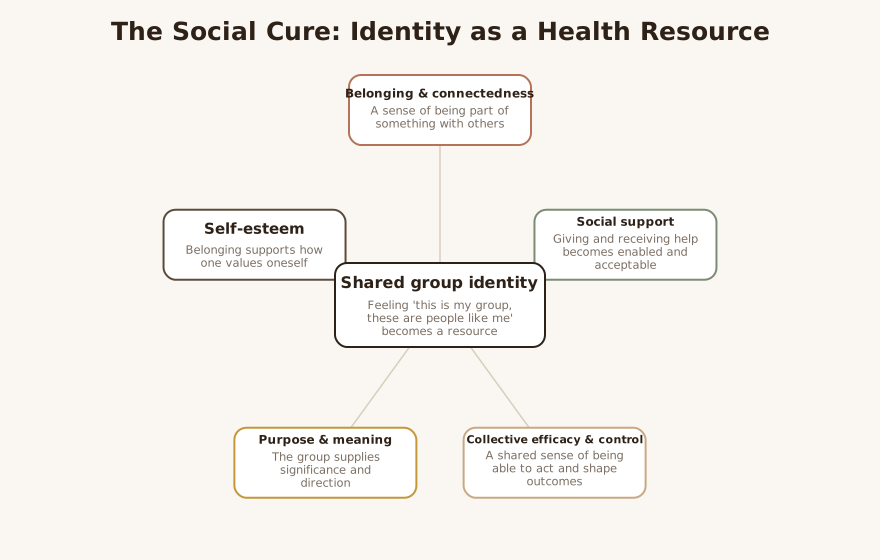
The foundational principle is that social group memberships are a psychological resource: when a group becomes part of how you define yourself, it supplies meaning, support, control, and self-esteem that buffer against adversity 1. A second principle is the primacy of identification over mere contact — sitting in a room with others does little unless you come to feel that this is “my group” and these are “people like me” 2. From shared identity flow several proposed mechanisms: groups provide a sense of belonging and connectedness, they enable and make acceptable the giving and receiving of social support, they confer a sense of collective efficacy and control, and they supply purpose and meaning 3. A third principle is that identity continuity matters: life transitions that strip away valued group memberships — retirement, illness, relocation, bereavement — are health risks, whereas maintaining old memberships and building new ones across a transition is protective 1. The framework distinguishes the number of group memberships a person holds, the strength of identification with each, and whether memberships are compatible or in conflict, treating each as a distinct target LLM. Importantly, the framework is even-handed: groups can also be a “social curse” when they are stigmatized, demanding, or in conflict, so the clinical task is not simply “more groups” but the right groups, well-integrated into the self 4.
Interventions & Techniques
Because the Social Cure is a framework, its techniques are vehicles that operationalize its principles rather than a single proprietary protocol LLM. The most directly associated assessment-and-planning tool is social identity mapping, a structured exercise in which client and clinician map current group memberships, rate identification strength and importance, and identify which memberships are gained, lost, or under threat 2. A flagship manualized program in this tradition is Groups 4 Health, a group-based intervention that explicitly teaches participants to understand, build, and maintain group memberships as a route out of loneliness and low mood; it is one of the few Social Cure applications with intervention-level data LLM. The framework also provides the theoretical rationale for social prescribing, in which a link worker or health coach connects a person to community groups and activities; recent longitudinal work frames social prescribing explicitly as a “social cure” pathway 3. In everyday therapy, the principles translate into mapping the client’s social world, deliberately scaffolding entry into valued groups, working to preserve threatened memberships across a transition, and reducing identity conflict between competing group demands LLM. These techniques pair naturally with established modalities — for example, the behavioral-activation logic of scheduling group engagement, or the cognitive work of addressing beliefs that block re-entry into social roles LLM.
LLM-generated illustrative example (not a guideline): A recently retired client presents with low mood and a sense of purposelessness. Rather than treating “retirement” only as a cognitive distortion to be reframed, the clinician uses social identity mapping and finds that retirement severed his identity as “a colleague and mentor.” The plan targets rebuilding an equivalent identity — volunteer mentoring, an alumni association — so the lost group membership is replaced rather than merely mourned LLM.
Evidence Base
The evidence base for the Social Cure is best described as emerging rather than established LLM. Its strongest empirical footing is a large and consistent body of cross-sectional and longitudinal correlational research showing that the number and subjective strength of group identifications predict better mental and physical health outcomes across diverse populations 1. The framework’s distinctive causal claim — that benefits flow specifically through identification — is supported by mediation analyses 2. A representative longitudinal study of a social prescribing pathway followed participants with chronic conditions, loneliness, or social anxiety across three timepoints and found that group memberships increased over the intervention and that health-related quality of life improved and was sustained 3. A serial mediation analysis in that study traced the pathway from increased group memberships to community belonging, to perceived social support, to reduced loneliness, to improved quality of life, and cross-lagged analysis suggested social factors drove later health improvements rather than the reverse 3. However, the same study illustrates the literature’s limits: severe attrition (from 630 at baseline to 63 at final follow-up) constrained the conclusions, and much of the field remains observational 3. Manualized programs in this tradition have early controlled data, but the body of randomized trials is still thin relative to mature psychotherapies, and effect sizes and durability vary LLM. The honest clinical summary is that the mechanism is well-theorized and increasingly well-evidenced, while the intervention literature is younger and should be applied as a promising adjunct, not a proven stand-alone cure LLM.
Populations & Indications
The framework is most relevant where loss, threat, or absence of valued group memberships is a plausible driver of distress LLM. People with chronic illness are a core population, since diagnosis often disrupts work, leisure, and family roles and imposes a stigmatized new identity 1. People in recovery from substance use are well served by the framework’s emphasis on shifting identity away from a using network toward a recovery community 2. Older adults and retirees face predictable identity loss at major transitions, making continuity of membership protective 1. Stroke and brain injury survivors are a population in which maintaining and rebuilding group memberships has been studied as part of rehabilitation 5. People with depression, particularly where withdrawal and loss of role are prominent, are strong candidates, as are marginalized groups for whom shared identity can be a source of resilience against discrimination 4. Across these groups, the common indication is the same: distress that is meaningfully tied to the social self LLM.
Problems-for-Work
The framework gives the clinician concrete leverage on several problems-for-work LLM. For social isolation and loneliness, the task is to increase the number and quality of valued group memberships rather than simply increasing contact frequency 3. For major depressive disorder with prominent withdrawal, group re-engagement can be sequenced as behavioral activation with an identity rationale that makes the activity feel meaningful rather than arbitrary LLM. For substance use disorder, the work centers on identity transition — loosening identification with a using group and strengthening identification with a recovery group 2. For chronic stress, the relevant mechanism is the buffering effect of belonging and shared support on the appraisal of stressors 2. For adjustment disorder around a transition such as retirement, migration, or diagnosis, the work is identity continuity — preserving old memberships and seeding new ones 1. For low self-esteem and demoralization, valued group membership supplies a source of worth and efficacy external to symptom-focused self-evaluation 4. For health disparities, the framework reframes connection as a structural health resource unevenly distributed across communities 3. For identity disturbance, mapping the social self can make a diffuse sense of “who am I” concrete and workable LLM.
LLM-generated illustrative example (not a guideline): A client in early recovery reports she “has nothing to do but think about using.” Using a Social Cure lens, the clinician helps her audit which relationships are tied to her using identity and which could anchor a sober identity, then scaffolds weekly engagement with a recovery group — targeting substance use disorder through a deliberate shift in group identification rather than willpower alone LLM.
Contraindications, Cautions & Cultural Humility
The Social Cure is not universally benign, and the framework itself flags this 4. Groups can be a “social curse” when they are abusive, exploitative, stigmatizing, or built around the very behavior the client wants to change, so the clinician must assess the content of a group, not merely its presence 4. Pushing socially anxious, traumatized, or autistic clients toward group engagement they are not ready for can be harmful and should follow, not precede, capacity-building work LLM. Identity conflict is a real risk: adding a new membership that clashes with an existing valued one (for example, a recovery identity that a client’s family rejects) can increase distress, so compatibility must be planned for LLM. Cultural humility is essential, because what counts as a meaningful group, and how group belonging is expressed, varies enormously across cultures, and a clinician’s assumptions about “healthy” sociality may not fit the client’s world LLM. For marginalized clients, identification with a stigmatized in-group can be both a source of resilience and a target of discrimination, and the clinician should not pathologize either the identity or the protective strategy 4. Finally, the framework should not be used to relocate responsibility for structurally produced isolation onto the individual; loneliness is often a product of inequitable access to community resources, not a personal failing 3.
Treatment-Plan Suggestions & SMART Objectives
| Goal | SMART objective (example) | Mechanism |
|---|---|---|
| Make the social self assessable | Within 2 sessions, client will complete a social identity map listing all current group memberships with identification-strength ratings | Surfaces group memberships as targets and reveals losses and threats 2 |
| Reduce loneliness via belonging | Over 8 weeks, client will join and attend at least one valued community group 3 of 4 weeks | Belonging and perceived support reduce loneliness and improve quality of life 3 |
| Activate behavior with identity meaning | For 6 weeks, client will complete 2 weekly group-based activities tied to a valued identity, logged in session | Group activity scheduled as identity-congruent behavioral activation lifts mood LLM |
| Support identity transition in recovery | Within 30 days, client will identify 2 sober-identity groups and attend 1 weekly | Shifting group identification supports recovery from substance use 2 |
| Preserve continuity across a life change | Within 4 weeks, client will name and re-engage 1 pre-transition membership at risk of being lost | Identity continuity buffers adjustment to retirement, illness, or relocation 1 |
| Reduce identity conflict | Within 6 weeks, client will articulate and problem-solve 1 conflict between competing group demands | Resolving incompatible memberships lowers strain on the social self LLM |
| Build esteem from valued membership | Over 8 weeks, client will identify 2 contributions made within a valued group | Group-derived worth and efficacy offset demoralization and low self-esteem 4 |
Common Misconceptions
A frequent misconception is that the Social Cure simply means “more friends” or “more contact”; the framework’s central claim is that it is subjective identification with a group, not contact frequency or network size, that confers benefit 2. A second is that it is itself a therapy you deliver; it is a framework that explains mechanism and must ride inside an established modality or program 1. A third is that groups are uniformly good for health, which the framework explicitly denies — stigmatized, conflicting, or abusive memberships can be a “social curse” 4. A fourth is that the evidence is settled; in reality the mechanism is well-theorized while the controlled intervention literature is still maturing 3. A fifth is that it is interchangeable with social support theory or social capital; the Social Cure overlaps with both but is distinguished by its emphasis on identity as the active ingredient 2. Finally, some assume it applies only to mental health, when much of its evidence concerns physical health and recovery outcomes as well 5.
Training & Certification
There is no licensure or protected credential attached to the Social Cure framework itself, and any qualified mental-health clinician can incorporate its principles into practice LLM. The primary route to competence is the literature, beginning with the foundational edited volume and the programmatic research-agenda paper 1 2. Specific tools and programs have their own training resources; social identity mapping is described in the published research and accompanying materials, and manualized group programs in this tradition typically have facilitator guides and training delivered by their developers LLM. Clinicians already trained in an established modality — such as behavioral activation, group psychotherapy, or motivational work in addictions — can layer the Social Cure lens onto existing competencies rather than retraining from scratch LLM. Supervision and peer consultation focused on the social dimension of cases are practical ways to build skill in applying the framework responsibly LLM.
Key Terms
- Social identity — the part of a person’s self-concept derived from membership in social groups, and the lever the framework works on 5.
- Social cure vs. social curse — the contrasting health-promoting and health-harming effects that group memberships can have depending on their nature 4.
- Social identity mapping — a structured assessment that charts a client’s group memberships, identification strength, and threats 2.
- Identity continuity — the maintenance of valued group memberships across life transitions, treated as protective for health 1.
- Multiple group memberships — holding several distinct valued identifications, associated with better outcomes than holding few 1.
- Identification (vs. contact) — the subjective sense of “this is my group,” held to be the active ingredient rather than mere presence of others 2.
Resources & Further Reading
▶ Watch — a video introduction to this concept:
- The Social Cure: Identity, Health and Well-Being (Jetten, Haslam & Haslam, eds., 2012)
- Advancing the social identity approach to health and well-being: Progressing the social cure research agenda (Jetten et al.)
- Social Prescribing as ‘Social Cure’: longitudinal study of social connectedness benefits (PMC8793307)
- A Social Cure (Psychology Today blog by the social-cure researchers)
- The Social Identity Approach to Health (Social Scaffolding, Cambridge, ch. 4)
- The Social Cure: Identity, Health and Well-Being (Google Books overview)
Reflective / Supervision Questions
- For this client, which group memberships have been lost, threatened, or never available, and how does that map onto the timeline of their distress? LLM
- Am I treating connection as a generic “more contact is better” prescription, or am I targeting genuine identification with valued groups? LLM
- Could any group I am encouraging function as a “social curse” — stigmatizing, conflict-inducing, or tied to the problem behavior? LLM
- Where am I assuming a culturally specific model of “healthy” sociality that may not fit this client’s world? LLM
- Am I using the Social Cure as a mechanism to enrich an established modality, or am I letting it substitute for evidence-based treatment of the presenting diagnosis? LLM
- Am I attending to structural barriers to belonging, or implicitly framing the client’s isolation as a personal failing? LLM