
Type & Discipline
Social comparison theory is a foundational theory within social psychology, situated in the family of self and social cognition.6 It concerns how people evaluate their own abilities and opinions by measuring themselves against other people rather than against objective standards.5 Although it originated as a basic-science account of self-evaluation, it is not a treatment model; clinicians encounter it as an explanatory framework that helps make sense of how comparison processes feed body-image disturbance, anxiety, depression, and self-criticism.LLM In clinical work it functions less as a protocol and more as a case-formulation lens: a way to name and target a specific cognitive-behavioral process the client is already engaged in.LLM
Creators & Lineage
Leon Festinger introduced social comparison theory in 1954, proposing that people have a basic drive to evaluate their opinions and abilities, and that when objective, nonsocial means of evaluation are unavailable, they evaluate themselves by comparison with other people.6 Festinger advanced a set of foundational hypotheses, including the claim that the tendency to compare with a particular other decreases as the difference between oneself and that other increases, and that people experience a unidirectional drive upward with respect to abilities.6 He also distinguished two goals served by comparison: self-evaluation, an objective assessment of one’s strengths and weaknesses, and self-enhancement, the drive to improve on shortcomings.5
The theory was substantially extended after Festinger. Thomas A. Wills introduced downward comparison in 1981, describing comparison with others perceived as worse off as a defensive strategy that can elevate self-regard and increase subjective well-being.6 Later theorists identified four self-evaluation motives—self-assessment, self-verification, self-improvement, and self-enhancement—and Abraham Tesser’s self-evaluation maintenance model examined how the achievements of close others can either threaten or bolster one’s own self-evaluation through comparison and reflection processes.6 The clinically relevant lineage includes social identity theory, self-discrepancy theory, cognitive behavioral theory, and relative deprivation theory; relative deprivation in particular reappears in contemporary clinical research as a mediating mechanism linking comparison to distress.2
Core Principles
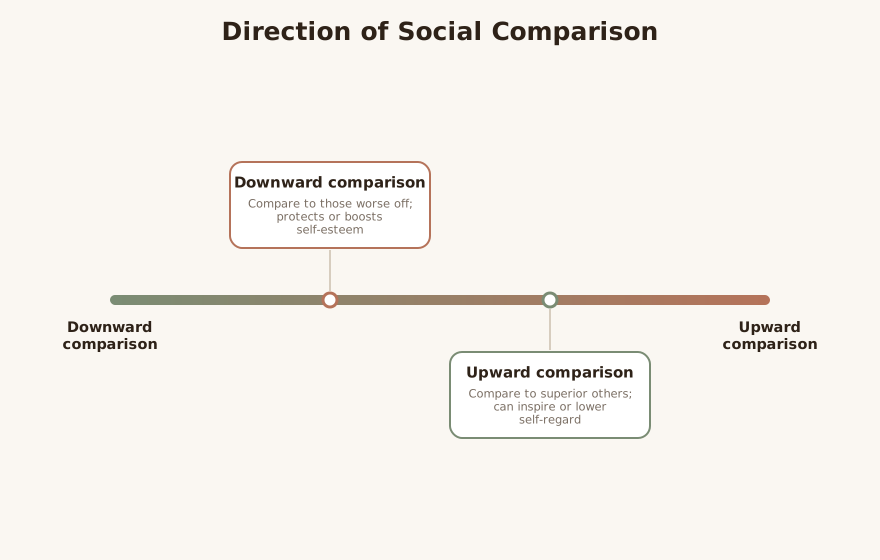
The central claim is that self-knowledge about abilities and opinions is inherently relational: in the absence of objective measures, the self is calibrated against other people.5 Comparison is directional. Upward comparison measures the self against superior others; it can supply inspirational motivation and a model for self-improvement, but it can also lower self-regard and provoke insecurity, jealousy, and dissatisfaction.6 Downward comparison measures the self against those perceived as worse off; it tends to protect or boost self-esteem but can foster overconfidence or arrogance.4
A second principle is that the direction and consequences of comparison are moderated by the individual’s state and traits.6 Self-esteem and mood shape both which comparisons people make and how those comparisons land: people with high self-esteem tend to benefit from upward comparisons, whereas those with low self-esteem or under threat gravitate toward downward comparisons.6 Negative mood is a notable exception—people in a negative mood may derive improvement from upward comparisons regardless of self-esteem level.6 The clinical upshot is that the same comparison can be motivating for one client and corrosive for another; the meaning the client assigns to the gap, not the gap itself, drives the affective outcome.LLM
A third principle, emphasized in contemporary work, is that the comparison target and medium matter enormously. Curated, idealized images—especially on social media platforms—intensify upward comparison and correlate with anxiety and dissatisfaction, particularly among women comparing themselves to idealized appearance standards.6 Festinger estimated comparison is pervasive, and explainer sources suggest a meaningful fraction of everyday thought involves comparing oneself to others.4
Interventions & Techniques
Social comparison theory does not prescribe a standalone treatment, but it maps cleanly onto cognitive-behavioral and related interventions, where it supplies both targets and rationale.LLM Useful clinical techniques that operationalize the theory include the following.LLM
- Comparison monitoring. Have the client notice and log triggering comparisons—when, with whom, on what dimension, and with what affective aftermath—turning an automatic process into observable data.4
- Direction analysis. Help clients identify whether a given comparison is upward or downward and whether it is functioning as motivation or as self-attack, since the same upward comparison can inspire or wound depending on appraisal.6
- Target selection and media hygiene. Because idealized social-media content amplifies harmful upward comparison, reducing exposure to or curating such content is a concrete behavioral lever; realistic representations appear less harmful than highly idealized ones.6
- Rumination interruption. Given that rumination is a key mechanism translating upward comparison into anxiety, techniques that disrupt repetitive negative thinking are well-aligned with the theory’s mechanics.2
- Gratitude and value re-anchoring. Practicing gratitude for one’s own circumstances and choosing to admire only worthwhile qualities such as generosity or kindness—rather than material gain—can blunt the sting of comparison.4
LLM-generated illustrative example (not a guideline): A clinician working with a young adult who spirals after scrolling fitness content might first build a comparison log, then map each entry as upward or downward, then test the prediction that limiting exposure for one week reduces evening self-criticism. LLM
Evidence Base
The maturity of social comparison theory as a basic social-psychological framework is best described as established: it has been a central, generative theory in social psychology since 1954 and has spawned durable extensions including downward comparison and self-evaluation maintenance.6 What is more mixed—and more recent—is the clinical and mechanistic evidence linking comparison to specific disorders.LLM
Two strands of contemporary research are directly relevant. First, a chain-mediation study of 463 Chinese college undergraduates (about 81% female) found that upward social comparison positively predicted social anxiety, and that this relationship was significantly mediated by rumination; a sequential pathway from upward comparison through relative deprivation to rumination to anxiety was also significant, though small in magnitude.2 Notably, relative deprivation alone did not independently mediate the comparison–anxiety link, and self-esteem was not a mediator in that model.2 Second, an fMRI study of 103 participants—56 with major depression and/or social anxiety and 47 healthy controls, aged 18–30—found that during upward comparison (performing worse than an opponent), the clinical group showed greater default mode network activation, including dorsomedial prefrontal cortex activation and reduced deactivation of posteromedial cortex, alongside higher reported shame, guilt, and nervousness.3 The authors interpret this as heightened self-referential processing and rumination in response to unfavorable comparison.3
Clinicians should weigh this evidence honestly: it is largely correlational and cross-sectional, drawn from specific (often young, college, predominantly female) samples, and the neuroimaging work is a small mechanistic study rather than a treatment trial.23 The theory is well-established; the causal clinical claims and any therapeutic application remain a developing literature.LLM
Populations & Indications
Comparison processes are most clinically salient for populations whose self-evaluation is heavily socially calibrated and frequently exposed to idealized comparison targets.LLM Adolescents are a core group: comparing themselves to unrealistic media standards regarding appearance and body weight correlates with body dissatisfaction and eating disorders.5 Social media users more broadly are vulnerable, as curated feeds of aspirational events and perfect images can diminish self-esteem and contribute to depression, particularly for those high in neuroticism.4 Young adults and college students feature prominently in the empirical literature on upward comparison and social anxiety.2
People with eating disorders and those with marked body-image disturbance are an indicated focus because appearance-based upward comparison is a documented pathway to body dissatisfaction.5 Perfectionists and the highly self-critical are conceptually well-suited targets, since their internal standards make upward comparison especially punishing.LLM Athletes, whose performance is continuously and publicly benchmarked, represent another population where ability-based comparison is structurally unavoidable.LLM
Problems-for-Work
- Body image disturbance and eating disorders. Appearance-focused upward comparison—especially against idealized or “fitspiration” media—fuels negative emotions and unhealthy behaviors, making comparison direction and media exposure direct problems-for-work.45
- Social anxiety disorder. Upward comparison predicts higher social anxiety, mediated by rumination, so reducing comparison-driven rumination is a concrete clinical target.2
- Major depressive disorder. Curated social-media comparison can diminish self-esteem and contribute to depression, and depressed individuals show heightened neural self-referential responses to unfavorable comparison.34
- Low self-esteem, self-criticism, and inadequacy. Because low self-esteem skews people toward defensive downward comparison and makes upward comparison wounding, self-worth that is contingent on comparison is itself the problem to address.6
- Envy and perfectionism. Upward comparison can produce insecurity and jealousy, and perfectionistic standards intensify the gap between self and superior others.6
- Generalized anxiety. Rumination and relative deprivation arising from comparison plausibly generalize beyond social-evaluative situations to broader worry.2
LLM-generated illustrative example (not a guideline): For a client presenting with envy after a colleague’s promotion, the clinician might frame the envy as an upward ability comparison, then explore whether it can be reframed toward self-improvement goals rather than self-diminishment. LLM
Contraindications, Cautions & Cultural Humility
Social comparison is a normal, ubiquitous human process, not a pathology in itself; the clinical goal is rarely to eliminate comparison but to change its targets, direction, and meaning.4 Caution is warranted before pushing downward comparison as a coping tool: while it can boost subjective well-being, it can also foster overconfidence, arrogance, and a judgmental, overly competitive stance, and it may be ethically uncomfortable when it depends on viewing others as worse off.4
Culture meaningfully shapes comparison. Individualistic cultures show higher competitiveness and more upward-comparison engagement, whereas collectivistic cultures tend toward subtler self-enhancement methods, so clinicians should not assume the same comparison dynamics across all clients.6 Much of the recent clinical evidence derives from specific samples—Chinese college students and young university-recruited adults—so generalization to other ages, cultures, and clinical presentations should be made cautiously.23 Gendered appearance pressures are also unevenly distributed, with idealized appearance comparison falling especially heavily on women.6 Clinicians should hold these patterns as hypotheses to check with the individual, not as fixed rules.LLM
Treatment-Plan Suggestions & SMART Objectives
| Goal | SMART objective (example) | Mechanism |
|---|---|---|
| Increase awareness of comparison triggers | Client will log upward/downward comparisons daily for 2 weeks, noting context and mood, by next 4 sessions | Comparison monitoring converts automatic process to observable data4 |
| Reduce harmful media-driven comparison | Client will cut idealized social-media exposure by 50% and substitute realistic content over 4 weeks | Idealized media intensifies harmful upward comparison6 |
| Decrease comparison-linked rumination | Client will apply a rumination-interruption skill within 10 minutes of noticing an upward-comparison spiral, 5 days/week, for 6 weeks | Rumination mediates upward comparison to anxiety2 |
| Reframe upward comparison toward growth | Client will reframe 3 upward comparisons per week from self-attack to a concrete self-improvement step, over 8 weeks | Upward comparison can serve inspiration vs. self-diminishment5 |
| Reduce contingent self-worth | Client will identify and journal 2 non-comparative sources of self-worth weekly for 6 weeks | Comparison-contingent esteem maintains vulnerability6 |
| Strengthen gratitude-based perspective | Client will complete a 3-item gratitude practice 4 days/week for 4 weeks | Gratitude blunts the affective sting of comparison4 |
| Reduce appearance-comparison distress | Client will reduce self-reported body-comparison episodes from baseline to <3/day over 8 weeks | Appearance comparison drives body dissatisfaction5 |
Common Misconceptions
A first misconception is that comparison is inherently harmful; in fact, comparison serves legitimate self-evaluation and self-improvement functions, and upward comparison can be inspirational and motivating.5 A second is that downward comparison is always healthy: it can raise well-being, but it also risks overconfidence and a competitive, judgmental attitude.4 A third is that the comparison gap itself determines the emotional outcome; the moderating roles of self-esteem and mood mean the same comparison can help one person and harm another.6 A fourth, common among clients, is that everyone else’s curated social-media life is an accurate benchmark—idealized feeds are precisely the targets most likely to diminish self-esteem.4 Finally, clinicians should not over-claim causality: current clinical findings linking upward comparison to social anxiety and depression are largely correlational and mechanistic, not proof of a treatment effect.23
Training & Certification
There is no certification specific to social comparison theory; it is a conceptual framework rather than a branded therapy, and it is typically encountered within general social-psychology education and within cognitive-behavioral training where its mechanisms are operationalized.LLM Clinicians seeking to apply it competently are best served by grounding in the cognitive behavioral theory from which the relevant techniques derive, supplemented by familiarity with the contemporary empirical literature on comparison, rumination, and media exposure.26 Reading the primary and reference sources below is a reasonable starting point for clinical fluency with the construct.LLM
Key Terms
- Upward comparison — Evaluating the self against superior others; can motivate improvement or lower self-regard.6
- Downward comparison — Evaluating the self against those worse off; tends to protect self-esteem but risks arrogance.46
- Self-evaluation — Festinger’s objective-assessment goal of comparison.5
- Self-enhancement — The drive to improve on one’s shortcomings through comparison.5
- Relative deprivation — A felt sense of unfair disadvantage that can arise from comparison and feed distress.2
- Rumination — Repetitive negative thinking that mediates the link between upward comparison and social anxiety.2
- Default mode network — Brain regions tied to self-referential processing, more active during upward comparison in depression and social anxiety.3
- Self-evaluation maintenance — Tesser’s model of how close others’ achievements threaten or bolster self-evaluation.6
Resources & Further Reading
▶ Watch — a video introduction to this concept:
- Social Comparison Theory — Springer reference entry
- Upward social comparison and social anxiety among college students: a chain-mediation model (PMC)
- Increased default mode network activation in depression and social anxiety during upward social comparison (PMC)
- Social Comparison Theory — Psychology Today
- Social Comparison Theory — EBSCO Research Starters
- Social comparison theory — Wikipedia
Reflective / Supervision Questions
- For this client, is the predominant comparison upward or downward, and is it currently functioning as motivation or as self-attack?6
- How does the client’s baseline self-esteem and mood shape which comparisons they seek and how those comparisons land?6
- To what extent is rumination the active mechanism turning comparison into anxiety for this client, and is it a viable treatment target?2
- What role does idealized media exposure play, and would a media-hygiene intervention be acceptable and feasible?46
- Am I imposing culturally specific assumptions about competition and comparison that may not fit this client’s background?6
- Where am I tempted to over-claim causal or therapeutic certainty given that the clinical evidence is largely correlational?23