
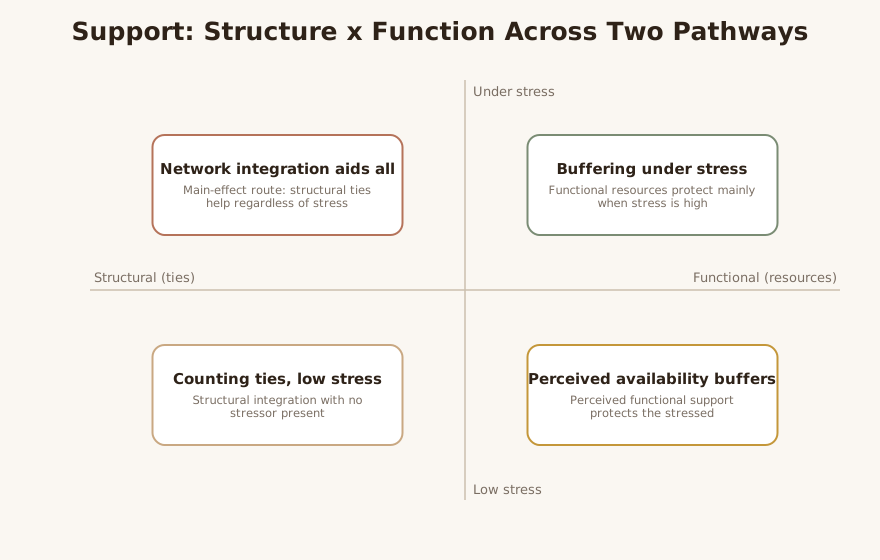
Social support theory is one of the most heavily replicated ideas in health psychology, and also one of the most casually misused. “Build a support system” is reflexive clinical advice, but the theory it rests on makes finer distinctions than the slogan suggests: who is in the network matters less than what that network actually does, when it does it, and whether what it provides matches what the stressor demands 2. For clinicians, the theory’s value is that it specifies mechanism, turning a vague virtue into a set of targetable functions LLM.
Type & Discipline
Social support theory is a descriptive theory drawn from health and social psychology and from medical sociology, concerned with how a person’s interpersonal relationships affect their physical and mental health 1. It sits inside the stress-and-coping tradition: its core question is how the resources embedded in social ties alter the pathway running from stressful life events to illness 2. Sidney Cobb framed support as a moderator of life stress, meaning that the same stressor produces different health consequences depending on the support available to the person experiencing it 1.
The discipline shapes how a clinician should hold the theory. It originated as basic and epidemiological science about population health, not as a model of psychotherapy, and its evidence base is largely correlational and prospective rather than clinical-trial-based 2. Its relevance to the consulting room is therefore inferential and adjunctive: it explains why isolation worsens outcomes and how connection protects them, which informs formulation and treatment planning, but it does not itself constitute a therapy LLM.
Creators & Lineage
The modern theory is usually dated to Sidney Cobb’s 1976 presidential address to the American Psychosomatic Society, “Social support as a moderator of life stress” 14. Cobb defined social support as “information leading the subject to believe that he is cared for and loved, esteemed, and a member of a network of mutual obligations” 1. He reviewed evidence that support protects against a wide range of conditions across the lifespan, including low birth weight, arthritis, tuberculosis, depression, and alcoholism, and that it speeds recovery, reduces medication requirements, and improves adherence to medical regimens 1. Crucially, Cobb’s claim was not that support eliminates stress but that it moderates the harmful consequences that typically follow major life crises and transitions 1.
The second foundational contribution is Sheldon Cohen and Thomas Ashby Wills’s 1985 review in Psychological Bulletin, which set out to determine whether support helps through “an overall beneficial effect of support (main- or direct-effect model) or to a process of support protecting persons from potentially adverse effects of stressful events (buffering model)” 25. By organizing the literature according to whether a measure assessed support structure or function, Cohen and Wills resolved a field that had reached contradictory conclusions, and their paper became the canonical statement of the buffering hypothesis 2. The lineage runs back to the stress-and-coping framework, in which support acts on appraisal and reaction, and it connects to attachment theory, which supplies a developmental account of how the capacity to use support is formed, and to social network theory, which formalizes the structural side LLM. More recent work extends the model by adding the dimension of timing, asking when across the lifecourse support is delivered 6.
Core Principles
The first principle is that support can be conceptualized two ways, and the distinction is consequential. By structure, Cohen and Wills “mean simply the existence of relationships,” and by function they mean “the extent to which one’s interpersonal relationships provide particular resources” 2. Structural measures count ties and assess a person’s degree of integration in a social network; functional measures assess what those ties actually supply 2.
The second principle is that there are two distinct pathways. The main-effect model proposes that “social resources have a beneficial effect irrespective of whether persons are under stress,” and the evidence for it appears as a statistical main effect with no stress-by-support interaction 2. The buffering model posits that “support ‘buffers’ (protects) persons from the potentially pathogenic influence of stressful events,” so that support helps primarily for people who are under stress 2. Cohen and Wills concluded that the evidence is consistent with both models, but that they operate through different processes: buffering effects appear “when the social support measure assesses the perceived availability of interpersonal resources that are responsive to the needs elicited by stressful events,” while main effects appear “when the support measure assesses a person’s degree of integration in a large social network” 2.
The third principle specifies the functions support performs. Cohen and Wills described four. Esteem support (also called emotional support) is “information that a person is esteemed and accepted,” communicating that they are valued despite difficulties or faults 2. Informational support is “help in defining, understanding, and coping with problematic events,” also called appraisal support or cognitive guidance 2. Social companionship is “spending time with others in leisure and recreational activities,” which can reduce stress by meeting affiliation needs, distracting from worry, or lifting mood 2. Instrumental support is “the provision of financial aid, material resources, and needed services” 2.
The fourth principle is matching. Cohen and Wills argued that buffering occurs when the support provided is “closely linked to the specific need elicited by a stressful event”: stress from a loss of companionship “would be best reduced by social companionship,” while stress from economic problems “would best be alleviated by instrumental support” 2. They noted that esteem and informational support are broadly useful across many stressors, whereas instrumental support and companionship buffer best when tightly matched to the stressor’s demands 2.
The fifth principle locates where in the stress process support acts. Cohen and Wills identified “two points at which social support may interfere with the hypothesized causal link between stressful events and illness” 2. First, support may intervene “between the stressful event (or expectation of that event) and a stress reaction by attenuating or preventing a stress appraisal response,” because “the perception that others can and will provide necessary resources may redefine the potential for harm posed by a situation” 2. Second, “adequate support may intervene between the experience of stress and the onset of the pathological outcome by reducing or eliminating the stress reaction or by directly influencing physiological processes” 2.
Interventions & Techniques
Social support theory does not supply a treatment protocol, but its principles map onto recognizable clinical moves LLM. The most direct is functional, not just structural, assessment: rather than asking whether a client “has people,” the clinician asks which of the four functions, esteem, informational, companionship, or instrumental, are present, absent, or mismatched, since the theory predicts that counting ties alone misses the buffering mechanism 2LLM. A client surrounded by people who provide companionship but no instrumental help may still be unbuffered against a stressor whose salient demand is material 2LLM.
A second technique is matching support to the stressor. Because buffering depends on the fit between provided resource and elicited need, an intervention can be aimed precisely: a financial crisis calls for instrumental aid and problem-focused informational support, whereas a self-esteem-threatening event calls for esteem support 2LLM. A third works at the appraisal point: the clinician helps the client recognize and mobilize available support so that the “perception that others can and will provide necessary resources” redefines the threat before it is appraised as overwhelming, which is consistent with Cohen and Wills’s first intervention point 2LLM. A fourth addresses the main-effect pathway by promoting social integration itself, encouraging participation in roles and communities, on the rationale that network integration confers benefit independent of any specific stressor 2LLM. These techniques are delivered inside established modalities rather than as a standalone therapy LLM.
LLM-generated illustrative example (not a guideline): A client laid off from work reports a large friend network but worsening anxiety. A functional assessment reveals plenty of companionship but no informational or instrumental support for the actual stressor: the job loss. The clinician helps the client identify a former colleague who can offer concrete leads (informational) and frames the work as targeting the specific need the stressor elicited, rather than simply “seeing friends more” LLM.
Evidence Base
Social support theory is established. Cohen and Wills’s review of literature published through 1983 found evidence “consistent with both” the main-effect and buffering models, and concluded that “both conceptualizations of social support are correct in some respects” while representing different processes 2. The association between social support and well-being is one of the more robust findings in health psychology, supported by correlational, prospective, and animal-analogue research that together suggest support is a causal contributor to well-being rather than a mere correlate 2. Cobb’s earlier synthesis had already linked support to a striking range of outcomes, from birth weight to recovery and adherence 1.
The honest caveats are important. First, “established theory” is not “established therapy”; the evidence concerns the support-health relationship in populations, not randomized trials of a “social support therapy,” which does not exist as a discrete modality LLM. Second, much of the foundational evidence is correlational, and Cohen and Wills were explicit that “the many correlational results do not by themselves allow causal interpretation” even as the broader pattern points toward causation 2. Third, the buffering effect is not universal: it is reliably found only when functional support is measured and is matched to the stressor, and it tends to disappear when only structural integration is measured, which means studies that operationalize support poorly will fail to detect it 2. A more recent literature adds a further qualifier, arguing for an extension to the stress-buffering model that takes the timing of support across the lifecourse into account, suggesting that when support arrives, developmentally, may matter as much as whether it arrives 6.
Populations & Indications
The framework applies broadly wherever stress and health intersect, but several populations are especially indicated LLM. People with chronic illness are a central case, since Cobb documented support’s role in recovery, medication reduction, and treatment adherence, and instrumental and informational support map directly onto the demands of disease management 1. Caregivers face chronic, often instrumental and emotional, demands that their own networks may or may not buffer, making caregiver burden a natural target LLM. Older adults are at elevated risk of network attrition, which threatens both the main-effect benefits of integration and the buffering benefits of available function 2LLM. People with depression or anxiety are indicated because perceived support availability operates at the appraisal stage Cohen and Wills described, and low perceived support is both a risk factor and a maintaining factor 2LLM.
Bereaved individuals lose not only a relationship but, frequently, a primary supplier of multiple support functions, so the stressor and the erosion of buffering coincide LLM. Postpartum mothers face a high-demand transition in which instrumental and esteem support are protective, and their absence is a recognized risk context LLM. Across these groups the clearest indication for invoking the theory is a presentation in which the resource a client needs is identifiable and a network gap is contributing to distress LLM.
Problems-for-Work
Social support concepts give clinicians a precise vocabulary for a cluster of presenting problems LLM.
- Lack of social support and loneliness. A structural deficit (few ties) and a functional deficit (ties that supply the wrong resources) are distinct problems requiring different work; the theory insists on separating them 2.
- Stress-related disorders and adjustment disorder. Where distress is organized around a discrete stressor, the buffering model points the clinician toward the specific support function the stressor demands 2.
- Major depressive disorder and generalized anxiety disorder. Low perceived availability of support raises the threat value of events at the appraisal stage; restoring perceived and actual support is a maintaining-factor target 2LLM.
- Grief. Bereavement removes a key support provider while imposing a major stressor, so the work often involves rebuilding lost functions across the remaining network 1LLM.
- Caregiver burden. Chronic instrumental and emotional demand without reciprocal buffering is the mechanism; respite (instrumental) and esteem support are matched levers 1LLM.
- People with chronic illness adjustment. Informational and instrumental support are tied to adherence and recovery, which Cobb linked directly to support 1.
LLM-generated illustrative example (not a guideline): A recently bereaved older client says she “has a full address book” but feels unsupported. The clinician maps functions: companionship is intact, but her late spouse had supplied nearly all instrumental and esteem support. Treatment focuses on distributing those two functions across existing ties and one new community role, rather than treating the problem as a simple shortage of contacts LLM.
Contraindications, Cautions & Cultural Humility
The first caution is against reading social support as an unalloyed good or as a number to be maximized. The theory is about function and fit, not headcount, and “more people” is not the intervention; a poorly matched or demanding relationship can add stress rather than buffer it 2LLM. Pushing a client toward social activity when their salient need is instrumental or informational risks missing the mechanism entirely 2LLM.
A second caution concerns clients for whom connection is itself complicated. For survivors of relational trauma, or clients with attachment difficulties, the capacity to perceive and use available support may be impaired, so “get more support” can be experienced as invalidating or unsafe; the developmental link to attachment is the relevant frame here LLM. Mobilizing support is also contraindicated where the available network is a source of harm, conflict, or coercion LLM.
Cultural humility is essential because what counts as support, and from whom it is appropriately sought, is culturally patterned. Cobb’s emphasis on “a network of mutual obligations” reads very differently across individualist and collectivist contexts, where the obligations, the appropriate providers, and the meaning of accepting help vary widely 1LLM. A Western clinician should be wary of pathologizing a client’s reliance on family or community as enmeshment, or of assuming that individual self-reliance is the healthy default; in many contexts dense, obligated networks are both normative and protective LLM. The newer lifecourse-timing literature adds that the developmental moment in which support was, or was not, available shapes its later meaning, which argues against treating present-day support in isolation from history 6.
Treatment-Plan Suggestions & SMART Objectives
| Goal | SMART objective (example) | Mechanism |
|---|---|---|
| Map the support network by function, not headcount | Within 2 sessions, client will complete a support map identifying who provides esteem, informational, companionship, and instrumental support | Separates structural from functional support 2 |
| Match support to the salient stressor | By week 4, client will name the support function their primary stressor demands and identify one provider for it | Buffering depends on stressor-need matching 2 |
| Increase perceived availability of support | Over 6 sessions, client will reach out to a named person for help twice weekly and log the response | Acts at the appraisal-stage intervention point 2 |
| Build esteem support around a self-esteem-threatening stressor | Within 8 weeks, client will identify and contact 2 people who communicate acceptance during setbacks | Esteem support counters threats to self-worth 2 |
| Secure instrumental support for a concrete demand | By week 6, client will arrange one form of tangible/financial/logistical help for the presenting stressor | Instrumental support matched to material need 2 |
| Increase social integration (main-effect pathway) | Over 10 weeks, client will take on one ongoing community or group role and attend at least monthly | Network integration benefits health independent of stress 2 |
| Rebuild lost support functions after a loss | Within 8 weeks, bereaved client will redistribute 2 functions previously supplied by the deceased across remaining ties | Restores buffering after a key provider is lost 1 |
| Reduce caregiver burden through matched support | By week 6, caregiver will obtain one source of respite (instrumental) and one of emotional/esteem support | Targets the demand-without-buffering mechanism 1 |
Common Misconceptions
The most common misconception is that social support means the number of people a client knows. Cohen and Wills’s central contribution was to separate structure (“the existence of relationships”) from function (“the extent to which one’s interpersonal relationships provide particular resources”), and to show that buffering is a property of function, not headcount 2. A second misconception is that support always works the same way; in fact the main-effect and buffering models describe two different processes, one operating regardless of stress and one only under stress, and which one is detected depends on how support is measured 2. A third is that any support helps any stressor; the matching principle holds that companionship and instrumental support buffer best when “closely linked to the specific need elicited by a stressful event” 2. A fourth is that support eliminates stress; Cobb’s framing was explicitly that support moderates the consequences of stress, not that it removes the stressor 1. A final misconception is that received support is what matters most; perceived availability is what operates at the appraisal stage, redefining a situation’s “potential for harm” before a stress reaction occurs 2.
Training & Certification
There is no certification in social support theory, and none would be appropriate, because it is a conceptual and epidemiological model rather than a credentialed treatment LLM. Clinicians typically encounter it within graduate coursework in health psychology, stress and coping, and behavioral medicine, and within supportive-psychotherapy and case-management training, where its constructs are absorbed into assessment and care planning 2LLM. Competence comes from supervised practice in formulating and mobilizing support and from familiarity with the stress-buffering literature rather than from a standalone course 2LLM.
Key Terms
- Social support (Cobb): “information leading the subject to believe that he is cared for and loved, esteemed, and a member of a network of mutual obligations” 1.
- Structure vs function: structure is “the existence of relationships”; function is “the extent to which one’s interpersonal relationships provide particular resources” 2.
- Main-effect (direct-effect) model: support benefits well-being irrespective of stress level 2.
- Buffering model: support protects people specifically when they are under stress 2.
- Esteem (emotional) support: information that one is esteemed and accepted despite difficulties 2.
- Informational support: help in defining, understanding, and coping with problematic events 2.
- Social companionship: spending time with others in leisure and recreational activities 2.
- Instrumental support: provision of financial aid, material resources, and needed services 2.
- Matching (stress-support specificity): buffering occurs when the support provided fits the specific need the stressor elicits 2.
- Two intervention points: support may act before stress appraisal, or between the stress reaction and the pathological outcome 2.
Resources & Further Reading
▶ Watch — a video introduction to this concept:
- Social support as a moderator of life stress (Cobb, 1976) — PubMed
- Social support as a moderator of life stress (Cobb, 1976) — APA PsycNet
- Stress, social support, and the buffering hypothesis (Cohen & Wills, 1985) — full-text PDF
- Stress, Social Support, and the Buffering Hypothesis — Carnegie Mellon (KiltHub/Figshare)
- An extension to the stress-buffering model: timing of support across the lifecourse — ScienceDirect
Reflective / Supervision Questions
- When I tell a client to “build a support system,” am I specifying which function (esteem, informational, companionship, instrumental) their stressor actually demands, or am I just recommending more contact? 2
- For this client, is the deficit structural (too few ties) or functional (ties that supply the wrong resources), and does my plan match the deficit I actually found? 2
- Am I working at the appraisal stage, helping the client perceive that support is available, or only at the level of received support after the fact? 2
- How might this client’s cultural context define who is an appropriate support provider and what accepting help means, and am I reading a dense, obligated network as enmeshment when it may be protective? 1LLM
- For a client with relational-trauma or attachment difficulties, is mobilizing support experienced as safe, or am I prescribing connection without addressing the capacity to use it? LLM
- Could the timing of support across this client’s developmental history, not just its present availability, be shaping how they receive help now? 6