
Type & Discipline
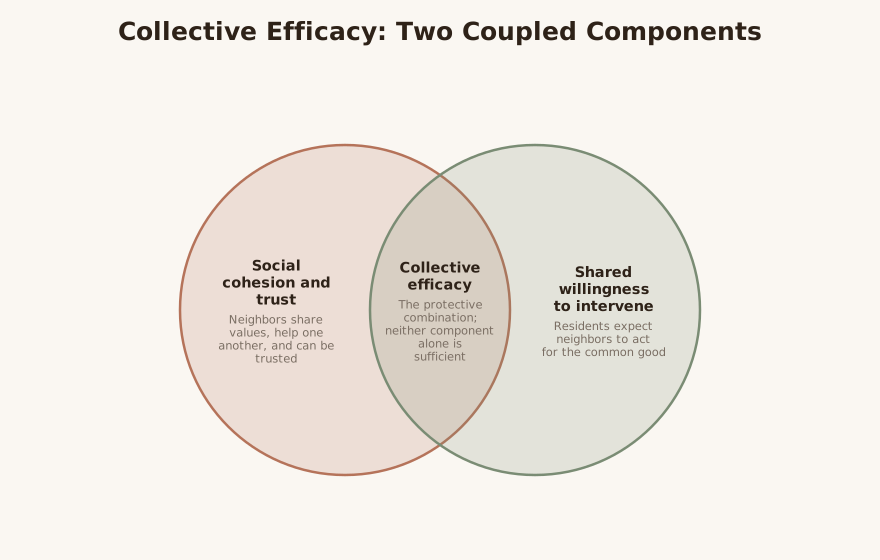
Collective efficacy is a construct — a measurable theoretical variable — rather than a therapeutic modality or a clinical technique LLM. It originates in sociology and social psychology, at the intersection of criminology, community psychology, and public health LLM. In its most influential formulation it names the linkage between social cohesion among neighbors and their shared willingness to intervene on behalf of the common good 1. The construct is operationalized at the level of a place or a group — a neighborhood, a school, an organization — not at the level of the individual client 4.
For clinicians, the important framing is that collective efficacy is a lens on the social determinants of mental and behavioral health, not a treatment one delivers in session LLM. It helps explain why two clients with similar individual histories can have very different trajectories depending on the capacity of the communities they live in to organize, supervise, and protect their members LLM. Understanding it sharpens case conceptualization, informs community-level and public-health practice, and clarifies the ceiling that environment places on individual intervention LLM.
Creators & Lineage
The term carries two related but distinct lineages, and conflating them is a common error LLM.
The first is Albert Bandura’s extension of self-efficacy theory to the group level. In social cognitive theory, perceived collective efficacy is a group’s shared belief in its conjoint capabilities to organize and execute the actions required to produce given attainments — the team-level analogue of individual self-efficacy LLM. This is a cognitive-motivational construct about shared belief in capability LLM.
The second, and the one most of the empirical literature refers to, is Robert J. Sampson’s neighborhood formulation, developed with Stephen Raudenbush and Felton Earls and published in Science in 1997 12. Here collective efficacy is not merely a shared belief but a task-specific capacity that fuses mutual trust and cohesion with shared expectations for informal social control — the readiness of residents to act, for example, to supervise children or to intervene when neighborhood norms are violated 13. This formulation grew out of and partly displaced social disorganization theory, which had long argued that structural conditions like poverty and residential instability weaken a community’s ability to realize common values 35. Sampson’s contribution was to identify the active mediating mechanism — collective efficacy — through which structural disadvantage translates into outcomes such as violence 16. The construct also sits adjacent to social capital theory, though Sampson stresses that what matters is not merely the existence of social ties but the willingness to mobilize them toward shared goals 6.
Core Principles
Two coupled dimensions. Collective efficacy is conceptualized as the product of two correlated components: social cohesion and trust (whether neighbors are willing to help one another, share values, and can be trusted) and shared expectations for control (whether residents believe their neighbors would act in concrete situations) 15. Neither alone is sufficient; cohesion without willingness to act, or willingness without trust, does not produce the protective effect LLM.
Task-specificity. Like self-efficacy, collective efficacy is anchored to particular tasks and goals rather than being a free-floating “good community” trait LLM. A neighborhood may have high efficacy for supervising children yet lower efficacy for confronting institutional actors 3.
A mediating mechanism, not a root cause. The signature empirical claim is that collective efficacy mediates the relationship between structural disadvantage and adverse outcomes 1. Concentrated poverty and residential instability erode collective efficacy, and the lowered collective efficacy in turn predicts higher violence 16.
Place over composition. The effect is a property of the place and its relational structure, not simply the sum of the individuals who happen to live there 6. This “neighborhood effect” persists after controlling for individual-level characteristics 1.
Contested boundaries. More recent work questions how collective collective efficacy actually is — how much variance truly sits at the neighborhood level versus the individual perceiver — cautioning against treating it as a clean, fully aggregated property 4.
Interventions & Techniques
Because collective efficacy is a construct rather than a manualized treatment, “interventions” operate at the community and systems level, and clinicians most often engage it indirectly LLM. Approaches that aim to raise collective efficacy include building dense, trusting relationships among residents; strengthening voluntary organizations and mutual-aid networks; and cultivating shared norms and the practical willingness to act on them 56. Programs that increase residents’ sense of shared ownership and that visibly reward neighborly intervention are theorized to lift the construct LLM.
For the individual clinician, the relevant techniques are translational LLM:
- Eco-mapping and contextual assessment — formally charting a client’s neighborhood resources, threats, and the degree to which their community can be mobilized on their behalf LLM.
- Connecting clients to collective structures — facilitated linkage to tenant associations, faith communities, peer-support networks, and mutual-aid groups that embody local cohesion and shared expectations LLM.
- Community-level and public-health practice — for clinicians working in prevention, consultation, or program design, supporting initiatives that build informal social control and resident voice LLM.
LLM-generated illustrative example (not a guideline): A clinician treating an adolescent with escalating conduct concerns maps the youth’s block and discovers that, despite material disadvantage, an active block association and a youth mentoring program exist nearby; the treatment plan deliberately routes the family toward these structures so that adult supervision and prosocial norms extend beyond the household. LLM
Evidence Base
The evidence for collective efficacy as a community-level predictor is established within observational social science, though it is important to be precise about what that means LLM. The foundational study surveyed 8,782 residents across 343 Chicago neighborhoods and demonstrated that a measure of collective efficacy had high between-neighborhood reliability and was negatively associated with violence even after controlling for individual characteristics, measurement error, and prior violence 12. Critically, much of the association of concentrated disadvantage and residential instability with violence was mediated by collective efficacy, supporting its status as a mechanism rather than a correlate 16. These findings have been replicated and extended across many cities and outcomes 3.
The honest caveats matter for clinicians LLM. The core evidence is cross-sectional and observational, which limits strong causal claims; collective efficacy is associated with, but not proven to single-handedly cause, lower violence 1. The construct is most validated for violence and disorder; its application to specific clinical outcomes (individual depression, substance use recovery) is more inferential and less directly tested LLM. And methodological scrutiny has questioned how much of the construct genuinely resides at the collective level rather than reflecting individual perception, urging humility about measurement 4. In short: strong as a community-level explanatory framework, weaker as a basis for individual clinical prediction LLM.
Populations & Indications
Collective efficacy is most directly relevant when the unit of concern is a community, neighborhood, or organization rather than a single individual 6. It is especially salient for disadvantaged urban populations, where the gap between structural conditions and community capacity is widest 1. It is a natural framework for work with at-risk youth, given the construct’s roots in informal supervision of children and adolescents 13. It informs community organizations engaged in violence prevention, mutual aid, and resident mobilization 5. And it is a staple of public-health populations work, where neighborhood-level exposures are understood as determinants of physical and behavioral health LLM.
In direct clinical practice, the construct is indicated as a case-conceptualization and referral lens — most useful when a client’s distress is meaningfully shaped by community-level disorder, isolation, or collective trauma, and when individual treatment alone is unlikely to address the environmental driver LLM.
Problems-for-Work
- Community violence — the construct’s anchoring outcome; higher collective efficacy predicts lower rates of violent crime, and clinicians can use this to contextualize trauma exposure and to advocate for community-level resources 1.
- Youth delinquency — low shared willingness to supervise and intervene leaves adolescents under-monitored; treatment plans can intentionally extend prosocial adult presence 13.
- Crime and disorder — visible disorder both reflects and erodes collective efficacy, shaping clients’ chronic threat appraisal and hypervigilance 5LLM.
- Social disorganization and neighborhood disadvantage — these structural problems operate on individuals largely through depleted collective efficacy, which reframes “client noncompliance” as constrained opportunity 16.
- Low social cohesion and community disempowerment — directly name the cohesion and willingness-to-act components; interventions target relational density and shared agency 5.
- Collective trauma — community-wide events can fracture cohesion and the willingness to intervene, and rebuilding these is part of community recovery LLM.
- Substance use in communities and health disparities — modeled as downstream of weakened neighborhood capacity to enforce norms and distribute resources LLM.
Contraindications, Cautions & Cultural Humility
The first caution is conceptual fidelity: collective efficacy is a community-level construct, and importing it as if it were an individual therapy or a within-session technique misrepresents the science 4LLM. There is no “collective efficacy intervention” to deliver one-to-one LLM.
The second is avoiding a deficit and blame frame. Describing a neighborhood as “low collective efficacy” can slide into pathologizing communities for conditions that structural disadvantage, disinvestment, and historical injustice produced LLM. The original theory is explicit that disadvantage and instability erode collective efficacy — the causal arrow runs from structure to community capacity, not from community moral failing 16. Clinicians should resist using the construct to locate fault in residents LLM.
Cultural humility is essential because cohesion and informal social control are culturally patterned LLM. What “willingness to intervene” looks like — and whether intervention by neighbors, elders, or institutions is welcomed or feared — varies across cultural, immigrant, and historically over-policed communities LLM. In communities with justified distrust of authorities, low measured collective efficacy may coexist with robust alternative protective networks the standard instruments do not capture 4LLM. Finally, measurement humility is warranted given evidence that the construct may be less purely “collective” than assumed; clinicians should treat it as an interpretive lens, not a verdict on a client’s community 4.
Treatment-Plan Suggestions & SMART Objectives
| Goal | SMART objective (example) | Mechanism |
|---|---|---|
| Strengthen the client’s connection to community structures | Within 8 weeks, client will attend at least 3 sessions of a neighborhood mutual-aid or peer-support group, documented in session | Builds relational cohesion and access to shared expectations for support 5 |
| Extend prosocial adult supervision around an at-risk youth | Within 6 weeks, family will enroll the adolescent in one supervised after-school or mentoring program, attending 75% of sessions | Increases informal social control and monitoring beyond the household 13 |
| Reduce isolation linked to perceived neighborhood threat | Within 4 weeks, client will identify and contact 2 trusted neighbors or local contacts for one concrete reciprocal exchange | Rebuilds local trust and the willingness to rely on neighbors 1 |
| Map community resources and threats | Within 2 sessions, client and clinician will co-create an eco-map identifying ≥5 neighborhood resources and ≥3 stressors | Makes contextual determinants explicit for shared planning LLM |
| Increase participation in collective action | Within 10 weeks, client will attend one tenant, block, or community meeting and report the experience | Reinforces shared agency and willingness to act for the common good 6 |
| Process community-level trauma exposure | Across 6 sessions, client will articulate the impact of neighborhood disorder on threat appraisal using a structured worksheet | Externalizes structural drivers, reducing self-blame LLM |
| Connect to public-health or prevention resources | Within 8 weeks, client will complete one warm-handoff referral to a community health or violence-prevention program | Links the individual to collective protective capacity 5 |
Common Misconceptions
“Collective efficacy is the same as Bandura’s self-efficacy.” They share a conceptual root, but the dominant empirical construct is Sampson’s neighborhood-level fusion of cohesion and shared willingness to act, which is more than a group’s shared belief in its capability 1LLM.
“It just means social capital or social ties.” Sampson distinguishes the two: dense ties do not help unless residents are willing to activate them toward shared goals; willingness to intervene is the defining ingredient 6.
“More cohesion is always the active ingredient.” Cohesion is necessary but not sufficient; without shared expectations for control it does not produce the protective effect on violence 1LLM.
“It’s an individual therapy technique.” It is a community-level construct; there is no validated one-to-one collective efficacy treatment 4LLM.
“Low collective efficacy means the residents are deficient.” The theory locates the cause in structural disadvantage and instability that erode community capacity, not in the moral character of residents 16.
Training & Certification
There is no certification in collective efficacy, because it is a research construct rather than a credentialed clinical practice LLM. Relevant competency is acquired through graduate training in community psychology, public health, criminology, or social work, and through familiarity with the primary literature LLM. Clinicians wishing to apply the lens should read the foundational Science paper and Sampson’s book-length treatment, and seek consultation or supervision from practitioners experienced in community-level and prevention work 16. For those doing applied measurement, training in multilevel modeling is valuable, given ongoing debate about how the construct is properly estimated 4.
Key Terms
- Collective efficacy — social cohesion among neighbors combined with their willingness to intervene for the common good 1.
- Informal social control — residents’ shared, non-institutional regulation of behavior (e.g., supervising children, addressing disorder) 13.
- Social cohesion and trust — the relational component: mutual trust, shared values, and willingness to help 5.
- Shared expectations for control — the belief that neighbors would act in specific situations 1.
- Mediation — the statistical role of collective efficacy in transmitting the effect of structural disadvantage onto violence 1.
- Social disorganization theory — the predecessor framework emphasizing how structural conditions weaken a community’s ability to realize shared values 35.
- Neighborhood effect — a place-level influence on outcomes that persists after adjusting for individual composition 6.
Resources & Further Reading
▶ Watch — a video introduction to this concept:
- Sampson, Raudenbush & Earls (1997), Neighborhoods and Violent Crime: A Multilevel Study of Collective Efficacy, Science
- PubMed record (PMID 9252316) for Sampson, Raudenbush & Earls (1997)
- Sampson, Robert J.: Collective Efficacy Theory — Encyclopedia of Criminological Theory (SAGE)
- Brunton-Smith et al. (2018), How Collective Is Collective Efficacy?, Criminology
- Collective Efficacy — Definition (Criminal Justice Glossary)
- Sampson (2012), Great American City: Chicago and the Enduring Neighborhood Effect (University of Chicago Press)
Reflective / Supervision Questions
- For your current caseload, where might depleted community capacity — rather than individual pathology — be driving the presenting problem? LLM
- When you describe a client’s neighborhood, do your words risk a deficit or blame frame, and how would you reframe them around structural causes? LLM
- How do you assess the protective networks a client relies on that standard instruments might miss, particularly in communities with justified distrust of authorities? LLM
- Where does individual treatment hit a ceiling set by the client’s environment, and what community-level referral or advocacy would extend your impact? LLM
- How might cultural differences in cohesion and willingness to intervene change what “collective efficacy” looks like for the populations you serve? LLM