
Type & Discipline
Social capital is a construct, not a therapeutic modality, and this distinction governs how clinicians should use it LLM. It originates in sociology and is most developed within political sociology and social epidemiology, where it describes the networks, norms of reciprocity, and trust that operate as a resource embedded in social relationships 7. The construct sits at the population and community level even when it is measured through individual perceptions, which makes it fundamentally different from an individual-level intervention a clinician delivers in session 3. For the practicing therapist, social capital is best understood as an explanatory and assessment lens rather than a technique to be deployed LLM. It explains why a client’s distress may be sustained or buffered by the relational environment surrounding them, and it organizes assessment of the resources a client can or cannot draw upon LLM. Treating it as a “treatment” overstates what the evidence supports and misrepresents the construct’s nature LLM.
Creators & Lineage
The modern construct was shaped by three foundational theorists whose emphases differ in clinically useful ways 6. Pierre Bourdieu framed social capital as one form of capital alongside economic and cultural capital, emphasizing how network resources reproduce class advantage and inequality 6. James Coleman developed a more functional account, describing social capital as features of social structure (obligations, information channels, norms) that facilitate the actions of individuals within them 6. Robert Putnam popularized the construct for a wide audience and shifted its focus toward civic life, defining social capital as “features of social organization such as networks, norms, and social trust that facilitate coordination and cooperation for mutual benefit” 1. Putnam’s 1995 essay and later book Bowling Alone argued that American civic engagement, associational membership, and interpersonal trust had declined across the late twentieth century 12. The construct’s clinical relevance descends through related traditions including social support theory, social network theory, community psychology, and social cohesion theory LLM.
Core Principles
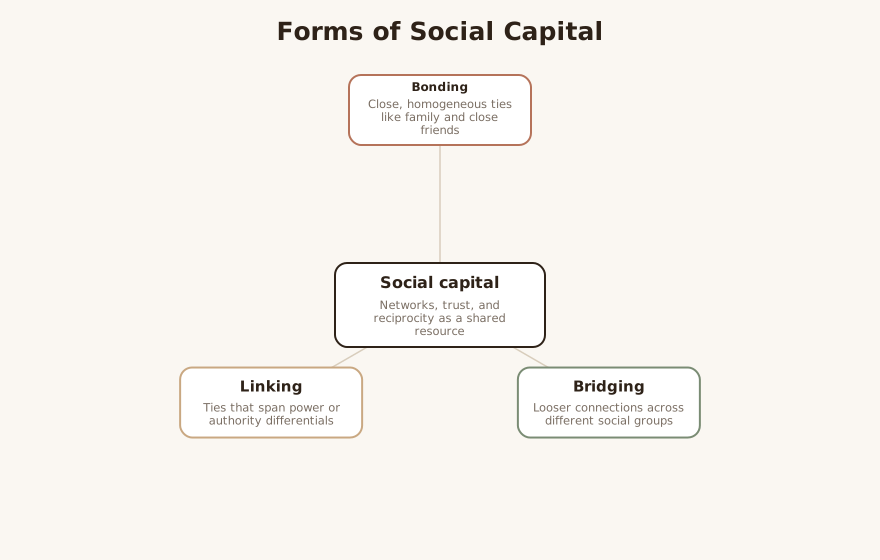
Three principles carry the most weight for clinical thinking LLM. First, social capital is relational and external to the individual: it inheres in the connections between people, not inside any one person, so it cannot be fully assessed by examining the client alone 7. Second, it is typically subdivided into bonding, bridging, and linking forms, each serving a different function 3. Bonding capital refers to close, homogeneous ties such as family and close friends; bridging capital refers to looser connections across different social groups; and linking capital refers to ties that span power or authority differentials, such as relationships with institutions, employers, or government 45. Third, social capital is conventionally measured along cognitive dimensions (trust, perceived support, neighborhood satisfaction) and structural dimensions (civic participation, group membership, volunteering) 5. A further principle is that social capital is not uniformly protective: dense bonding ties can also constrain, exclude, or enforce harmful norms, so more is not always better 7.
Interventions & Techniques
Because social capital is a construct, the relevant clinical work consists of applications drawn from established modalities, not a freestanding protocol LLM. A first application is network and resource assessment: mapping a client’s bonding, bridging, and linking ties to identify where support is concentrated, thin, or absent LLM. A second is behavioral activation toward community ties, in which graded activity scheduling is deliberately oriented toward re-engagement with groups, associations, or civic participation rather than solitary activities LLM. A third is group-based modalities, where the therapeutic group itself functions as a setting for building reciprocity and trust LLM. A fourth is social prescribing and linkage, connecting clients to community organizations, mutual-aid groups, faith communities, or recovery fellowships that supply ongoing relational resources beyond the therapy hour LLM. Putnam’s observation that participation in associations and informal networks has declined gives these applications a clear target: rebuilding the kinds of repeated, low-stakes contact that generate trust and reciprocity over time 1.
LLM-generated illustrative example (not a guideline): A clinician working with an isolated older adult sketches a simple network map and notices intact bonding ties to two adult children but no bridging ties since retirement; behavioral activation is then oriented toward a weekly community choir to rebuild bridging contact. LLM
Evidence Base
The honest summary is that social capital is well established as a construct linked to health, but the evidence is predominantly observational rather than interventional or causal LLM. A systematic review of 60 studies found strong evidence that people of lower socioeconomic status have reduced social capital, which in turn correlates with worse health outcomes 5. The same review identified a plausible buffer effect in which social capital, particularly bonding capital, may mitigate the negative health effects of poverty, supported in 11 of 18 interaction studies, especially among ethnic-minority and disadvantaged communities 5. However, the authors were explicit that the buffer evidence “remains much weaker” than the basic correlation, that area-level (contextual) effects were weak or non-significant once individual factors were controlled, and crucially that no conclusions about causal mechanisms could be drawn 5. Study quality varied substantially, with many studies lacking a sound theoretical framework for selecting measures 5. Research on community resilience similarly examines bonding, bridging, and linking capital as distinct contributors to health, reinforcing that the dimensions behave differently rather than as one global variable 4. Clinicians should therefore avoid claiming that “social-capital interventions treat depression”; the defensible claim is that social connection is robustly associated with better mental health and is a reasonable target alongside evidence-based treatment LLM.
Populations & Indications
The construct is most clinically illuminating for clients whose distress is entangled with the relational environment LLM. Immigrants and refugees often experience disrupted bonding ties and absent bridging and linking capital in a new society, which the dependency hypothesis suggests is hardest to rebuild without economic resources 5. Older adults frequently lose bridging and linking ties through retirement, bereavement, and reduced mobility, narrowing networks to a few bonding relationships LLM. Low-income communities and other marginalized populations show the strongest documented gap in social capital, making the construct directly relevant to formulation 5. People in recovery rely heavily on the bonding and reciprocity supplied by fellowships and recovery communities LLM. Adolescents are forming bridging capital as they move beyond family, and disruptions here bear on identity and mood LLM. Across these groups, the indication for using the construct is the same: when a client’s presentation includes isolation, disconnection, or loss of community, social capital helps structure both the formulation and the relational targets of treatment LLM.
Problems-for-Work
The construct maps cleanly onto several clinical problems-for-work LLM. Social isolation and loneliness are the most direct: each can be reframed as a deficit in accessible bonding or bridging ties, with treatment oriented toward rebuilding contact LLM. Community disconnection is essentially a social-capital deficit at the neighborhood or civic level, consistent with Putnam’s account of declining associational life 1. Demoralization and low self-esteem often co-occur with thinned networks, where the absence of reciprocal relationships removes ordinary sources of recognition and mattering LLM. Major depressive disorder and generalized anxiety disorder frequently feature withdrawal that erodes social capital, creating a maintaining cycle that behavioral re-engagement can interrupt LLM. Substance use disorder recovery is strongly supported by the bonding capital of recovery communities LLM. Adjustment disorder, especially following relocation or role transition, often reflects a sudden loss of bridging and linking ties LLM. Health disparities are the population-level expression, where reduced social capital tracks socioeconomic disadvantage 5.
Contraindications, Cautions & Cultural Humility
There is no “contraindication” in the pharmacologic sense, but several cautions are essential LLM. First, social capital is not uniformly benign: dense bonding networks can enforce stigma, gatekeep, or perpetuate harmful norms, so a clinician should not reflexively push a client toward “more connection” without examining the quality and safety of those ties 7. Second, the dependency hypothesis warns that bridging and linking capital often require economic resources to access, so encouraging a low-income client to “network” can be an empty prescription if structural barriers go unaddressed 5. Third, cultural humility is central: bonding, bridging, and linking ties carry different meanings across cultures, and immigrant or marginalized clients may have rich relational worlds that are simply invisible to network measures designed for majority populations 6. Fourth, the construct describes community-level patterns, and applying it without attention to the individual risks pathologizing structural disadvantage as personal deficit LLM. Clinicians should hold social capital as a lens that contextualizes distress within systems, not as another standard the client has failed to meet LLM.
Treatment-Plan Suggestions & SMART Objectives
| Goal | SMART objective (example) | Mechanism |
|---|---|---|
| Reduce social isolation | Within 8 weeks, client will initiate one in-person social contact per week and log each | Rebuilds bonding/bridging ties; behavioral re-engagement 3 |
| Rebuild community connection | Within 6 weeks, client will attend a community or interest group at least twice | Restores associational participation 1 |
| Strengthen recovery network | Within 4 weeks, client will attend two recovery-community meetings weekly | Leverages bonding capital and reciprocity LLM |
| Counter demoralization | Within 8 weeks, client will identify and contact two dormant supportive relationships | Reactivates reciprocal recognition and mattering LLM |
| Access institutional support | Within 6 weeks, client will complete one linkage to a community service or benefit | Builds linking capital across power differentials 4 |
| Map relational resources | Within 2 sessions, client and clinician will complete a network map of bonding, bridging, and linking ties | Clarifies assets and gaps for targeting 5 |
| Reduce loneliness in transition | Within 8 weeks, client will establish one regular bridging contact in the new setting | Replaces ties lost to relocation/role change LLM |
Common Misconceptions
The most common error is treating social capital as a standalone therapy with its own evidence base; it is a sociological construct, and the clinical work happens within established modalities LLM. A second misconception is that more social capital is always better; bonding ties can constrain and exclude, and the construct includes a recognized “dark side” 7. A third is conflating social capital with individual social support; social capital is a property of networks and communities, of which a given client’s support is only one slice 7. A fourth is assuming the evidence is causal; the systematic review was explicit that associations, not causal mechanisms, are what the literature establishes 5. A fifth is treating bonding, bridging, and linking as interchangeable; they have distinct functions, and a client can be rich in one while impoverished in another 43. Finally, some clinicians read Putnam’s “decline” thesis as a moral judgment of individuals, when it describes a structural and historical trend in civic life 1.
Training & Certification
There is no certification in social capital because it is a construct rather than a credentialed clinical modality LLM. Clinicians develop competence by reading the foundational sociological literature, particularly the differing accounts of Bourdieu, Coleman, and Putnam, to understand what the construct does and does not claim 6. The practical skills that operationalize it, such as social network assessment, behavioral activation, group facilitation, and community linkage, are learned through training in the established modalities that contain them rather than through any social-capital-specific course LLM. Familiarity with the bonding, bridging, and linking framework and with the health-equity literature equips a clinician to use the construct responsibly 35. For most practitioners, the appropriate “training” is conceptual fluency sufficient to integrate the lens into formulation without overclaiming an evidence base it does not have LLM.
Key Terms
- Social capital — the networks, norms of reciprocity, and trust that function as a resource embedded in social relationships 7.
- Bonding capital — close, homogeneous ties such as family and close friends 4.
- Bridging capital — looser connections across different social groups 4.
- Linking capital — ties that span differences in power or authority, such as relationships with institutions 4.
- Cognitive social capital — perceptual dimensions including trust, perceived support, and neighborhood satisfaction 5.
- Structural social capital — behavioral dimensions including civic participation, membership, and volunteering 5.
- Buffer effect — the hypothesis that social capital can mitigate the health harms of poverty 5.
- Dependency effect — the hypothesis that accessing bridging and linking capital requires economic resources 5.
Resources & Further Reading
▶ Watch — a video introduction to this concept:
- Bowling Alone: America’s Declining Social Capital — Putnam, 1995 (Journal of Democracy, PDF)
- Bowling Alone: The Collapse and Revival of American Community — Robert D. Putnam (2000)
- Functions of social capital – bonding, bridging, linking (SocialCapitalResearch PDF)
- Community resilience and health: bonding, bridging, and linking social capital (ScienceDirect)
- A systematic review of social capital and socioeconomic inequalities in health (PMC)
- Social Capital Explained: Bourdieu, Putnam, and Coleman (Thinking Sociologically)
- Social capital — Wikipedia
Reflective / Supervision Questions
- For a given client, which forms of social capital (bonding, bridging, linking) are intact, thin, or absent, and how does that map onto the presenting problem? LLM
- Am I treating “more connection” as automatically therapeutic, or have I examined whether the client’s existing ties are safe and supportive? LLM
- When I encourage networking or community engagement, am I accounting for the structural and economic barriers that may make bridging and linking capital inaccessible? LLM
- How do this client’s cultural background and relational world shape what counts as social capital, and am I measuring it through an appropriate lens? LLM
- Am I being honest with myself and the client that social connection is associated with better outcomes rather than a proven causal cure? LLM
- Where does using this construct risk reframing structural disadvantage as a personal deficit, and how do I guard against that in formulation? LLM