
Type & Discipline
Poststructuralism and deconstruction are positions within Continental philosophy and critical theory, not models of psychotherapy 4. Deconstruction is the specific critical method developed by Jacques Derrida, and it is best understood as a practice within the broader poststructuralist framework rather than as a rival to it 4. The shared move of both is to treat meaning as unstable: language never fully captures its object, so textual and conceptual meaning remains provisional, deferred, and open to re-reading rather than fixed and self-evident 4.
For the clinician the categorical point comes first: these are philosophies of meaning, and any therapeutic use is borrowed and adapted, not delivered as the philosophy itself LLM. They enter the consulting room almost entirely through one channel — the narrative and postmodern therapy traditions that translated “meaning is constructed and revisable” into clinical practice LLM. Treating “deconstruction” as if it were a manualized, evidence-based intervention would be a category error, and this article keeps that boundary explicit throughout LLM.
Creators & Lineage
Jacques Derrida (1930–2004) is the originator of deconstruction, which he developed across an extraordinary burst of publication in 1967 — his annus mirabilis, when he released three books at once, the most influential of which is Of Grammatology 1. Of Grammatology drew on structuralist linguistics and on Heidegger to mount a sustained critique of the Western privileging of speech over writing and, more broadly, of the assumption that meaning rests on a stable, self-present foundation 36. Derrida coined and popularized the term “deconstruction” through this and related works 3.
Michel Foucault is the second figure named in this concept’s lineage, and his contribution runs through poststructuralism’s analysis of power rather than through deconstruction proper 2. Foucault examined how reason, knowledge, and institutions co-produce one another, and how categories such as madness are constituted by defining reason against an “other” 2. His genealogical method opposes the search for origins and essences, studying instead “the accidents and contingencies that converge at crucial moments” to give rise to concepts, institutions, and identities that then appear natural and timeless 2. Alongside Derrida and Foucault, the broader poststructuralist field includes Lyotard, whose “incredulity toward meta-narratives” names the loss of confidence in single legitimating stories 2, and literary theorists such as Hélène Cixous and the Yale critics Paul de Man, J. Hillis Miller, and Geoffrey Hartman who carried deconstruction into textual practice 4.
The clinical lineage is a separate, later development that no philosophical source documents LLM. Narrative therapy, associated with Michael White and David Epston, is the principal bridge: it imported poststructuralist ideas — that identity is constituted in language, that “truths” about a person are socially produced, and that dominant narratives can be examined and revised — into a coherent therapeutic practice LLM. Social constructionism, postmodern therapy, and critical theory form the surrounding intellectual ecology through which these ideas reached the field LLM.
Core Principles
The first principle is the instability of meaning: because a word can refer to an object but can never be that object, meaning accessed through language is indeterminate, provisional, and endlessly open to interpretation rather than fixed and final 4. Derrida names the mechanism différance: meaning both differs (a sign means what it does only by contrast with other signs) and defers (its full presence is perpetually postponed), so words have “only a relatively stable unity of meaning, shifting histories of use, and no fixed or defined borders” 3. This directly challenges the metaphysical assumption that meaning derives from a self-present consciousness or a direct, foundational intuition 1.
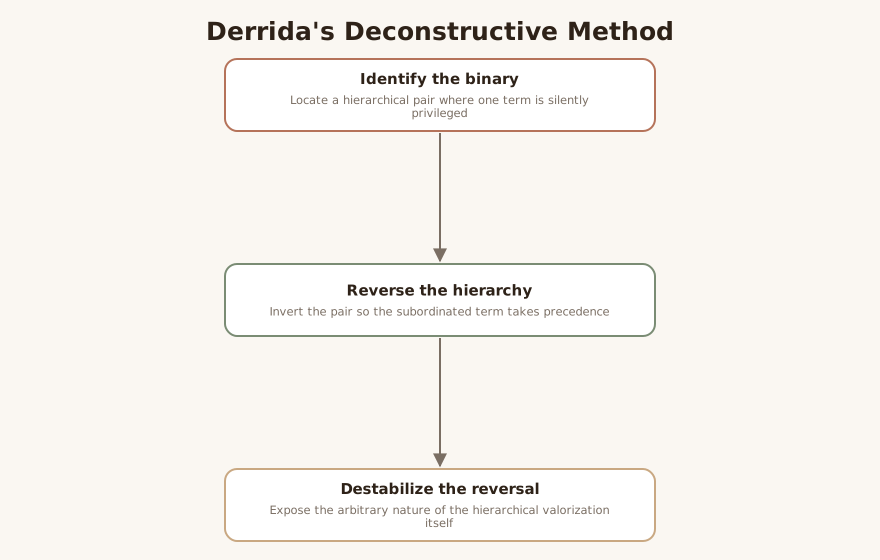
The second principle is the critique of binary oppositions: deconstruction targets hierarchical pairs — speech/writing, essence/appearance, presence/absence, reason/madness — in which one term is silently privileged and the other subordinated 1. The method works in two phases: it first reverses the hierarchy, then destabilizes the reversal itself by exposing “the arbitrary nature of the process of hierarchical valorization,” showing that the privileged term depends on the very term it excludes 31. One term “always and necessarily ‘infects’ the other,” so the opposition cannot hold cleanly 1. The point is not to flip the hierarchy but to displace it and surface what it had to exclude to look natural 3.
The third principle, from Foucault, is power/knowledge and the contingency of categories: what a society takes to be true is bound up with how power is organized, and discourse does not merely describe subjects but helps constitute them 2. Genealogy reveals that identities and categories which feel essential are in fact historically accidental, assembled at particular moments and capable of being otherwise 2. Together these principles yield the concept’s one-line thesis: taken-for-granted “truths” can be unpacked to reveal hidden assumptions and exclusions 4.
Interventions & Techniques
Poststructuralism and deconstruction supply no protocol, manual, or technique set of their own LLM. What they offer the clinician is an interpretive stance and a set of questions, which become “interventions” only once they are folded into an established modality — overwhelmingly narrative therapy and its postmodern relatives LLM. The framing below is poststructuralist; the delivery is recognized psychotherapy LLM.
Externalizing the problem operationalizes the critique of essentializing categories: rather than treating a client as being “an anxious person,” the clinician helps separate the person from the problem, so the problem becomes an object that acts on the client rather than a fixed truth about who they are LLM. Deconstructing dominant narratives applies Derrida’s move directly — taking a story the client treats as simply “the truth about me” and asking what it had to leave out, whose interests it serves, and where it came from, so the narrative is exposed as constructed rather than given LLM. Mapping discourse and power draws on Foucault: helping a client notice which cultural standards they are being measured against, and that those standards are historically contingent rather than natural law LLM. Seeking unique outcomes and re-authoring uses the instability of meaning constructively — every dominant story has exceptions it suppresses, and surfacing them opens space for an alternative, preferred narrative LLM.
LLM-generated illustrative example (not a guideline): A client says, “I’m just a failure — that’s the bottom line.” A clinician working from a deconstructive stance might ask, “Where did the ‘failure’ verdict come from, whose yardstick is it, and what does it have to ignore about you to stay true?” — then move with the client toward exceptions the verdict can’t account for. LLM
Evidence Base
Honesty requires separating two very different claims LLM. As philosophy and critical theory, poststructuralism and deconstruction are established and canonical: Derrida’s deconstruction and Foucault’s genealogy are foundational twentieth-century contributions, taught and anthologized across the humanities, and Of Grammatology remains a touchstone text 16. Their maturity as intellectual frameworks is not in question 4.
As clinical interventions, however, they have no evidence base of their own LLM. There are no randomized controlled trials of “deconstructive therapy” and no manualized protocol, because deconstruction was never intended to be a treatment LLM. Whatever clinical credibility the stance can claim is borrowed from the therapies it informs — chiefly narrative therapy and other postmodern approaches — whose own evidence base is comparatively modest, more practice-based and qualitative than randomized, and generally weaker than that for cognitive-behavioral treatments LLM. The defensible position is therefore to use poststructuralist ideas as an interpretive lens within an established modality, and never to represent “deconstruction” to clients or in documentation as an evidence-based therapy in its own right LLM.
Populations & Indications
A poststructuralist lens is most apt where the presenting distress is bound up with identity, meaning, and the weight of inherited “truths” about who a person is or must be LLM. Adults wrestling with rigid self-definitions are a broad fit, because the stance offers a way to loosen totalizing self-descriptions without dismissing the client’s experience LLM. People navigating identity concerns — including questions of role, belonging, and self-definition — benefit from a frame that treats identity as constructed and revisable rather than fixed and diagnostic LLM.
Marginalized and minority groups and LGBTQ+ individuals individuals are a particularly strong indication, because Foucault’s analysis of how dominant discourse constitutes and pathologizes “deviant” categories gives clinical language to lived experiences of being defined by an external norm 2LLM. The lens supports separating a person from the stigmatizing categories imposed on them and treating those categories as contingent rather than natural LLM. Survivors of trauma may find value in re-authoring work that contests a trauma-saturated identity, and couples and families can use deconstruction to surface and renegotiate the dominant relational stories that organize conflict LLM.
Problems-for-Work
Problem-saturated self-narratives. When a client’s account of themselves has collapsed into a single dominant, problem-soaked story, deconstruction reframes that story as one constructed version rather than the truth, and the work becomes surfacing the exceptions and re-authoring a preferred narrative LLM.
Identity disturbance. For clients whose sense of self feels unstable or rigidly negative, treating identity as constituted in language and therefore revisable — rather than as a fixed defect — can reduce the felt permanence of the disturbance LLM.
Internalized oppression and internalized stigma. Foucault’s account of how power operates through discourse supports helping a client recognize that demeaning beliefs about themselves were absorbed from a culture that devalues them, not discovered as facts about their worth 2LLM.
Shame and self-criticism. Externalizing the critical voice and asking whose standards it enforces deconstructs the apparent objectivity of the self-judgment, loosening its grip LLM.
Relationship conflict. Couples often fight inside a dominant story about the relationship; mapping and deconstructing that story can open alternative accounts that conflict had foreclosed LLM.
Existential distress and adjustment difficulties. Where distress tracks a collapse of taken-for-granted meaning, a stance that treats meaning as constructed (and so reconstructable) can be generative rather than destabilizing, provided it is paired with support and not delivered as bare relativism LLM.
Contraindications, Cautions & Cultural Humility
The central caution is that a stance built on the instability of meaning can be experienced as invalidating or destabilizing if mishandled LLM. With clients who are acutely disorganized, psychotic, or in active trauma activation, telling them that their reality is “constructed” can deepen destabilization; the lens should wait until the client is grounded and resourced, and the therapeutic relationship itself must remain a stable anchor LLM. Deconstruction is also contraindicated as a substitute for safety and risk work: philosophical exploration must never displace risk assessment, safety planning, or concrete intervention when a client is in crisis LLM.
A second caution is relativism: a naive application can imply that because meaning is unstable, nothing a client suffered “really” happened or matters; this is a misreading and a clinical harm LLM. The aim is to contest disempowering interpretations, not to deny the reality of trauma, oppression, or material constraint LLM. Some distress also tracks genuinely constrained external conditions, and a lens that locates everything in narrative risks neglecting that — deconstruction should widen the formulation, not collapse it into language alone LLM.
Cultural humility is intrinsic to the stance rather than added on LLM. Foucault’s own analysis warns that dominant discourse — including the clinician’s diagnostic and theoretical vocabulary — constitutes the people it describes, so the clinician must hold their own categories as contingent and avoid imposing them 2. At the same time, deconstruction is a Western, intellectual tradition, and its emphasis on questioning and destabilizing meaning may not map onto clients for whom communal, religious, or ancestral meanings are sources of coherence and resilience rather than constructions to be unpacked LLM. The humble move is to deconstruct with the client, in service of their preferred direction, never to perform critique on them LLM.
Treatment-Plan Suggestions & SMART Objectives
| Goal | SMART objective (example) | Mechanism |
|---|---|---|
| Loosen a problem-saturated self-narrative | Within 8 weeks, client will identify 3 exceptions (“unique outcomes”) to their dominant negative story and record them weekly | Surfacing what the dominant narrative suppresses opens an alternative account LLM |
| Reduce identity disturbance | Over 6 sessions, client will articulate 2 self-descriptions held as fixed and reframe each as a revisable construction | Treating identity as constituted in language reduces its felt permanence LLM |
| Counter internalized stigma / oppression | Within 4 weeks, client will trace 3 self-devaluing beliefs to their cultural/discursive source and name them as imposed rather than true | Discourse-and-power mapping externalizes the belief’s origin 2 |
| Decrease shame and self-criticism | By week 6, client will externalize the self-critical voice and identify whose standards it enforces in 3+ sessions | Deconstructing the voice’s apparent objectivity loosens its authority LLM |
| Re-author a preferred narrative | Across treatment, client will co-construct and rehearse one alternative, value-aligned story of self | Re-authoring builds a narrative the client endorses LLM |
| Renegotiate a dominant relationship story (couples) | Within 10 sessions, partners will name the dominant story organizing their conflict and propose one alternative account | Mapping and displacing the shared narrative opens new options LLM |
| Stabilize meaning after existential disruption | Over 8 weeks, client will articulate 2 self-chosen sources of meaning and one weekly practice expressing them | Treating meaning as constructable supports active reconstruction LLM |
Common Misconceptions
“Deconstruction means tearing everything down or proving nothing matters.” This is the most damaging misreading LLM. Deconstruction does not destroy a text or a self; it reads closely to surface the assumptions and exclusions a meaning depends on, in order to open it up rather than negate it 3.
“Because meaning is unstable, the client’s trauma or experience isn’t real.” The instability is about interpretations and categories, not about whether events occurred or caused harm; collapsing the two is a clinical error, not a faithful application LLM.
“Deconstruction is the same as poststructuralism.” Deconstruction is the specific method Derrida developed; poststructuralism is the broader framework within which it sits, alongside Foucault’s genealogy of power and other approaches 42.
“Poststructuralism or deconstruction is a therapy.” It is a philosophy; any therapeutic use is an adaptation delivered through narrative or other postmodern psychotherapy, not a validated standalone treatment LLM.
Training & Certification
There is no certification in poststructuralism or deconstruction, because they are philosophies rather than clinical credentials LLM. Clinicians who want to work competently with the concerns these ideas raise should pursue formal training in the empirically practiced modalities that carry them — chiefly narrative therapy and other postmodern and collaborative approaches — through recognized supervision, coursework, and the primary clinical literature LLM. Direct, careful reading of the source philosophy, especially Derrida’s account of binary oppositions and différance and Foucault’s analysis of power/knowledge, gives the clinician a more accurate stance than secondhand slogans and guards against the “tear-it-all-down” and bare-relativism misreadings 12. Ongoing supervision matters because deconstructive work intersects with identity, trauma, and meaning, where mistimed or heavy-handed application can destabilize vulnerable clients LLM.
Key Terms
Deconstruction — Derrida’s critical method of reading a text or concept closely to expose its internal assumptions, dependence on what it excludes, and the instability of its meaning 3.
Différance — Derrida’s term for the way meaning both differs and is deferred, so a sign’s full presence is never achieved and words have no fixed borders 3.
Binary opposition — a hierarchical conceptual pair (e.g., speech/writing, reason/madness) in which one term is privileged; deconstruction reverses and then displaces the hierarchy 1.
Metaphysics of presence — the Western assumption, challenged by Derrida, that meaning rests on a stable, self-present foundation or immediate intuition 1.
Power/knowledge — Foucault’s coupling of what counts as truth with how power is organized; discourse helps constitute the subjects it describes 2.
Genealogy — Foucault’s method of tracing the contingent, accidental history of categories and identities that present themselves as natural and timeless 2.
Meta-narrative — a single overarching legitimating story; Lyotard defines the postmodern as “incredulity” toward such narratives 2.
Resources & Further Reading
▶ Watch — a video introduction to this concept:
- Jacques Derrida — Stanford Encyclopedia of Philosophy — authoritative account of deconstruction, différance, and binary oppositions 1
- Postmodernism — Stanford Encyclopedia of Philosophy — Foucault on power/knowledge and genealogy, Lyotard on meta-narratives, and the poststructuralism–deconstruction relation 2
- Deconstruction — Encyclopedia.com (Encyclopedia of Philosophy) — concise definition, the two-phase method, and unstable meaning 3
- Deconstruction and Poststructuralism — University of Washington Library Guide — how the two relate and treat meaning, with key figures 4
- Poststructuralism as Deconstruction: Derrida’s Of Grammatology (Cambridge UP) — scholarly treatment of deconstruction as poststructuralist practice 5
- Derrida, Of Grammatology (1967) — overview of the foundational book 6
Reflective / Supervision Questions
- When a client states a “truth” about themselves, do I treat it as a fact to be managed or as a constructed narrative to be explored, and what drives my choice LLM?
- Am I deconstructing with the client toward their preferred direction, or performing critique on them in a way that overrides their experience LLM?
- Where might my own diagnostic and theoretical vocabulary be constituting the client rather than describing them, and how would I hold those categories more lightly 2?
- How do I distinguish contesting a disempowering interpretation from implying that the client’s trauma or oppression is “merely” constructed and therefore unreal LLM?
- Have I assessed grounding, stability, and risk before introducing destabilizing meaning-work with a vulnerable client LLM?
- Does a Western, questioning, deconstructive stance fit this client’s cultural and spiritual sources of meaning, or am I imposing it where communal meaning is a strength LLM?