
Symbolic interactionism is not a treatment model. It is a theory of how people become who they are and how they hold meaning in place through interaction. For clinicians, it offers a precise vocabulary for what we already observe daily: that a client’s distress is rarely about events as such, but about what those events have come to mean, and that meaning was built, and can be rebuilt, in relationship. LLM This article maps the theory onto practice without overclaiming that the theory itself is an evidence-based intervention. LLM
Type & Discipline
Symbolic interactionism is a microsociological theory situated within the broader discipline of sociology and, by extension, social psychology. 6 It is “micro-level” in the sense that it examines face-to-face interaction and the construction of meaning between individuals rather than large-scale social structures. 5 It emerged from early twentieth-century American sociology, particularly the University of Chicago, and drew heavily on pragmatist philosophy. 3 Within the helping professions it functions as an explanatory and orienting framework, much like attachment theory or systems theory, rather than as a manualized therapy. LLM
The theory’s central claim is deceptively simple: human life is lived in the symbolic domain, and reality is fundamentally social, constructed through language and communication. 3 Because symbols, above all language, mediate every encounter, the same external event can carry radically different meanings for different people, and those meanings are what drive behavior. 6
Creators & Lineage
Three figures anchor the tradition. Charles Horton Cooley contributed the “looking-glass self,” the idea that we come to understand ourselves through imagined reflections of how others view us. 6 George Herbert Mead (1863-1931) is regarded as the true founder of the perspective, though he never published a systematic treatise; his students compiled his lectures posthumously into Mind, Self and Society (1934). 6 Mead established three central concepts that title that work: Mind, Self, and Society. 6 Herbert Blumer, Mead’s student, coined the term “symbolic interactionism” in 1937 and systematized the approach into its now-canonical premises. 3
The tradition also incorporates W. I. Thomas, whose “definition of the situation” became a load-bearing concept, and later theorists such as Sheldon Stryker (structural symbolic interactionism, the “Indiana School”) and Manford Kuhn (the Iowa School), who connected interactionist ideas to social structure and to quantitative measurement of self-concept. 36
For the clinician, the relevant downstream lineage runs into the therapy room. The constructionist assumptions of symbolic interactionism, that meaning is made rather than found, are direct ancestors of social constructionism and, in clinical form, of narrative therapy. LLM Role theory, which addresses how people occupy and transition between socially defined roles, is one of the more empirically rigorous theories derived from the interactionist framework. 6
Core Principles
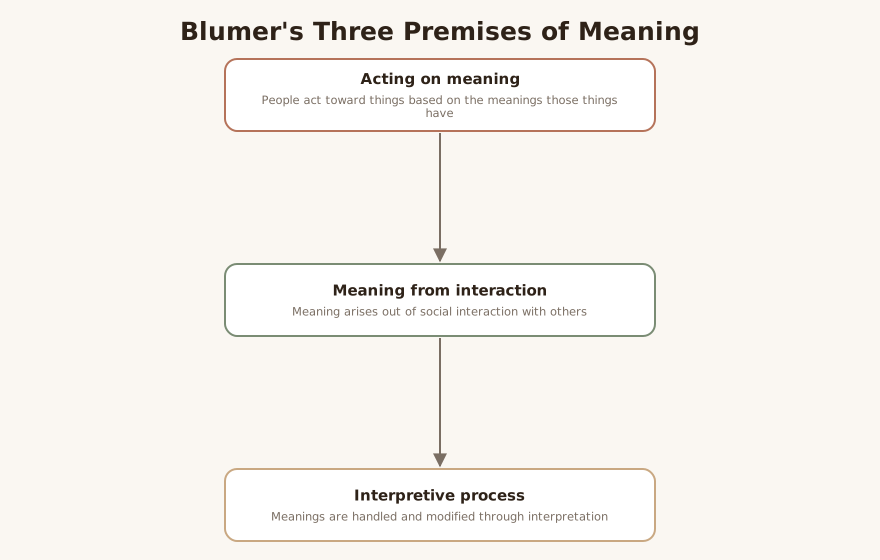
Blumer distilled the perspective into three premises that remain its operational core. First, humans act toward things on the basis of the meanings those things have for them. 3 Second, the meaning of such things is derived from, or arises out of, the social interaction one has with others. 6 Third, these meanings are handled in, and modified through, an interpretive process the person uses in dealing with the things they encounter. 6
That third premise is clinically the most important. Meaning is not fixed at the moment it is acquired; it is continually reworked through an internal interpretive process Mead called “minding,” a pause to consider future action before acting. 6 This is, in effect, a sociological description of reflective function, and it is precisely the capacity therapy seeks to expand. LLM
Several derived concepts follow. The self is reflexive: humans can take themselves as objects, viewing themselves as they believe others perceive them. 36 Role-taking is the mechanism by which a person adopts another’s perspective and anticipates how their actions affect others. 6 The generalized other is the internalized, organized attitude of one’s whole community or social group, distinct from the significant others (specific important individuals) who also shape the self. 3 Finally, the definition of the situation holds that people act on their interpretation of a situation, not on objective reality, captured in Thomas’s theorem: if situations are defined as real, they are real in their consequences. 3
LLM-generated illustrative example (not a guideline): A client reads a manager’s brief, neutral email as proof of impending dismissal and spends the weekend in panic. The email did not change; the client’s definition of the situation did, and that definition was “real in its consequences.” LLM
Interventions & Techniques
Symbolic interactionism does not prescribe techniques, but it generates a set of clinically usable moves when paired with an established therapy. LLM The unifying intervention is making meaning explicit and then examining where it came from and whether it still fits. LLM
A first move is eliciting the definition of the situation: asking not “what happened” but “what did that mean to you, and what did you assume others meant,” surfacing the interpretive layer that drives affect and behavior. LLM A second is tracing the looking-glass self, walking a client through Cooley’s three steps: how they imagine they appear to another, how they imagine that other judges them, and the self-feeling (often shame or pride) that results. 5 Separating “how I imagine I am seen” from “how I am actually seen” is frequently where therapeutic leverage sits. LLM
A third move works with role-taking and the generalized other: helping a client notice whose internalized voice (“everyone thinks…”) is governing their self-evaluation, and whether that generalized other is an accurate composite or a distortion. 3 A fourth is re-symbolizing: because meaning is modified through an interpretive process, it can be renegotiated in the relational safety of therapy, where the therapist is a new “significant other” offering a different reflection. 6 These moves dovetail with cognitive restructuring, narrative re-authoring, and chair work without belonging exclusively to any one of them. LLM
Evidence Base
Honesty about maturity is essential here. Symbolic interactionism is an established and influential theoretical framework, supported by a sustained scholarly community, including the Society for the Study of Symbolic Interaction and its journal Symbolic Interaction. 6 As social theory, it is mature and foundational. 3
But it is established as a sociological framework, not as a clinical intervention, and it carries well-documented limitations. Critics argue it functions as a broad theoretical framework rather than a testable theory, too general to generate and test specific hypotheses, even though derived theories such as role theory and identity theory are more scientifically rigorous. 6 It is methodologically committed to qualitative methods, particularly participant observation and interviews, which yield rich meaning but limited generalizability. 56 It has been criticized for inadequately addressing macro-level social structure, power, and inequality, and for underweighting emotion and the psychological complexity of participants. 6
The clinical implication: use symbolic interactionism as a case-conceptualization lens, and deliver care through a therapy with its own evidence base (e.g., CBT, narrative therapy, family systems). LLM Do not represent the theory itself as an empirically supported treatment, because it is not one. LLM
Populations & Indications
The framework is most useful where the presenting problem is fundamentally about self-concept, meaning, and the social mirror. LLM Adolescents, whose identity is actively being constructed through peer feedback, map directly onto the looking-glass self and the developing generalized other. 6 Adults in identity transitions, divorce, career change, retirement, gender or coming-out processes, are renegotiating roles and the meaning of self, the precise territory of role-taking. LLM
People with internalized stigma and members of marginalized and minority communities are described well by the theory: stigma operates by importing a devaluing generalized other into the self-concept. LLM Families and couples are interactional systems in which shared meanings, and conflicting definitions of the situation, are continuously negotiated, making the framework a natural fit for relational work. LLM
Problems-for-Work
Identity disturbance and self-concept disturbance are reframed as a self built from distorted or chaotic reflected appraisals; treatment helps the client author a more coherent and self-authored self rather than a purely other-derived one. 6LLM
Internalized stigma and shame are addressed by externalizing the generalized other: naming whose attitudes have been internalized and questioning their authority over the client’s self-feeling. 3LLM
Low self-esteem is approached through Cooley’s looking-glass: low esteem is often an inaccurate imagining of others’ judgments rather than an accurate appraisal, and the imagining is testable. 5LLM
Role transitions and adjustment disorder are worked as the loss of an old role-meaning and the unbuilt scaffolding of a new one; therapy supports renegotiating the definition of the new situation. 3LLM
Social anxiety is understood as a hypertrophied, punitive generalized other: the client over-attributes harsh evaluation to a generalized audience and behaves as if that definition were real. 3LLM
Relationship and communication problems are reframed as clashing definitions of the situation and failed role-taking; intervention restores the capacity to take the other’s perspective. 6LLM
LLM-generated illustrative example (not a guideline): A new parent presents with adjustment difficulties. Conceptualized through role transition, the work centers on the gap between the idealized “good parent” generalized other they carry and the messy reality, and on renegotiating that internalized standard. LLM
Contraindications, Cautions & Cultural Humility
Because symbolic interactionism is a lens rather than a procedure, it carries no medical contraindications, but it carries interpretive cautions. LLM Its emphasis on meaning and interpretation can, if applied carelessly, slide into invalidation, implying a client could simply “redefine” a situation of real material harm, abuse, poverty, discrimination, away. LLM The Thomas theorem cuts both ways: oppression is also “real in its consequences,” and the theory’s own critics note its tendency to underweight structural power and inequality. 6
Cultural humility is built into the theory’s logic rather than bolted on. The generalized other and the meaning of any symbol are culturally specific, so a therapist must resist importing their own generalized other as the norm. LLM What reads as low self-esteem in one cultural frame may be appropriate relational deference in another. LLM The framework’s qualitative, immersive epistemology actually models good practice here: understand meaning from within the client’s symbolic world rather than from outside it. 5 Caution is also warranted with clients in acute crisis, where exploring layered meaning should not displace stabilization and safety. LLM
Treatment-Plan Suggestions & SMART Objectives
| Goal | SMART objective (example) | Mechanism |
|---|---|---|
| Reduce internalized stigma | Within 8 sessions, client will identify and verbally externalize at least 3 internalized stigmatizing beliefs and name their social source, rated weekly | Externalizing the generalized other 3 |
| Increase accuracy of self-appraisal | Over 6 weeks, client will complete daily logs distinguishing “imagined judgment” from “evidence of actual judgment” on 5 of 7 days | Testing the looking-glass self 5 |
| Support role transition | Within 10 sessions, client will articulate a revised definition of their new role and 3 concrete behaviors aligned with it | Renegotiating the definition of the situation 3 |
| Reduce social-anxiety avoidance | Over 8 weeks, client will complete 1 graded social exposure weekly and record the discrepancy between predicted and actual evaluation | Recalibrating a punitive generalized other 3 |
| Improve couple communication | Within 6 joint sessions, each partner will accurately paraphrase the other’s “definition of the situation” before responding, in 80% of conflict discussions | Restoring role-taking 6 |
| Strengthen coherent self-concept | Over 12 sessions, client will co-author a written self-narrative integrating significant relationships and self-authored values | Reflexive self-construction 6 |
| Reduce shame-driven withdrawal | Within 8 sessions, client will identify the “significant others” whose reflected appraisals fuel shame and reappraise 3 of them with the therapist | Replacing the reflecting other 6 |
Common Misconceptions
A first misconception is that symbolic interactionism is a therapy. It is a sociological theory of meaning and the self; it has no treatment protocol or outcome trials of its own. 6LLM
A second is that “meaning is socially constructed” means “nothing is real” or “any interpretation is as good as another.” The theory holds that meanings are socially derived and interpretively modified, not that material reality is illusory; indeed the Thomas theorem stresses that definitions have real, often harsh, consequences. 3
A third is conflating the theory with pure individual cognition. Meaning in this framework is irreducibly social, it arises out of interaction with others, not inside a single isolated mind. 6 A fourth is assuming it is empirically tested like an intervention; its preferred methods are qualitative and interpretive, and even sympathetic critics call it a framework rather than a testable theory. 6
Training & Certification
There is no clinical certification in symbolic interactionism, because it is not a credentialed therapy. LLM Scholarly engagement runs through sociology and social-psychology graduate training and through the Society for the Study of Symbolic Interaction, which sponsors conferences, the journal Symbolic Interaction, and awards. 6 For clinicians, the practical path is to read the primary and secondary literature, Mead’s Mind, Self and Society and Blumer’s premises, and then obtain certification in the delivery modality (CBT, narrative therapy, family systems) through which the concepts are applied. 16LLM
Key Terms
Symbol / significant symbol — a gesture or word that means the same thing to the one making it and the one receiving it, the basis of shared meaning and language. 6
Looking-glass self (Cooley) — the self that forms from imagining how we appear to others and how they judge that appearance. 6
Self / the reflexive self — the capacity to take oneself as an object and see oneself as others might. 3
Role-taking — adopting another’s perspective to anticipate how one’s actions affect them. 6
Generalized other — the internalized, organized attitudes of one’s whole community or group. 3
Significant other — a specific important person whose appraisals shape the self. 3
Definition of the situation (Thomas) — the interpretation people act upon; “if situations are defined as real, they are real in their consequences.” 3
Minding (Mead) — the internal interpretive pause in which meaning is weighed before action. 6
Blumer’s three premises — meaning drives action; meaning arises from interaction; meaning is modified through interpretation. 36
Resources & Further Reading
▶ Watch — a video introduction to this concept:
- Mead, G. H. (1934). Mind, Self and Society — full text (Internet Archive)
- Mind, Self and Society — Table of Contents (Mead Project, Brock University)
- Symbolic Interactionism — Encyclopedia.com
- Symbolic Interactionism: George Herbert Mead & Herbert Blumer — Montgomery College
- Symbolic interactionism — Wikipedia
Reflective / Supervision Questions
- For this client’s presenting problem, what is the meaning driving the distress, and where and with whom was that meaning built? LLM
- Whose “generalized other” is governing my client’s self-evaluation, and is it an accurate composite or a distortion worth questioning? LLM
- Am I using symbolic interactionism as a conceptual lens while delivering a recognized, billable modality, or am I drifting into treating “meaning-making” as if it were itself the evidence-based treatment? LLM
- Where might my interpretive emphasis risk invalidating a client’s real material or structural circumstances, and how do I hold both meaning and the reality of consequences? LLM
- Whose generalized other am I, as the therapist, importing as the cultural norm, and how does that shape what I read as “low self-esteem,” “deference,” or “dysfunction”? LLM
- As a new significant other in this client’s life, what reflected appraisal am I offering, and is it the one I intend? LLM