
Type & Discipline
The social construction of reality is a theory within sociology—specifically the sociology of knowledge—and not a treatment model or school of psychotherapy 2. It was set out most fully in Peter Berger and Thomas Luckmann’s 1966 treatise, whose subtitle, A Treatise in the Sociology of Knowledge, signals its concern: how the “knowledge” that orients people in everyday life comes to exist and to feel obvious 1. The theory belongs to a phenomenological lineage and asks not what is ultimately true but how shared meanings become taken for granted as reality by the members of a society 4.
Its central claim is that the everyday world we treat as simply “there”—roles, institutions, common sense, identity itself—is in fact produced, sustained, and transmitted through human social activity rather than given by nature 3. Berger and Luckmann shifted the sociology of knowledge away from the history of ideas and toward the ordinary, pre-theoretical knowledge that guides daily conduct 5.
For clinicians, the categorical point matters: this is a sociological theory, and any clinical use is borrowed and adapted, not delivered as the theory itself LLM. It enters the consulting room chiefly through narrative therapy and the wider family of social-constructionist therapies, which translated the premise—that meaning is co-constructed rather than discovered—into practice LLM. Treating “social construction of reality” as if it were an evidence-based intervention would be a category error LLM.
Creators & Lineage
Peter L. Berger (1929–2017) and Thomas Luckmann (1927–2016) were sociologists who co-authored The Social Construction of Reality in 1966, a book widely regarded as a foundational text of twentieth-century social theory and one that popularized the very phrase “social construction” 2. Both were shaped by the phenomenological tradition, particularly the work of Alfred Schütz, whose analysis of the everyday lifeworld and its structures of relevance the authors drew on directly 5. They also synthesized the classical sociological theorists—Émile Durkheim’s insistence that social facts confront the individual as external and constraining, and Max Weber’s emphasis on subjective meaning and social action—holding both the objective and subjective faces of society in a single framework 4.
The intellectual surround includes symbolic interactionism, which similarly treats the self and meaning as arising through social interaction and shared symbols, and the broader current of social constructionism that the book helped launch 5. Within psychotherapy, the most direct clinical descendant is narrative therapy, developed by Michael White and David Epston, which rests squarely on the constructionist premise that the stories people live by are socially constituted and can therefore be re-authored LLM. Solution-focused and collaborative/dialogic therapies share the same constructionist soil, treating problems and solutions as products of language and conversation rather than fixed properties of the person LLM.
Core Principles
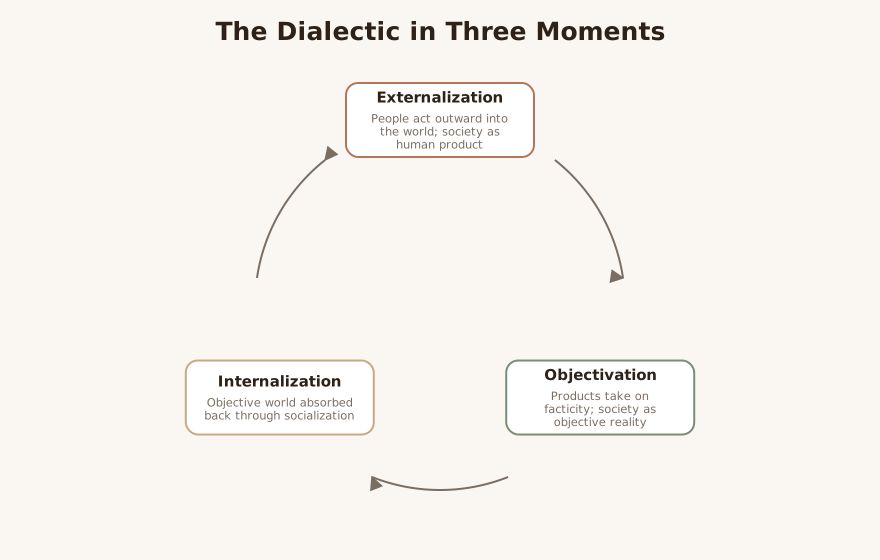
The organizing idea is a dialectic in three moments, often summarized as: society is a human product; society is an objective reality; and the human being is a social product 4. Berger and Luckmann name these moments externalization, objectivation, and internalization, and insist they occur together and continuously rather than in sequence 5. Reality is built when people act outward into the world (externalization), those products take on a facticity that confronts later actors as solid and external (objectivation), and that objective world is then absorbed back into consciousness through socialization (internalization) 5.
The mechanism by which this gets going is habitualization and then institutionalization 2. Any frequently repeated action congeals into a pattern that can be reproduced with economy of effort; when such habitualized actions become reciprocally typified by classes of actors—“this is how people like us do this”—an institution exists 2. Crucially, institutions, once formed, are experienced by new arrivals as objective, given, and beyond individual will, even though they were originally somebody’s invention 4.
A further principle is legitimation: the social order, especially as it must be handed to a new generation that did not build it, requires explanation and justification, which is supplied by ascending levels of legitimation up to the comprehensive “symbolic universe” that locates all of social reality within an overarching frame of meaning 4. A recurring danger in the process is reification—apprehending human products as if they were non-human facts of nature, divine will, or cosmic law, thereby forgetting their authorship 5. Finally, all of this is sustained intersubjectively: reality is maintained through ongoing conversation and through plausibility structures, the social bases and relationships that keep a given world credible 2.
Interventions & Techniques
The social construction of reality supplies no protocol, manual, or technique set of its own LLM. What it offers the clinician is a lens—a way of hearing a client’s “facts about themselves” as constructed, sustained, and therefore revisable, rather than as fixed truths to be accepted or merely corrected LLM. The techniques below are recognized methods, drawn mainly from narrative therapy, into which a constructionist sensibility is folded; the framing is constructionist, the delivery is established psychotherapy LLM.
Externalizing conversations operationalize the theory’s anti-reification stance: by separating the problem from the person (“the depression” rather than “I am defective”), the clinician treats the problem-identity as an objectivated, internalized construct rather than the client’s essence, opening it to inspection and change LLM. Deconstructing taken-for-granted stories mirrors Berger and Luckmann’s move of de-naturalizing the obvious—asking where a “truth” about the self came from, whose interests it serves, and how it was learned, which exposes its social authorship LLM. Mapping the influence of dominant cultural narratives uses the legitimation and symbolic-universe ideas: gendered, familial, or culturally prescribed stories are named as social constructions the client absorbed through socialization rather than personal failings LLM. Re-authoring and identifying unique outcomes enacts the externalization moment in reverse—helping the client deliberately act into a preferred story and build new, more livable meaning LLM. Recruiting an audience (definitional ceremonies, outsider witnesses, letters) leverages the insight that reality is maintained through conversation and plausibility structures, so a new self-story needs social ratification to hold LLM.
LLM-generated illustrative example (not a guideline): A 17-year-old says, “I’m just the screw-up of the family—that’s who I am.” A clinician working from a constructionist lens might respond, “That sounds like a story that got told about you so often it started to feel like a fact. Who first cast you in that role, and what does ‘screw-up’ make invisible about you?”—then move into externalizing and re-authoring work, eventually inviting a trusted person to witness a different account. LLM
Evidence Base
Honesty requires separating two very different claims LLM. As sociological theory, the social construction of reality is established and canonical: Berger and Luckmann’s 1966 treatise is treated as a foundational contribution to the sociology of knowledge, is routinely taught in introductory and advanced sociology, and popularized a vocabulary—“social construction,” “institutionalization,” “plausibility structures”—now standard across the social sciences 2. Its core mechanisms have been elaborated and applied for nearly six decades 4.
As a clinical intervention, however, the theory has no evidence base of its own LLM. There are no randomized controlled trials of “social-construction therapy,” no manualized protocol, and no outcome literature, because the theory was never intended as a treatment LLM. Whatever clinical credibility it can claim is borrowed from the constructionist therapies it informs—chiefly narrative therapy and solution-focused and collaborative approaches—whose evidence base is growing but remains generally weaker, smaller, and less standardized than that for cognitive-behavioral treatments, with much of it drawn from case studies, qualitative work, and a limited number of controlled trials LLM. The defensible position for a practitioner is therefore: use the theory as an interpretive and relational lens within an established modality, not as a standalone treatment, and do not represent it to clients or in documentation as an evidence-based therapy LLM.
Populations & Indications
Constructionist framing is most apt where the presenting distress is organized around meaning, identity, and socially imposed stories rather than around discrete symptoms with a clear physiological target LLM. Clients in narrative therapy are by definition the natural fit, since the modality is built on the theory’s premises and uses its anti-reifying logic throughout LLM. Cultural and minority-group members carrying internalized stigma often benefit, because the theory gives precise language for how an oppressive “truth” about a group was socially constructed and absorbed, separating it from the person’s worth LLM.
Adolescents navigating identity formation are frequently working out which family and cultural scripts they will keep, revise, or reject—exactly the negotiation the theory describes between inherited and authored reality LLM. People navigating identity transitions—coming out, immigration, religious deconversion or conversion, career or gender transitions—face the dissolution and rebuilding of a taken-for-granted world, where naming the constructed nature of roles can be stabilizing rather than destabilizing LLM. Couples and families in entrenched conflict often operate from clashing, equally “obvious” realities; surfacing each as a constructed account rather than the truth can de-escalate the fight over who is right LLM.
Problems-for-Work
Internalized stigma. When a client treats a stigmatizing belief about themselves as plain fact, the theory reframes it as an objectivated social construction that was learned through socialization, which can be examined for its origin and authorship and then deliberately re-authored LLM.
Identity disturbance and self-concept difficulties. For clients who experience their self-description as fixed and damning, externalizing and de-naturalizing the story opens the possibility that identity is a construction-in-progress rather than a verdict LLM.
Role confusion and adjustment disorder. During role transitions, the loss of a taken-for-granted world drives much of the distress; naming roles as constructed and negotiable supports the active rebuilding of a workable reality LLM.
Family conflict and relationship conflict. Where partners or family members are locked into incompatible “obvious” accounts of events, treating each account as a socially constructed reality rather than the truth shifts the work from winning to mutual understanding and joint re-authoring LLM.
Meaning-making difficulties and demoralization. For clients who feel their life-story has lost coherence, the constructionist premise—that meaning is built, not found—reframes the task as authorship and recruits social witnesses to make new meaning hold LLM.
Contraindications, Cautions & Cultural Humility
The most serious caution is that “everything is constructed” can be heard as “nothing is real,” which is both philosophically inaccurate and clinically dangerous LLM. Berger and Luckmann do not deny that institutions exert genuine, coercive force; objectivated reality really does constrain people, and trauma, abuse, poverty, and discrimination are not dissolved by relabeling them as constructions 4. A clinician must never let a constructionist frame minimize a client’s lived harm or imply that distress is merely a story they could choose to drop LLM. With clients in acute crisis, psychosis, or active trauma activation, abstract de-naturalizing of “what is real” can be destabilizing and should wait until the client is grounded and safe; reality-testing and safety take precedence over deconstruction LLM.
Cultural and spiritual humility is essential and, in fact, native to the theory LLM. Because the social construction of reality insists that the clinician’s own framework is also a construction—shaped by professional training, culture, and class—it warns against importing the therapist’s symbolic universe as the truth against which the client’s world is measured 5. This is especially important with clients whose religious, communal, or collectivist sources of meaning are central to their resilience; these are not naive illusions to be exposed but plausibility structures that sustain a coherent and valued world LLM. The right move is to use the theory’s structure—surfacing and respecting the client’s constructed reality, separating limiting stories from the person—while leaving the client’s own meaningful commitments intact and treating real-world oppression as real LLM.
Treatment-Plan Suggestions & SMART Objectives
| Goal | SMART objective (example) | Mechanism |
|---|---|---|
| Reduce internalized stigma | Within 8 weeks, client will identify 3 stigmatizing beliefs, trace each to its social source, and rate believability dropping from 9/10 to 4/10 | De-reification exposes the constructed, learned origin of the belief LLM |
| Strengthen a preferred identity narrative | Over 10 sessions, client will articulate and document a re-authored self-story and name 3 supporting “unique outcomes” | Externalization-in-reverse builds an alternative, livable construction LLM |
| Separate problem from person | By week 6, client will use externalizing language (“the anxiety”) in session 4+ times per meeting | Anti-reification opens the problem-identity to change LLM |
| Stabilize identity during role transition | Within 12 weeks, client will define 2 chosen roles and the values underwriting them, reviewed weekly | Deliberate re-construction of a taken-for-granted world LLM |
| De-escalate clashing realities in a couple/family | Over 6 sessions, each member will accurately restate the other’s account before responding, in 80% of conflict topics | Treating each account as constructed shifts goal from winning to understanding LLM |
| Recruit social support for new self-story | Within treatment, client will share the re-authored narrative with 2 trusted witnesses and report their response | Plausibility structures and conversation maintain the new reality LLM |
| Rebuild meaning after demoralization | Within 8 weeks, client will complete a values/meaning exercise and act on one value-aligned commitment weekly | Meaning treated as authored rather than awaited restores agency LLM |
Common Misconceptions
“Social construction means nothing is real—it’s just relativism.” This is the most damaging misreading LLM. Berger and Luckmann hold both that society is a human product and that it is an objective reality that genuinely constrains people; objectivation is precisely the moment human products become solid and externally binding 4. The theory explains how reality becomes real to us, not that reality is fake 3.
“It’s a kind of therapy.” It is a sociological theory; any therapeutic use is an adaptation delivered through narrative therapy or other constructionist approaches, not a validated standalone treatment LLM.
“‘Construction’ means a deliberate, conscious choice.” Most construction is pre-reflective and habitual—reality is built through habitualization and absorbed through socialization largely without anyone deciding to build it, which is why it feels given rather than chosen 2.
“Berger and Luckmann were postmodernists who denied objective truth.” Their project is rooted in phenomenological sociology and the classical theorists, and they explicitly retain society’s objective facticity; they are usually distinguished from later radical-relativist constructionisms 5.
Training & Certification
There is no certification in the social construction of reality, because it is a sociological theory rather than a clinical credential LLM. Clinicians who want to work competently with the concerns it raises should pursue training in the empirically grounded modalities that carry these premises—principally narrative therapy, and relatedly solution-focused and collaborative/dialogic approaches—through recognized coursework, supervision, and reading of the primary clinical literature (White and Epston) LLM. Direct engagement with Berger and Luckmann’s 1966 text gives the clinician a more accurate grasp of the theory than secondhand summaries and guards specifically against the “nothing is real” misreading 1. Ongoing supervision is valuable because constructionist work intersects with culture, power, identity, and real-world oppression, where a careless application can minimize genuine harm LLM.
Key Terms
Externalization, objectivation, internalization — the three dialectical moments by which reality is produced: people act into the world, those products become an external given, and that world is absorbed back into consciousness through socialization 5.
Habitualization — the congealing of repeated action into an economical, reproducible pattern, the precursor to institution-building 2.
Institutionalization — the point at which habitualized actions are reciprocally typified by classes of actors, so that an institution exists and is experienced as objective by later arrivals 2.
Legitimation — the explanations and justifications that make the social order plausible and transmissible, rising to the comprehensive “symbolic universe” that frames all of reality 4.
Reification — apprehending human products as if they were non-human facts (nature, cosmic law, divine will), forgetting their authorship; the error a constructionist lens works to undo 5.
Plausibility structure — the social base and relationships (the ongoing conversation) that keep a given reality credible and maintained over time 2.
Primary and secondary socialization — primary socialization is the first internalization of the world in childhood; secondary socialization inducts the already-socialized person into new sub-worlds and roles 6.
Resources & Further Reading
▶ Watch — a video introduction to this concept:
- The Social Construction of Reality: A Treatise in the Sociology of Knowledge (Berger & Luckmann, 1966)
- The Social Construction of Reality (Wikipedia)
- Social Construction of Reality (SimplyPsychology)
- The Social Construction of Reality: Berger and Luckmann (Pure Sociology)
- The Ideas of Berger and Luckmann in Sociology (Easy Sociology)
- Social Construction of Reality (Introduction to Sociology, Howard CC)
Reflective / Supervision Questions
- When a client states a “fact” about themselves, do I hear it as a fixed truth, a distortion to correct, or a socially constructed and re-authorable story—and what determines which? LLM
- Am I holding both sides of the dialectic—respecting that my client’s reality is constructed and that it genuinely constrains and can genuinely harm them? LLM
- Where am I treating my own clinical framework as the real against which I measure the client’s world, rather than as one more construction shaped by my training and culture? LLM
- How do I distinguish a limiting story worth deconstructing from a client’s source of meaning and resilience that deserves protection, not exposure? LLM
- With this client in crisis or acute trauma, is deconstruction grounding or destabilizing right now, and does safety and reality-testing need to come first? LLM
- Does a constructionist frame fit this client’s cultural and relational context, or am I imposing an individualist, self-authoring model where meaning is in fact communal? LLM