
Type & Discipline
Shamanism is not a psychotherapy and not a single tradition; it is a construct from the anthropology of religion and medical anthropology that names a cross-culturally recurring role 25. In the standard description, a shaman is a practitioner who interacts with a spirit world through altered states of consciousness such as trance, in order to direct spirits or spiritual energies into the physical world for healing, divination, or to aid human beings 5. The role is fundamentally one of mediation: the shaman communicates with the spirits on behalf of the community and acts as an intermediary or messenger between the human world and the spirit worlds 5. For the clinician, the most useful framing is therefore anthropological rather than technical — shamanism is a lens for understanding clients whose worldview includes spirits, ritual healers, and soul loss, not a procedure a therapist performs LLM.
This article deliberately sits at the level of the category. Sibling articles in this wiki cover the techniques and their Western adaptations — Eliade’s “techniques of ecstasy,” Harner’s core shamanism and shamanic journeying, and soul retrieval as a discrete practice 45. Here the unit of analysis is the recurring complex itself: what is shared across cultures, why scholars argue about whether the shared pattern is real or imposed, and what a practicing therapist should do with all of it LLM.
Creators & Lineage
The word shaman is not Western in origin. It was originally used to describe North Asian Siberian religious specialists in the Tungusic Evenki language, entering scholarly usage through Russian (šamán) and possibly deriving from a Tungus root meaning “to know,” though that derivation is disputed on linguistic grounds 25. From this regional term, anthropology generalized outward to describe healers and diviners across many unrelated cultures 2.
The foundational synthesizer is Mircea Eliade, whose 1951 study Shamanism: Archaic Techniques of Ecstasy established the still-dominant academic framing 4. Eliade defined shamanism as a “technique of religious ecstasy” and characterized shamans as intermediaries between the human and spirit worlds who mend the soul and enter supernatural realms to obtain solutions to problems 5. His work anchors most reading lists on the subject and gave the field its central image — the trance journey or soul-flight as the defining shamanic act 45.
The second major figure for clinicians is Michael Winkelman, whose work frames shamanism around altered states of consciousness as a cross-cultural and biologically grounded phenomenon 1. Winkelman’s later writing argues for an evolutionary origin of spirituality and healing, treating shamanic practice as an ancient and recurring human adaptation rather than a local curiosity 3. Empirically, his statistical analysis used a 47-society stratified subsample of the Standard Cross-Cultural Sample, drawing on data ranging from antiquity to the twentieth century, and found that shamanic practices recur with notable consistency across geographically and historically separated cultures 2. Alongside Eliade and Winkelman, the cross-cultural study of altered states owes much to researchers such as Erika Bourguignon, whose comparative work on trance and possession established how widespread institutionalized altered states are across human societies LLM. Michael Harner belongs to this lineage too, but as the architect of the neoshamanic synthesis adapted for Westerners — a development treated in the dedicated core-shamanism articles rather than here 5LLM.
Core Principles
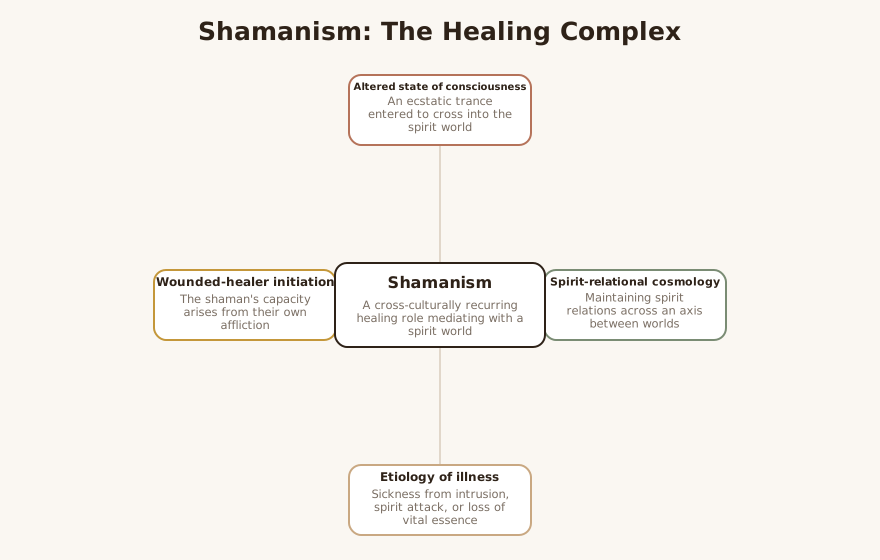
Several features recur across the ethnographic record and together define the complex 2. The first is the altered state of consciousness: the shaman effects a transition of consciousness — an ecstatic trance entered autohypnotically, through ritual performance, or through entheogens — to cross into the spirit world 5. Winkelman’s cross-cultural inventory describes this as “ecstasy,” an altered state involving soul journey or soul flight, frequently induced by chanting, music, drumming, and dancing 2.
A second principle is the spirit-relational cosmology: the shaman traverses an axis between worlds and maintains spirit relations that are foundational to professional capacity, rather than received as doctrine 25. A third is a characteristic etiology of illness: sickness may be understood as caused by the intrusion of objects or by attacks by spirits, or by the loss of a vital essence, with corresponding remedies such as soul and power-animal recovery 2. The concept of soul loss appears widely in healing contexts, where treatment may consist of retrieving the lost soul of the ill person 5.
A fourth principle is the wounded-healer initiation. The shaman’s vocation often begins with an initiatory crisis — a rite of passage commonly involving physical illness or psychological crisis, sometimes pushing the candidate to the brink of death and resolved through a death-and-rebirth experience 25. Finally, the role is communal and functional rather than private: the shaman heals, divines, prophesies, leads ritual, preserves tradition through storytelling and song, and serves as a psychopomp or “guide of souls” for the dying and dead 5. Across these features the consistent thread is mediation between a community and an unseen order on which the community’s wellbeing is believed to depend LLM.
Interventions & Techniques
Because shamanism is a category rather than a manual, its “techniques” are the recurring methods documented across cultures, not portable tools a clinician adds to a kit LLM. The central method is induction of the altered state through sonic and kinetic driving — drumming, rattling, chanting, music, and dance — and at times through entheogens or ritual ordeal 25. Within that state the practitioner undertakes the journey or soul-flight, traveling to spirit realms to seek help, retrieve what was lost, or obtain solutions to a presenting problem 45.
The functional repertoire that follows includes divination and diagnosis (identifying the spiritual cause of suffering), healing by removing an intrusion or recovering a lost soul or power animal, prophecy, sacrifice and ceremony, and psychopomp work guiding souls in transition 25. From a clinician’s standpoint these map recognizably onto generic mechanisms of ritual healing — a culturally sanctioned healer, a shared explanatory model, a structured procedure with a clear beginning and end, heightened arousal or trance, and a public act of reincorporation — which is part of why the complex recurs and part of why it can be effective within its own frame LLM.
LLM-generated illustrative example (not a guideline): A clinician treating a recent immigrant learns the client has also consulted a traditional healer who performed a “calling back” ritual for a fright the client suffered after a car accident. Rather than dismissing this, the clinician asks the client to describe what the ritual was for and what shifted afterward, using the answers to understand the client’s explanatory model and to frame evidence-based trauma work in language the client already finds meaningful LLM.
Evidence Base
Honesty about evidence requires holding two layers apart LLM. At the descriptive layer, shamanism is well established: the existence of the role and its recurring features across unrelated cultures is an empirically documented anthropological finding, supported by cross-cultural statistical work and by ethnographers who report that shamans from oceanically separated traditions recognize one another’s goals, rituals, and beliefs 2. In that sense “established” means established as a real, recurring human phenomenon and a mature field of study 25.
At the explanatory layer, the major theories are interpretive and actively debated 5. Eliade’s universalizing synthesis and Winkelman’s neurotheological account — which proposes that shamanic ritual produces neurological integration enhancing attention, self-awareness, learning, and memory while strengthening community cohesion — are influential hypotheses, not settled science, and scholars debate both Eliade’s generalizing approach and the very applicability of the word “shamanism” 25. Critically for clinicians, none of this is clinical-efficacy evidence: there are no randomized controlled trials establishing shamanic healing as a treatment, and “established” must never be read as “proven therapy” LLM. The defensible clinical posture is that any benefit of ritual healing plausibly operates through recognized common factors — expectancy, the healer relationship, structured meaning-making, and physiological down-regulation — which is why elements can be understood, and respected, without endorsing the metaphysics LLM.
Populations & Indications
Shamanic frameworks are most clinically relevant when a client’s own world already contains them 2. The primary populations are members of Indigenous and traditional communities where shamans or equivalent specialists are living practitioners, and, in clinical settings, immigrants and diaspora clients who carry these explanatory models with them 2LLM. Beyond these, the complex speaks to people who actively seek spiritual healing, those in existential or spiritual crisis, and communities in collective distress for whom individualized, intrapsychic models feel incomplete 5LLM.
The “indications” within the shamanic frame are the conditions it claims to address: soul loss following fright or trauma, spirit intrusion experienced as localized affliction, dispiritedness and loss of vitality, grief and the work of guiding the dead, and the initiatory crisis itself 25. For the therapist, the operative point is that indication within the shamanic model is not the same as clinical indication — the value of recognizing these categories is in understanding the client’s experience and mobilizing culturally congruent meaning, while the actual treatment of psychiatric illness remains standard evidence-based care LLM.
Problems-for-Work
The construct’s vocabulary maps onto presentations clinicians see regularly, and the mapping is useful even when the metaphysics is held lightly LLM.
Culture-bound syndromes and idioms of distress. When a client describes a fright-induced loss of vital essence — the soul-loss pattern that shamanic healing addresses through retrieval — the clinician gains an explanatory model that organizes otherwise puzzling somatic and dissociative complaints 25. Application: eliciting and validating the idiom, then delivering an indicated protocol within that shared frame LLM.
Grief and the dead. The shaman’s psychopomp role names a near-universal human task — accompanying the dead and the bereaved across a threshold 5. Application: honoring a client’s culturally specific mourning ritual as legitimate clinical material rather than superstition LLM.
Existential and spiritual crisis. The initiatory-crisis pattern reframes a period of breakdown as a potential threshold of transformation, which can reduce shame for clients who experience their distress in spiritual terms 25. Application: meaning-centered work that treats the crisis as significant without abandoning risk assessment LLM.
Disconnection and loss of meaning. The complex’s emphasis on relationship — to community, ancestors, and an unseen order — gives language to clients whose core complaint is felt disconnection 2LLM.
LLM-generated illustrative example (not a guideline): A bereaved client from a tradition with strong ancestor practices feels guilty that she “cannot let go,” which Western grief language frames as stuck. Drawing on the psychopomp motif as a metaphor, the clinician reframes the bond as an ongoing relationship to be tended rather than severed, which lowers the client’s shame and lets standard grief processing proceed LLM.
Contraindications, Cautions & Cultural Humility
There are no medical “contraindications” to a worldview, but the cautions here are sharp and partly scholarly LLM. The category itself is contested, and the two most authoritative sources here land differently — which is worth telling clients and supervisees honestly LLM. The HRAF anthropological essay defends the concept as useful when applied carefully, judging earlier worries about romanticizing the archaic past to be overstated 2. Wikipedia foregrounds the rejectionist critique: that there is no single agreed-upon definition, that the historian Ronald Hutton catalogued four competing definitions, that anthropologist Piers Vitebsky holds “there is no unity in shamanism” despite astonishing similarities, and that critics such as Alice Kehoe call the term a Western construct that can reinforce the “noble savage” stereotype and misrepresent Indigenous practices 5. A clinician should therefore treat “shamanism” as a contested umbrella, name it as such, and never assume a given Indigenous client identifies with the label 5LLM.
The appropriation caution is equally important. Practices abstracted from their cultures and sold as universal “neoshamanism” are widely criticized, and entheogen, drumming, and trance practices exist in non-shamanic cultures too and cannot be collapsed into one global religion 5. A licensed therapist must not perform ceremony or present decontextualized ritual as authentically Indigenous; the appropriate move is to refer to and collaborate with legitimate traditional healers where the client wishes 5LLM. Clinically, trance-induction and dissociation-adjacent methods carry real risk for clients with psychosis, dissociative disorders, or unstable trauma activation, and the initiatory-crisis frame must never delay assessment of acute risk; standard crisis care and evidence-based treatment remain primary LLM.
Treatment-Plan Suggestions & SMART Objectives
The objectives below translate what a clinician can ethically borrow — the client’s explanatory model, ritualized meaning-making, and culturally congruent framing — into documentable goals delivered inside recognized psychotherapy, never as shamanic healing offered as a service LLM.
| Goal | SMART objective (example) | Mechanism |
|---|---|---|
| Elicit and honor the client’s explanatory model | Within 3 sessions, client will describe their own understanding of the cause and cure of their distress, and clinician will integrate it into the formulation | Shared explanatory model improves engagement and alliance 2 |
| Reduce shame around a culture-bound idiom (e.g., soul loss / fright) | Over 6 weeks, client will reframe symptoms using a non-pathologizing shared term and report reduced self-blame on a brief measure | Validating the idiom of distress rather than overriding it 25 |
| Process grief through culturally congruent ritual | Within 8 weeks, client will design and complete one personally meaningful, time-bounded mourning practice and rate change in distress | Ritual structure and psychopomp-style meaning-making 5 |
| Reframe an existential/initiatory crisis | Over treatment, client will articulate one way the crisis could mark transformation rather than only breakdown, while completing risk planning | Reframing crisis as threshold reduces shame 25 |
| Restore sense of connection | Within 6 weeks, client will re-engage 2 relationships (community, kin, or tradition) and log contact | Relational reconnection counters felt disconnection 2 |
| Coordinate with a traditional healer (client-led) | Over treatment, client will, if they choose, maintain contact with a traditional healer while evidence-based care continues, documented collaboratively | Respectful integration without appropriation 5 |
| Lower physiological arousal | Client will practice paced, rhythmic relaxation 4x/week and report reduced baseline tension over 4 weeks | Somatic down-regulation analogous to ritual entrainment 2 |
Common Misconceptions
“Shamanism is one religion.” There is no single agreed-upon definition, no doctrinal unity, and serious scholarly disagreement about whether the category is coherent at all 5. “Shamanism is a proven therapy.” It is an established anthropological phenomenon, not a treatment validated by clinical trials; recurrence across cultures is evidence of a human pattern, not of efficacy by Western standards 2LLM. “A shaman is mainly a psychotherapist.” The role is communal and multi-functional — healer, diviner, ritual leader, tradition-keeper, and guide of souls — embedded in a spirit cosmology, not a private clinical dyad 5. “The Western ‘neoshaman’ is the same thing as a traditional shaman.” Abstracted, commercialized adaptations are widely criticized for not resembling the source cultures and for appropriation 5. “Anyone troubled is having a shamanic initiation.” The initiatory-crisis motif is a cultural rite of passage, not a license to romanticize untreated psychiatric crisis or skip risk assessment 25LLM.
Training & Certification
There is no clinical credential in “shamanism,” and the deeper point is that, within traditional contexts, the role is conferred by community, spirits, and an initiatory ordeal rather than by certification — competence is relational and culturally sanctioned, not licensed 25. For the licensed therapist, the relevant training is not in performing shamanic practice but in the cross-cultural literacy to recognize it: reading the foundational scholarship (Eliade’s Archaic Techniques of Ecstasy and the cross-cultural and evolutionary work of Winkelman among others), understanding idioms of distress, and developing the cultural humility to collaborate with traditional healers without appropriating their work 1345LLM. No exposure to this material confers any clinical scope; the credentials that govern practice remain the therapist’s licensure and the evidence-based modalities they are trained in LLM.
Key Terms
- Shaman: a religious/healing specialist who interacts with a spirit world through altered states on behalf of a community; the term originates in the Tungusic Evenki language of Siberia 25.
- Ecstasy / soul-flight: the trance-based journey of consciousness to a spirit realm, central to Eliade’s definition of shamanism as a “technique of religious ecstasy” 45.
- Altered state of consciousness (ASC): the trance state, often induced by drumming, chanting, dance, or entheogens, in which shamanic work occurs 25.
- Soul loss / soul retrieval: an etiology in which a vital essence departs (often after fright or trauma) and is recovered by the healer 25.
- Spirit intrusion: illness attributed to an intrusive object or spirit, removed by extraction-type healing 2.
- Initiatory crisis / wounded healer: the illness or psychological crisis that inaugurates the shaman’s vocation, resolved through death-and-rebirth 25.
- Psychopomp: the shaman’s role as a “guide of souls” for the dying and dead 5.
- Axis mundi: the cosmological axis the shaman traverses between worlds 5.
- Neoshamanism: modern Western adaptations of shamanic technique, widely critiqued for decontextualization and appropriation 5.
Resources & Further Reading
▶ Watch — a video introduction to this concept:
- Winkelman, M. — Shamanism and Altered States of Consciousness: An Introduction (ResearchGate)
- Cross-Culturally Exploring the Concept of Shamanism — Human Relations Area Files, Yale
- Winkelman, M. — Shamanism and the Evolutionary Origins of Spirituality and Healing (Academia.edu)
- Best Books on Shamanism: 30 Essential Academic Studies (incl. Eliade, Archaic Techniques of Ecstasy)
- Shamanism — Wikipedia
Reflective / Supervision Questions
- When a client describes their distress in shamanic or spirit terms, am I eliciting their explanatory model as legitimate clinical material, or quietly overriding it with mine? 2LLM
- Given that “shamanism” is a contested category that some scholars defend and others reject as a Western imposition, how do I name that honestly to a client without either dismissing their experience or romanticizing it? 25
- Where is the line between borrowing a metaphor (soul loss, the threshold, the guide of souls) and appropriating or performing a practice I have no standing to deliver? 5LLM
- For which clients would trance-adjacent or dissociation-adjacent techniques be contraindicated, and how do I screen before introducing any ritual or imagery element? LLM
- If a client is also working with a traditional healer, how do I collaborate respectfully while ensuring evidence-based care remains primary for any serious condition? 5LLM
- Am I treating an existential or spiritual crisis as meaningful and completing standard risk assessment, rather than letting the “initiatory” frame substitute for clinical judgment? 2LLM