
Type & Discipline
Eliade’s “techniques of ecstasy” is a construct drawn from the history of religions and comparative anthropology, not a treatment protocol or a school of psychotherapy 3. It names a cross-cultural pattern: the shaman as a ritual specialist who deliberately enters ecstatic or trance states so that the soul may leave the body and journey to other worlds 1. Eliade offered “technique of ecstasy” as what he called the “least hazardous” working definition of shamanism, framing it as “mysticism, magic and religion in the broadest sense” rather than as a single religion or a science 2. For a clinical audience, the important orientation is this: the construct describes a believed and practiced healing technology embedded in particular cosmologies, and its relevance to contemporary therapy is interpretive and historical rather than evidentiary LLM. It belongs to the family of Indigenous and shamanic frameworks, and it has shaped how Western psychology imagines altered states, journeying imagery, and “soul loss” as a metaphor for trauma and dissociation LLM.
Creators & Lineage
The framework is principally the work of Mircea Eliade (1907–1986), a Romanian-born historian of religions and phenomenologist who chaired the history of religions department at the University of Chicago from the mid-1950s until his retirement in 1983 3. Eliade published Le Chamanisme et les techniques archaïques de l’extase in French in 1951; the influential English translation by Willard Trask, Shamanism: Archaic Techniques of Ecstasy, appeared in 1964 through the Bollingen Series 3. The book sits alongside his broader theoretical apparatus — the dialectic of the sacred and the profane, the concept of hierophany (a manifestation of the sacred), and the mythic structure he developed in works such as The Myth of the Eternal Return 3. The text catalogs initiatory sickness and dreams, the methods for obtaining shamanic powers, the role of initiation, and the symbolism of the shaman’s costume and drum 2.
In the lineage running forward from Eliade into clinical and quasi-clinical practice, several descendants matter LLM. Transpersonal psychology absorbed his vocabulary of ecstatic and non-ordinary states of consciousness LLM. Guided imagery and visualization, and hypnotherapy and trance states, parallel the structured induction and journey imagery Eliade described, though these techniques have their own independent clinical genealogies LLM. And Indigenous and traditional healing systems are the living source traditions from which Eliade abstracted his model — a point that carries ethical weight and is taken up below LLM.
Core Principles
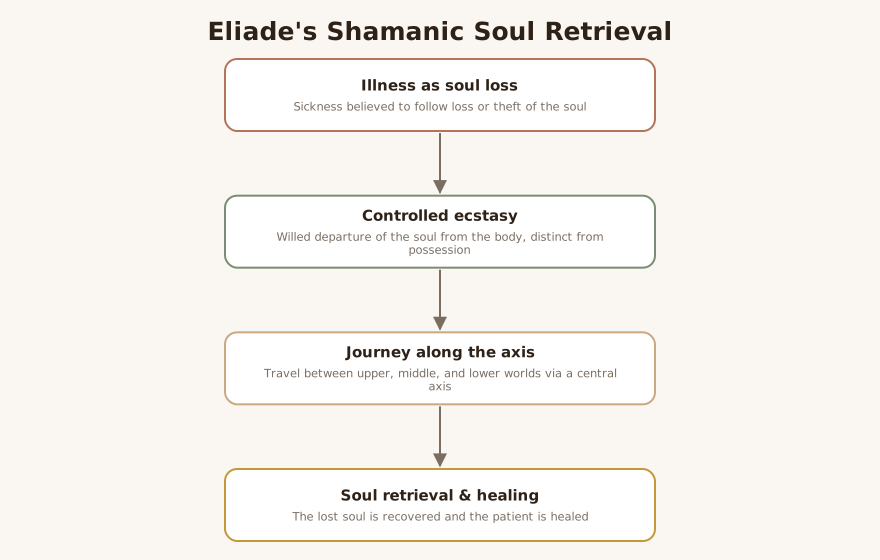
The construct rests on a believed cosmology and a believed mechanism, both of which the clinician should understand as the worldview of practitioners rather than as established fact LLM. First, ecstasy as controlled departure of the soul: Eliade emphasized that in shamanic ecstasy “the soul can leave the body to undertake celestial ascensions or descent” to the underworld 5. This is the defining capacity — the shaman is a technician of a deliberate, willed alteration of consciousness, distinguished from passive possession in which a spirit enters and controls the practitioner 1.
Second, a layered cosmos connected by an axis. The shaman moves between an upper world, a middle world of ordinary life, and a lower world, traveling along a central axis (a world tree, pillar, or ritual ladder) that links the cosmic zones 1. Among the Dayak, for example, advanced initiation features “an ecstatic journey to heaven on a ritual ladder” 5.
Third, illness as soul loss and healing as soul retrieval. In the shamanic worldview the fundamental cause of illness is the loss or theft of the soul; the shaman’s central function is to journey in trance, recover the lost soul, and restore it to the sufferer 5. Fourth, the psychopomp role: the shaman accompanies the dead into “the kingdom of shadows” and mediates between the living, the dead, and the gods 5.
Fifth, initiation through symbolic death and rebirth. The shamanic vocation classically begins with an initiatory crisis or sickness — the candidate becomes withdrawn, sleeps excessively, seeks solitude, and has prophetic dreams — followed by visions of bodily dismemberment in which spirits cut the body into pieces and then renew it 5. Eliade read this dismemberment-and-renewal sequence as a structural template of death and rebirth that recurs across cultures 5.
Interventions & Techniques
Strictly speaking, this construct contains no clinical interventions; the “techniques” Eliade described are ritual technologies of traditional practitioners, not therapist tools LLM. What follows is a description of those ritual techniques, paired with the contemporary practices that echo them, so the clinician can recognize the lineage without conflating the two LLM.
The shaman’s ritual repertoire centers on rhythmic trance induction — drumming, chanting, dancing, and sometimes fasting or plant medicines — used to produce the ecstatic state from which the journey proceeds 1. The journey itself is a guided inner narrative: ascent to the sky world or descent to the underworld, encounter with helping and hostile spirits, and a task (retrieval, escort, negotiation) performed on the community’s behalf 5. The costume and drum function as symbolic technology — the drum is often described as the shaman’s “horse” or vehicle, and the costume encodes the cosmology on the body 2.
The contemporary analogues a therapist may already use are formally similar but theoretically distinct LLM. Guided imagery scripts that move a client through a calming or restorative inner landscape parallel the structured journey LLM. Hypnotic and trance inductions that produce focused, absorbed, dissociative-adjacent states parallel the ecstatic induction LLM. Transpersonal and depth approaches that work explicitly with symbols of descent, death, and renewal parallel the initiatory template LLM. None of these requires the shamanic cosmology to be literally true, and none should be presented to clients as shamanism LLM.
Evidence Base
Maturity here must be stated carefully. As a scholarly construct, Eliade’s model is well established — it is foundational, widely taught, and durable within the comparative study of religion 3. As a clinical treatment, the construct has no direct controlled-trial evidence; there is no body of randomized trials testing “soul flight” or Eliade’s shamanic journeying as a therapy for PTSD, grief, dissociation, or any other disorder LLM. The evidence that bears on a clinician’s practice is therefore indirect, residing in the better-studied lineage descendants — guided imagery, clinical hypnosis, and elements of transpersonal work — each of which has its own, separate, and more rigorous evidence base LLM.
Equally important, the scholarly standing of Eliade’s framework is itself contested. Historian Ronald Hutton, in Shamans: Siberian Spirituality and the Western Imagination (2001), argued that Eliade oversimplified Siberian cosmology, excluded practitioners who did not fit his chosen image of “the shaman,” and reached sweeping generalizations unsupported by the ethnographic record 2. Hutton specifically disputed Eliade’s claims about the minor role of divination and about a universal death-and-rebirth cosmology, finding the evidence ran the other way 2. Eliade’s still broader thesis — that all shamanisms descend from a single Palaeolithic “original religion of humanity” — is precisely the kind of universalizing claim later scholars reject 2. The honest summary for clinicians: a rich, generative, and historically important construct, with no clinical-outcome evidence of its own and significant methodological criticism of its source scholarship LLM.
Populations & Indications
Because the construct is interpretive, “indication” is better read as relevance — the populations for whom this lens may help a clinician understand a client’s experience or organize a culturally attuned conversation LLM. It is most relevant with trauma survivors, for whom the imagery of fragmentation, loss, and the long journey toward reintegration can be a resonant metaphor LLM. It is relevant for clients with dissociative experiences and depersonalization/derealization, whose phenomenology of “leaving the body” or feeling soul-absent overlaps descriptively (not mechanistically) with the ecstatic-flight idiom LLM. It is relevant for people in non-Western or Indigenous healing contexts and for individuals exploring spirituality in therapy, where the client’s own framework may include journeying, spirit helpers, or soul concepts LLM. And it is relevant in complicated grief and in palliative or end-of-life care, where the psychopomp motif — accompanying the dying or the dead — names something therapists already do at the bedside LLM.
LLM-generated illustrative example (not a guideline): A bereaved client describes feeling that “part of me went with him when he died.” Rather than correcting the image, the clinician recognizes the soul-loss idiom, validates it as a meaningful description of grief’s amputating quality, and uses it as a shared metaphor for the reintegrative work ahead LLM.
Problems-for-Work
The construct supplies metaphors and cultural idioms for several presenting problems, which can sharpen formulation and rapport LLM.
- Posttraumatic stress disorder: the initiatory dismemberment-and-renewal arc offers a non-pathologizing frame for the disintegration-then-reintegration trajectory of trauma recovery LLM.
- Dissociation and depersonalization/derealization: the ecstatic-flight image can normalize the felt sense of leaving the body, opening a conversation about grounding and return LLM.
- Soul loss / loss of self (cultural idioms of distress): where a client’s culture names the problem as soul loss, the clinician can work within that idiom rather than against it 1.
- Complicated grief / prolonged grief disorder: the psychopomp motif legitimizes the wish to accompany or stay connected to the dead, which can be channeled into continuing-bonds work LLM.
- Existential distress and loss of meaning and demoralization: the cosmology of connected worlds and meaningful ordeal can scaffold meaning-reconstruction LLM.
- Religious or spiritual problem: for clients in spiritual crisis, the framework helps the clinician hold the material respectfully without endorsing or dismissing it LLM.
LLM-generated illustrative example (not a guideline): A combat veteran with PTSD says he feels “like I died over there and a stranger came back.” The clinician reflects the death-and-return structure, frames recovery as renewal rather than restoration of an unchanged self, and integrates this metaphor into evidence-based trauma-focused work LLM.
Contraindications, Cautions & Cultural Humility
The first caution is appropriation. These techniques belong to living Indigenous traditions, and a non-Indigenous clinician must never present themselves as a shaman, sell “shamanic healing,” or extract decontextualized practices from communities to whom they belong LLM. Eliade’s very method — abstracting a universal “shamanism” out of many specific traditions — is the decontextualizing move that critics charge stripped these practices of their cultural and historical particularity 2. Using the construct responsibly means treating it as a lens on the client’s meaning, not as a license to enact ritual LLM.
The second caution is clinical safety with altered states. Trance, deep imagery, and journey inductions can intensify dissociation, flooding, or depersonalization in vulnerable clients, and can destabilize people with psychosis or acute suicidality; such inductions should not be used casually, and never with clients for whom losing grounded contact is the presenting danger LLM. The third caution is diagnostic discernment: a spiritual or visionary experience framed in a client’s tradition is not, by itself, evidence of psychopathology, and the clinician should distinguish a culturally sanctioned experience from a clinical disorder before intervening LLM. Finally, the evidence caution: the construct must not be sold to clients as a proven cure; honesty about its scholarly-but-unvalidated status is itself an element of ethical practice LLM.
Treatment-Plan Suggestions & SMART Objectives
These objectives borrow the metaphor of the construct while doing the clinical work through established, evidence-supported methods LLM.
| Goal | SMART objective (example) | Mechanism |
|---|---|---|
| Reduce dissociative “leaving the body” episodes | Within 8 weeks, client will use a grounding sequence at the first sign of derealization, reducing episode duration by 50% per self-monitoring log | Interoceptive grounding; counter-conditioning of dissociative escape |
| Reframe trauma as renewal rather than ruin | Over 6 sessions, client will articulate a death-and-renewal narrative of their recovery in their own words, rated as self-validating | Narrative meaning-making; cognitive reappraisal |
| Work within a soul-loss idiom of distress | Within 4 sessions, client and clinician will co-create a shared metaphor for the “missing part” and one concrete step toward its return | Cultural-idiom alignment; therapeutic alliance |
| Channel grief’s continuing bond | Within 6 weeks, client will complete one structured “accompaniment” ritual (letter, place visit) and report reduced intrusive yearning | Continuing-bonds processing; grief exposure |
| Restore meaning and morale | Over 8 sessions, client will identify three sources of personal meaning and act on one weekly, raising a demoralization measure by one band | Meaning reconstruction; behavioral activation |
| Use guided imagery for affect regulation | Within 5 sessions, client will independently run a 10-minute restorative imagery script and report a 2-point distress drop pre-to-post | Imagery-based parasympathetic down-regulation |
| Hold spiritual material without pathologizing | Within 4 sessions, client will distinguish their spiritual experience from symptoms and state which (if any) cause impairment | Differential formulation; spiritual integration |
Common Misconceptions
“Eliade described an actual treatment that therapists can deliver.” No — he described a cross-cultural religious and ritual pattern, not a clinical intervention, and applying it as therapy is an interpretive extension, not a faithful reading 1.
“There is one universal shamanism.” This is Eliade’s own contested claim; ethnographers such as Hutton showed that practices vary enormously across cultures and that Eliade’s universal model excluded inconvenient cases 2.
“Shamanism is the same as spirit possession.” Eliade explicitly distinguished ecstatic soul-flight — the soul deliberately leaving the body to journey — from possession, in which a spirit enters and controls the practitioner 1.
“Soul loss is a psychiatric symptom.” It is a cultural idiom of distress within particular worldviews; treating it reflexively as pathology misreads the client and risks cultural harm LLM.
“Using journey imagery makes me a shaman.” It does not; clinical imagery and hypnosis are independent techniques, and claiming a shamanic role appropriates a tradition the clinician does not hold LLM.
Training & Certification
There is no clinical certification in Eliade’s construct, and none should be implied to clients LLM. The appropriate “training” is twofold: scholarly literacy in the primary text and its critics so the framework is used accurately, and credentialed training in the actual evidence-based methods that carry the clinical work — for example, certified clinical hypnosis training, supervised guided-imagery practice, or recognized transpersonal psychology coursework LLM. Reading Eliade’s original work directly, alongside critical scholarship such as Hutton’s, is the minimum due diligence before invoking the construct in any professional context 1. Clinicians who wish to incorporate Indigenous healing should do so only through genuine relationship with, and the leadership of, those communities — not through books or workshops that sell decontextualized technique LLM.
Key Terms
- Ecstasy / techniques of ecstasy: Eliade’s defining term for the deliberate, controlled trance in which the shaman’s soul departs the body 1.
- Soul flight: the journey of the freed soul to upper or lower worlds 5.
- Axis mundi / cosmic zones: the central axis (tree, pillar, ladder) connecting the three layered worlds 1.
- Initiatory sickness: the crisis of withdrawal, dreams, and visionary dismemberment that classically inaugurates the shamanic vocation 5.
- Psychopomp: the shaman’s role as escort of the dead to the kingdom of shadows 5.
- Soul retrieval: the healing act of recovering and restoring a lost soul 5.
- Hierophany: in Eliade’s broader theory, a manifestation of the sacred 3.
Resources & Further Reading
▶ Watch — a video introduction to this concept:
- Eliade, Shamanism: Archaic Techniques of Ecstasy (1951/1964) — full text
- Shamanism: Archaic Techniques of Ecstasy — Wikipedia
- Mircea Eliade — Encyclopaedia Britannica
- Shamanism — Princeton University Press / Bollingen edition
- Mircea Eliade: shamanic initiation and the techniques of ecstasy — Axis Mundi
Reflective / Supervision Questions
- When a client uses a soul-loss or soul-flight idiom, am I working within their meaning or quietly translating it into my own diagnostic categories LLM?
- Where is the line, in my own practice, between honoring a tradition and appropriating it — and who holds me accountable to that line LLM?
- If I use trance or deep imagery, have I screened for dissociation, psychosis, and acute risk, and do I have a reliable way to bring the client back to grounded contact LLM?
- Am I being honest with clients (and myself) that this framework is evocative but clinically unvalidated, and that the real work runs through evidence-based methods LLM?
- How do I hold a client’s spiritual or visionary experience as potentially meaningful and healthy, rather than defaulting to pathology LLM?