
Type & Discipline
Explanatory models are a conceptual construct rather than a treatment modality: they are the notions a patient, family, or clinician holds about a specific episode of illness — its cause, its onset and timing, its underlying pathophysiology, its likely course and severity, and the treatment that is appropriate to it 1. The construct originates in medical anthropology and cross-cultural psychiatry, fields concerned with how culture shapes the experience and meaning of sickness 1. It is most often used clinically as an assessment heuristic, operationalized through a short set of questions a clinician asks to surface how the person in front of them understands what is happening to their body and mind 2.
A central distinction underwrites the whole framework: the difference between disease and illness 5. In Kleinman’s usage, disease is the practitioner’s reformulation of a problem in terms of biomedical pathology, while illness is the patient’s lived experience of symptoms, suffering, and disability and the meanings they attach to it 5. Explanatory models are the means by which that lived illness experience becomes visible and discussable in the clinical encounter, so that the clinician is treating a person’s illness and not only a diagnosis 5. Because every party to a clinical interaction holds an explanatory model — including the clinician, whose biomedical model is itself culturally shaped — the construct frames care as a meeting of belief systems rather than a one-directional delivery of facts 1.
Creators & Lineage
The construct was introduced by psychiatrist and medical anthropologist Arthur Kleinman, working with Leon Eisenberg and Byron Good, in their 1978 Annals of Internal Medicine paper “Culture, Illness, and Care,” which translated anthropologic and cross-cultural research into lessons for everyday clinical practice 1. That paper argued that clinical care routinely fails when practitioners attend to disease while neglecting illness, and it proposed eliciting the patient’s explanatory model as a corrective 1. Kleinman developed the idea further in his 1988 book The Illness Narratives: Suffering, Healing, and the Human Condition, which deepened the disease/illness distinction and placed the patient’s story of their suffering at the center of good doctoring 5.
The framework sits within the broader lineage of medical anthropology and cultural psychiatry, traditions that study how social and cultural context organizes the experience of sickness and healing 1. It is closely related to the Cultural Formulation approach later adopted in the DSM, which institutionalized a structured cultural assessment for psychiatric practice, and it shares conceptual territory with the Health Belief Model, which independently emphasizes a patient’s beliefs about a condition and its treatment LLM. Kleinman’s eight-question elicitation has been widely disseminated through cultural-competence resources, including the U.S. Office of Minority Health’s Think Cultural Health initiative, which reproduces the questions for clinician training 2.
Core Principles
The first principle is that illness and disease are not the same thing, and that the patient is the authority on the former 5. The patient’s explanatory model is therefore not a layperson’s flawed approximation of the “real” medical account; it is a legitimate and clinically essential body of knowledge about how this person experiences and reasons about their condition 1. The second principle is that the clinician also holds an explanatory model — the biomedical one — which is partial and culturally situated rather than a neutral view from nowhere 1.
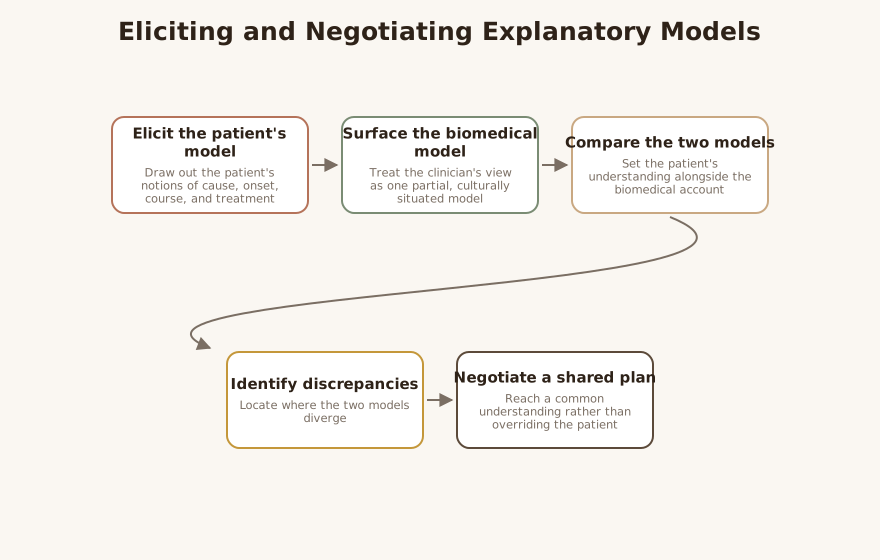
A third principle is that explanatory models are episode-specific and often partly tacit, fragmentary, or even contradictory, rather than coherent theories the patient can recite on demand 4. They are elicited, not simply asked for, and they may shift over the course of an illness 4. A fourth principle is that the clinical task is comparison and negotiation: the clinician’s job is to elicit the patient’s model, compare it with the biomedical model, identify discrepancies, and negotiate a shared understanding and plan rather than overriding the patient’s view 1. A fifth principle is that this work is the core of culturally responsive care; attending to explanatory models is how a clinician avoids imposing assumptions and instead grounds the encounter in the patient’s own framework of meaning 3.
Interventions & Techniques
The signature technique is the structured elicitation of the patient’s explanatory model through Kleinman’s eight questions, a brief, memorable set of open prompts that can be folded into an intake or a follow-up visit 2. The questions ask: what do you call your problem and what name do you give it; what do you think has caused it; why do you think it started when it did; what do you think the sickness does and how does it work; how severe is it and will it have a short or long course; what kind of treatment do you think you should receive and what are the most important results you hope to get; what are the chief problems the sickness has caused; and what do you fear most about it 2. Each prompt maps onto one of the dimensions of an explanatory model — labeling, etiology, timing of onset, pathophysiology, course and severity, and desired treatment and outcomes 1.
In practice the elicitation is followed by three further moves: presenting the clinician’s own explanatory model in accessible language, openly comparing the two models to locate points of convergence and conflict, and negotiating a plan that the patient can accept as consistent with their understanding of the problem 1. Where the gap is wide, the negotiation may involve explaining the biomedical rationale, acknowledging the validity of the patient’s concerns, and finding a treatment that honors both frameworks where possible 1. The questions are framed to elicit a narrative, not to fill out a checklist, and clinicians are encouraged to ask them with genuine curiosity and to follow the patient’s lead 3.
LLM-generated illustrative example (not a guideline): A clinician treating a recently arrived immigrant for panic attacks asks Kleinman’s questions and learns the client calls the problem “attack of nerves,” attributes it to a frightening event and to “blood rising,” fears it signals a stroke, and expects rest and family support rather than medication. The clinician can now address the stroke fear directly, link the bodily account to anxiety physiology in the client’s own terms, and negotiate a plan that includes both the family support the client values and a graded exposure approach. LLM
Evidence Base
The maturity of the explanatory-models framework is best described as established as a foundational and widely adopted conceptual and assessment tool, not as an empirically validated treatment with its own outcome trials LLM. Its standing rests on the durability and reach of the original 1978 Annals of Internal Medicine paper, the influence of The Illness Narratives, and the incorporation of the eight questions into mainstream cultural-competence training and clinical-organization resources 1 5 2. A review in BJPsych Advances makes the case that assessing explanatory models and health beliefs is an essential but commonly overlooked clinical competency, arguing for its routine use precisely because it is so often neglected 6.
Clinicians should be candid that the framework’s value is conceptual and process-oriented rather than demonstrated through randomized comparisons of patients assessed with versus without it LLM. The plausible mechanisms — improved alliance, more accurate understanding of nonadherence, reduced cultural misunderstanding, and treatment plans that fit the patient’s goals — are well argued in the literature and consistent with broader engagement research, but the construct is offered as a way of practicing rather than as a manualized intervention with an effect size 6. Its longevity across four decades, its adoption by health departments and cultural-competence bodies, and its repeated endorsement in clinical-education sources are reasonable indicators of professional acceptance 2 4.
Populations & Indications
The framework is indicated most clearly with culturally and ethnically diverse patients, where the distance between the patient’s and clinician’s frameworks of meaning is likely to be greatest 1. It is particularly valuable with immigrants and refugees, whose understandings of cause, illness labeling, and appropriate treatment may differ substantially from the host country’s biomedical norms and whose idioms of distress may not map neatly onto standard diagnoses 3. It is also well suited to cross-cultural clinical populations generally, where unexamined assumptions on either side can quietly derail care 4.
Beyond cross-cultural settings, the construct is broadly useful with people living with chronic illness, where the patient’s evolving model of their condition’s course and meaning powerfully shapes coping and adherence over time 5. It is relevant with patients who have serious mental illness, where explanatory models bear directly on insight, stigma, and willingness to accept treatment, and with families of patients, whose own explanatory models may support or undermine the plan 1. In truth, eliciting an explanatory model is appropriate with any patient, because every clinical encounter involves a meeting of meanings; the framework simply makes that meeting explicit 1.
Problems-for-Work
The framework directly targets treatment nonadherence, reframing it not as patient willfulness but as a frequently predictable consequence of an unspoken mismatch between the patient’s explanatory model and the prescribed plan 1. Eliciting the model surfaces the mismatch so it can be negotiated rather than discovered after the fact 6.
LLM-generated illustrative example (not a guideline): A client repeatedly stops an SSRI; eliciting the explanatory model reveals they believe their depression is caused by a moral or spiritual failing that pills cannot reach, so the clinician renegotiates the plan to pair medication with a values-based and meaning-focused intervention the client finds credible. LLM
The construct is well suited to therapeutic misalliance and engagement problems, because openly comparing models communicates respect and reduces the sense of being unheard that drives early dropout 3. It supports work on cultural mistrust by inviting the patient’s framework into the room as legitimate clinical material rather than something to be corrected 4. It is useful in conceptualizing somatic symptom presentations and illness-related distress, where the patient’s beliefs about what their bodily symptoms mean are often the heart of the problem 5. By clarifying how a patient understands and labels their condition, it also addresses diagnostic misunderstanding and lowers help-seeking barriers, and it gives a clinician a concrete way to engage stigma around mental illness by working with, rather than against, the patient’s prior beliefs 6.
Contraindications, Cautions & Cultural Humility
There are no clinical contraindications to eliciting an explanatory model, but there are real cautions in how it is used LLM. The chief risk is that the eight questions become a mechanical checklist administered without genuine curiosity, which can feel interrogative and undermine the very rapport the technique is meant to build 3. The questions are an entry into a conversation, not a form to complete, and they should be adapted to the patient and the moment 3.
A second caution is reductionism by ethnicity: an explanatory model is the property of an individual in a specific illness episode, not a fixed attribute that can be read off a person’s culture or country of origin 4. Assuming a patient’s beliefs from their background substitutes a stereotype for an inquiry and inverts the framework’s purpose 4. A third caution is that the clinician must remember their own biomedical model is also a culturally situated explanatory model, so the encounter is a negotiation between two frameworks rather than the correction of the patient’s error 1. Practiced in this spirit, the framework is an expression of cultural humility — an ongoing, patient-led inquiry rather than a competency a clinician can declare complete 6. Negotiation, finally, does not mean endorsing harmful beliefs uncritically; it means understanding them well enough to find a plan that is both safe and acceptable to the patient 1.
Treatment-Plan Suggestions & SMART Objectives
| Goal | SMART objective (example) | Mechanism |
|---|---|---|
| Surface the patient’s understanding of the problem | Within the first 2 sessions, complete an eight-question explanatory-model elicitation and document the patient’s labeling, attributed cause, and feared outcome | Structured elicitation makes the lived illness experience visible alongside the diagnosis 2 |
| Improve treatment adherence | Over 4 weeks, identify the 1-2 points where the patient’s model conflicts with the treatment plan and renegotiate the plan, with adherence self-rated weekly | Resolving the model mismatch removes a common predictable driver of nonadherence 1 |
| Strengthen engagement and reduce early dropout | By session 3, explicitly compare clinician and patient explanatory models aloud, with patient-rated alliance maintained or improved on a brief measure | Openly honoring the patient’s framework communicates respect and reduces feeling unheard 3 |
| Address a feared meaning of symptoms | Within 4 sessions, identify the patient’s chief fear about the illness and provide tailored psychoeducation in the patient’s own terms, with fear ratings tracked | Targeting the specific feared meaning, not a generic explanation, reduces illness-related distress 2 |
| Reduce cultural mistrust | Over 6 weeks, elicit and validate the patient’s culturally grounded model before introducing the biomedical account, with trust rated session by session | Inviting the patient’s framework in as legitimate material counters mistrust 4 |
| Bridge a somatic explanatory model | Within 8 weeks, collaboratively link the patient’s bodily account of symptoms to an agreed psychophysiological formulation both parties accept | Connecting the patient’s somatic model to physiology in their terms reduces diagnostic conflict 5 |
| Negotiate a shared, acceptable plan | By session 4, produce a written plan that names at least 1 element drawn from the patient’s model and 1 from the clinician’s, with patient agreement documented | Explicit two-model negotiation yields a plan the patient can accept and follow 1 |
Common Misconceptions
One misconception is that an explanatory model is the patient’s mistaken version of the real medical facts; in Kleinman’s framework it is a legitimate and clinically essential account of the patient’s lived illness, not a flawed copy of the clinician’s disease model 5. A second is that only patients have explanatory models, when the clinician’s biomedical view is itself a culturally shaped explanatory model that must enter the negotiation 1.
A third misconception is that a patient’s explanatory model can be predicted from their ethnicity or country of origin; the model is individual and episode-specific and must be elicited, not assumed 4. A fourth is that eliciting the model means simply agreeing with whatever the patient believes; the aim is comparison and negotiation toward a plan that is acceptable and safe, not uncritical endorsement 1. A fifth is that the eight questions are a rigid script; they are flexible prompts meant to open a narrative conversation 3.
Training & Certification
There is no formal certification in explanatory models; the construct is taught as part of medical, psychiatric, and cross-cultural clinical education rather than credentialed separately LLM. The foundational learning resources are the original 1978 Annals of Internal Medicine paper and Kleinman’s book The Illness Narratives, which together provide the authoritative account of the disease/illness distinction and the elicitation method 1 5.
For applied skill-building, the U.S. Office of Minority Health’s Think Cultural Health initiative publishes Kleinman’s eight questions as a ready clinical reference, and cultural-competence resources such as Culturally Connected and the Centre for Culture, Equity & Health offer practitioner-oriented explanations and worked guidance on using the model in practice 2 3 4. The BJPsych Advances review provides a current clinical argument for treating explanatory-model assessment as a core competency and can orient supervisors integrating it into training 6.
Key Terms
Explanatory model: The notions a patient, family, or clinician holds about a specific illness episode — its cause, onset, pathophysiology, course, and appropriate treatment 1.
Illness: The patient’s lived experience of symptoms, suffering, and disability and the meanings attached to them, as distinct from disease 5.
Disease: The practitioner’s reformulation of the problem in terms of biomedical pathology 5.
Kleinman’s eight questions: A brief set of open prompts used to elicit a patient’s explanatory model across labeling, cause, onset, mechanism, course, treatment, and fears 2.
Negotiation: The clinical process of comparing the patient’s and clinician’s explanatory models and arriving at a shared, acceptable plan 1.
Resources & Further Reading
▶ Watch — a video introduction to this concept:
- Kleinman, Eisenberg & Good (1978). Culture, Illness, and Care: Clinical Lessons From Anthropologic and Cross-Cultural Research
- Arthur Kleinman’s Eight Questions — Think Cultural Health (HHS Office of Minority Health)
- Kleinman’s Explanatory Model — Culturally Connected
- The Arthur Kleinman Explanatory Model — Centre for Culture, Equity & Health
- The Illness Narratives: Suffering, Healing, and the Human Condition (Kleinman, 1988) — Basic Books
- Assessing explanatory models and health beliefs: an essential but overlooked competency for clinicians — BJPsych Advances
Reflective / Supervision Questions
- When a patient is “nonadherent,” do I first check whether the treatment plan conflicts with their explanatory model, or do I default to attributing it to motivation? LLM
- Can I articulate my own biomedical explanatory model for this case as one framework among others, rather than as the neutral truth? LLM
- Am I eliciting the eight questions with genuine curiosity, or administering them as a checklist that could feel like an interrogation? LLM
- Where have I assumed a patient’s beliefs from their culture or origin rather than asking them directly? LLM
- When the patient’s and my models conflict, do I move to override, or do I negotiate toward a plan we can both accept? LLM
- How do I document a patient’s explanatory model so that it actively shapes the treatment plan rather than sitting inert in the chart? LLM