
Type & Discipline
Culture-bound syndromes (CBS) are a descriptive construct rather than a treatment modality, drawn from the overlapping fields of cultural psychiatry and medical anthropology 4. The term names locally specific clusters of symptoms, behaviors, and troubling experiences that are recognized as a coherent illness within a particular culture but that may not map cleanly onto standard psychiatric categories 5. Classic examples include susto, ataque de nervios, amok, koro, dhat, taijin kyofusho, and hikikomori 4. Clinically, the construct functions as an assessment lens: it directs the therapist to ask how a given community names, explains, and experiences suffering rather than assuming that distress everywhere takes the shape described in a Western nosology 1. It is important to be clear from the outset that “culture-bound syndrome” is now a historical label, largely retired in DSM-5 in favor of the broader framework of Cultural Concepts of Distress 6.
Creators & Lineage
The idea that some forms of illness are tied to specific cultural contexts has deep roots in comparative psychiatry and ethnography, with no single founder 4. The construct gained formal psychiatric standing when DSM-IV-TR introduced a “Glossary of Culture-Bound Syndromes” listing roughly 25 named conditions in an appendix 6. Critics, including the architects of the DSM-5 revision, argued that segregating these syndromes into an appendix made them look like “highly localized and confined” curiosities, a “cabinet of curiosities” set apart from “real” disorders 6. The intellectual lineage that reshaped the field runs through medical anthropology and the work of clinicians such as Arthur Kleinman on explanatory models, and was carried into DSM-5 by figures including Roberto Lewis-Fernández and Devon Hinton 6. Their work moved the field from a static list toward three dynamic Cultural Concepts of Distress and an operational tool, the Cultural Formulation Interview 6. This lineage—from culture-bound syndromes to cultural concepts of distress, the Cultural Formulation Interview, and the broader projects of cultural psychiatry and medical anthropology—is the context in which a contemporary clinician should read the term 1.
Core Principles
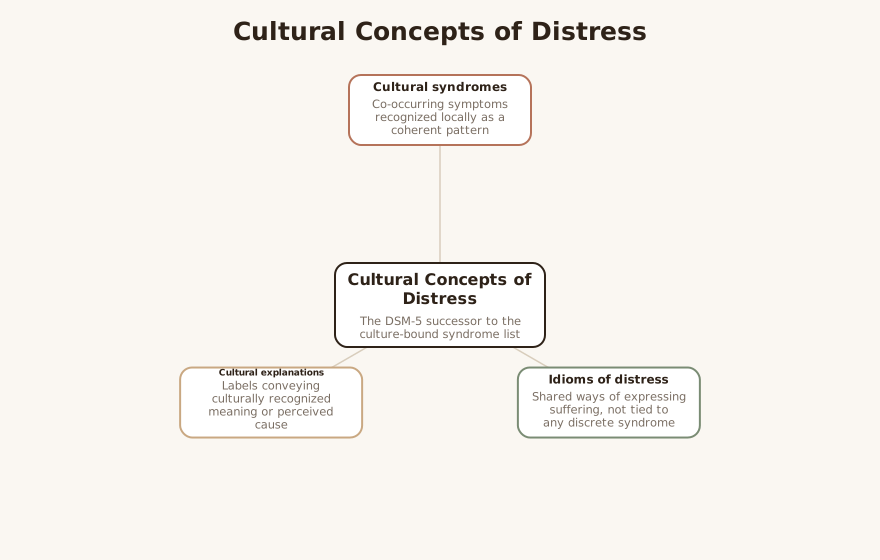
The first principle is that culture molds which thoughts, emotions, and behaviors rise to the level of a “symptom,” and shapes how people interpret and report them 1. The second is that culture influences the types and pathways of help-seeking, including whether a person presents to a clinician, a faith healer, a family elder, or no one at all 1. A third principle distinguishes three related but separable concepts that replaced the older CBS list: cultural syndromes, cultural idioms of distress, and cultural explanations or perceived causes 2. A cultural syndrome is a cluster of symptoms and attributions that tend to co-occur among members of a specific group and is recognized locally as a coherent pattern 6. A cultural idiom of distress is a shared way of expressing or talking about suffering that need not correspond to any discrete syndrome 6. A cultural explanation is a label or feature of an explanatory model that conveys culturally recognized meaning or etiology for the distress 6. In practice these three overlap, but separating them helps the clinician see how a patient is actually deploying cultural concepts in the room 1.
Interventions & Techniques
The “intervention” attached to this construct is structured cultural assessment rather than a discrete technique 1. The principal tool is the Cultural Formulation Interview (CFI), a semi-structured, person-centered interview of 16 questions covering the cultural definition of the problem, perceptions of cause and context, supports and coping, and current help-seeking 1. The CFI is explicitly not reserved for racial or ethnic minorities; it is designed for any clinician–patient encounter, on the premise that culture operates in every interaction 1. There are two versions—one administered to the patient and an informant version for a family member—plus supplementary modules addressing specific populations such as children, immigrants, older adults, and caregivers 6. The technique in everyday terms is to elicit the patient’s own explanatory model: what they call the problem, what they believe caused it, who they have told, and what they expect treatment to do 1. Once that model is on the table, evidence-based modalities are adapted to it rather than imposed over it 2.
LLM-generated illustrative example (not a guideline): A clinician seeing a Salvadoran client who reports being “asustada” after witnessing a car accident uses the Cultural Formulation Interview to map the client’s understanding of susto—soul fright—before introducing trauma-focused work, framing grounding skills in language the client already uses for “calling the spirit back.” LLM
Evidence Base
The evidence base here is best described as historical and descriptive rather than a body of randomized trials of “CBS treatment” 5. Much of the literature consists of ethnographic case series and phenomenological description of named syndromes across regions 4. The strongest empirical signal concerns diagnostic accuracy: in one frequently cited body of work using cultural formulation methods, among 70 cases referred with a psychotic-disorder diagnosis, 49% were rediagnosed as nonpsychotic, while 5% of 253 nonpsychotic referrals were rediagnosed as psychotic 1. That finding demonstrates that attending to culture has a measurable impact on diagnosis and on the risk of misdiagnosis 1. A literature review of cultural concepts of distress and psychiatric disorders supports the broader claim that these concepts correlate meaningfully with recognized conditions while not being reducible to them 2. What the field does not yet have is robust outcome evidence that any specific culturally adapted protocol outperforms standard care for these presentations, so the construct is best treated as an assessment and engagement framework with strong face validity rather than an established treatment with a mature efficacy literature 3.
Populations & Indications
The construct is most directly relevant to immigrants, refugees and asylum seekers, international populations, and racial, ethnic, religious, and cultural minorities, as well as bicultural individuals navigating two explanatory worlds at once 1. It is indicated whenever the clinician suspects that a patient’s presentation is being filtered through an unfamiliar idiom of distress, or whenever standard screening seems to fit poorly 2. Refugees and asylum seekers are a particularly high-yield group because trauma, displacement, and somatic presentation frequently co-occur and can be mislabeled 5. Bicultural clients may present a syndrome in one frame to family and in another frame to the clinician, and the informant version of the CFI can help reconcile these accounts 6. The framework is also indicated, more subtly, with majority-culture patients, since DSM-5 treats culture as universal rather than as something only minorities possess 1.
Problems-for-Work
Several presenting problems map onto this construct in practice 2. Idioms of distress are the clearest case: a patient who describes “nerves” or a syndrome rather than a checklist of symptoms is using a culturally shared vocabulary that the clinician must translate before treating 6. Somatic symptom disorder is another, since many cultural syndromes—dhat, brain fag—foreground bodily complaints as the primary language of suffering 4. Anxiety and panic disorder frequently underlie syndromes such as taijin kyofusho or the acute episodes of ataque de nervios 4. Dissociation and acute stress reaction appear in fright-based syndromes like susto and in the agitation of conditions historically labeled amok or piblokto 4. Depression can be masked when low mood is expressed somatically or as a culturally named affliction rather than as sadness 1. Misdiagnosis and help-seeking barriers are themselves the problems-for-work most amenable to this lens: the framework exists precisely to reduce diagnostic error and to lower the threshold for engagement when a patient’s model of illness differs from the clinician’s 1.
Contraindications, Cautions & Cultural Humility
There is no contraindication to assessing culture, but there are real cautions in how the construct is used 3. The chief danger is reification—treating a syndrome as a fixed, exotic entity belonging to “those people,” which is exactly the “cabinet of curiosities” framing DSM-5 sought to dismantle 6. A second caution is ethnocentrism in reverse: anthropologists have long noted that conditions familiar to Western clinicians, such as premenstrual dysphoria or anorexia nervosa, are themselves culturally shaped, so culture-bound thinking should not be applied only to the unfamiliar 4. A third tension is the standing disagreement between relativist and universalist readings: anthropologists tend to emphasize local meaning while physicians emphasize shared neuropsychological substrate, and good practice holds both 5. Cultural humility means treating the patient, not a culture group, as the expert on their own experience, and using tools like the CFI to ask rather than to assume 1. The clinician should also guard against stereotyping by group membership, since within-group variation is large and a named syndrome may not apply to a given individual at all 2.
Treatment-Plan Suggestions & SMART Objectives
| Goal | SMART objective (example) | Mechanism |
|---|---|---|
| Elicit the client’s explanatory model | Within 2 sessions, complete the core Cultural Formulation Interview and document the client’s name, perceived cause, and expectations for the problem | Person-centered cultural assessment 1 |
| Reduce risk of misdiagnosis | Within 3 sessions, reconcile the presenting idiom of distress with a DSM-5 diagnosis (or revise), documenting the rationale | Cultural reformulation reduces over/under-diagnosis 1 |
| Translate somatic complaints | Over 4 weeks, help the client link 3 recurring bodily complaints to an emotional or situational trigger | Bridges somatic idiom and affect 4 |
| Lower help-seeking barriers | Within 30 days, identify and engage 1 culturally trusted support (family, faith, community) into the plan with consent | Aligns care with existing help-seeking pathway 1 |
| Adapt an evidence-based modality | Within 4 sessions, deliver one core skill using the client’s own illness vocabulary | Cultural adaptation improves engagement 2 |
| Address anxiety/panic presentation | Over 6 weeks, reduce frequency of acute episodes by 50% via interoceptive and grounding skills framed in the client’s idiom | Symptom-targeted skills within cultural frame 4 |
| Strengthen therapeutic alliance | By session 4, client rates feeling “understood about my background” ≥4/5 | Explanatory-model match builds alliance 3 |
Common Misconceptions
A first misconception is that culture-bound syndromes are still a current DSM category; in fact DSM-5 dropped the term in 2013 in favor of Cultural Concepts of Distress 4. A second is that these syndromes are simply “folk” mislabels for “real” Western disorders; the literature shows they overlap with recognized conditions but are not fully reducible to them 2. A third is that the framework only matters for minority or immigrant patients, when DSM-5 explicitly frames culture as relevant to every clinical encounter 1. A fourth is that a named syndrome describes a fixed, homogeneous group, ignoring the large within-group variation that makes individual assessment essential 2. A fifth is that using the CFI is a lengthy specialist procedure; the core interview is a focused 16-item conversation that fits within an intake 1.
Training & Certification
There is no certification in “culture-bound syndromes” as such, and none is needed, because the relevant skill is competence in cultural formulation 1. Practical training centers on learning to administer the Cultural Formulation Interview and its supplementary modules, materials that are published with DSM-5 and used in graduate and residency curricula 6. Broader competence is built through coursework or continuing education in cultural psychiatry and medical anthropology, and through supervised practice with diverse populations 4. For most clinicians, the realistic training path is reading the DSM-5 cultural formulation materials, practicing the CFI under supervision, and consulting cultural brokers or interpreters when working across a significant language or worldview gap 1.
Key Terms
- Cultural syndrome — a locally recognized cluster of co-occurring symptoms and attributions 6.
- Idiom of distress — a shared cultural way of expressing or talking about suffering, not necessarily tied to a syndrome 6.
- Cultural explanation / perceived cause — a culturally recognized account of the meaning or etiology of distress 6.
- Explanatory model — the patient’s own understanding of what the problem is, what caused it, and what should help 1.
- Cultural Formulation Interview (CFI) — the 16-question, person-centered DSM-5 tool for cultural assessment 1.
- Cultural Concepts of Distress — the DSM-5 framework that replaced the culture-bound syndrome glossary 4.
Resources & Further Reading
▶ Watch — a video introduction to this concept:
- Culture and Psychiatric Diagnosis (PMC / NIH)
- Cultural concepts of distress and psychiatric disorders: literature review (PubMed)
- Culture-bound syndromes, idioms of distress, and cultural concepts of distress (PubMed)
- Culture-bound syndrome (Wikipedia)
- Culture-Bound Syndrome — an overview (ScienceDirect Topics)
- DSM-5 on Culture: A Significant Advance (FPR)
- Culture-Bound Syndromes (DOI)
Reflective / Supervision Questions
- When a client describes their suffering in an unfamiliar idiom, do I reach for translation into a DSM category first, or do I first elicit their own explanatory model? LLM
- Where might my own cultural assumptions be functioning as the invisible “default” against which I am reading this client’s presentation? LLM
- Am I at risk of reifying a named syndrome and treating this individual as a representative of a group rather than as a person? LLM
- How would my formulation change if I administered the Cultural Formulation Interview to a family informant as well as to the client? LLM
- For this case, what concrete help-seeking barrier could I lower this week by aligning the plan with a support the client already trusts? LLM