
Type & Discipline
Sandplay is a nonverbal, nondirective psychotherapeutic modality rooted in analytical (Jungian) psychology and in the anthropology of symbol 3. The client builds three-dimensional scenes in a standardized sand tray using water, the sand itself, and a large collection of miniature figures, and the resulting images are understood as expressions of the psyche 4. It belongs to the family of symbol-based and expressive therapies and is closely allied with play therapy and the expressive arts, sharing their reliance on image rather than narrative as the primary vehicle of change 6.
What distinguishes Sandplay from generic “sand tray” work is its specifically Jungian framing: the tray is conceived not merely as a projective or diagnostic surface but as a container in which the psyche’s innate movement toward wholeness can unfold 5. The discipline therefore sits at the intersection of depth psychology and a symbolic, almost ritual, understanding of healing in which meaning is enacted before it is spoken 3. LLM In practice this means the clinician treats the sand picture as a living symbolic statement rather than a puzzle to be solved or a checklist of “what the figures mean.”
Creators & Lineage
The modality has two principal lineages. The first is the British pediatrician Margaret Lowenfeld, who in the 1920s and 1930s developed the “World Technique,” giving children a tray, sand, water, and miniatures so they could build “worlds” that communicated their inner experience directly, without dependence on language 1. The second and defining lineage is Dora Kalff, a Swiss Jungian analyst who studied Lowenfeld’s method and, with the encouragement of C.G. Jung and in dialogue with Jungian theory, transformed it into the depth-psychological method now called Sandplay 1.
Kalff’s central contribution was theoretical and relational rather than merely technical: she reframed the work around Jung’s concept of the self-healing psyche and around the idea of the “free and protected space” provided by the therapist’s accepting presence 3. Her foundational text, Sandplay: A Psychotherapeutic Approach to the Psyche, remains the canonical articulation of the method 3. Kalff trained clinicians internationally, and the tradition of “working with Dora Kalff” — direct apprenticeship and the transmission of an attitude rather than a manualized protocol — is still invoked as a touchstone of authentic practice 7.
This lineage was institutionalized through the founding of the International Society for Sandplay Therapy (ISST), which Kalff helped establish to set training standards and preserve the method’s integrity across countries 1. National societies such as Sandplay Therapists of America (STA) and the British and Irish Sandplay Society carry that lineage forward today 25.
Core Principles
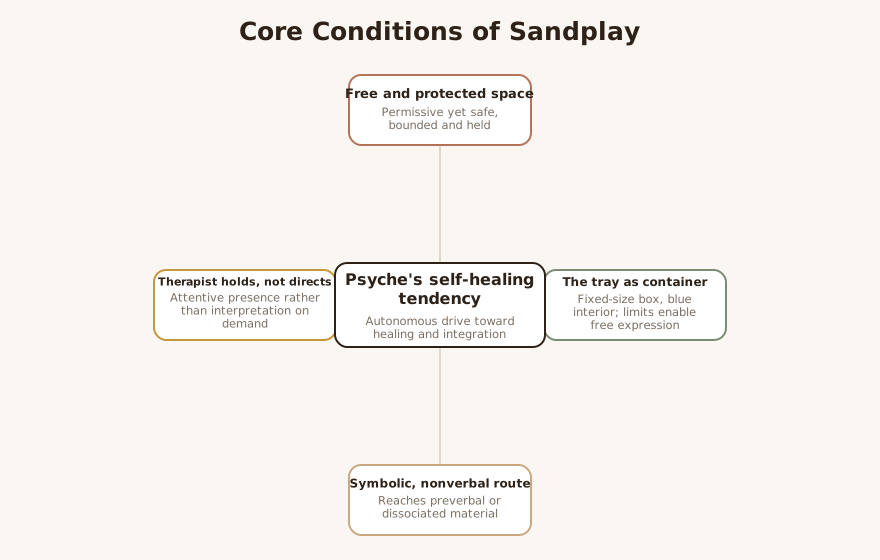
The organizing principle is Jung’s notion that the psyche possesses an autonomous tendency toward healing and integration, and that, given the right conditions, this tendency will express and regulate itself through symbolic images 5. The therapist’s task is not to direct or interpret on demand but to create and hold the conditions under which this process can occur 3.
The most important of these conditions is Kalff’s “free and protected space”: an environment that is simultaneously permissive (the client may build anything, with no right or wrong) and safe (bounded, reliable, and held by the analyst’s attentive, non-judgmental presence) 3. The physical tray — a fixed-size box with blue-painted interior representing water and sky — is itself a symbol of containment, and its limits are part of what makes free expression psychologically safe 4.
A second principle is the primacy of the nonverbal and the symbolic. Because images can carry material that is preverbal, dissociated, or not yet available to conscious narration, Sandplay can reach experiences that talk therapy cannot easily access 6. LLM This is one reason the method is so often applied to early developmental trauma and to clients who cannot yet put feeling into words.
A third principle is restraint in interpretation. Kalff’s tradition generally holds that premature or intrusive interpretation can interrupt the symbolic process; meaning is allowed to mature, often across a series of trays, and is frequently left largely unspoken during the active phase of the work 5. The healing is understood to occur in the making and witnessing of the image, not primarily in its verbal decoding 3.
Interventions & Techniques
The core “intervention” is deceptively simple. The clinician offers a sand tray (typically two, one dry and one with water available), a collection of miniatures spanning many categories — people, animals, buildings, vehicles, vegetation, religious and mythic figures, threatening figures, and bridges or other connectors — and an invitation to build 4. The client selects figures and arranges them in the sand, may rearrange, bury, flood, or destroy elements, and the therapist watches with quiet, full attention 6.
Technique in Sandplay is largely a discipline of the therapist’s stance rather than a set of active maneuvers 3:
- Holding the free and protected space. The clinician maintains an accepting, non-intrusive presence so the client feels free to create without performance pressure or fear of judgment 3.
- Witnessing rather than directing. The therapist generally does not instruct the client what to build and avoids leading questions during construction 5.
- Restrained, deferred verbal processing. Reflection on a tray, when it occurs, is offered gently and often well after the image is complete; much meaning is left to ripen across sessions 5.
- Tracking the series. Because change is understood to unfold over a sequence of trays, the clinician attends to recurring motifs, movement from chaos toward order, and the emergence of centering or “self” symbols across the whole course of work 3.
- Documentation. Practitioners commonly photograph each completed tray to follow the symbolic process over time without disturbing it in the moment 6.
LLM-generated illustrative example (not a guideline): A school-age child who cannot describe what frightens her at home repeatedly buries a small figure under sand, then places a fence and a single protective animal nearby. Over several weeks the buried figure is uncovered, the fence opens, and a bridge appears connecting two sides of the tray. The therapist does not narrate or interpret this in the moment; she witnesses, photographs, and lets the sequence speak LLM.
Evidence Base
Sandplay is an established clinical tradition with a long international history of practice, formal training societies, and a substantial body of case literature and theory 12. Its standing rests heavily on decades of clinical observation, depth-psychological theory, and the institutional infrastructure built by ISST and its national affiliates rather than on a large corpus of randomized controlled trials 15.
Honesty about maturity is warranted: “established as a practice” is not the same as “established by controlled outcome research.” LLM The method’s nondirective, symbolic, and individualized nature makes it inherently difficult to manualize and to study with standard efficacy designs, and clinicians should not represent it as a first-line, evidence-graded treatment on par with, for example, trauma-focused CBT. The strongest defensible claims are that Sandplay is a recognized, widely taught modality with a coherent theoretical rationale and accumulated clinical experience, particularly for nonverbal and developmentally early material 46. Practitioners describing the modality to clients, payers, or referrers should frame it in these terms rather than overstating empirical support LLM.
Populations & Indications
Sandplay is applied across the lifespan but is especially associated with children and adolescents, for whom symbolic play is a natural language and who often cannot or will not narrate their distress directly 6. It is widely used with trauma survivors, including those with PTSD and with developmental or attachment-related trauma, where the nonverbal route can reach material laid down before language 46.
The method is also used with adults in depth psychotherapy who are working toward individuation and integration, where the tray becomes a vehicle for active engagement with unconscious material in the lineage of Jungian work 5. Grieving individuals, anxious and depressed clients, and people who struggle to put feeling into words (alexithymia) are also among those for whom the symbolic, image-first approach is indicated 6. LLM Across all of these, the common indication is the same: a need or capacity for symbolic expression that exceeds, precedes, or bypasses verbal processing.
Problems-for-Work
- Posttraumatic stress disorder (PTSD) and developmental trauma. The nonverbal channel allows traumatic and preverbal material to be expressed and externalized in the tray without forcing premature verbal recall 6. LLM Application: a survivor of early relational trauma repeatedly stages and re-stages a threatening scene, gradually introducing protective and ordering figures across a series of trays.
- Childhood emotional and behavioral problems. Children communicate conflict, fear, and family dynamics through play that they cannot articulate, giving the clinician access to inner experience and a medium for change 6.
- Grief. The tray offers a contained space to depict loss, separation, and continuing bonds symbolically 6. LLM Application: a bereaved client builds a scene placing the deceased across a river, then later adds a bridge, marking a shift in the relationship to the loss.
- Anxiety and depression. Externalizing internal states into a bounded, manageable scene can lend distance and a sense of agency over overwhelming affect 6. LLM
- Attachment disturbance. Recurrent relational configurations — closeness, distance, protection, abandonment — often appear and rework themselves across trays within the safety of the therapeutic relationship 5. LLM
- Dissociation. Symbolic externalization can allow split-off or fragmented material to be represented and, over time, integrated in the tray 4. LLM
- Difficulty verbalizing emotion (alexithymia). When words are unavailable, image-making provides a direct expressive route to inner states 6. LLM
Contraindications, Cautions & Cultural Humility
Sandplay is a depth method, and its main cautions follow from that depth LLM. Because the work can mobilize unconscious and traumatic material rapidly and nonverbally, it should be undertaken only by clinicians with adequate training and, ideally, the consultation/supervision structure the societies emphasize, so that what surfaces can be safely held 15. With acutely destabilized, floridly psychotic, or severely dissociative clients, the activation of powerful symbolic material without sufficient stabilization could be overwhelming, and pacing, containment, and clinical judgment are essential LLM.
Restraint in interpretation is itself a safeguard: imposing the therapist’s meaning onto a client’s tray, or “reading” figures from a fixed symbolic dictionary, risks both clinical error and a breach of the free and protected space 5. Symbols are personal and contextual, and their meaning belongs to the client’s process, not to a universal key 3. LLM
Cultural humility is especially salient because miniatures carry cultural, religious, and mythic content. LLM A figure that is sacred or fraught in one tradition may be neutral in another; clinicians should curate collections thoughtfully, remain alert to their own projections, and let the client define meaning rather than assuming a culturally specific reading. Informed consent should make clear what the method does and does not claim, and clinicians should avoid presenting Sandplay as an evidence-graded, stand-alone treatment for serious disorders when more strongly supported interventions are indicated LLM.
Treatment-Plan Suggestions & SMART Objectives
| Goal | SMART objective (example) | Mechanism |
|---|---|---|
| Increase nonverbal expression of distress (child) | Over 8 weekly sessions, the child will independently construct a sand scene in at least 6 sessions, externalizing inner experience without prompting | Symbolic play provides a developmentally natural channel for material the child cannot verbalize 6 |
| Reduce trauma-related avoidance | Within 12 sessions, the client will represent and re-stage a distressing theme in the tray across at least 3 sessions, tolerating the associated affect within session | Nonverbal externalization allows preverbal/traumatic material to be approached without forced verbal recall 6 |
| Improve affect tolerance / regulation | Over 10 sessions, the client will report or demonstrate increased capacity to remain present while depicting overwhelming feelings in 4+ trays | Containment within the bounded tray and the “free and protected space” supports affect tolerance 3 |
| Process grief and reorganize the bond with a lost person | Within 8 sessions, the client will create at least 2 trays depicting the loss and one depicting a changed/continuing relationship to it | Symbolic depiction supports mourning and the reworking of continuing bonds 6 |
| Strengthen sense of agency over internal states | Over 8 weeks, the client will externalize an anxiety- or depression-related state into the tray in 5+ sessions, reporting reduced sense of being controlled by it | Externalization creates distance and a sense of mastery over affect 6 |
| Support integration / movement toward wholeness (adult depth work) | Across the course of treatment, the client will produce a tray series showing movement from disorganization toward centering/ordering motifs | The psyche’s self-healing tendency expresses and reorganizes itself through the symbolic series 5 |
| Build a secure therapeutic relationship | Within 6 sessions, the client will engage in tray-building while the clinician maintains a non-intrusive witnessing stance, evidenced by increasing spontaneity | The accepting, protected relational space fosters safety and attachment repair 3 |
Common Misconceptions
- “Sandplay is the same as any sand tray exercise.” The Jungian Sandplay tradition is a specific depth method built on the self-healing psyche and the free and protected space, distinct from generic projective sand-tray techniques 53. LLM
- “The figures have fixed meanings the therapist decodes.” Meaning is personal, contextual, and emergent; reading figures from a universal symbol dictionary is contrary to the method 5. LLM
- “It’s just for children.” While especially natural for children, Sandplay is practiced with adolescents and adults in depth psychotherapy, including individuation work 56. LLM
- “The therapist should interpret each tray as it’s built.” The tradition emphasizes restraint and deferred meaning; healing is located in the making and witnessing of the image, often across a series 35. LLM
- “It is an empirically validated, first-line treatment.” It is an established practice tradition with limited controlled-trial support and should not be overstated as evidence-graded therapy 1. LLM
Training & Certification
Sandplay is a credentialed depth method with formal, society-based training pathways rather than a technique one can simply add after a weekend workshop 1. The International Society for Sandplay Therapy (ISST) was founded in Kalff’s lineage to set and maintain training standards internationally 1. National member societies — including Sandplay Therapists of America (STA) and the British and Irish Sandplay Society — administer training, consultation, and certification within that framework 25.
Training in this tradition characteristically combines didactic study of theory, personal process work (often including the trainee’s own Sandplay), and extensive supervised/consulted casework, reflecting the transmission of an attitude that traces back to direct work with Dora Kalff 72. Clinicians interested in practicing Sandplay (as opposed to general sand-tray methods) should pursue training through a recognized society to ensure competence and adherence to the method’s safeguards 12.
Key Terms
- Free and protected space: Kalff’s term for the simultaneously permissive and safe environment — bounded tray plus the therapist’s accepting presence — that allows the psyche to express itself freely 3.
- Self-healing tendency of the psyche: The Jungian premise that, given the right conditions, the psyche moves autonomously toward integration and wholeness 5.
- The tray: The standardized, blue-lined sand box whose fixed dimensions and water/sky symbolism serve as a container for the symbolic scene 4.
- Miniatures / figures: The curated collection of small objects (people, animals, structures, mythic and threatening figures, bridges, etc.) used to build the scene 4.
- The World Technique: Margaret Lowenfeld’s precursor method in which children built “worlds” in sand, later developed by Kalff into Sandplay 1.
- Series: The sequence of trays over a course of treatment, through which symbolic change and movement toward centering is tracked 3.
- Witnessing: The therapist’s attentive, non-intrusive, largely non-interpretive presence during construction 5.
Resources & Further Reading
▶ Watch — a video introduction to this concept:
- International Society for Sandplay Therapy (ISST) — History
- Sandplay Therapists of America (STA)
- Sandplay: A Psychotherapeutic Approach to the Psyche — Dora Kalff (foundational text)
- Introduction to Sandplay Therapy (STA, Journal of Sandplay Therapy)
- Jungian Sandplay (British and Irish Sandplay Society)
- Sand Tray / Sandplay Therapy: Benefits, Techniques & How It Works (GoodTherapy)
- Working with Dora Kalff (Sandplay Therapists of America)
Reflective / Supervision Questions
- When witnessing a client’s tray, how do I distinguish genuine attunement from the urge to interpret or “make sense” of the image for my own comfort? LLM
- What is my own relationship to the free and protected space — can I tolerate not knowing, and not naming, what a tray means? LLM
- How do my cultural, religious, and personal associations to particular miniatures shape what I notice and how I respond, and how do I keep meaning anchored in the client’s process? 3 LLM
- For this client, is Sandplay the appropriate depth approach now, or does their current stability call for more containment and a more strongly evidence-supported intervention first? LLM
- Have I been honest with the client, referrers, and myself about what Sandplay can and cannot claim as evidence? 1 LLM
- Where am I in my own training and consultation relative to the depth of material this work can mobilize, and do I have the supervision structure to hold it? 15 LLM