
Type & Discipline
Continuing Bonds (CB) is a theory within thanatology and the broader field of grief and bereavement studies 6. It is best understood not as a manualized treatment but as a conceptual paradigm that reframes what healthy mourning looks like 4. The central proposition is that, after a death, the relationship with the deceased transforms and continues in a new, evolving, symbolic form rather than being severed 4. Because it is a framework rather than a stand-alone therapy, clinicians most often apply CB as an organizing lens within recognized bereavement and psychotherapeutic modalities LLM.
The theory occupies a deliberate counter-position to the twentieth-century Western consensus that grieving required “letting go,” detachment, and the eventual relinquishing of the tie to the deceased 6. CB instead treats an ongoing, integrated connection as a normative and frequently adaptive feature of mourning 4.
Creators & Lineage
The framework was crystallized by Dennis Klass, Phyllis Silverman, and Steven Nickman in their 1996 edited volume Continuing Bonds: New Understandings of Grief 1. The phrase itself reportedly emerged when the editors were dissatisfied with working titles such as “Detachment Revisited,” and Carol Klass — a child development specialist — suggested “continuing bonds,” a term the group recognized as capturing their observations; notably, the construct drew on child development research rather than classical grief psychology 6.
The historical context matters for understanding why CB was framed as a “new” paradigm. Twentieth-century Western psychology, shaped heavily by Freud’s “grief work” hypothesis (decathexis — the withdrawal of emotional energy from the lost object) and later by readings of Bowlby’s attachment theory, treated enduring attachment to the dead as a sign of unresolved or pathological grief 6. CB challenged this directly, observing that across history and culture — Roman parentalia, ancestor cults, memorial masses, Victorian mourning customs — humans have routinely sustained relationships with the deceased through ritual 6.
The theory sits in active dialogue with several adjacent frameworks. It is most often paired with the dual process model of bereavement (Stroebe & Schut), which describes oscillation between loss-oriented and restoration-oriented coping; with attachment theory, which supplies a developmental account of why bonds persist; and with meaning reconstruction approaches, which frame grief as the rebuilding of a coherent narrative 2. It is frequently positioned against, or as a successor to, the popular stage models of grief associated with Kübler-Ross 4.
Core Principles
First, the relationship does not end; it changes 4. The bereaved person renegotiates rather than terminates the tie, and remembering can itself be part of healing — connection does not preclude growth or moving forward in life 4.
Second, continuing the bond is normative, not pathological by default. This reframe explicitly validates survivors who feel guilty for wanting to keep the connection alive or who struggle with cultural pressure to “let go” 4. CB shifts the paradigm away from completion and detachment toward integration and carrying the relationship forward 5.
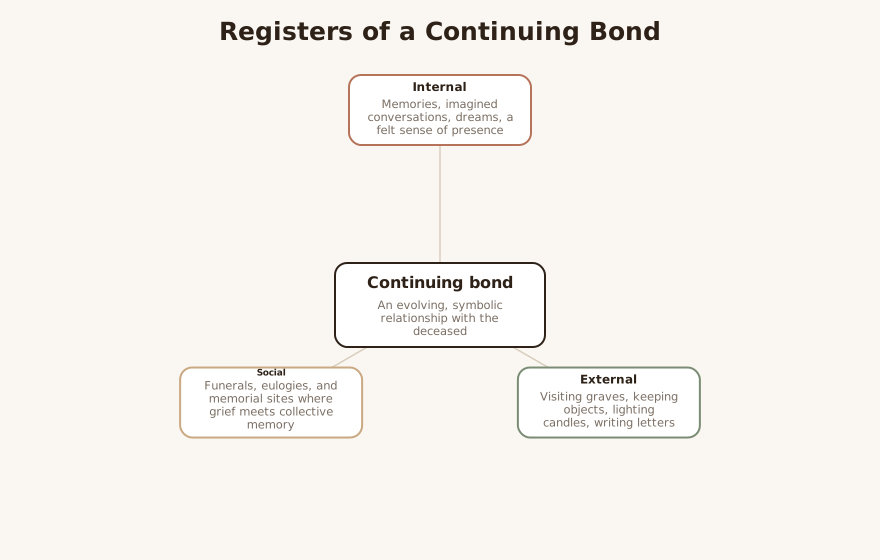
Third, bonds are expressed across multiple registers. The theory describes internal experiences (memories, imagined conversations, dreams, a felt sense of presence), external practices (visiting graves, keeping objects, lighting candles, writing letters), and social expressions (funerals, eulogies, and memorial sites where individual grief intersects with collective memory) 6.
Fourth — and this is the clinically decisive refinement — not all continuing bonds are equal. Contemporary theory holds that whether a bond aids or impedes adaptation depends on the type of bond and the underlying psychological process, not merely on its presence 2. The simple question “should the bond continue?” has been replaced by “which bonds, in which person, supporting which process?” 2.
Interventions & Techniques
Because CB is a lens rather than a protocol, its techniques are typically woven into bereavement counseling and broader psychotherapy LLM. Common CB-informed interventions include:
- Legacy and memory work: photo albums, memory boxes, storytelling, and shared narratives that preserve and reorganize the relationship 4.
- Letter-writing and addressed journaling: written expression directed to the deceased to give voice to the ongoing relationship 4.
- Commemorative rituals: lighting candles, visiting meaningful locations, anniversary observances 4.
- Living the person’s values: supporting causes they championed, embodying their lessons, or carrying forward a role they modeled 4.
- Imagined dialogue: empty-chair or internal-conversation techniques in which the client articulates what they would say, and imagines what the deceased might offer in return LLM.
The clinical aim is to help the survivor construct an integrated, internalized representation of the deceased that offers comfort and continuity while leaving room for new attachments and ongoing life 2.
LLM-generated illustrative example (not a guideline): A widower describes “talking to” his late wife each morning over coffee and asking what she would think of decisions about their adult children. The clinician, rather than treating this as denial, explores whether the practice leaves him feeling steadied and able to act — an internalized, self-authored bond — or whether it functions to avoid accepting that she has died. LLM
Evidence Base
Maturity should be characterized honestly: CB is an established and influential theory, but its outcome evidence is mixed and context-dependent 23. The framework has substantially reshaped grief counseling and lay understanding, displacing the older detachment paradigm 6. What it has not delivered is a clean empirical verdict that continuing bonds are uniformly helpful.
A central scholarly conclusion is that it is not possible to conclude that either continuing or relinquishing bonds is generally helpful across the board 6. Stroebe, Schut, and colleagues argued that the field needed theoretical integration — combining attachment theory, the dual process model, and the study of mental representations of the deceased — precisely because the literature lacked clarity about which bonds support adaptation versus which impede it 2. A 2023 systematic review in Death Studies synthesized the accumulating evidence on the impact of continuing bonds following bereavement, continuing this effort to disentangle adaptive from maladaptive expressions 3.
Two methodological caveats are worth flagging for clinicians. The original 1996 work rested on qualitative rather than quantitative evidence, which proponents defended as necessary to capture grief’s relational texture but which critics regarded as a limitation 6. And early bereavement outcome studies often measured depression narrowly while neglecting yearning, a core grief response closely tied to ongoing bonds 6.
Populations & Indications
CB-informed work is broadly applicable across bereaved populations: bereaved adults, widows and widowers, bereaved parents, and bereaved children and adolescents LLM. The construct’s developmental roots in child development research make it particularly resonant for work with grieving children, for whom an evolving inner relationship with a deceased parent can support ongoing development 6. It also extends to anticipatory contexts — people in palliative and hospice care and the caregivers of the dying — where the relationship is already being renegotiated before death occurs LLM.
Indications include normative grief and bereavement, mourning, adjustment difficulties following loss, and the loss of a loved one across the lifespan LLM. The framework is also invoked in the context of more severe presentations — prolonged grief disorder, complicated grief, traumatic loss, and depression following bereavement — though here the type of bond becomes the critical clinical variable rather than the bond’s mere existence 2.
Problems-for-Work
- Grief and bereavement: normalizing an ongoing connection and helping the client find sustainable forms (ritual, memory, narrative) for it 4.
- Prolonged grief disorder / complicated grief: distinguishing an integrated, comforting bond from one organized around non-acceptance of the death, and gently shifting the latter 2.
- Adjustment disorder following loss: using legacy and meaning work to support re-engagement with life while honoring the relationship LLM.
- Anticipatory grief in palliative settings: beginning to shape the future continuing bond before death, e.g., recording stories or co-creating memory artifacts LLM.
- Traumatic loss: sequencing trauma stabilization before bond-focused work, since intrusive or distressing imagery can masquerade as connection LLM.
LLM-generated illustrative example (not a guideline): A bereaved mother keeps her child’s room exactly as it was and feels she “must” do so or she will be abandoning him. The clinician frames the goal not as dismantling the room but as broadening the bond — adding flexible, self-chosen forms of connection (a ritual, a letter, a cause in his name) so the relationship is held in more than one rigid, anxiety-driven place. LLM
Contraindications, Cautions & Cultural Humility
CB is not a license to encourage every form of connection. The literature distinguishes between bonds generally regarded as adaptive — internalized memories and imagined dialogues that comfort and steady the survivor — and externalized expressions that may signal unresolved grief, such as persistent quasi-sensory phenomena or a refusal to accept the reality of the death 6. Attachment theorists have specifically criticized early CB proponents for sometimes overlooking pathological signs while presuming bonds are beneficial 6. Clinically, the caution is to assess function: does the bond soothe and free the person to live, or does it bind them to avoidance and non-acceptance? 2
Cultural humility is essential, and the evidence demands it. Adaptiveness appears to be culturally patterned: a frequently cited study (Lalande & Bonanno, 2006) found continuing bonds associated with better adjustment among Chinese participants but poorer adjustment among Americans, undercutting any claim to universal validity 6. The historical record likewise shows that sustained relationships with the dead are the cultural norm in many traditions, not a deviation 6. Clinicians should therefore avoid imposing either a “let go” or a “hold on” prescription, and should instead work within the client’s own meaning, faith, and cultural framework LLM. Where trauma, severe depression, or active suicidality are present, those clinical priorities take precedence over bond-focused techniques LLM.
Treatment-Plan Suggestions & SMART Objectives
| Goal | SMART objective (example) | Mechanism |
|---|---|---|
| Normalize the ongoing relationship | Within 4 sessions, client will identify and name at least 2 ways the relationship with the deceased continues, without self-reported guilt, rated on a 0-10 scale | Reframes grief away from detachment; reduces shame-driven avoidance 4 |
| Establish a comforting internalized bond | Over 6 weeks, client will practice an internal “dialogue” or memory ritual ≥3x/week and report a felt sense of comfort or guidance in ≥2 sessions | Builds an integrated mental representation of the deceased 2 |
| Diversify rigid externalized bonds | Within 8 sessions, client will add 2 flexible, self-chosen forms of connection (e.g., letter, ritual, legacy act) alongside any rigid behaviors | Shifts from avoidance-driven to integrative bonds 2 |
| Support re-engagement with life | Within 2 months, client will resume or initiate 1 valued activity or relationship while maintaining a chosen commemorative practice | Operationalizes oscillation between loss- and restoration-oriented coping 2 |
| Construct meaning and legacy | Over 6 sessions, client will complete one legacy artifact (memory box, narrative, photo project) and articulate its meaning | Meaning reconstruction; consolidates the evolving bond 4 |
| Reduce non-acceptance in complicated grief | Within 10 sessions, client will reduce avoidance behaviors tied to non-acceptance of the death, tracked weekly | Targets maladaptive bond organized around denial of reality 2 |
| Strengthen cultural/spiritual congruence | By session 4, client will identify continuing-bond practices congruent with their culture/faith and integrate ≥1 into routine | Aligns intervention with client meaning system; cultural humility 6 |
Common Misconceptions
- “Continuing bonds means never moving on.” The theory holds the opposite — connection and continued growth coexist; remembering can be part of healing 4.
- “All continuing bonds are healthy.” This is the most clinically dangerous misreading; adaptiveness depends on bond type and underlying process, and some externalized or non-accepting bonds may be maladaptive 26.
- “CB disproves attachment theory or stage models.” CB is in tension and dialogue with these frameworks rather than a simple replacement; integration across attachment, dual process, and mental-representation models is the current direction 2.
- “CB is a proven, uniformly beneficial intervention.” It is an influential theory with mixed, culturally patterned outcome evidence — not a settled empirical prescription 36.
- “Talking to the dead is a symptom.” Imagined conversations and a felt sense of presence are common, often internalized and adaptive, not inherently pathological 6.
Training & Certification
There is no certification in “Continuing Bonds” itself, consistent with its status as a theory rather than a modality LLM. Clinicians typically encounter it within graduate bereavement coursework, thanatology training, and grief-counseling continuing education, and apply it through credentials in the host modalities (e.g., CBT, complicated grief treatment, interpersonal therapy) LLM. The foundational primary text remains the 1996 Klass, Silverman, and Nickman volume 1, and accessible orientations are available through clinical organizations and grief-education resources 45. Practitioner-facing talks also frame the construct as “learning to carry grief in a new way” 7.
Key Terms
- Continuing bond: an ongoing, evolving symbolic relationship with the deceased 4.
- Decathexis / grief work: the older Freudian model of withdrawing emotional investment from the deceased as the goal of mourning 6.
- Internalized bond: memory- and representation-based connection, generally regarded as adaptive 6.
- Externalized bond: outwardly enacted or quasi-sensory connection that, when tied to non-acceptance, may be maladaptive 6.
- Dual process model: oscillation between loss-oriented and restoration-oriented coping 2.
- Mental representation of the deceased: the internal cognitive-emotional image the survivor holds and continues to relate to 2.
Resources & Further Reading
▶ Watch — a video introduction to this concept:
- Continuing Bonds: New Understandings of Grief (Klass, Silverman & Nickman, 1996)
- Continuing bonds in adaptation to bereavement: Toward theoretical integration (Stroebe et al.) — PubMed
- The impact of continuing bonds following bereavement: A systematic review (Death Studies, 2023)
- Continuing Bonds Theory (Klass, Silverman & Nickman) — The Loss Foundation
- Continuing Bonds: Shifting the Grief Paradigm — What’s Your Grief
- Continuing bonds — Wikipedia
- The Continuing Bond: Learning to Carry Grief in a New Way (YouTube)
Reflective / Supervision Questions
- When a client describes an ongoing connection to a deceased loved one, how do I assess whether it is steadying and integrative versus organized around non-acceptance of the death? 2
- Where might my own cultural or training assumptions about “letting go” be shaping what I label healthy or pathological in a client’s grief? 6
- Am I distinguishing internalized from externalized bonds in my formulation, and does my intervention follow from that distinction? 6
- For a given client, within which billable modality am I actually delivering this work, and does my documentation reflect that? LLM
- How do I hold the honest evidence picture — that continuing bonds are neither universally helpful nor harmful — without either over-prescribing or pathologizing connection? 3