
Type & Discipline
The Lowenfeld World Technique is a structured play-based assessment and treatment method belonging to the broader family of play therapy, and it sits at the historical root of what is now called sandtray and sandplay therapy 12. In the method, a child is offered trays of wet and dry sand together with a large cabinet of categorized miniature objects and invited to build a three-dimensional scene the children themselves named a “world” 1. As a discipline marker, it is best understood as a projective, expressive, nonverbal technique rather than a verbal or insight-oriented talking therapy LLM. Practitioners observe and document the construction without imposing predetermined symbolic meanings, which distinguishes the World Technique from later interpretive schools that grew out of it 1. For the contemporary clinician, the most useful framing is that this is the parent technique from which Dora Kalff’s Jungian sandplay later derived, so understanding it clarifies what is original versus what is a later theoretical overlay 2.
Creators & Lineage
Margaret Lowenfeld was a pediatrician and child psychiatrist who founded one of England’s first psychological clinics for children in 1928 and developed the World Technique in the late 1920s as a response to the limits of talk-based work with children 12. She drew the original idea from H.G. Wells’s 1911 book describing “floor games,” adapting the notion of children building imaginary worlds into a clinical instrument 4. Lowenfeld worked at a time when the dominant child therapies were Freudian and Jungian interpretive frameworks, and her deliberate refusal to pre-assign symbolic meanings to the child’s objects was a methodological stance, not an oversight 1.
The lineage then forks. Dora Maria Kalff (1904–1990), a Jungian psychologist who trained with Lowenfeld, synthesized the World Technique with C.G. Jung’s depth psychology and Eastern philosophical traditions in the late 1950s to create what she called sandplay therapy 23. Kalff’s adaptation added interpretive and archetypal layers that Lowenfeld had intentionally withheld, and as her teaching spread through Europe, America, and Japan it led to the founding of the International Society for Sandplay Therapy (ISST) on August 13, 1985, by fourteen founding members, many of whom were Jungian analysts 2. Lowenfeld’s technique also influenced Sweden’s “Erica Method,” a parallel diagnostic descendant 4. The practical takeaway: “sandplay” (Kalff, Jungian, interpretive) and the “World Technique” (Lowenfeld, non-interpretive) are related but not identical, and the terms should not be used interchangeably 12.
Core Principles
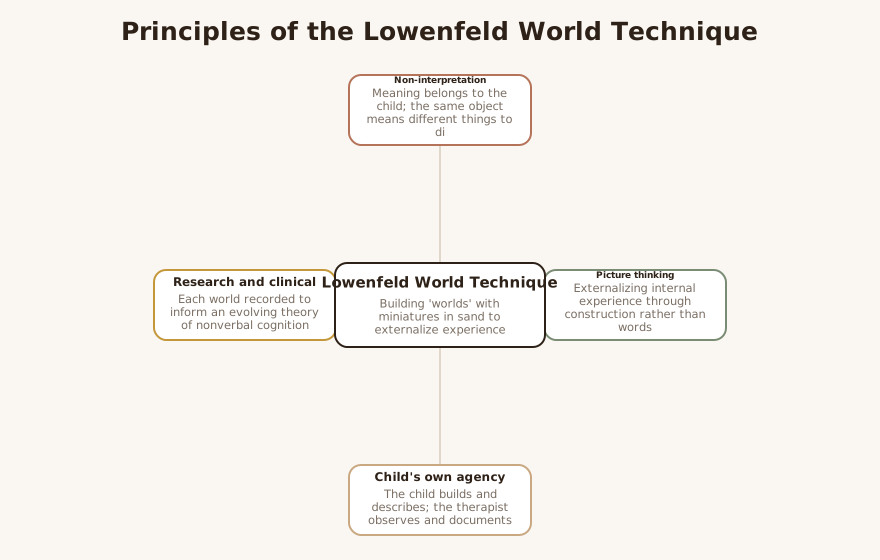
The defining principle is non-interpretation: Lowenfeld held that the same object carries different meaning for different children — a horse might represent fear for one child and companionship for another — so meaning belongs to the child, not to a fixed symbolic key 1. A second principle is that some ideas and feelings cannot easily be put into words, and the sand world offers a route around that limit 1. Lowenfeld described this as “picture thinking,” a mode of externalizing internal experience through construction rather than verbal articulation, and she theorized a developmental substrate she termed “Protosystem Thinking” 1.
A third principle is the primacy of the child’s own agency in building and describing the world; the therapist’s role during construction is to observe and document rather than to direct or correct 1. A fourth, often underappreciated, is the technique’s dual function as both a research instrument and a clinical one — Lowenfeld meticulously recorded each world (through drawings, process notes, and the child’s own descriptions) precisely so that the material could inform an evolving theory of children’s nonverbal cognition 1. For the working therapist, these principles translate into a disciplined stance of containment and witnessing rather than analysis LLM.
Interventions & Techniques
In practice, the clinician sets out separate trays of wet and dry sand and a cabinet of miniatures sorted into categories — animals, action figures, buildings, vehicles, and more 1. Lowenfeld’s own collection was extensive: roughly 25 boxes organized into about twenty subject areas, including domestic and jungle animals, vehicles, ships and trains, military figures, houses and bridges, people in varied poses, trees and landscape pieces, and specialty items, made of wood, metal, and plastic dating mainly from the 1930s to 1960s 4. The breadth matters: a collection rich enough to let a child find an object that fits their inner experience is part of the method, not mere decoration LLM.
The core procedure is simple and repeatable LLM:
- Invitation and free build. The child is invited to make a “world” in the sand using any objects they choose, with the wet/dry trays allowing molding, burying, and water effects 1.
- Observation without interruption. The therapist watches the selection, placement, and sequence quietly during construction, intervening minimally 13.
- The child’s narration. Afterward, the child’s own description of the world is elicited and recorded, because the child is the authority on what the scene means 1.
- Documentation. The clinician records the world via notes and drawings for continuity and pattern-tracking across sessions 1.
- Discussion and modification (more so in later sandplay). In Kalff-influenced practice the clinician later discusses choices and symbolic meanings and the client may modify the scene; Lowenfeld’s original emphasis stayed closer to witnessing and the child’s own account 13.
LLM-generated illustrative example (not a guideline): A seven-year-old repeatedly buries a small figure under wet sand, then places a fence around the spot and sets a dog beside it. The clinician does not announce “this is your fear” but instead notes the sequence, and later asks, “Can you tell me about this part of your world?” — letting the child supply that the buried figure “is hiding and the dog is guarding him.” LLM
Evidence Base
Honest appraisal: the World Technique is best labeled established in the sense of being historically foundational, widely taught, and clinically durable for nearly a century — not in the sense of resting on a large modern randomized-controlled-trial base 12. Much of the support is descriptive, observational, and clinical-tradition based, consistent with Lowenfeld’s own use of the method as a research-and-clinical hybrid documented case by case 1.
For the sandplay descendants, some outcome literature exists: research published in Nursing Open documented benefits for chronically ill children, including reduced anxiety and behavioral problems, with relief reported by caregivers as well, and the approach is described as effective for people with disabilities, language difficulties, or resistance to conventional verbal psychotherapy 3. These are encouraging but modest signals, often from small or non-randomized studies, and they pertain to sandplay broadly rather than to Lowenfeld’s strict non-interpretive protocol specifically 3. The responsible clinical claim is that sand-tray methods have plausible, accumulating, but still maturing empirical support, and should be offered as one expressive component within an evidence-informed plan rather than as a stand-alone proven cure LLM.
Populations & Indications
The technique was designed for children, and it remains most strongly indicated for young clients who cannot yet verbalize their feelings 13. It is well suited to clients with histories of trauma, neglect, or abuse, and the sand-tray family is described as helpful for teens and adults carrying severe emotional wounds as well 3. It is a strong fit for nonverbal or preverbal clients and anyone with limited verbal expression, including those with language difficulties or learning disabilities, because the medium bypasses the demand to find words first 13. Families and dyads can also use the tray as a shared expressive space LLM. Beyond core trauma populations, the sandplay literature names anger management, mood and anxiety disorders, relationship difficulties, and divorce adjustment as appropriate targets 3.
Problems-for-Work
The technique maps onto a range of presenting problems where words are scarce or affect is hard to hold LLM:
- Childhood trauma and PTSD. The sand world lets a child externalize and re-organize traumatic material at a safe symbolic distance rather than recounting it verbally 13.
- Anxiety. Reductions in anxiety have been documented in sand-tray work with chronically ill children 3.
- Emotional dysregulation and behavioral problems. Building and reworking a scene offers a contained channel for affect, with documented reductions in behavioral problems 3.
- Attachment difficulties and grief. The miniatures (figures, homes, animals) allow relational and loss themes to be staged and revisited over sessions LLM.
- Difficulty verbalizing emotions. This is the technique’s signature indication — “picture thinking” gives form to what cannot be said 1.
LLM-generated illustrative example (not a guideline): A grieving nine-year-old who “doesn’t want to talk about” a deceased grandparent places a single figure on a hill, surrounds it with trees, and over three sessions gradually adds family figures approaching it — giving the clinician and child a shared, low-pressure language for the loss. LLM
Contraindications, Cautions & Cultural Humility
The technique is low-risk but not risk-free LLM. Because trauma material can surface nonverbally and sometimes rapidly, clinicians should be prepared to slow the pace, support grounding, and avoid pushing premature verbal processing of what the sand world brings up LLM. The non-interpretive stance is itself a safeguard worth honoring: imposing fixed symbolic meanings onto a child’s objects contradicts Lowenfeld’s core principle and risks the clinician’s projections overriding the child’s own meaning 1.
Cultural humility is essential at the level of the miniatures themselves LLM. Lowenfeld’s historical collection reflected its 1930s–1960s British context and included now-dated categories such as “Cowboys and Native Americans” 4. A contemporary collection should be curated for diverse skin tones, family structures, faith symbols, and cultural objects, and should retire stereotyped figures, so that every client can find objects that authentically represent their world LLM. Practitioners should also remember the evidence base is still maturing, so informed consent should frame sand-tray work as an expressive method, not a proven stand-alone treatment, and it should be integrated with established trauma and anxiety treatments where indicated 3.
Treatment-Plan Suggestions & SMART Objectives
| Goal | SMART objective (example) | Mechanism |
|---|---|---|
| Increase nonverbal expression of distress | Within 6 sessions, client builds and narrates at least one sand world per session in 4 of 6 sessions | “Picture thinking” externalizes preverbal material the child cannot yet verbalize 1 |
| Reduce trauma-related anxiety | Over 8 weeks, client reports or displays reduced anxiety markers during/after sand work in 3 consecutive sessions | Safe symbolic distance allows trauma material to be approached without verbal recounting 13 |
| Improve emotional regulation | Within 8 sessions, client demonstrates one self-soothing or contained reworking of a scene rather than escalation in 3 of 4 observed instances | Building and modifying the world provides a contained channel for affect 3 |
| Process grief/loss | Over 6 sessions, client stages and revisits a loss-themed world and adds one supportive figure by session 6 | Miniatures allow relational and loss themes to be externalized and re-organized LLM |
| Strengthen narrative of safety | Within 5 sessions, client constructs a “safe place” world and describes it in their own words in 2 sessions | Child-led meaning-making restores agency and a sense of containment 1 |
| Support attachment repair (dyadic) | Over 8 sessions, caregiver–child dyad co-builds one shared world per session in 5 of 8 sessions | Shared tray provides a low-pressure relational space for connection LLM |
| Reduce behavioral dysregulation | Across 8 weeks, observed behavioral problems decrease per caregiver report by session 8 | Documented reductions in behavioral problems with sand-tray work 3 |
Common Misconceptions
“Sandplay and the World Technique are the same thing.” They are not: Lowenfeld’s World Technique is the non-interpretive parent method, while Kalff’s sandplay added Jungian and archetypal interpretation in the late 1950s 12. “The therapist interprets the symbols.” In Lowenfeld’s original method, meaning belongs to the child, and the same object can mean opposite things for different children 1. “It’s just unstructured play.” The technique is a documented, repeatable procedure with a specific materials set and a research-grade recording practice 14. “It only works for young children.” While designed for children, the sand-tray family is applied to teens and adults with severe emotional wounds and to clients resistant to verbal therapy 3. “It’s a proven stand-alone cure.” The evidence is established as a tradition but modest empirically; it is best used as one expressive component of a broader plan 3LLM.
Training & Certification
There is no single global license for the World Technique itself, but the sandplay lineage is formally credentialed LLM. Sandplay certification typically requires roughly 120 hours covering clinical practice, Jungian theory, consultation, and case reports, reflecting the depth-psychology emphasis Kalff introduced 3. The International Society for Sandplay Therapy (ISST), founded in 1985, is the principal professional body governing standards in the Kalffian tradition 2. Clinicians wishing to practice closer to Lowenfeld’s original non-interpretive method can study through resources associated with the Lowenfeld tradition while still pursuing supervised training and consultation, since competent sand-tray work depends on supervised practice with the materials and on the clinician’s own experience of the medium 1LLM.
Key Terms
- World / “building a world.” The three-dimensional sand scene the child constructs from miniatures; the term came from the children themselves 1.
- Picture thinking. Lowenfeld’s term for externalizing inner experience through construction rather than words 1.
- Protosystem Thinking. Lowenfeld’s theorized developmental mode of nonverbal cognition underlying the worlds 1.
- Non-interpretation. The principle that the child, not the therapist, holds the meaning of the objects 1.
- Sandplay (Kalff). The Jungian, interpretive descendant of the World Technique developed in the late 1950s 23.
- Floor Games. H.G. Wells’s 1911 book of children’s world-building that inspired the technique 4.
- Erica Method. A Swedish diagnostic descendant of Lowenfeld’s work 4.
Resources & Further Reading
▶ Watch — a video introduction to this concept:
- The World Technique — The Dr Margaret Lowenfeld Trust
- History — International Society for Sandplay Therapy (ISST)
- Sandplay Therapy — Psychology Today
- Toys used for Lowenfeld’s “World Technique” therapy — Science Museum Group Collection
Reflective / Supervision Questions
- When I observe a child’s world, where am I tempted to interpret, and how do I keep meaning with the child as Lowenfeld intended? 1LLM
- Does my miniatures collection represent the full diversity of the clients I serve, and which dated or stereotyped figures should I retire? 4LLM
- How do I explain to a family the difference between Lowenfeld’s non-interpretive World Technique and Kalff’s interpretive sandplay, and which am I actually practicing? 12
- Given that the evidence base is established-but-modest, how am I integrating sand-tray work with other evidence-informed treatments for this client? 3LLM
- When trauma material surfaces nonverbally in the tray, what is my plan for pacing, grounding, and containment before any verbal processing? LLM