
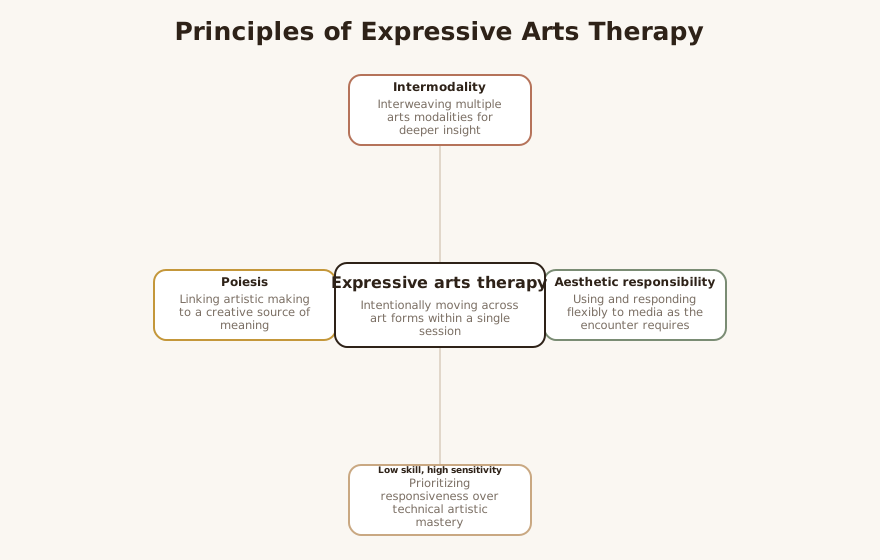
Expressive arts therapy is easy to mistake for art therapy with a broader supply closet, but the distinction is structural rather than cosmetic. LLM Where art, music, dance/movement, and drama therapists each specialize in one medium, the expressive arts therapist specializes in the movement between media — using visual art, sound, movement, enactment, and poetry as an integrated toolkit and deliberately crossing from one to another within a single session. 14 This article orients referring and collaborating clinicians to what the discipline actually is, where its claims rest on a credentialed tradition versus controlled evidence, and how to borrow its techniques responsibly inside the modalities you are already licensed to bill. LLM
Type & Discipline
Expressive arts therapy is a distinct member of the creative arts therapies family, defined by its intermodal method rather than by a single medium. 1 The International Expressive Arts Therapy Association (IEATA) defines it as “a therapeutic model that engages multiple expressive arts modalities with an intermodal approach in order to facilitate an integrative experience involving the threading of: visual arts, music, dance/movement, drama/theater, poetry/writing, and other creative processes.” 1 IEATA situates the field within the broader umbrella of “expressive therapies / creative arts therapies,” which it lists as including art therapy, music therapy, dance/movement therapy, drama therapy, poetry/writing therapy, play therapy, and expressive arts therapy itself. 1 The discipline has been characterized in the literature as “a multimodal holistic health intervention that mobilizes creative expression in the service of healing both mind and body,” with practitioners positioned as skilled interpreters of creative expression rather than expert artists in any one field. 5 The defining commitment is integration: the clinician works at the junctures where one art form gives way to another, treating that crossing as the therapeutic event. 3
Creators & Lineage
The modern discipline coalesced in the early 1970s, when Paolo Knill, Shaun McNiff, and Norma Canner helped found the graduate program at Lesley College (now Lesley University), the institutional cradle of intermodal expressive therapy in the United States. 3 Knill is frequently described as the “grandfather of expressive arts therapy,” and the field’s foundational theory is most associated with his collaboration with Stephen K. Levine and Ellen G. Levine. 3 A separate but parallel lineage is Person-Centered Expressive Arts Therapy, developed by Natalie Rogers, which weds the intermodal creative process to the person-centered theory of her father, Carl Rogers. 1 These roots place the discipline at the confluence of the single-medium creative arts therapies — art, music, drama, and dance/movement therapy — and the humanistic and existential-phenomenological traditions, with Knill’s paradigm emphasizing “being in the world,” art combined with healing relationship, and the offering of “soul nourishment.” 3 The field’s growth over roughly four decades has been described as a deepening of knowledge of the psyche through creative expression and the symbolic meaning of one’s images. 4
Core Principles
The organizing principle is intermodality: IEATA defines the intermodal process as “the process of interweaving and sequencing multiple expressive arts modalities,” holding that “it is this intermodality that leads to deeper insight and expanded awareness.” 1 This is explicitly contrasted with a multimodal approach, which uses various art forms but treats them “as separate and unique processes” rather than as interconnected ones. 1 A second principle is aesthetic responsibility — the clinician’s ability to use appropriate media for therapeutic purposes and to respond flexibly to “sound, image, movement, enactment and text as they are required in the encounter with the lived situation of the client.” 3 A third is the low skill, high sensitivity stance, which prioritizes responsiveness and engagement over technical artistic mastery, lowering the threshold for clients who do not consider themselves “artistic.” 3 Underpinning all of this is poiesis — the capacity that links artistic making to a creative source of meaning through imagination and bodily, sensory experience. 3 The practical wager is that some material, especially affect and preverbal experience, is reached more readily through making and moving across forms than through talk alone. LLM
Interventions & Techniques
In practice, an expressive arts session may open in one modality and migrate to another as material emerges — for example, a movement warm-up that flows into image-making and closes in written reflection. 1LLM The clinician’s specific expertise is in “the junctures at which one mode of artistic expression needs to give way to, or be supplemented by, another.” 3 Commonly described techniques span the modalities: drawing and painting, sculpting with clay, mask-making, movement, journaling, poetry, role-play, collage, self-portraiture, photography, mandala-making, filmmaking, mindful painting for stress relief, guided imagery with music, and mindful photography. 5 Reported clinical aims for these techniques include helping clients who struggle with verbal expression, facilitating non-verbal emotional processing, and enhancing self-awareness, resilience, and mind-body integration. 5 The intermodal sequence is not random; it is meant to let an experience that has stalled in one form (say, a feeling that cannot be spoken) find expression in another (a posture, a sound, an image) and then return, transformed, to reflection. LLM
LLM-generated illustrative example (not a guideline): An adult who “goes flat” whenever asked to describe a panic episode is invited first to walk the shape of the panic across the room, then to render that movement as a quick charcoal drawing, then to write three lines addressed to the drawing. The shift from movement to image to text gives the experience three handholds; in reflection the client notices the drawing has no edges, opening a conversation about feeling boundless and unsafe that talk alone had not reached. LLM
Evidence Base
Honesty here requires separating two claims that are easily conflated: expressive arts therapy is an established discipline with training institutes, an international association, and roughly four decades of practice, but its controlled efficacy evidence base is comparatively emerging and thin. 14LLM The discipline’s own scholarship reflects this tension. A 2022 analysis in The Arts in Psychotherapy frames expressive arts therapy as a profession working in a “wild zone,” noting that because it did not anchor itself to a single modality it was initially met with resistance within the broader creative arts therapy field, and that its practitioners answered by claiming mastery of the principles of integration and wholeness rather than of any one art form. 2 That same paper foregrounds unresolved questions of self-definition, professionalization, and credentialing and reads the field’s position through a lens of “mestiza consciousness” — a framing that, while generative, also signals a professional identity that is still consolidating rather than settled. 2 The applied literature describes the intermodal approach being used for trauma and PTSD — where processing is often non-verbal and sensory material can be transformed into a trauma narrative — and for cognition and mental health in dementia, but these are described as promising applications rather than as a mature body of randomized, replicated trials. 4 The defensible summary for clinicians is cautious: an institutionally established field whose mechanistic rationale is coherent and whose techniques are widely used, but whose controlled outcome evidence does not yet match the confidence with which the modality is sometimes promoted. LLM
Populations & Indications
The discipline has been applied across a wide age and ability range, reflecting the accessibility of its “low skill, high sensitivity” stance. 3LLM Reported populations include children and adolescents, trauma survivors, people with developmental disabilities, older adults and people with dementia, refugees and displaced persons, and adults in inpatient or rehabilitation settings. 4LLM Indications are best framed around access rather than around any single diagnosis: clients who cannot or will not verbalize, who are guarded in talk therapy, or for whom one expressive channel is blocked but another is open. 5LLM The non-verbal, sensory route is the specific reason the approach is reached for in trauma and PTSD, where clients may “not respond well to traditional treatments” and where image and movement can carry what words cannot. 4 In dementia and mild cognitive impairment, the appeal is similar — engagement and expression that do not depend on intact verbal and narrative memory. 4
Problems-for-Work
The modality is most naturally suited to problems where verbal access is the rate-limiting step. LLM For difficulty verbalizing emotions and alexithymia, the intermodal sequence offers several non-verbal channels and a structured way to translate between them. 15 For PTSD and trauma, sensory image- and movement-based work can support a titrated, non-verbal approach to material that resists direct narration. 4 For grief, making and then moving a created object or image across forms can give shape to loss and support continuing-bonds work. LLM For emotional dysregulation, the embodied, rhythmic qualities of movement and sound can be used as in-session down-regulation before reflection. 5LLM For anxiety and depression, techniques such as mindful painting and guided imagery with music are used to interrupt rumination and re-engage agency. 5 For low self-esteem, adjustment disorder, and identity disturbance, building and narrating a sequence of self-representations across modalities can scaffold a more coherent and agentic self-story. 5LLM
LLM-generated illustrative example (not a guideline): A recently displaced refugee client who cannot yet speak about what was left behind is offered clay to build “the thing you most want to keep,” then invited to hum or sound the object, then to give it one sentence. The intermodal path lets identity and loss surface obliquely; the client later returns to the clay object across sessions as a stable anchor for adjustment work. LLM
Contraindications, Cautions & Cultural Humility
Expressive arts therapy is rarely physically contraindicated, but several cautions are clinically important. LLM First, the same non-verbal power that makes intermodal work useful in trauma can surface material faster than a client is ready to integrate; pacing, grounding, and a stabilization-first stance matter more, not less, when multiple expressive channels are opened at once. 4LLM Second, the field’s own identity is still consolidating, so clinicians and clients should not assume a single standardized protocol or a settled outcome literature behind the name. 2LLM Third, the clinician must resist imposing fixed symbolic interpretations: meaning is co-constructed, and color, gesture, sound, and the very act of depicting persons carry culturally and religiously specific significance that should be asked about rather than read from a key. LLM Cultural humility is doubly relevant because the discipline’s own literature reaches for border and hybridity metaphors to describe itself; the same humility about not flattening difference should extend to the client’s cultural relationship to each art form. 2LLM Finally, intermodal techniques delivered by a clinician without expressive-arts training are not equivalent to credentialed expressive arts therapy, and outcomes should not be generalized across those different conditions. 1LLM
Treatment-Plan Suggestions & SMART Objectives
| Goal | SMART objective (example) | Mechanism |
|---|---|---|
| Build affect vocabulary across channels | Within 8 sessions, client will name at least 3 distinct emotions per session by translating one created image into a single written line, in 4 consecutive sessions | Intermodal transfer; nonverbal-to-verbal bridging |
| Reduce in-session arousal | Over 6 weeks, client will use a movement or sound exercise to lower self-rated distress by 2+ points (0–10) within session, in 5 of 6 sessions | Embodied/rhythmic down-regulation |
| Titrated trauma approach | Within 10 sessions, client will represent one trauma-linked experience first in image then in writing without dissociating, with grounding steps completed first | Sensory-to-narrative transformation with containment |
| Support grief processing | Over 8 sessions, client will create one object representing the loss, sound or move it, and narrate a continuing bond, reviewed twice | Symbolization across modalities; continuing-bonds expression |
| Increase engagement (guarded clients) | Within 4 sessions, client will participate in two different art forms and disclose one previously unspoken concern | Indirect/non-verbal access; reduced verbal pressure |
| Strengthen self-concept / identity | Within 12 sessions, client will complete a self-portrait series across two modalities and identify 3 statements of value or competence | Mastery experience; coherent self-representation |
| Improve emotion regulation between sessions | Over 6 weeks, client will build a multimodal “coping resources” set (image + phrase + movement) and use it at least twice weekly, self-reported | Externalized, embodied coping plan |
Common Misconceptions
“It is just art therapy with more materials” misses the defining feature: the discipline specializes in the intermodal crossing between forms, which IEATA explicitly distinguishes from a multimodal use of art forms as “separate and unique processes.” 1 “You have to be artistic” inverts the field’s “low skill, high sensitivity” principle, which prioritizes responsiveness over technical mastery. 3 “It is a relaxing enrichment activity” understates a psychotherapeutic practice grounded in aesthetic responsibility and intermodal theory rather than recreation. 3 “The evidence is robust across conditions” overstates the case; the discipline is institutionally established but its controlled outcome literature is still emerging, and its own scholarship describes a profession in a “wild zone” with unsettled identity and credentialing questions. 2 Finally, “any therapist who mixes a few art forms is doing expressive arts therapy” conflates a borrowed technique with a credentialed specialization that requires specific graduate training. 13
Training & Certification
Expressive arts therapy is delivered by clinicians trained in the intermodal method, with the graduate program founded at Lesley in the early 1970s by Knill, McNiff, and Canner serving as an early model for the field. 3 The International Expressive Arts Therapy Association functions as the discipline’s international professional body and the steward of its definitions, distinguishing therapeutic practice (“expressive arts therapy”) from non-clinical “expressive arts consultation, education, and facilitation” in a non-clinical setting. 1 Because the field is intermodal rather than tied to a single licensed profession, its credentialing and scope sit alongside — and are sometimes regulated under — the more established single-modality creative arts therapy and counseling licenses, and the boundaries of that professionalization are an active topic in the field’s own literature. 12 Clinicians considering training should verify how the credential interacts with their own state’s licensure for billing and scope, since recognition is uneven. LLM
Key Terms
Intermodal / intermodal transfer — interweaving and sequencing multiple expressive arts modalities within the work, the process IEATA identifies as the engine of “deeper insight and expanded awareness.” 1 Multimodal — using various art forms but as separate, unconnected processes; contrasted with the intermodal approach. 1 Aesthetic responsibility — the clinician’s capacity to choose and use appropriate media and respond flexibly to sound, image, movement, enactment, and text as the client’s situation requires. 3 Low skill, high sensitivity — the stance prioritizing engaged responsiveness over technical artistic skill. 3 Poiesis — the imaginative, bodily-sensory capacity linking artistic making to a creative source of meaning. 3 Person-Centered Expressive Arts Therapy — Natalie Rogers’s integration of the intermodal creative process with Carl Rogers’s person-centered theory. 1
Resources & Further Reading
▶ Watch — a video introduction to this concept:
- IEATA — Glossary (definitions of expressive arts therapy, intermodal, multimodal) 1
- Expressive arts therapy: A profession in a “wild zone” — The Arts in Psychotherapy (2022) 2
- Foundations of Expressive Arts Therapy (Knill, Levine & Levine) — book review 3
- Expressive Art Therapy — an overview | ScienceDirect Topics 4
- Expressive Arts Therapy: 15 Creative Activities and Techniques — PositivePsychology.com 5
Reflective / Supervision Questions
- When I move a client across art forms in a session, am I doing it for a clear therapeutic reason (this experience has stalled in one channel and needs another), or simply for variety? LLM
- Am I delivering intermodal techniques as a method inside my own licensed modality, or implying a credentialed “expressive arts therapy” I am not trained to provide? LLM
- For trauma and refugee clients, have I sequenced stabilization and grounding before opening multiple expressive channels at once? LLM
- Given that the field’s controlled evidence base is still emerging, how do I describe expected benefit honestly to clients and referrers? LLM
- How do I distinguish a client’s own meaning for an image, movement, or sound from my interpretive projection onto it? LLM
- What cultural or religious meanings might this client attach to a given art form — depicting persons, dancing, sounding, masking — that I should ask about rather than assume? LLM
- When should I refer to a credentialed expressive arts or single-modality creative arts therapist rather than incorporate these techniques myself? LLM