
Type & Discipline
Process-Oriented Psychology, commonly called Processwork, is a depth-psychological modality situated within Jungian and transpersonal psychology 7. It is best understood as a post-Jungian development: it retains Jung’s emphasis on the unconscious and on meaning while extending attention into the body, perceptual channels, relationships, and group fields 7. Practitioners describe it as an awareness practice as much as a therapy — a disciplined method of noticing and following experiences that are emerging at the edge of a person’s identity 6. The approach is explicitly multi-level, addressing intrapsychic, somatic, relational, and collective phenomena within a single conceptual frame 1.
Within a clinical taxonomy, Processwork sits alongside other body-oriented and depth psychotherapies, but it is unusual in treating bodily symptoms, dreams, movement, and conflict as expressions of one underlying patterning it calls the “dreaming process” 2. For practicing therapists, it is most useful to think of Processwork as a meta-skill set — ways of tracking signals and working with what is unintended or marginalized in a client’s communication — that can inform work across settings rather than as a narrow technique list 6.
Creators & Lineage
Processwork was founded by Arnold Mindell, an American Jungian analyst trained at the C.G. Jung Institute in Zurich, who originally came to psychology from a background in physics at MIT and Union College 8. That dual lineage matters clinically: Mindell brought a physicist’s interest in fields, signals, and process into a Jungian framework, which shaped the modality’s language of “channels,” “signals,” and “dreaming” 8. His foundational insight, articulated in the early 1980s, was that nighttime dreams and bodily symptoms mirror one another — that the body is, in effect, “dreaming” — which he termed the dreambody 3.
The approach was developed collaboratively over decades, with Amy Mindell a central co-developer, particularly of the concept of “metaskills” — the feeling attitudes a therapist brings to technique 2. Processwork’s intellectual roots draw on Jungian analytical psychology, transpersonal psychology, Taoism, and systems theory, alongside body-oriented psychotherapy traditions 7. The Taoist influence is explicit in the clinical stance of “following” rather than directing experience — aligning with what is already happening rather than imposing a treatment agenda 6. Institutionally, the tradition is anchored by training organizations including the Process Work Institute in Portland, Oregon, and a global network coordinated through the International Association of Process-Oriented Psychology (IAPOP) 1 5.
Core Principles
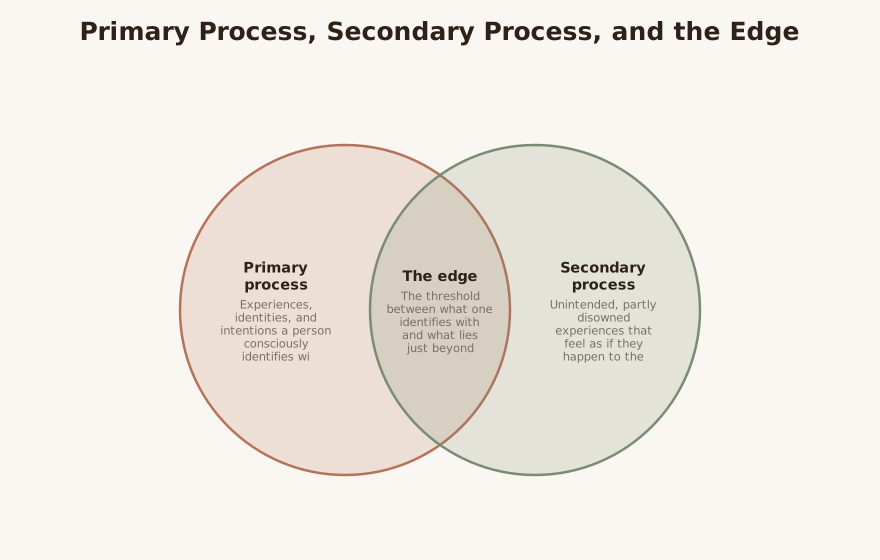
The central organizing idea is the dreaming process: a continuous, meaningful patterning that expresses itself simultaneously through dreams, body symptoms, moods, relationships, and group events 2. Processwork distinguishes between primary process — the experiences, identities, and intentions a person consciously identifies with — and secondary process, the experiences that arrive unintended, are partly disowned, or feel as if they “happen to” the person 7. Symptoms, slips, involuntary movements, and disturbances are read as secondary-process signals carrying information the primary identity has not yet integrated 7.
A second key construct is the edge: the threshold between what a person can identify with and what lies just beyond their current self-concept 6. Much of the clinical work happens at edges, where growth, anxiety, and resistance concentrate 6. Information is understood to flow through perceptual channels — visual, auditory, proprioceptive (body sensation), kinesthetic (movement), relationship, and world channels — and a core skill is noticing which channel a signal is “occupied” in and helping it unfold there 7.
LLM-generated illustrative example (not a guideline): A client describing work stress repeatedly clenches one fist while saying “everything’s fine.” The clenching is a secondary-process signal in the proprioceptive/kinesthetic channel; rather than interpreting it, the therapist might invite the client to let the fist do what it wants and notice what emerges. LLM
The overarching ethic is deep democracy — the stance that all parts of an experience, and all voices in a group, have a place and carry information worth attending to, including the marginalized, disturbing, or extreme 7. Clinically this translates into a non-pathologizing curiosity toward whatever is happening, including states usually framed as symptoms to be eliminated 2.
Interventions & Techniques
Processwork techniques begin with signal awareness: closely tracking minimal cues — tone shifts, micro-movements, gaze, breathing, posture — and noticing which are intended (primary) versus unintended (secondary) 7. The therapist then works to amplify the secondary signal so its meaning can unfold, often by inviting the client to exaggerate a movement, stay with a sensation, or follow an image 4. Crucially, amplification is usually done within the channel where the signal appears — a movement is unfolded through movement, a sensation through sensation — and may be channel-changed when the process naturally migrates 7.
Working with the dreaming body is the somatic core of the method: a physical symptom or chronic sensation is treated as a meaningful expression rather than only as pathology, and the client is helped to “make a process” out of it — to let the symptom speak, move, or show its image 3 4. Mindell’s case material describes following symptoms (pain, pressure, illness) until they reveal a figure or dynamic that connects to the person’s dreams and life direction 3.
Relationship and group methods extend the same logic outward. In couples and group settings, practitioners track roles and “ghost roles” (positions present in the field but unoccupied), and facilitate dialogue across them — work Mindell developed into Worldwork, a large-group conflict-facilitation practice 7. Across all levels, the therapist’s metaskills — compassion, playfulness, fluidity, an attitude of following — are taught as equal in importance to the technical moves 2.
LLM-generated illustrative example (not a guideline): In a couple session, one partner falls silent whenever finances arise. Treating the silence as an occupied “role” rather than mere withdrawal, the therapist might give voice to the silence (“If this quiet could speak, what would it say?”) to surface the marginalized position in the relationship field. LLM
Evidence Base
Processwork’s maturity is best described as that of an established practice tradition with robust theoretical and training infrastructure but a limited controlled-trial evidence base 1 5. It has existed for more than four decades, has a substantial literature authored chiefly by Mindell and colleagues, and is supported by accredited training programs and a coordinating international association 5 1. In that institutional sense it is well established 5.
However, clinicians should be candid that the modality has not been validated by the randomized controlled trials and standardized outcome studies that anchor evidence-based designations for therapies such as CBT LLM. The publicly available descriptions from Processwork organizations and reference sources emphasize theory, method, and case illustration rather than controlled efficacy data 1 7. Its empirical support is therefore primarily theoretical, clinical-experiential, and case-based rather than trial-based LLM. For practitioners, the honest framing is that Processwork offers a coherent, widely taught depth framework whose specific outcome claims remain under-tested by contemporary standards, and it should be positioned accordingly when discussing treatment options with clients LLM.
Populations & Indications
Processwork was developed primarily for adults in depth psychotherapy who are oriented toward meaning, self-exploration, and working with their inner life over time 2. It is frequently applied with people experiencing psychosomatic and chronic bodily symptoms, where its dreambody framework offers a way to relate to the symptom as meaningful rather than purely mechanical 3 4. Clients exploring spirituality, meaning, and transpersonal experience are a natural fit given the modality’s transpersonal lineage 7.
The approach also extends explicitly to relationship and group work — couples, families, teams, and larger groups in conflict — through its roles and Worldwork methods 7. Notably, Processwork has historically engaged people in altered or extreme states of consciousness, including states that conventional psychiatry frames as psychotic, approaching them with the same following-and-unfolding stance rather than purely suppressive aims 7. This last application is among its more distinctive and also more debated indications, and warrants particular caution (see below) LLM.
Problems-for-Work
- Somatic symptom disorder and chronic pain. Processwork’s dreambody methods give a structured, non-pathologizing way to attend to symptoms that resist purely medical framing, helping clients find meaning and agency in relation to persistent body experience 3 4.
- Relationship conflict. Tracking roles, edges, and unintended signals between partners surfaces dynamics that direct content-level discussion misses 7.
- Identity disturbance. The primary/secondary and edge framework offers language for parts of self that feel disowned, supporting integration of marginalized experience 7.
- Existential distress and meaning concerns. The transpersonal orientation treats meaning-seeking as central rather than peripheral, fitting clients in spiritual or life-direction crises 7 2.
- Unresolved trauma and dissociation. Channel and signal awareness can help clients re-contact and sequence overwhelming material at a titrated pace, though this requires careful pacing (see cautions) LLM.
- Group and intergroup conflict. Worldwork applies the same signal- and role-tracking to organizational and community tensions, including around rank and power 7.
LLM-generated illustrative example (not a guideline): A client with chronic migraines describes the pain as “a vice.” Following the dreambody approach, the therapist invites them to embody the “vice” — to feel and enact the squeezing — which surfaces a long-suppressed wish to set firmer boundaries, reframing the symptom as information rather than only affliction. LLM
Contraindications, Cautions & Cultural Humility
Processwork’s openness to amplifying body sensations, movement, and altered states means it can intensify experience quickly, which is a genuine risk with trauma, dissociation, and fragile states LLM. Amplifying a secondary signal in a client with limited affect tolerance or active dissociation can flood rather than integrate, so titration, grounding, and a stabilization-first orientation are essential before deep unfolding work LLM. The modality’s distinctive engagement with extreme and psychotic-spectrum states should be approached with particular care and only within appropriate clinical and safety frameworks; it is not a substitute for psychiatric assessment, medication evaluation, or crisis management where those are indicated LLM.
Because Processwork’s outcome evidence is limited, informed consent should be transparent about its status as a depth tradition rather than an empirically validated protocol for a given diagnosis LLM. On cultural humility, Processwork itself foregrounds rank, power, and privilege as clinical realities through its deep-democracy and Worldwork frameworks, which is a strength — but the same body-, dream-, and altered-state-oriented techniques are not equally congenial across cultural, religious, or somatic-comfort backgrounds, and consent and pacing must respect that 7 LLM. Practitioners should also be alert to the power differential inherent in interpreting a client’s “secondary process” and hold such readings tentatively, as hypotheses the client tests against their own experience LLM.
Treatment-Plan Suggestions & SMART Objectives
| Goal | SMART objective (example) | Mechanism |
|---|---|---|
| Increase interoceptive awareness of a chronic symptom | Within 6 sessions, client will describe one body symptom in sensory detail (location, quality, movement) in 3 consecutive sessions without dismissing it | Signal awareness / dreambody attention 3 |
| Integrate a disowned (“secondary”) quality | Over 8 weeks, client will identify and verbally claim one previously rejected trait, rating ownership ≥6/10 on a self-report scale | Working at the edge; primary/secondary integration 7 |
| Reduce reactivity in relationship conflict | Within 8 sessions, client will name the “role” they and their partner each occupy in a recurring fight, in 2 of 3 conflict reviews | Role awareness in the relationship channel 7 |
| Build affect tolerance before deeper work | Across 4 sessions, client will use one grounding/channel-shift skill to down-regulate within 5 minutes when activated, in ≥80% of attempts | Titrated channel awareness; stabilization LLM |
| Reconnect to sense of meaning/direction | Within 10 sessions, client will articulate one life direction emerging from symptom or dream material, reviewed in session | Following the dreaming process 2 |
| Decrease symptom-related distress | Over 12 weeks, client will report a 2-point reduction in symptom-related distress (0–10) while increasing curiosity toward the symptom | Non-pathologizing relationship to the symptom 4 |
| Strengthen agency over involuntary signals | Within 6 sessions, client will intentionally amplify and then complete one involuntary movement in session, reporting the meaning found | Amplification within channel 4 |
Common Misconceptions
A frequent misconception is that Processwork is “just dream analysis” in the classical Jungian sense; in fact it treats nighttime dreams as only one expression of a broader dreaming process that also lives in the body, movement, and relationships 2 3. Another is that it is a purely spiritual or New Age practice without clinical rigor — but it has formal multi-year training programs, a defined theory of process structure, and an international professional association 5 1. A third error is conflating the modality’s openness to extreme states with an anti-psychiatry stance; engaging such states with curiosity does not mean abandoning safety, assessment, or medical care LLM.
Therapists sometimes assume amplification means “pushing” a client into catharsis, when the actual stance is to follow what is already emerging and unfold it within the client’s own channel and pace 6 7. Finally, the term “deep democracy” is occasionally misread as a political ideology; within Processwork it primarily names a clinical and facilitative attitude that every part of experience and every voice in a field carries information 7.
Training & Certification
Formal training is offered through dedicated Processwork institutes, the most prominent being the Process Work Institute in Portland, Oregon, which provides structured study programs in the modality 1. Training typically combines theory, supervised clinical practice, personal process work, and study of metaskills, reflecting the tradition’s view that the practitioner’s inner attitude is itself a clinical instrument 2 1. The global field is coordinated by the International Association of Process-Oriented Psychology (IAPOP), which maintains the history and standards of the broader community and links regional training centers 5.
Regional centers — such as the Melbourne Process Work Centre — deliver introductory and advanced training and serve as access points for clinicians seeking exposure or full certification 6. Because Processwork credentials are distinct from statutory mental-health licensure, clinicians should understand that completing Processwork training does not by itself confer the legal authority to practice psychotherapy; it is layered on top of, not a substitute for, jurisdictional licensure LLM.
Key Terms
- Dreaming process — the continuous, meaningful patterning that expresses through dreams, body, mood, and relationships 2.
- Dreambody — the concept that body symptoms and dreams mirror the same underlying process; the body is “dreaming” 3.
- Primary process — experiences and identities the person consciously identifies with 7.
- Secondary process — unintended, partly disowned experiences that seem to “happen to” the person, including symptoms 7.
- Edge — the threshold between current identity and what lies just beyond it 6.
- Channels — the perceptual modes (visual, auditory, proprioceptive, kinesthetic, relationship, world) through which signals appear 7.
- Amplification — helping a signal unfold by intensifying or following it, usually within its channel 4.
- Metaskills — the feeling attitudes (compassion, playfulness, fluidity) the therapist brings to technique 2.
- Deep democracy — the stance that all parts of experience and all voices in a field carry valuable information 7.
- Worldwork — Processwork’s large-group conflict-facilitation method 7.
Resources & Further Reading
▶ Watch — a video introduction to this concept:
- Process Work Institute — What Is Processwork 1
- Amy and Arnold Mindell — Process Work (official site) 2
- Mindell, A. (1982). Dreambody: The Body’s Role in Healing the Self 3
- Mindell, A. Working with the Dreaming Body 4
- IAPOP — History / Foundations of Process Work 5
- Melbourne Process Work Centre — What Is Process-Oriented Psychology? 6
- Process-oriented psychology — Wikipedia 7
- Arnold Mindell — Wikipedia 8
Reflective / Supervision Questions
- When I notice a client’s involuntary signal (a gesture, a shift in tone), do I tend to interpret it for them or help them follow it in its own channel — and what drives that choice? LLM
- How do I assess affect tolerance and dissociation before amplifying body experience, and what is my concrete plan if a client floods? LLM
- Where am I holding a “secondary process” reading as fact rather than as a tentative hypothesis the client tests against their own experience? LLM
- How transparent am I being with clients about Processwork’s status as a depth tradition with limited controlled-trial evidence? 1 LLM
- In couples or group work, which roles or “ghost roles” am I unconsciously occupying or excluding, and how does my own rank shape the field? 7 LLM
- When extreme or altered states arise, how do I hold both Processwork’s following stance and my responsibilities for safety and psychiatric care? LLM