
Type & Discipline
Sandtray and sandplay therapy are expressive, play-based interventions in which a client builds a three-dimensional scene in a tray of sand using miniature figures and objects, externalizing inner experience that may be hard to put into words 7. They sit within the broader field of play therapy and the family of arts-based and expressive therapies 6. Two related but distinct traditions share the apparatus: sandplay, the depth-psychological (Jungian) method developed by Dora Kalff, and sandtray, the broader, cross-theoretical application articulated by Linda Homeyer and Daniel Sweeney 54. The shared premise is that the tray functions as a contained, symbolic medium where the psyche can represent itself spatially and concretely before it is verbalized 7. For clinicians, the practical value is that it adds a nonverbal channel to almost any psychotherapeutic frame rather than replacing talk therapy 7LLM.
Creators & Lineage
The lineage begins with Margaret Lowenfeld, a pediatrician who founded one of England’s first child psychology clinics in 1928 and created the “World Technique,” using a tray of sand and miniatures so children could build a three-dimensional world representing inner contents 5. Dora Kalff (1904–1990), a Jungian psychologist and Lowenfeld student, synthesized this method with Jungian depth psychology and influences from Zen, Tibetan Buddhism, and Taoism in the late 1950s, producing sandplay therapy and the foundational text Sandplay: A Psychotherapeutic Approach to the Psyche (1966) 51. Kalff founded the International Society for Sandplay Therapy (ISST) on August 13, 1985, in Zollikon, Switzerland, with fourteen members from several countries, establishing training and teaching standards that spread the method internationally, notably across Asia 5.
Classical sandplay is nondirective and symbolic, emphasizing a “free and protected space” in which the therapist witnesses the client’s process largely without interpretation during creation 71. Linda Homeyer and Daniel Sweeney later developed sandtray therapy as a broader, integrative practice that can be delivered from humanistic, person-centered, Gestalt, Adlerian, or cognitive-behavioral orientations, often with more verbal processing and, where clinically indicated, more directive prompts 46. The two terms are frequently conflated, but the distinction—Jungian/nondirective versus cross-theoretical/flexible—matters for technique selection and supervision 4LLM. The modality also draws on humanistic and Gestalt roots in its trust of the client’s self-directed process and present-moment, experiential focus 6LLM.
Core Principles
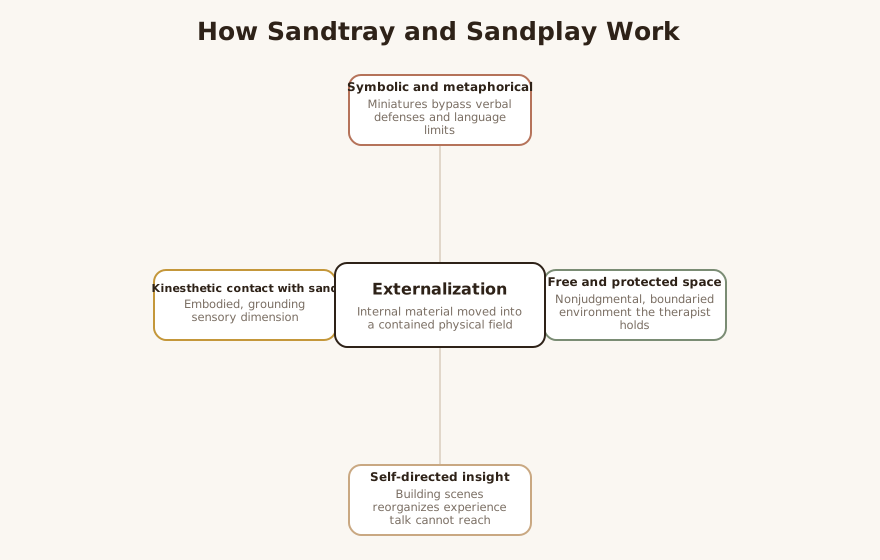
First, the tray provides externalization: the client moves internal material into a contained physical field where it can be seen, rearranged, and reflected on at a workable distance 7LLM. Second, work is symbolic and metaphorical—miniatures stand in for people, feelings, and situations, allowing expression that bypasses verbal defenses and developmental or language limits 76. Third, sandplay in particular relies on the “free and protected space,” a nonjudgmental, boundaried environment the therapist holds so the client’s organizing process can unfold 1LLM. Fourth, the approach assumes a self-directed, often nonverbal route to insight and change: by building and modifying scenes, clients access and reorganize experience that talk alone may not reach 7. Fifth, the kinesthetic, sensory contact with sand itself is therapeutic, adding an embodied, grounding dimension to the work 5LLM. Across traditions, the therapist’s stance is attentive presence and attunement rather than rapid interpretation 14.
Interventions & Techniques
In a typical session, the client is invited to build a scene—or “world”—in a standardized sand tray using miniatures organized by category (people, animals, structures, vehicles, vegetation, fantasy/spiritual figures, and symbols of conflict and resource) 64. The therapist generally observes without interrupting during construction, then, depending on tradition, either witnesses quietly (classical sandplay) or invites verbal processing of the choices, arrangement, and meaning of the scene (sandtray) 74. Common techniques include open invitations (“build a world in the sand”), focused prompts (a tray about a relationship, a loss, or a feared situation), inviting the client to title the scene, asking what each figure might say, and tracking changes across a series of trays over time 4LLM. Clients may rephrase the scene by moving or removing figures, and these in-tray changes can rehearse changes the client wants in life 7.
LLM-generated illustrative example (not a guideline): A clinician working from a CBT frame asks an adolescent with social anxiety to build “what walking into the cafeteria feels like.” The crowded, looming figures around a small buried figure become a concrete map for identifying automatic thoughts and, in a later tray, for rehearsing a coping scene where the figure stands and the crowd shrinks. LLM
Directiveness, verbal processing, and interpretation are calibrated to the client and theoretical frame; more directive, verbal use suits sandtray, while restraint and symbolic patience characterize sandplay 41.
Evidence Base
Sandtray/sandplay therapy is best described as an established and widely practiced modality with a developing, modest evidence base 12. A peer-reviewed overview by Roesler (2019) summarized the theoretical basis, applications, and empirical status, concluding that the method is well-described clinically and internationally adopted, while controlled outcome research remains limited 1. A meta-analysis by Wiersma and colleagues (2022) pooled available treatment-outcome studies and reported generally positive effects, supporting clinical use, while noting heterogeneity and methodological limitations in the underlying literature 2. Honest appraisal for clinicians: much of the evidence is descriptive, single-group, or drawn from small and heterogeneous samples, with relatively few rigorous randomized controlled trials compared with first-line modalities such as trauma-focused CBT 12LLM. “Established” here means recognized, organized, and trainable—not that its outcome evidence rivals that of the most heavily trialed manualized treatments 2LLM. It is reasonable to use it as an adjunct or as a primary expressive approach within a broader, evidence-informed treatment plan, with outcome monitoring 2LLM.
Populations & Indications
The modality is particularly indicated for clients who cannot, or do not readily, express experience verbally—young children, clients with language or developmental differences, and adults with alexithymia or constricted affect 76. It is used across the lifespan: children, adolescents, and adults, and in dyadic and group formats including couples, families, and therapy groups 74. Reported applications include trauma, neglect, and abuse, anger and mood and anxiety disorders, grief, relationship and family disruption such as divorce, and adjustment difficulties 7. It is also applied with medically ill children and clients with disabilities or communication difficulties 7. For trauma survivors specifically, the externalizing, titrated nature of the tray can let clients approach overwhelming material at a tolerable symbolic distance 7LLM. In family and couple work, a shared or sequential tray can externalize relational dynamics that are hard to name directly 4LLM.
Problems-for-Work
- PTSD / trauma: Build a scene representing a manageable piece of the experience; the symbolic distance supports titrated processing and a sense of mastery as the client reworks the tray 7LLM.
- Childhood behavioral problems: Trays externalize impulses and conflicts a child cannot articulate, giving clinician and caregiver a shared, concrete reference for patterns and triggers 7LLM.
- Anxiety: A tray of a feared situation maps the threat appraisal and supports graded, rehearsed coping scenes 6LLM.
- Depression: Scenes can surface hopelessness, isolation, or loss themes that the client then reorganizes toward resource and connection 7LLM.
- Grief: Miniatures allow the client to represent and stay in relationship with what was lost, supporting mourning and meaning-making 6LLM.
- Family / relationship conflict: A shared tray externalizes alliances, distance, and roles, making relational dynamics discussable 4LLM.
- Attachment difficulties: The “free and protected space” and the therapist’s attuned witnessing offer a corrective relational experience alongside the imagery 1LLM.
- Adjustment disorder: Building “before/after” or “now/hoped-for” trays helps clients narrate transitions and locate agency 4LLM.
Contraindications, Cautions & Cultural Humility
There are no absolute contraindications, but caution applies where externalized symbolic material could destabilize a fragile client; with acute psychosis, severe dissociation, or unstable safety, expressive depth work should follow stabilization and be paced carefully 4LLM. Avoid over-interpreting a client’s scene—imposing symbolic meaning can be inaccurate and can rupture the alliance; let meaning emerge from the client 14. Some clients experience the tray as childish or exposing, so informed consent and a clear rationale matter 6LLM. Cultural humility is central: miniature collections should include figures, spiritual symbols, family structures, and skin tones that represent diverse clients, and clinicians must not assume the meaning of any symbol, since the same figure can carry very different significance across cultures and individuals 4LLM. The method’s historical absorption of Eastern philosophical influences should be held respectfully rather than as exotic decoration 5LLM.
Treatment-Plan Suggestions & SMART Objectives
| Goal | SMART objective (example) | Mechanism |
|---|---|---|
| Increase nonverbal emotional expression | Within 6 sessions, client builds and verbally describes at least one feeling-state tray per session, naming 2+ emotions each time | Externalization and symbolization bypass verbal defenses 7 |
| Reduce trauma-related distress | Over 8 sessions, client constructs and reworks a trauma-themed scene with SUDS dropping from 8 to 4 or lower at completion | Titrated, symbol-distanced exposure and mastery 7LLM |
| Improve affect identification (alexithymia) | Within 5 sessions, client correctly labels the emotion behind 3 chosen figures per tray, up from 0–1 at baseline | Concrete symbols scaffold interoceptive labeling 6LLM |
| Strengthen family communication | Over 6 family sessions, members co-build a shared tray and each names one relational need aloud | Shared externalization makes dynamics discussable 4LLM |
| Process grief | Within 8 sessions, client builds a memorial/loss tray and articulates one piece of continuing-bond meaning | Symbolic representation supports mourning 6LLM |
| Build coping for anxiety | Within 5 sessions, client constructs a feared-situation tray then a coping tray and rehearses 2 coping steps | Scene rehearsal links insight to behavior change 67LLM |
| Increase distress tolerance / grounding | Each session, client uses sensory contact with sand for 2+ minutes and rates calmer affect afterward | Kinesthetic, sensory grounding regulates arousal 5LLM |
Common Misconceptions
A first misconception is that sandtray and sandplay are interchangeable; they share apparatus but differ in theory and stance—Kalff’s sandplay is Jungian and nondirective, while Homeyer and Sweeney’s sandtray is cross-theoretical and often more verbal and directive 54. A second is that it is “only for children”; it is used with adolescents, adults, couples, families, and groups 74. A third is that the therapist’s job is to decode symbols for the client—pushing interpretation contradicts the witnessing stance and risks inaccuracy 14. A fourth is that it replaces talk therapy; it is typically conducted alongside verbal psychotherapy 7. A fifth is that strong evidence makes it equivalent to first-line treatments—its outcome literature is positive but modest and heterogeneous 2LLM.
Training & Certification
Competent practice requires foundational training in psychotherapy or counseling plus specific instruction in sandtray/sandplay theory, ethics, the witnessing stance, and supervised case experience 4LLM. Formal certification pathways exist; consumer guidance describes seeking certified practitioners with on the order of roughly 120 hours of coursework, alongside appropriate licensure 7. The International Society for Sandplay Therapy and its member societies set training guidelines and teaching standards for the Jungian sandplay tradition, typically including didactic training, personal process work, and supervised cases 5. Sandtray training in the Homeyer–Sweeney tradition is available through workshops, the practical manual, and supervised practice and is designed to layer onto a clinician’s existing theoretical orientation 4LLM. As with any expressive modality, ongoing supervision is recommended, especially for trauma applications 4LLM.
Key Terms
- World Technique: Lowenfeld’s original method of building a miniature world in a sand tray to represent inner contents 5.
- Sandplay: Kalff’s Jungian, nondirective, symbolic method emphasizing the free and protected space 51.
- Sandtray: The broader, cross-theoretical, often more verbal and directive application articulated by Homeyer and Sweeney 4.
- Free and protected space: The nonjudgmental, boundaried therapeutic field the therapist holds for the client’s self-directed process 1LLM.
- Tray / world: The standardized sand container in which the client builds the scene 6.
- Miniatures: The categorized figures and objects the client selects to populate the scene 64.
- Externalization: Moving internal experience into a visible, manipulable physical field 7LLM.
- Witnessing stance: The therapist’s attuned, largely non-interpretive presence during scene construction 14.
Resources & Further Reading
▶ Watch — a video introduction to this concept:
- Roesler, C. (2019). Sandplay therapy: An overview of theory, applications and evidence base. The Arts in Psychotherapy.
- Wiersma, J. K., et al. (2022). A meta-analysis of sandplay therapy treatment outcomes. International Journal of Play Therapy.
- Sandtray/Sandplay Therapy (chapter). Handbook of Play Therapy. Wiley.
- Homeyer, L. E., & Sweeney, D. S. Sandtray Therapy: A Practical Manual. Routledge.
- History — International Society for Sandplay Therapy (ISST).
- Sand Tray / Sand Play Therapy — GoodTherapy.
- Sandplay Therapy — Psychology Today.
Reflective / Supervision Questions
- When I select a more directive sandtray prompt versus a nondirective sandplay invitation, whose need is driving that choice—the client’s process or my discomfort with silence? LLM
- How do I notice and resist the pull to interpret a client’s symbols before meaning has emerged from them? LLM
- Does my miniature collection adequately represent the cultures, family structures, spiritualities, and bodies of the clients I serve, and what am I assuming about symbol meaning? LLM
- For trauma cases, how am I titrating depth and confirming stabilization before inviting symbolic processing? LLM
- How do I document and frame this technique within the psychotherapy modality I am actually delivering, and how am I monitoring outcomes given the modality’s modest evidence base? 2LLM