
Type & Discipline
Ziran (自然) is a philosophical concept, not a treatment modality. It belongs to Taoism (Daoism), the classical Chinese tradition rooted in texts such as the Daodejing (Tao Te Ching) and the Zhuangzi 5. The term is conventionally translated as “naturalness” or “spontaneity,” with a literal sense of “self-so,” “so-of-itself,” or “that which is so by itself” 17. The two characters are zì (self) and rán (so / right), yielding the reading “of its own” or “by itself” 5.
For the practicing therapist, the relevant point is one of category. Ziran is a contemplative and ethical orientation toward how a person — or anything — comes to act in accord with its own nature, rather than a manualized protocol with defined sessions, fidelity measures, or outcome targets LLM. It enters the consulting room the way mindfulness once did: as a frame and a metaphor that can be operationalized inside an established, evidence-based modality, not as a stand-alone intervention with its own trial literature LLM.
Creators & Lineage
Ziran has no single author. It is associated above all with Laozi, the traditional attributed author of the Daodejing, and with Zhuangzi, both regarded in Taoist tradition as the founders who gave the idea its most explicit early exposition 3. The concept appears prominently across early Daoist texts including the Daodejing, the Zhuangzi, and the Taipingjing 5. In the Daodejing, chapter 25 describes the Dao itself as “ruled by itself” — ziran — pointing to the Dao’s intrinsic, ungoverned nature rather than to any external command 5.
Later commentators sharpened the idea. The Neo-Daoist philosopher Wang Bi treated ziran as ultimate reality — the true “just-so-ness” shared by both the natural world and humanity — and held that sages do not artificially transform themselves but effortlessly abide in ziran, letting things take their own course 5. Guo Xiang (d. 312) glossed ziran as spontaneous “self-production” and “self-transformation,” positioning it as the most fundamental layer of reality underneath all existence 5.
In Western intellectual history, the cluster of ideas around spontaneity and naturalness was later taken up, in a different vocabulary, by humanistic psychology, where naturalness and spontaneity figure as markers of healthy, self-actualizing functioning 6. That resonance is conceptual and historical, not a claim that humanistic psychologists were translating Taoism directly LLM. The lineage a clinician should hold in mind, then, runs from Taoism and its sibling concept wu wei, through humanistic notions of self-actualization, and into contemporary acceptance-based therapies that prize psychological flexibility over rigid self-control LLM.
Core Principles
The central image is that the universe continually generates itself through dynamic, self-organizing processes, and that things flourish when they “develop in accord with the Cosmic Way (Dao)” 1. Ziran names that quality of unforced, self-arising development — a state of “just-so-ness” or “as-it-is-ness,” functioning at once as a personal virtue and as a description of how natural processes unfold without artificial constraint 5.
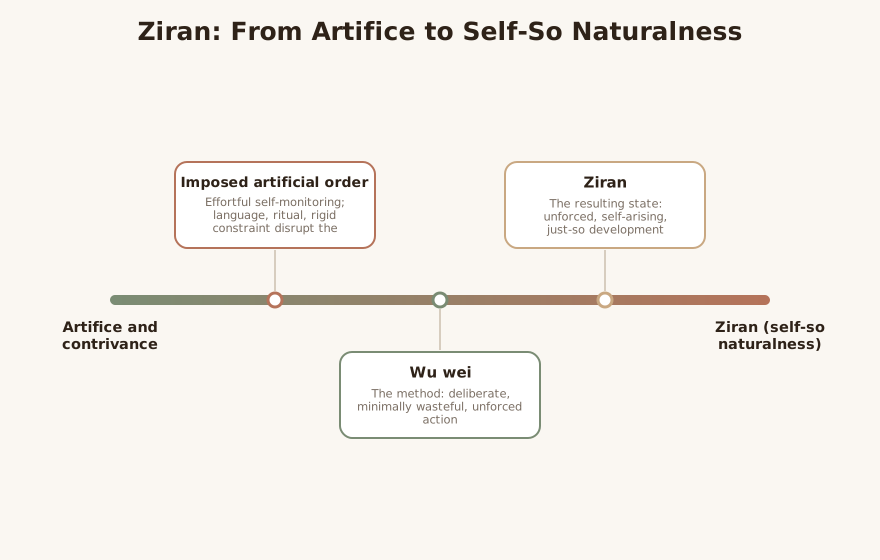
A first principle is that artifice obstructs nature. Humans disrupt the natural flow by imposing artificial order through language, rituals, and rigid government; the corrective is to cultivate openness toward ziran and attune to the constant transformations of the Way 1. Suffering, in this frame, arises when individuals act unnaturally and interrupt the Dao’s spontaneous transformations 3.
A second principle is that ziran is the positive face of wu wei. Where wu wei (often translated “non-action” or “action-less action”) names a way of acting, ziran names the resulting state of being 34. One source frames wu wei as the method and ziran as the state — deliberate, minimally wasteful action that lets one’s authentic nature express itself 4. Crucially, wu wei “is not no action”; it is mindful, responsive choosing, not passivity 4.
A third principle is authenticity through unlearning. The ideal involves “unlearning” inherited societal norms to recover naturalness, with discipline internalized so thoroughly that action becomes effortless and unaffected 3. Ziran, on this reading, means recognizing and inhabiting one’s fundamental nature without artificial definitions or borrowed stories about oneself 4.
It is worth flagging a genuine scholarly tension here, because it bears directly on clinical use. Peer-reviewed work has framed ziran as a question — authenticity or authority? — asking whether the concept licenses individual self-expression or instead counsels deference to a larger natural order 2. Clinicians should resist collapsing ziran into a simple “just be yourself” slogan; the tradition is more ambivalent than that LLM.
Interventions & Techniques
Ziran is a frame, so the “techniques” below are clinical translations rather than canonical practices LLM. Each is best delivered inside an established modality.
- Naming the artifice. Because the tradition locates suffering in imposed, contrived order 1, a clinician can help a client notice where effortful self-construction — rehearsing, performing, over-controlling — is generating the very distress the client seeks to escape LLM.
- Distinguishing responsiveness from passivity. Since wu wei “is not no action” 4, psychoeducation should explicitly separate ziran-informed acceptance from resignation or avoidance, so the client does not hear “be natural” as “do nothing” LLM.
- Unlearning borrowed stories. Drawing on the “unlearning” of inherited norms 3 and the idea of dropping artificial self-definitions 4, narrative and defusion-style work can loosen rigid self-concepts (“I am the competent one,” “I must never disappoint”) so a more self-arising response can emerge LLM.
- Cultivating effortless action through internalized skill. The tradition holds that mastery internalized deeply enough becomes spontaneous and unaffected 3; behaviorally, this maps onto rehearsing valued actions until they no longer require white-knuckle self-monitoring LLM.
- Direct experience over analysis. One source stresses that ziran is understood through direct experience rather than intellectual dissection 4; experiential and mindfulness-based exercises therefore fit the concept better than purely didactic explanation LLM.
Evidence Base
Be candid with clients and colleagues: the evidence base for ziran as a clinical intervention is metaphorical, not empirical LLM. There are no randomized controlled trials of “ziran therapy,” no validated ziran fidelity scales, and no outcome data attached to the concept itself LLM. The primary sources are philosophical, historical, and encyclopedic — they describe what ziran means within Taoism, not what it does in a treatment population 135.
What exists is conceptual scaffolding. Scholarship situates ziran within Taoist metaphysics and ethics 12, and a humanistic-psychology literature treats spontaneity and naturalness as features of healthy functioning 6. Even within philosophy the meaning is contested, as the “authenticity or authority” framing makes plain 2. The honest clinical position is that ziran can enrich the rationale and language of acceptance-, mindfulness-, and values-based work whose own evidence base is established, while contributing no independent efficacy claim of its own LLM. Any benefit a client experiences should be attributed to the host modality and the therapeutic relationship, not to the metaphor as such LLM.
Populations & Indications
The concept tends to resonate most with adults whose presenting difficulties center on over-control, self-construction, and the fatigue of performing a self LLM. Likely candidates include perfectionists, people-pleasers, people with anxiety, creative professionals, and those explicitly struggling with authenticity LLM. The shared thread is a felt gap between an effortful, curated self and a more spontaneous one — precisely the gap ziran names when it contrasts contrived order with self-arising naturalness 14.
Creative professionals are a notable fit, because the tradition explicitly links internalized mastery to spontaneous, unaffected expression across painting, calligraphy, and other arts 3. For clients whose creative block is really a fear of producing something imperfect, the ziran frame reframes good work as what “will issue forth something novel and unique” once contrivance is set down 3.
LLM-generated illustrative example (not a guideline): A graphic designer who triple-checks every email and reworks each draft into paralysis might explore, within their existing therapy, how much of their effort is “imposed order” versus genuinely useful care — testing whether a less rehearsed first draft still lands well LLM.
Problems-for-Work
- Perfectionism and self-criticism. Ziran’s critique of imposed, artificial order 1 offers a lever: the client examines whether relentless self-correction is service to a value or simply contrivance generating distress LLM.
- Social anxiety and inauthenticity. The notion of dropping borrowed self-definitions 4 supports exposure-based work in which the client risks a less managed, more self-arising presentation and gathers disconfirming evidence LLM.
- Experiential avoidance and rumination. Because wu wei is responsive, not inert 4, the frame helps separate skillful acceptance from avoidance, and present-moment naturalness from ruminative analysis LLM.
- Low self-esteem and identity disturbance. The “just-so-ness” shared by self and world 5 can scaffold a steadier, less contingent sense of self for a client whose worth feels perpetually under audit LLM.
LLM-generated illustrative example (not a guideline): A client who feels she “disappears” into whatever others need might use the ziran frame, inside her ongoing therapy, to practice noticing her own preference before agreeing — small acts of self-so in low-stakes situations LLM.
Contraindications, Cautions & Cultural Humility
Several cautions matter. First, avoid the passivity misreading: a client in an abusive relationship, in crisis, or facing a problem requiring decisive action should never hear “be natural / let things take their course” as permission to disengage — the tradition itself insists wu wei “is not no action” 4. Second, mind the authenticity-versus-authority ambiguity: the concept does not unambiguously endorse radical self-expression, and presenting it as a clean “just be yourself” oversimplifies a contested idea 2. Used carelessly, that simplification could validate impulsivity or rationalize avoidance of legitimate obligations LLM.
Cultural humility is essential. Ziran is a living concept within a specific religious and philosophical tradition, not a free-floating wellness slogan 13. Clinicians borrowing it should name its Taoist origin, avoid flattening it into generic self-help, and stay alert to appropriation — especially with clients for whom these traditions are part of heritage rather than novelty LLM. It is also not a substitute for evidence-based treatment of any diagnosable condition; it is, at most, an adjunctive frame within such treatment LLM.
Treatment-Plan Suggestions & SMART Objectives
| Goal | SMART objective (example) | Mechanism |
|---|---|---|
| Reduce perfectionistic over-control | Within 8 weeks, client submits 3 pieces of work as “good-enough” first drafts without rework, rating distress before/after | Naming and relaxing imposed, artificial order 1 |
| Increase authentic self-expression | Over 6 weeks, client voices a genuine preference in 2 low-stakes social situations weekly | Dropping borrowed self-definitions 4 |
| Distinguish acceptance from avoidance | Within 4 weeks, client identifies 3 instances where “letting be” was responsive vs. avoidant in session | Wu wei as action, not inaction 4 |
| Soften self-criticism | Over 8 weeks, client logs daily a self-critical thought and a “self-so” reframe, reviewed weekly | Cultivating naturalness over contrivance 3 |
| Reduce rumination | Within 6 weeks, client completes 4 brief experiential exercises favoring direct experience over analysis | Ziran grasped through experience, not dissection 4 |
| Stabilize a contingent sense of self | Over 10 weeks, client articulates 3 stable self-descriptions not tied to performance | “Just-so-ness” of self 5 |
| Build effortless valued action | Within 8 weeks, client rehearses one valued behavior to the point it needs no pre-rehearsal | Internalized mastery becoming spontaneous 3 |
Common Misconceptions
“Ziran means do nothing / go with the flow passively.” This conflates ziran with inaction; its partner concept wu wei is explicitly mindful, responsive choosing, not passivity 4. “Ziran just means be your authentic self.” The scholarship frames the concept as an open question between authenticity and deference to a larger order, so the slogan oversimplifies it 2. “Naturalness means raw, uncultivated impulse.” On the contrary, the tradition describes naturalness as the fruit of discipline internalized so deeply that action becomes effortless and unaffected 3. “Ziran is an evidence-based therapy technique.” It is a philosophical frame with no independent outcome literature; any clinical value rides on the host modality LLM.
Training & Certification
There is no credential, certification, or governing body for “ziran-based therapy,” because it is a philosophical concept rather than a modality LLM. A clinician wanting to use it responsibly is better served by (a) grounding in the primary tradition through reputable reference and scholarly sources 15, and (b) formal training in the evidence-based modality that will actually host the work — for example acceptance and commitment therapy, mindfulness-based interventions, or humanistically oriented approaches LLM. The concept’s resonance with humanistic constructs of spontaneity and naturalness offers one credible bridge for clinicians already trained in that lineage 6.
Key Terms
- Ziran (自然): “Self-so,” “so-of-itself”; naturalness or spontaneity as both a personal virtue and a property of unfolding natural processes 57.
- Wu wei (無為): “Non-action” / “action-less action”; effortless, responsive action that does not force outcomes — the method of which ziran is the resulting state 34.
- Dao (道): The “Way”; described as “ruled by itself” (ziran), the self-arising course things follow when not obstructed 15.
- Just-so-ness / as-it-is-ness: Renderings of ziran emphasizing things being exactly as they spontaneously are, without artificial constraint 5.
- Self-transformation: Guo Xiang’s gloss of ziran as spontaneous self-production underlying all existence 5.
Resources & Further Reading
▶ Watch — a video introduction to this concept:
- Ziran | Daoism, Nature, Harmony — Encyclopaedia Britannica
- Ziran: Authenticity or Authority? — Religions (MDPI, peer-reviewed)
- Ziran — New World Encyclopedia
- Wu-Wei and Ziran: Learning to Embrace Virtue & Freedom — Personal Tao
- Ziran — Wikipedia
- Spontaneity and Naturalness — Journal of Humanistic Psychology
- Ziran [Spontaneity, the “Self-so”] (自然) — encyclopedia entry
Reflective / Supervision Questions
- When I invoke “naturalness” with a client, am I helping them relax contrivance, or am I subtly endorsing avoidance? How would I know the difference in this case? LLM
- Am I treating ziran as authenticity (self-expression) or as deference to a larger order — and have I made that interpretive choice explicit to my client and myself? 2
- For this client, is the ziran frame deepening an evidence-based intervention, or substituting for one that the presentation actually requires? LLM
- How am I handling the cultural origins of this concept — naming its Taoist lineage, or quietly repackaging it as generic self-help? 13
- Where in my own clinical practice am I over-controlling — rehearsing, performing, managing — in ways the concept I am teaching would gently question? LLM