
Type & Discipline
Foucauldian power/knowledge is a body of social theory, not a therapy. LLM It originates in philosophy and historical sociology and belongs to the family of poststructuralist social theory. LLM Michel Foucault reconceived the relationship between power and knowledge, arguing that the two are inseparable rather than independent — that “the exercise of power perpetually creates knowledge and, conversely, knowledge constantly induces effects of power.” 2 For clinicians, the value of this material is not a set of techniques but a critical lens on the field they practice in: a way of seeing how psychiatry, psychology, and therapy themselves participate in producing the categories of “normal” and “abnormal” that they then treat. 1
This article treats the theory as a reflective and ethical resource. LLM You will not bill for “doing Foucault,” but the framework can sharpen how you formulate cases, hold diagnostic categories, and notice the power that adheres to your own role. LLM Its claims are conceptual and historical, so its “evidence” is intellectual rigor and influence rather than randomized trials. LLM
Creators & Lineage
Michel Foucault is the originating figure. LLM Across Madness and Civilization, Discipline and Punish (1975), and The History of Sexuality, Vol. I (1976), he traced how modern societies shifted from violent sovereign power toward dispersed forms of control exercised through institutions, knowledge, and the body. 1 He insisted power be studied “from the bottom up,” in “the multitude of loci of power spread throughout a society: families, workplaces, everyday practices,” rather than as something held at the top and pushed down. 1
The bridge from Foucault to the consulting room is the work of sociologist Nikolas Rose. 3 Rose is “particularly known for his development of the work of the French historian and philosopher Michel Foucault” and for reviving studies of governmentality in the Anglo-American world. 3 His foundational books — The Psychological Complex (1985), Governing the Soul (1989), and Inventing Our Selves (1996) — are recognized as founding texts in understanding the links between expertise, subjectivity, and political power. 3 Rose argues that “the proliferation of the ‘psy’ disciplines has been intrinsically linked with transformations in governmentality, in the rationalities and technologies of political power in ‘advanced and liberal democracies’.” 3 His Governing the Soul: The Shaping of the Private Self gives the lineage its most quoted title. 5
For practicing therapists, the most consequential downstream lineage runs into the clinic through narrative therapy (White and Epston), social constructionism, critical psychology, and the anti-psychiatry movement — each of which borrows Foucault’s suspicion that diagnostic “truth” is also an exercise of power. LLM
Core Principles
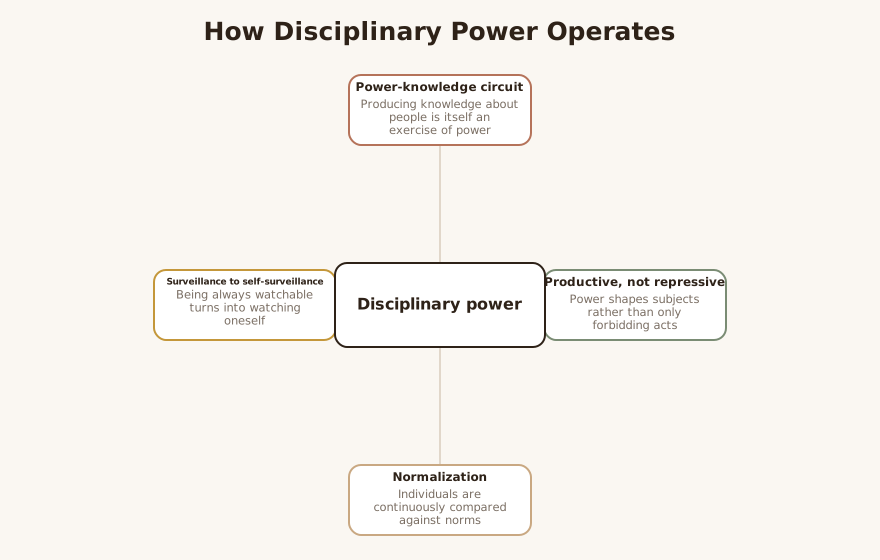
Power and knowledge are one circuit. Rather than knowledge being a neutral tool that power happens to use, Foucault held that producing knowledge about human beings is itself an exercise of power, and that power “decides what is knowable and by whom.” 2 The examination — the graded test, the intake assessment, the mental status exam — exemplifies this fusion by combining “the deployment of force and the establishment of truth” in a single act. 1
Power is productive, not merely repressive. Disciplinary power does not only forbid; it produces subjects — it shapes how people understand and monitor themselves. 1 Individuals come to internalize the “truths” that power produces about them. 2
Normalization replaces prohibition. Modern discipline works by establishing norms and then continuously comparing individuals against them, “focusing on what people fail to do” and producing the categories of “normal” and “abnormal” used in schools, hospitals, and workplaces. 1 This differs fundamentally from older legal systems that simply declared acts forbidden. 1
Surveillance becomes self-surveillance. In the Panopticon, inmates who could always be watched eventually internalize the gaze and regulate themselves; visibility becomes a trap. 1 The clinical analogue is the client who has learned to watch and correct themselves against a standard they did not choose. LLM
The human sciences are not innocent. Foucault showed how psychiatry, psychology, and medicine became instruments of power while claiming scientific objectivity, “encoding social and ethical commitments” — for instance, presenting a contestable moral framework about madness as neutral scientific fact. 1
Biopower governs populations and life itself. Distinct from sovereign power’s right to kill, biopower “endeavors to administer, optimize, and multiply” life through medical, statistical, and administrative knowledge that manages bodies and populations at scale. 1
Interventions & Techniques
Foucauldian theory supplies no manualized intervention; what it offers is a posture and a set of analytic questions a clinician can fold into recognized therapies. LLM The “techniques” below are reflective moves, not billable procedures in themselves. LLM
Externalizing the problem from the person. Borrowed into narrative therapy, this asks the clinician and client to treat the problem as a separate entity shaped by social discourse, rather than as a defect inside the person — a direct application of the idea that “abnormality” is produced, not discovered. LLM
Mapping the discourse. The clinician helps the client notice whose standards they are measuring themselves against and where those standards came from, surfacing the normalizing judgments that drive shame. 1
Tracing internalized surveillance. Naming the “always-watched” feeling — the self-monitoring inmate of one’s own Panopticon — can loosen its grip by making the internalized gaze visible and questionable. 1
Holding diagnosis lightly. A Foucauldian stance treats the diagnostic label as a tool with effects, not a final truth about the person, and invites attention to what the label does as well as what it describes. 2
LLM-generated illustrative example (not a guideline): A 34-year-old client says, “I’m just a depressive — it’s who I am.” The clinician gently externalizes: “When did ‘depression’ start telling you that’s the whole of you?” Over several sessions they map where the standard of the relentlessly productive, cheerful self came from (work, family, social media) and notice how much self-monitoring it demands. The DSM label remains useful for coordinating care, but it stops being the client’s identity. LLM
Evidence Base
Maturity here is established — but as social theory, not as an empirical treatment. LLM Foucault’s analyses and Rose’s extensions are among the most cited and influential frameworks in the humanities and social sciences, and Rose’s books are treated as founding texts for an entire field of inquiry. 3 That is a strong claim to intellectual maturity. LLM
It is not, however, evidence in the clinical-trial sense. LLM There is no randomized literature showing that “applying Foucault” improves symptom outcomes, because the framework is not a procedure with an outcome to measure — it is a way of interrogating the assumptions behind procedures. LLM Be honest with clients and supervisees about this: the theory earns its place by clarifying ethics and reducing harm, not by outperforming CBT on a depression scale. LLM Where it informs practice, it does so through downstream modalities (notably narrative therapy) that carry their own, separate, and more modest evidence base. LLM
Populations & Indications
The framework is especially clarifying when working with marginalized populations and stigmatized groups, where the gap between a person’s distress and the social judgments layered onto it is widest. LLM It is directly relevant to psychiatric service users, who have often had the categories of “normal” and “abnormal” applied to them from the outside, and who may carry the internalized gaze most heavily. 1
It is also addressed to clinicians and the mental health field itself — Rose’s whole project is an analysis of how the “psy” disciplines operate as part of governance, which makes practitioners both an audience and an object of study. 3 At the broadest scale it speaks to society at large, since biopower describes the administration of whole populations through health knowledge. 1 Indications are therefore less about client diagnosis and more about situations — anywhere identity, stigma, and the authority of expertise are in play. LLM
Problems-for-Work
Stigma and marginalization. The theory reframes stigma as a product of normalizing judgment rather than an inherent attribute, which can de-shame and re-politicize a client’s experience. 1
Internalized oppression. The Panopticon model explains why a person continues to police themselves against an external standard even when no one is watching, giving a vocabulary for that lived experience. 1
Power imbalance in relationships. Because power is “dispersed networks” running through “families, workplaces, everyday practices,” the lens helps map subtle, everyday power relations rather than only dramatic abuse. 1
Identity and self-definition. If individuals internalize the truths power produces about them, then identity work can include questioning which truths were imposed. 2
Normalization and social control. Clients pressured to conform to a norm (around gender, productivity, “wellness”) can examine the norm itself rather than only their failure to meet it. 1
Pathologization of distress. The framework invites caution about converting an understandable response to circumstance into a “case,” echoing Foucault’s account of how the examination turns individuals into documented cases. 1
LLM-generated illustrative example (not a guideline): A queer client raised in a conservative community presents with chronic anxiety. Rather than treating the anxiety as a freestanding disorder, the clinician and client examine the normalizing discourses the client has been measured against, and how surveillance from family and community became self-surveillance. Symptom-focused skills (paced breathing, exposure) still run in parallel; the Foucauldian lens reframes the meaning of the symptoms so the client stops experiencing them as personal defect. LLM
Contraindications, Cautions & Cultural Humility
The chief caution is misuse as a reason to withhold care. LLM A critique of how psychiatry produces categories is not a license to deny a suffering client effective, evidence-based treatment, including diagnosis and medication where indicated; doing so can itself be a harm. LLM The theory is a check on the clinician’s certainty, not on the client’s access. LLM
A second caution is over-intellectualizing. LLM Introducing critical theory to a client in acute crisis, or to one who finds a diagnosis genuinely relieving, can feel invalidating; titrate to the person in front of you. LLM
Used well, the framework is itself an instrument of cultural humility: it asks the clinician to notice that their own expertise carries power and “encodes social and ethical commitments” presented as neutral. 1 Because power runs bottom-up through everyday relations, the therapy room is one of its “loci” — the clinician is never outside the power relation they are analyzing. 1 Naming the asymmetry between clinician and client, especially across lines of race, class, gender, or psychiatric history, is the practical form this humility takes. LLM
Treatment-Plan Suggestions & SMART Objectives
| Goal | SMART objective (example) | Mechanism |
|---|---|---|
| Reduce shame attached to a diagnosis | Within 6 sessions, client will articulate, in their own words, the difference between “having a label” and “being the label,” rated in 2 consecutive sessions | Holding diagnosis lightly; de-fusing identity from category 2 |
| Surface internalized norms driving distress | Within 4 sessions, client will name 3 specific standards they measure themselves against and where each came from | Mapping normalizing judgment 1 |
| Loosen self-surveillance | Over 8 weeks, client will log 5 instances of the “always-watched” feeling and one alternative response per instance | Making the internalized gaze visible and questionable 1 |
| Externalize the problem | By session 5, client will describe the problem as a separate influence at least once per session using externalizing language | Treating “abnormality” as produced, not intrinsic LLM |
| Reframe stigma as social, not personal | Within 6 sessions, client will reattribute one self-blaming statement to a social/normalizing source | Stigma as product of normalizing judgment 1 |
| Restore agency over self-definition | Over 10 sessions, client will author a preferred self-description independent of imposed categories, reviewed for stability twice | Questioning which “truths” were internalized 2 |
| Map relational power dynamics | Within 4 sessions, client will diagram one everyday relationship’s power flows and identify one point of leverage | Power as dispersed, bottom-up networks 1 |
Common Misconceptions
“Power is just oppression.” Foucault’s point is the opposite: power is productive — it makes subjects, knowledge, and norms, not only prohibitions. 1 Treating it as purely negative misses the whole argument. LLM
“Power sits at the top.” Foucault explicitly studied power “from the bottom up,” dispersed through everyday institutions and relations, not concentrated in a sovereign. 1
“If diagnosis is a construct, it’s fake.” Constructed does not mean unreal or useless; the claim is that categories have real effects and carry hidden commitments, not that distress is imaginary. 2
“This is an anti-treatment, anti-medication stance.” The framework critiques the authority and effects of expertise; it does not instruct clinicians to abandon effective care. LLM
“Rose just repeats Foucault.” Rose extends the analysis specifically to psychological expertise, showing how psychology promises freedom and autonomy yet uses expertise “to shape the very autonomy it claims to restore.” 4
Training & Certification
There is no certification in Foucauldian theory, and none is needed or offered. LLM It is acquired through reading and supervision rather than credentialing. LLM A practical reading path for clinicians is the Stanford Encyclopedia of Philosophy entry on Foucault for the core concepts 1, Rose’s Governing the Soul for the application to the “psy” disciplines 5, and his article “Engineering the Human Soul” for the governmentality argument in condensed form 4. Clinicians who want to practice with these ideas should pursue formal training in a modality that operationalizes them — most directly narrative therapy. LLM
Key Terms
- Power/knowledge — the thesis that power and knowledge are inseparable, each producing the other. 2
- Disciplinary power — control exercised through hierarchical observation, normalizing judgment, and the examination. 1
- Normalization — governing by comparing individuals to a norm and sorting “normal” from “abnormal.” 1
- The examination — a procedure fusing observation and judgment that turns individuals into documented “cases.” 1
- Panopticon — an architecture of potential constant visibility that produces self-surveillance. 1
- Biopower — power that administers and optimizes the life of populations through medical and statistical knowledge. 1
- The psy-disciplines — psychology, psychiatry, and allied expertise analyzed as instruments of governance. 3
- Governmentality — the rationalities and techniques by which conduct is shaped, including through expertise. 3
- Technologies of the self — practices by which people work on themselves, often guided by psychological expertise. 4
Resources & Further Reading
▶ Watch — a video introduction to this concept:
- Michel Foucault — Stanford Encyclopedia of Philosophy 1
- Foucault’s Theory of Power & Knowledge — Definition, Examples & Analysis (Perlego) 2
- Nikolas Rose — Wikipedia 3
- Rose, “Engineering the Human Soul: Analyzing Psychological Expertise” (Science in Context) 4
- Rose, Governing the Soul: The Shaping of the Private Self (book record) 5
- Sovereign power, disciplinary power and biopower: resisting what power with what resistance? (research record) 6
Reflective / Supervision Questions
- Where in my own intake and assessment process am I conducting “the examination” — fusing observation with judgment to turn a person into a case? 1
- Whose norms am I implicitly asking this client to meet, and have I named that standard out loud? 1
- When I give a diagnosis, am I aware of what the label does to this client’s self-understanding, not only what it describes? 2
- How does the power asymmetry in this therapy room — across diagnosis, race, class, or gender — shape what the client can say to me? 1
- Am I using a critique of expertise to deepen care, or am I at risk of using it to withhold effective treatment? LLM
- Where does my own role sit within the “psy” disciplines Rose describes, and how comfortable am I sitting with that? 3