
Type & Discipline
Bounded rationality is not a therapy. It is a theory of human decision-making that originated in economics, organizational science, and cognitive science.14 Its central claim is descriptive rather than prescriptive: it describes how people actually decide, given that rationality is limited when individuals make decisions, rather than how an idealized agent should decide under perfect conditions.3 In this wiki it sits as a cross-disciplinary frame from decision science whose mechanisms map usefully onto clinical work with perfectionism, indecision, and anxious overthinking. LLM
The companion concept, satisficing, is the behavioral strategy bounded rationality predicts: a portmanteau of satisfy and suffice, it names the practice of searching through available alternatives until an acceptability threshold is met, without necessarily maximizing any specific objective.2 Together they offer therapists a vocabulary that is empowering rather than pathologizing — “good enough” is reframed not as a failure of effort but as the realistic, adaptive default of any finite mind. LLM
Creators & Lineage
The concept of bounded rationality was coined by Herbert A. Simon, who proposed it as an alternative basis for the mathematical and neoclassical economic modelling of decision-making.3 Simon introduced the term satisficing in 1956, having developed the underlying ideas as early as his 1947 book Administrative Behavior.2 His work spanned economics, psychology, political science, organizational theory, and artificial intelligence, and his contributions to decision-making in organizations were foundational enough to make him one of the most influential social scientists of the twentieth century.5 His standing in decision science is well established — this is a mature, canonical theory, not a fringe idea.54
The lineage runs in several directions. In behavioral economics and cognitive psychology, Simon’s ideas were extended by Daniel Kahneman and Amos Tversky, whose research on heuristics of judgment, risky choice, and the framing effect built on his foundation.3 A second branch, associated with Gerd Gigerenzer, developed “ecological rationality,” arguing that simple heuristics often lead to better decisions than theoretically optimal procedures.3 More recently, the framework has been applied to artificial intelligence and decision-making in public organizations, where the limits of computation are explicit and unavoidable.5 For clinicians, the relevant inheritance is decision theory and its descent into cognitive behavioral therapy, where appraisals about decisions, certainty, and “enough” are the working material of treatment. LLM
Core Principles
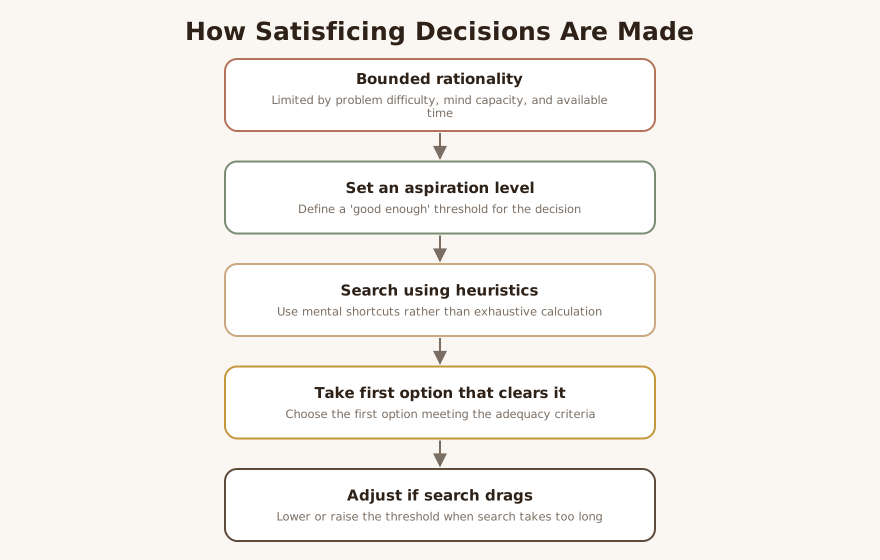
- Rationality is bounded by three things. The quality of a decision is limited by the difficulty of the problem requiring a decision, the cognitive capability of the mind, and the time available to make the decision.3 No real agent escapes all three.1
- People satisfice rather than optimize. Decision-makers act as satisficers, seeking a satisfactory solution with everything they have at the moment rather than an optimal one.3 They choose an option that fulfills their adequacy criteria rather than the single best option.3
- The aspiration level is the lever. Satisficing works by setting an aspiration level — a threshold of “good enough” — and choosing the first option that meets or exceeds it, adjusting the threshold if the search drags on.2
- Heuristics, not exhaustive calculation. Economic agents use heuristics to make decisions rather than a strict rigid rule of optimization.3 Mental shortcuts are a feature of bounded minds, not a defect. LLM
- It is a critique of the “rational agent.” Bounded rationality addresses the discrepancy between the assumed perfect rationality of human behavior used by other economic theories and the reality of human cognition.3 The optimizing agent of classical economics is a fiction; the satisficer is the real one.4 LLM
Interventions & Techniques
Because bounded rationality is a theory, not a manual, its clinical “techniques” are translations — ways of operationalizing satisficing inside an existing evidence-based modality.4 LLM The core move is to install an aspiration level deliberately: with the client, define in advance what “good enough” looks like for a given decision (the threshold), then commit to selecting the first option that clears it.2 LLM This converts an open-ended, anxiety-amplifying search into a bounded one. LLM
Several practical translations follow. LLM A decision deadline externalizes the “time available” constraint Simon identified, forcing closure and disconfirming the belief that more deliberation reliably yields better outcomes.3 LLM A satisficing experiment is a behavioral experiment in CBT terms: the client makes a low-stakes choice (a restaurant, a paint color) by the good-enough rule and rates predicted versus actual regret, testing the maximizing prediction directly.2 LLM Psychoeducation about the maximizer–satisficer distinction is itself an intervention, because the research finding that satisficers tend to be relatively pleased with their decisions while maximizers tend to be less happy with their decision outcomes reframes “high standards” as a cost, not a virtue.2 LLM Finally, naming the three bounds — problem difficulty, cognitive capacity, finite time — functions as a self-compassion and cognitive-distancing frame: the client is reaching a normal human limit, not failing.31 LLM
Evidence Base
Honesty about maturity requires two separate statements. As a theory of decision-making, bounded rationality is established — a canonical, widely taught, and extensively elaborated framework across economics, psychology, organizational science, and AI, with Simon’s contributions recognized as foundational.541 It is not speculative. LLM
As a clinical intervention, however, it has no standalone evidence base. There is no manualized “bounded rationality therapy,” no randomized controlled trials of satisficing as a treatment, and no efficacy rating, because it was never a treatment.4 LLM Its clinical legitimacy is entirely borrowed: it supplies a conceptual model that is delivered through, and tested as part of, evidence-based therapies — chiefly cognitive behavioral therapy and acceptance- and values-based approaches.4 LLM The maximizer/satisficer wellbeing finding (that maximizers report more post-choice regret) is suggestive and frequently cited, but clinicians should treat it as a useful heuristic rather than a dosing instruction.2 LLM The correct framing for practice: use the model as scaffolding; deliver change through its evidence-based vehicles. LLM
Populations & Indications
The frame is most useful for adults whose distress is organized around decisions, standards, and certainty.4 LLM It speaks directly to people with perfectionism, who hold an implicit optimizing standard the human mind cannot meet, and to people with anxiety disorders, particularly generalized anxiety, where worry functions as an attempt to compute every contingency before acting.3 LLM It is clinically apt for people with OCD, whose checking and reassurance-seeking are, in decision terms, an unbounded search for certainty that no aspiration level is ever permitted to close.3 LLM It serves decision-makers and leaders carrying high-stakes, time-pressured choices, for whom the “satisfactory not optimal” reframe is both true and stabilizing.5 LLM And it applies to general clinical populations presenting with everyday indecision, choice overload, and stress.4 LLM It is best suited to clients with the cognitive flexibility to adopt a new appraisal frame; it is not a fit for acute crisis or for decisions that genuinely warrant maximal care. LLM
Problems-for-Work
- Perfectionism. The optimizing standard is the cognitive engine; introducing an aspiration level reframes “best” as one good-enough option among many that clear the bar.2 LLM
- Maximizing / decision paralysis. Choice overload is treated by deliberately bounding the search and committing to the first option above threshold.2 LLM
- Indecisiveness. A pre-set deadline operationalizes the finite-time constraint and breaks the loop of “I just need a little more information.”3 LLM
- Generalized anxiety disorder. Worry-as-computation is challenged by the fact that no bounded mind can pre-solve every contingency; satisficing licenses action under irreducible uncertainty.31 LLM
- Obsessive-compulsive disorder. Checking and reassurance-seeking are framed as a search with no acceptability threshold; treatment (within ERP/CBT) restores a stopping rule.3 LLM
- Rumination. Repetitive post-decision review maps onto maximizer regret; the satisficer stance (“I chose adequately, given what I had”) interrupts it.2 LLM
- Stress. Naming the three bounds normalizes overwhelm as the predictable result of finite capacity meeting an unbounded demand.3 LLM
LLM-generated illustrative example (not a guideline): A perfectionistic graduate student cannot submit a chapter because each draft “could be better.” With her therapist she sets an aspiration level — “clear, defensible, and on time” — agrees to submit the first draft that clears it, and rates predicted regret (8/10) against actual regret one week later (2/10), directly testing the maximizing belief. LLM
Contraindications, Cautions & Cultural Humility
The frame can be misapplied to domains where care genuinely should be maximal — medical decisions, safety, irreversible choices, or relational ruptures — and the clinician must distinguish anxious over-optimization from appropriate diligence.4 LLM “Good enough” must never become a tool for minimizing a client’s legitimate standards, values, or reasonable grievances; satisficing is about the search process, not about lowering what matters. LLM There is also a values-clash caution: “good enough” can collide with cultural, familial, religious, or professional contexts where excellence and thoroughness carry deep meaning, and the language should be adapted with humility rather than imposed.1 LLM Finally, the maximizer–satisficer research describes population tendencies, not a verdict on any individual; clinicians should hold it lightly and avoid labeling a client a “maximizer” as if it were a diagnosis.2 LLM
Treatment-Plan Suggestions & SMART Objectives
| Goal | SMART objective (example) | Mechanism |
|---|---|---|
| Reduce decision paralysis | For 4 weeks, client makes one low-stakes daily choice using a pre-set “good enough” threshold, ≥5 days/week, logging time-to-decide | Aspiration-level setting / bounded search2 |
| Loosen perfectionistic standards | Within 6 weeks, client submits 3 pieces of work at “clear and on time” (not “perfect”) and rates predicted vs. actual regret | Maximizer-belief disconfirmation2 |
| Break information-gathering loops | For 6 weeks, client sets a research deadline before deciding and acts when it arrives, ≥1×/week | Finite-time constraint3 |
| Reduce post-decision rumination | Daily for 4 weeks, after any decision client states “I chose adequately given what I had” and rates rumination 0–10 | Satisficer reappraisal2 |
| Tolerate uncertainty in worry | Over 8 weeks, client identifies one worry as an attempt to “compute everything,” then acts without full information, logged weekly | Bounded-rationality reframe31 |
| Restore a stopping rule (checking) | Within 6 weeks, client reduces checking/reassurance episodes by defining and honoring an acceptability threshold, tracked daily | Acceptability-threshold / ERP support3 |
| Normalize overwhelm | For 4 weeks, when stressed client names which of the 3 bounds (difficulty, capacity, time) is binding, ≥3×/week | Self-compassion / cognitive distancing3 |
Illustrative; deliver via established CBT/ACT methods and measure with validated tools (e.g., GAD-7, Y-BOCS, perfectionism scales). LLM
Common Misconceptions
- “Satisficing means settling for mediocrity or being lazy.” It means stopping the search once an option is genuinely good enough; it is a strategy for finite minds, not a license for low standards.2 LLM
- “Bounded rationality means people are irrational.” The point is the opposite — people are rational within limits, adapting sensibly to constraints of information, capacity, and time.31 LLM
- “Optimizing is always better.” The research finding is that maximizers often feel more regret and less satisfaction, so the strategy with the better life outcome is frequently the satisficing one.2 LLM
- “It’s the same as positive thinking.” It is a structural claim about search and stopping rules, not an attitude adjustment. LLM
Training & Certification
There is no certification in bounded rationality, and none is needed, because it is not a freestanding treatment.4 LLM Competent clinical use rests on two things: conceptual literacy in the theory (Simon’s work and reputable secondary sources) and credentialed training in the evidence-based therapies that operationalize it — chiefly CBT and ACT, plus ERP for OCD presentations.54 LLM The model is a lens added to an existing scope of practice, not a new one. LLM
Key Terms
- Bounded rationality — the idea that rationality is limited when individuals make decisions, so they select a satisfactory rather than optimal option.3
- Satisficing — searching through alternatives until an acceptability threshold is met, without necessarily maximizing any objective.2
- Aspiration level — the “good enough” threshold a decision must meet; the search stops at the first option that clears it.2
- Maximizer vs. satisficer — two decision styles; maximizers tend to be less happy with outcomes, satisficers relatively more pleased.2
- Heuristics — mental shortcuts agents use instead of strict optimization.3
- Ecological rationality — Gigerenzer’s view that simple heuristics often outperform theoretically optimal procedures.3
Resources & Further Reading
▶ Watch — a video introduction to this concept:
- Bounded Rationality — Stanford Encyclopedia of Philosophy
- Satisficing — Wikipedia
- Bounded rationality — Wikipedia
- Bounded Rationality — EBSCO Research Starters
- Bounded Rationality, Satisficing, AI, and Decision-Making in Public Organizations: The Contributions of Herbert Simon — Public Administration Review
- Bounded Rationality and Satisficing: A New Paradigm in Decision-Making by Herbert A. Simon — BA Notes
Reflective / Supervision Questions
- When I encourage a client toward “good enough,” am I helping them act under realistic limits, or am I subtly minimizing a standard or grievance that genuinely matters to them?
- How do I distinguish a client’s anxious over-optimization from diligence that a high-stakes decision actually warrants?
- Where does the maximizer–satisficer framing illuminate my client’s distress, and where might labeling them risk flattening a more complex picture?
- In which of my own clinical decisions do I optimize when I could satisfice — and what does that model for the people I treat?