
Type & Discipline
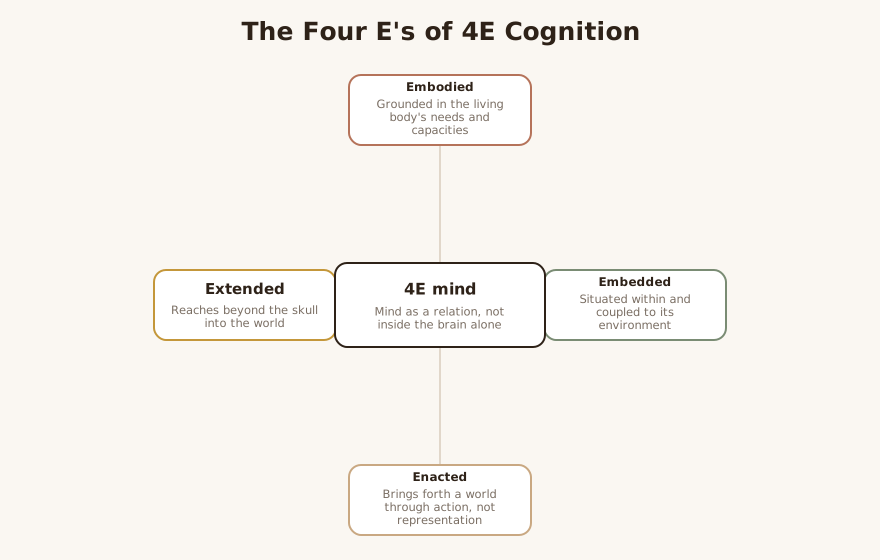
Embodied / 4E cognition is a research program and family of theories in cognitive science and the philosophy of mind, not a school of psychotherapy 3. The label “4E” names four interlocking claims: cognition is embodied (it involves the whole body in interaction with its environment, not the brain alone), embedded (it is situated within and depends on physical and social context), enactive (it consists in active exploration and “bringing forth” of a meaningful world rather than passive reception of information), and extended (it can reach beyond the skull and skin into tools, artifacts, and culture as a coupled brain–body–world system) 4. The framework arose as a deliberate alternative to classical cognitivism, which treats the mind as a computer that collects, transforms, and stores internal representations of a pre-given world 2. For clinicians, the relevant point is that 4E reframes “the mind” as a relation between a person and their world — including body, others, and culture — rather than as software running inside the head 6.
Within the 4E cluster, enactivism is the most theoretically demanding member, and a 2025 analysis argues it is the most philosophically distinctive of the four — the one that most sharply departs from the representational picture rather than merely supplementing it 5. Where embedded and extended views can be read as add-ons to a still-internalist story, enactivism makes a stronger claim: that meaning itself is generated by the organism’s autonomous activity 2. That stronger claim is what most directly shapes its clinical resonance LLM.
Creators & Lineage
The enactive approach was introduced by Francisco Varela, Evan Thompson, and Eleanor Rosch in their 1991 book The Embodied Mind: Cognitive Science and Human Experience, which remains the foundational text 1. Varela, a biologist, brought the concept of autopoiesis (developed with Humberto Maturana) and initiated neurophenomenology, an effort to bridge first-person contemplative experience with neuroscience 2. Thompson expanded the framework toward consciousness, biological autonomy, emotion, and the continuity of life and mind, and argued that phenomenology is compatible with — not opposed to — scientific investigation 2. Rosch contributed a Buddhist philosophical perspective, arguing that Western psychology had neglected the disciplined introspective methods that contemplative practice offers 2.
The lineage draws explicitly on the phenomenology of Maurice Merleau-Ponty, for whom qualitative experience arises through active bodily engagement with the world 2. It also incorporates pragmatist threads from Peirce and Dewey and contemplative traditions from Buddhist philosophy 7. Later developers, notably Hanne De Jaegher and Ezequiel Di Paolo, extended the model into the social domain with the notion of participatory sense-making — the idea that the interaction process between people itself plays a constitutive role in social cognition 7. Several distinct varieties now coexist: autopoietic/biological enactivism (Varela, Thompson, Di Paolo), sensorimotor enactivism (Alva Noë and O’Regan, holding that perception is realized in the skillful activity of the whole animal), and radical enactivism (Hutto and Myin, which strips out talk of mediating representation entirely) 2.
For psychotherapy, two adjacent lineages matter. Somatic psychology and body-oriented therapies share 4E’s conviction that meaning lives in the lived body, and the broad family of predictive processing / active inference models is increasingly read alongside enactivism as a complementary account of how brains and bodies anticipate and act LLM. These therapeutic and computational lineages are not made by the philosophical sources cited here and should be held as related literatures rather than as claims from this framework LLM.
Core Principles
Sense-making. The central enactive idea is that living systems generate meaning through their own activity: an organism establishes a perspective from which features of the environment acquire significance and value 2. Sucrose is “food” only for an organism metabolically equipped to use it; the world is not neutral data but a field of relevance disclosed by the body’s needs and capacities 2. Clinically, this reframes symptoms as forms of meaning a person’s whole system has enacted, not merely as faulty internal representations to be corrected LLM.
Autonomy and structural coupling. Living systems are autonomous — self-creating and self-sustaining — and they do not passively adapt to a pre-existing world but reciprocally co-create the environment they inhabit through ongoing structural coupling 2. Organism and environment dynamically determine one another 2.
Enaction over representation. Rather than receiving and representing an outside world, the organism enacts or “brings forth” a world of significance through embodied action 6. As Thompson puts it, you need a brain to have a mind, but the mind is not inside the brain — it is a relation between the person and the world, including society and culture 6. Perception, on this view, is something we do — a skillful way of exploring the environment — not a picture we receive 4.
Continuity of life and mind, and first-person experience. Enactivism takes lived, first-person experience seriously as data, and Varela’s neurophenomenology sought disciplined methods (including those refined by contemplative practice) for studying it 2. This is the principle that most directly licenses attention to interoception, felt sense, and embodiment in the consulting room LLM.
Interventions & Techniques
4E cognition is a conceptual lens, so it does not prescribe a fixed protocol; it instead reframes what existing embodied and relational interventions are doing LLM. Clinicians working from this orientation typically foreground the body as a site of meaning and intervene at the level of perception–action coupling rather than verbal content alone LLM. Common techniques drawn from compatible modalities include interoceptive awareness training, grounding and orienting exercises that re-establish a felt sense of safety in the present environment, titrated attention to bodily sensation, movement and posture work, and mindfulness practices that cultivate the disciplined first-person attention the enactive tradition values LLM. The relational dimension — co-regulation, attunement, and the therapist–client dyad as an interactive system of participatory sense-making — is treated as itself a vehicle of change rather than a backdrop to it 7.
LLM-generated illustrative example (not a guideline): A clinician working with a client who reports feeling “numb and far away” might, instead of immediately interpreting the affect, invite the client to notice the contact of their feet on the floor, name three sounds in the room, and track whether the felt sense of “distance” shifts as they move their attention — treating perception as an enactable skill the client can re-engage. LLM
Evidence Base
Honesty about the word “established” matters here, because it means two different things. As a research paradigm, 4E cognition and enactivism are well established and influential: the framework has generated a large body of work across consciousness studies, emotion, social cognition, AI, robotics, and education, and it is consolidated in canonical reference works such as The Oxford Handbook of 4E Cognition 3. The maturity rating “established” refers to this paradigmatic standing in cognitive science and philosophy 3. The framework also has live and substantive critics: the “scale-up” objection holds that enactivism struggles to explain abstract thought without smuggling representation back in, and theorists such as Andy Clark argue that internal visual processing cannot be fully redescribed as action 7.
What “established” does not mean is that there is a manualized “4E therapy” with randomized controlled trial support — there is not, because 4E is a theory of mind, not a treatment package LLM. The clinical evidence that bears on this orientation belongs to the specific modalities it informs (somatic and sensorimotor approaches, mindfulness-based interventions, body-oriented trauma work), each of which carries its own separate and variable evidence base that is not established by the philosophical sources cited in this article LLM. Clinicians should therefore present 4E as a coherent, intellectually serious rationale for embodied work — not as an empirically validated stand-alone intervention LLM.
Populations & Indications
Because the framework centers the lived body and the person’s coupling with their world, it is most clinically generative for presentations in which that coupling has been disrupted LLM. It speaks readily to adults in psychotherapy who experience disembodiment, to people with trauma histories whose felt sense of agency and safety has been compromised, and to clients with dissociation, depersonalization, or derealization for whom the ordinary enacted sense of being a body in a world has thinned out LLM. It is also a useful lens for people with chronic illness or disability, where the meaning of bodily capacities and the environment’s affordances are renegotiated, and for people with eating disorders, where body image and interoceptive signals are central LLM. Finally, the framework has clear value for clinicians and theorists themselves as a way of organizing why embodied and relational methods work 6.
Problems-for-Work
The orientation maps onto specific clinical problems by locating each in disrupted sense-making, perception–action coupling, or interoception LLM.
- Dissociation and depersonalization/derealization: reframed as a breakdown in the enacted, felt coupling between self, body, and present environment; work targets re-establishing orienting and interoceptive contact LLM.
- Trauma and PTSD: the body’s anticipatory coupling has been organized around threat; interventions re-pattern perception and posture so the present environment can again be enacted as safe LLM.
- Alexithymia and emotional dysregulation: treated as impoverished access to the bodily signals from which emotional meaning is made, addressed through graded interoceptive attention LLM.
- Disembodiment and body image disturbance: approached as distortions in how the body is lived and enacted, not only in how it is cognitively appraised LLM.
- Rumination and overthinking: reframed as cognition decoupled from embodied, present-moment action, with movement and grounding used to re-couple attention to the lived world LLM.
LLM-generated illustrative example (not a guideline): With a ruminating client, a therapist might pair a brief cognitive defusion exercise with standing up and slowly walking the perimeter of the room while describing what they see — deliberately re-coupling stalled internal narrative to enacted perception and movement. LLM
Contraindications, Cautions & Cultural Humility
There are no formal contraindications to a theoretical lens, but the embodied techniques it inspires carry real cautions LLM. Interoceptive and body-focused work can be destabilizing for clients with severe dissociation, acute trauma activation, psychosis, or eating disorders, where attention to the body may intensify distress or compensatory behavior; titration, pacing, and a window-of-tolerance approach are essential LLM. Clinicians should avoid implying that a client can simply “enact” their way out of suffering, which can shade into invalidation LLM. Cultural humility is especially important given the framework’s borrowing from Buddhist contemplative traditions: practitioners should resist decontextualized or appropriative use of those practices and recognize that what counts as appropriate bodily expression, eye contact, touch, and emotional display varies across cultures LLM. The enactive emphasis that mind is constituted partly by society and culture is itself a reminder to hold each client’s world as theirs, not the clinician’s 6.
Treatment-Plan Suggestions & SMART Objectives
| Goal | SMART objective (example) | Mechanism |
|---|---|---|
| Increase interoceptive awareness | Client will identify and name one bodily sensation linked to a named emotion in 4 of 5 sessions over 6 weeks | Re-engages the body as the source of emotional meaning (sense-making) LLM |
| Reduce dissociative episodes | Client will use a grounding/orienting sequence to return to present-moment awareness within 5 minutes of onset, logged daily, over 8 weeks | Restores enacted coupling between self and present environment LLM |
| Build felt sense of safety | Client will report a 2-point increase on a 0–10 felt-safety scale during a standard orienting exercise across 6 sessions | Re-patterns perception–action coupling away from threat anticipation LLM |
| Decrease rumination | Client will complete a daily 5-minute movement-plus-naming practice on 5 of 7 days for 4 weeks | Re-couples decoupled internal narrative to embodied present action LLM |
| Improve emotion regulation | Client will demonstrate one self-selected somatic down-regulation skill during in-session activation in 3 consecutive sessions | Uses bodily action to modulate affective state LLM |
| Reconnect with body (disembodiment) | Client will engage in a structured body-scan or contact exercise and rate embodiment 1–10 weekly, targeting a sustained increase over 8 weeks | Strengthens the lived, enacted relation to one’s own body LLM |
| Strengthen relational co-regulation | Client will participate in dyadic attunement exercises and identify one moment of felt connection per session for 6 weeks | Leverages participatory sense-making in the therapeutic dyad LLM |
Common Misconceptions
A frequent misconception is that 4E means “the brain doesn’t matter”; in fact the enactive view is that you need a brain to have a mind, but that the mind is a brain–body–world relation rather than something the brain alone produces 6. A second is that the four E’s are interchangeable synonyms; they make distinct claims, and enactivism in particular is the most radical, asserting that meaning is generated by the organism’s activity rather than represented internally 5. A third is that enactivism denies any internal processing altogether — radical enactivism makes strong anti-representational claims, but critics rightly note that some internal processing resists redescription purely as action 7. Clinically, the most consequential misconception is treating 4E as an evidence-based therapy; it is an established research paradigm that informs treatment, not a validated protocol LLM.
Training & Certification
There is no certification in “4E cognition” or “enactivism” as a therapy, because they are not therapies LLM. Clinicians acquire the underlying scholarship through philosophy-of-mind and cognitive-science literature — the foundational Embodied Mind and the Oxford Handbook of 4E Cognition are the standard entry points — and through reference resources such as the Internet Encyclopedia of Philosophy 132. Clinical competence in the methods the framework inspires is gained through training and certification in the recognized modalities that operationalize it: somatic and sensorimotor psychotherapy programs, mindfulness-based intervention trainings, and body-oriented trauma curricula, each governed by its own credentialing bodies LLM. Contemplative-science organizations such as the Mind & Life Institute also offer a bridge between the enactive tradition and applied practice 6.
Key Terms
- Sense-making: the autonomous activity by which a living system generates meaning and relevance from its environment 2.
- Structural coupling: the reciprocal, dynamic co-determination of organism and environment over time 2.
- Autopoiesis: the capacity of a system to self-create and self-maintain, taken as the biological root of cognition 7.
- Enaction: the bringing forth of a meaningful world through embodied action rather than internal representation 6.
- Participatory sense-making: the constitutive role that the interaction process between people plays in social cognition 7.
- Neurophenomenology: Varela’s program for integrating disciplined first-person experience with neuroscience 2.
- Sensorimotor contingencies: the lawful ways sensory stimulation changes with movement, central to Noë’s account of perception 2.
Resources & Further Reading
▶ Watch — a video introduction to this concept:
- The Embodied Mind: Cognitive Science and Human Experience (Varela, Thompson & Rosch) — MIT Press
- Enactivism — Internet Encyclopedia of Philosophy
- The Oxford Handbook of 4E Cognition (Newen, De Bruin & Gallagher, 2018) — Oxford Academic
- ‘4E’ (embodied, embedded, enactive, extended) cognition — Cognitive Classics, School of Advanced Study
- The exceptionality of enactivism within 4E cognition (Phenomenology and the Cognitive Sciences, 2025)
- What is Mind? An ‘Enactive Approach’ to Understanding Cognition — Mind & Life Institute
- Enactivism — Wikipedia
Reflective / Supervision Questions
- Where in my caseload am I treating a symptom as a faulty internal belief when it might be better understood as meaning a client’s whole embodied system is making?
- When I introduce body-focused or interoceptive work, how do I assess whether a particular client’s dissociation or activation makes that destabilizing rather than grounding?
- How do I distinguish, in my documentation and in my own thinking, between 4E as a clinical rationale and the recognized modality I am actually billing and practicing?
- In what ways might the therapeutic relationship itself function as participatory sense-making, and am I attending to that as a mechanism of change?
- How do I honor the contemplative and cultural sources of these practices without decontextualizing or appropriating them, and how does each client’s culture shape what embodiment means to them?