
Type & Discipline
Neuropsychoanalysis is an interdisciplinary interface field rather than a discrete school of therapy LLM. It sits at the meeting point of psychoanalysis and the neurosciences, attempting to correlate the depth-psychological model of mind — drive, affect, conflict, the unconscious — with the brain mechanisms that affective neuroscience and neurobiology have made tractable 4. Its founding premise, as the field’s own association frames it, is that “the brain is the organ of the mind,” so a full account of mental life must integrate neuroscientific findings “with all levels of the mind” 4. Practically, this makes neuropsychoanalysis an explanatory and heuristic framework: it gives clinicians a neurobiological vocabulary for what depth therapy has long described phenomenologically, but it is not itself a manualized, separately billable treatment LLM.
Creators & Lineage
The field’s two principal figures are the neuroscientist Jaak Panksepp and the psychoanalyst and neuropsychologist Mark Solms LLM. Solms is generally credited as the first person to use the term “neuropsychoanalysis,” and he founded the International Neuropsychoanalysis Society in 2000 8. He is best known scientifically for work on the forebrain mechanisms of dreaming, arguing that dreaming and REM sleep are governed by different brain systems — a claim that reopened a Freud-adjacent question about the motivational origins of dreams 8. Solms is also the authorized editor of the Revised Standard Edition of Freud’s complete psychological works, which anchors the field firmly in the Freudian lineage 8.
Panksepp supplied the other pillar: affective neuroscience, the cross-species study of the subcortical emotional systems he held to be the evolutionary foundation of feeling 1. The intellectual ancestry thus runs from Freudian metapsychology and the broader psychoanalytic tradition on one side, and from the neurobiology of emotion and comparative affective neuroscience on the other LLM. Solms’ later work pushes toward consciousness itself, locating the source of subjective experience in deep brain structures rather than the cortex 5.
Core Principles
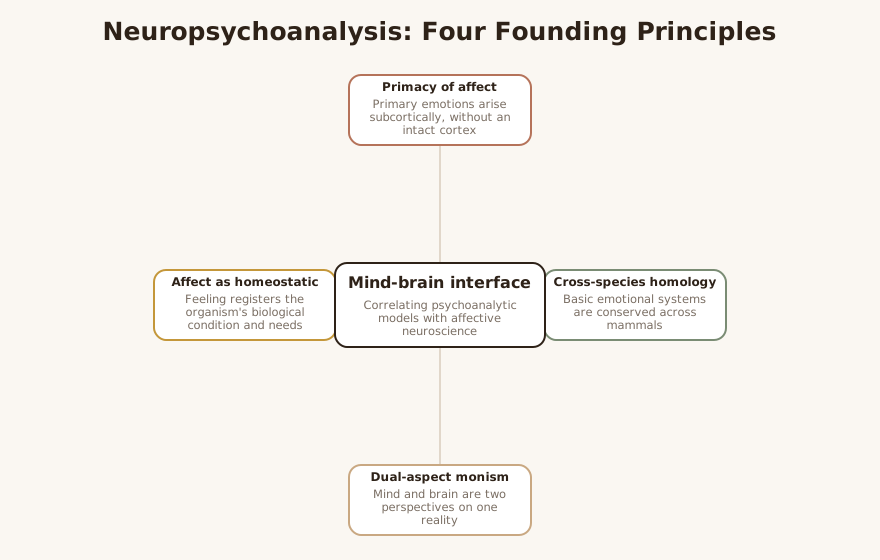
The first principle is the primacy of affect: primary emotions are constituted at the subcortical level and do not require an intact neocortex to be experienced 1. Panksepp’s strongest evidence was that hydranencephalic children, born without a cerebral cortex, still express pleasure through smiling and laughter and aversion through fussing 1. This inverts the cortex-centric model of mind and aligns with the psychoanalytic intuition that feeling and motivation precede and shape rational thought LLM.
The second principle is cross-species homology: the basic emotional systems are conserved across mammals, which is why electrical stimulation, pharmacological challenge, and lesion studies in animals are taken to illuminate human emotion 1. The third is dual-aspect monism — the stance that mind and brain are two perspectives on one underlying reality rather than two separate things, so a somatic act is simultaneously a psychic act 3. The fourth, developed most fully by Solms, treats consciousness and affect as fundamentally homeostatic: feeling is how the organism registers its own biological condition and what it needs 5.
Interventions & Techniques
Neuropsychoanalysis does not supply a distinct toolkit of techniques; it informs how a clinician conducts depth- and affect-focused psychodynamic work LLM. In practice this means treating affect as primary clinical data rather than as noise to be reasoned away, and listening for which basic emotion system is driving a presentation — for example, a depleted SEEKING system in anhedonic depression or an inflamed separation-distress (PANIC/GRIEF) system in attachment-related despair 1. Dream material remains a legitimate object of inquiry, reframed through Solms’ account of the motivational circuitry that generates dreaming 8.
The work otherwise proceeds as recognizable psychodynamic and insight-oriented psychotherapy: building a working alliance, attending to transference and defense, and helping the patient name and tolerate affect LLM. What neuropsychoanalysis adds is a translational rationale — a way to explain to patient and clinician alike why affect regulation, not insight alone, is therapeutic, and why bodily states and feeling states are inseparable 3.
Evidence Base
Honesty about maturity is essential here, and it requires a sharp distinction. The substrate of neuropsychoanalysis — affective neuroscience — has substantial translational support: the seven basic emotion systems were mapped through decades of stimulation, pharmacology, and lesion work, and downstream findings include depression conceptualized as SEEKING/PANIC dysregulation, deep brain stimulation of the medial forebrain bundle producing recovery in a majority of treatment-resistant patients in a small study, and the antidepressant rapastinel, derived from genes expressed in highly playful rats 1. These are real fruits of the research program 1.
But those are neuroscience and pharmacology findings, not outcome trials of a psychotherapy LLM. Neuropsychoanalysis as a clinical framework has essentially no randomized controlled outcome data of its own, because it is an explanatory interface rather than a standalone manualized treatment LLM. Its status is therefore genuinely emerging: a well-supported neurobiological foundation coupled with clinical application that rests on the existing evidence base for psychodynamic and affect-focused therapies, plus theoretical coherence, rather than on dedicated trials LLM.
Populations & Indications
The framework is most often invoked with adults in psychodynamic therapy, where its language of drive and affect maps naturally onto the work LLM. It is frequently applied to people with mood disorders, given the explicit SEEKING/PANIC model of depression 1. It has a natural home with neurological and neuropsychiatric patients, where Solms’ Luria-influenced method of correlating lesion with subjective change is most directly usable 8.
Trauma survivors are a key population, since the field’s emphasis on subcortical, body-based affect fits the clinical picture of trauma far better than a purely cognitive model LLM. People with personality pathology are also indicated, where chronic disturbances of drive, attachment, and affect regulation can be read through the basic emotion systems LLM. Across all of these, neuropsychoanalysis functions as a way of formulating the case, not as an inclusion criterion for a specific protocol LLM.
Problems-for-Work
In major depressive disorder, the clinician can formulate anhedonia and inertia as a down-regulated SEEKING system and the painful, agitated quality of some depressions as separation-distress (PANIC/GRIEF) activation, which guides where to put therapeutic emphasis 1.
In anxiety disorders, the FEAR system provides a frame for understanding chronic threat sensitivity as a subcortical, pre-cognitive process that talk alone will not switch off 1.
LLM-generated illustrative example (not a guideline): A patient describes “going flat — nothing pulls at me anymore.” Rather than treating this only as a cognitive distortion, the therapist names it as the SEEKING system having gone quiet, validates it as a biological state, and works toward small, genuinely appetitive actions to re-engage that system. LLM
For emotional dysregulation and affect/drive disturbances, the basic-emotion-systems map gives a shared language for identifying which feeling is overwhelming the patient 1. For trauma, the field supports a body-and-affect-first stance LLM. For dreaming and unconscious processes, it offers a contemporary neurobiological account of dreams 8. For personality pathology, it frames entrenched relational patterns as dysregulation across the CARE, PANIC, and RAGE systems 1.
Contraindications, Cautions & Cultural Humility
There are no formal contraindications to using a conceptual lens, but there are real cautions LLM. The most important is the risk of reductionism. Critics argue that neuropsychoanalysis can install a “corrective biology” — a framework that quietly imposes normative assumptions about what counts as a well-regulated, adaptive subject by yoking drives to evolutionary fitness 3. The same critique warns that the field can “too neatly cleave dysregulation from regulation,” losing psychoanalysis’s hard-won recognition that suffering and seemingly maladaptive patterns can be meaningful, even protective, survival strategies 3.
Clinically, this means a therapist should resist collapsing a patient’s complex, conflicted inner life into “your PANIC system is overactive,” which can feel invalidating and pseudo-explanatory LLM. Cross-species homology and subcortical universality should not be heard as cultural universality: how affects are named, expressed, and regulated is profoundly shaped by culture and context, and the neuroscience does not license overriding a patient’s own account of their experience LLM. Cultural humility here means using the framework to deepen curiosity, not to adjudicate from above what a person’s distress “really” is 3.
Treatment-Plan Suggestions & SMART Objectives
| Goal | SMART objective (example) | Mechanism |
|---|---|---|
| Re-engage appetitive motivation in depression | Patient initiates 3 self-selected, mildly rewarding activities per week for 4 weeks, logging engagement | Reactivation of the SEEKING system 1 |
| Tolerate separation-related distress | Patient identifies and verbalizes separation-distress affect in 4 consecutive sessions without withdrawal | Naming and down-regulating PANIC/GRIEF activation 1 |
| Reduce pre-cognitive threat reactivity | Patient uses one grounding/affect-labeling skill at threat onset, 5 of 7 days, for 6 weeks | Modulating subcortical FEAR-system arousal 1 |
| Improve affect identification | Patient names the primary feeling in 80% of distress episodes recorded in a daily log over 1 month | Linking subjective state to basic emotion systems 1 |
| Integrate bodily and emotional experience | Patient describes the somatic correlate of a named emotion in 3 sessions across 6 weeks | Dual-aspect, body-and-affect-first formulation 3 |
| Use dream material reflectively | Patient brings and explores one dream every two weeks for 8 weeks | Engaging motivational/unconscious processes 8 |
| Strengthen affect regulation in personality work | Patient reports one successfully regulated interpersonal conflict per week for 8 weeks | Rebalancing CARE/RAGE/PANIC system reactivity 1 |
Common Misconceptions
A first misconception is that neuropsychoanalysis “proves Freud” with brain scans; in reality it selectively translates some psychoanalytic concepts into neurobiology while leaving much of metapsychology untouched and contested 3. A second is that it is a new, evidence-based psychotherapy with its own efficacy data — it is an explanatory framework resting on the affective-neuroscience substrate and on existing psychodynamic evidence, not a trialed protocol LLM.
A third is that emotions “live in the cortex” and are products of higher cognition; the field’s core claim is the opposite, that primary affect is subcortical and developmentally prior 1. A fourth is that the framework dissolves the mind-body problem cleanly: critics contend it actually reinstates a mind-body division through the back door and risks flattening the psyche into “functional systems” like digestion or respiration 3. Holding these caveats keeps the model useful rather than overclaimed LLM.
Training & Certification
There is no licensure in neuropsychoanalysis; clinicians come to it from an existing credential in psychology, psychiatry, social work, counseling, or psychoanalysis and add this lens through continuing education LLM. The Neuropsychoanalysis Association provides the main institutional home, offering training programs, videos, and learning materials for clinicians, researchers, and students, along with conferences such as its congresses 4. It also maintains the peer-reviewed journal Neuropsychoanalysis and an international clinical register of trained practitioners, plus research grants and prizes 4. Solms’ books and lectures, including The Hidden Spring, function as accessible primary entry points into the field’s view of affect and consciousness 57.
Key Terms
Basic emotion systems — Panksepp’s seven conserved subcortical systems: SEEKING, FEAR, RAGE, LUST, CARE, PANIC/GRIEF, and PLAY 1. SEEKING — the appetitive, exploratory system whose down-regulation maps onto anhedonic depression 1. PANIC/GRIEF — the separation-distress system implicated in painful, attachment-related despair 1. Dual-aspect monism — the view that mind and brain are two aspects of one reality, so somatic and psychic acts coincide 3. Affective primacy — the principle that primary feelings are generated subcortically and need no cortex to be felt 1. Corrective biology — a critics’ term for the field’s tendency to smuggle in norms about the “well-regulated” subject 3. Cross-species homology — the conservation of emotion systems across mammals that licenses animal-to-human inference 1.
Resources & Further Reading
▶ Watch — a video introduction to this concept:
- Selected Principles of Pankseppian Affective Neuroscience (Montag & Panksepp, 2018, Frontiers in Neuroscience)
- Revisiting Panksepp: a review of his contributions to neuropsychoanalysis (2025, PMC)
- Corrective biology: psychosomatics in and as neuropsychoanalysis (2019, PMC)
- The Neuropsychoanalysis Association (npsa-association.org)
- The Hidden Spring: A Journey to the Source of Consciousness — Mark Solms (2021)
- Affective Neuroscience: Jaak Panksepp’s ‘rat tickling theory of emotion’ (BJPsych Advances)
- Mark Solms: Neuropsychoanalysis and the Source of Consciousness (Robinson’s Podcast #119)
- Mark Solms (Wikipedia)
Reflective / Supervision Questions
- When you reach for “your X system is overactive,” are you deepening understanding or foreclosing it 3?
- Where in your current caseload would an affect-primary, subcortical lens change what you prioritize in session 1?
- Are you treating a patient’s seemingly maladaptive pattern as a meaningful survival strategy, or quietly sorting them into “regulated” versus “dysregulated” 3?
- How do you hold the neurobiological universality of basic emotions alongside the cultural and personal specificity of how this patient experiences and names feeling LLM?
- And honestly: are you presenting neuropsychoanalysis to yourself and your patients as an established treatment, or as the emerging, explanatory framework it actually is LLM?