
Type & Discipline
Narrative identity is a construct, not a treatment — a theoretical and empirical object from personality and developmental psychology rather than a manualized therapy.1 It names the internalized, evolving story a person constructs from their reconstructed past and imagined future to confer a sense of unity and purpose on life.1 In the field’s standard three-layer model of personality, narrative identity is the third and most distinctly human layer: it sits on top of dispositional traits (layer one) and characteristic adaptations such as goals and values (layer two), and it is the layer that answers the question “Who am I, and how did I come to be this person?”15 For clinicians, this matters because it locates the life story as a measurable, changeable feature of personality — distinct from temperament, and the level at which much of the meaning-making work of psychotherapy actually happens. LLM
The discipline is personality / clinical psychology, with deep roots in developmental and lifespan theory.1 As a research program it is mature: it has validated coding systems, longitudinal data, and a coherent body of findings, which is why it belongs in a clinician’s conceptual toolkit even though “doing narrative identity” is not a billable service in itself. LLM
Creators & Lineage
The contemporary construct is most associated with Dan P. McAdams, whose life-story model of identity, developed from the 1980s onward, frames identity itself as an internalized and evolving narrative.15 McAdams directs the Study of Lives Research Group at Northwestern University (successor to the Foley Center for the Study of Lives), the program that has generated much of the coding methodology and empirical evidence.6 His collaborator Kate C. McLean co-authored the field’s most-cited synthesis, and the construct’s measurement and clinical implications have been advanced by Jefferson A. Singer (self-defining memories) and Jonathan M. Adler (longitudinal links to mental health).123
The intellectual lineage runs through two streams.1 The first is Erik Erikson’s theory of identity, which posed identity formation as the central psychosocial task of adolescence and emerging adulthood; McAdams reframed Erikson’s identity not as a fixed status but as a story the person authors and revises across the lifespan.15 The second is the hermeneutic philosophy of Paul Ricoeur, who argued that selfhood is fundamentally narrative — that a person achieves identity through the act of emplotting disparate experiences into a story with characters, scenes, and a through-line. LLM Narrative identity also runs parallel to clinical narrative therapy (White and Epston) and to broader life story theory, though it is a descriptive research construct rather than a therapeutic school.4 LLM
Core Principles
- The self is authored, not merely possessed. Beginning in adolescence and emerging adulthood, people become the narrators of their own lives, selectively reconstructing the past and imagining the future to produce a story that feels like theirs.15
- The story’s job is unity and purpose. Narrative identity integrates the scattered facts of a life into a configuration that provides a sense of sameness and continuity over time, and a sense of where the life is headed.1
- It is reconstructive and evolving, not a transcript. The life story is revised as circumstances and developmental needs change; the “same” event can be re-narrated very differently across the lifespan.15
- It is socially and culturally embedded. Stories are told to audiences, shaped by cultural “master narratives” about how a good life is supposed to go, and constrained by what a given culture makes tellable.1
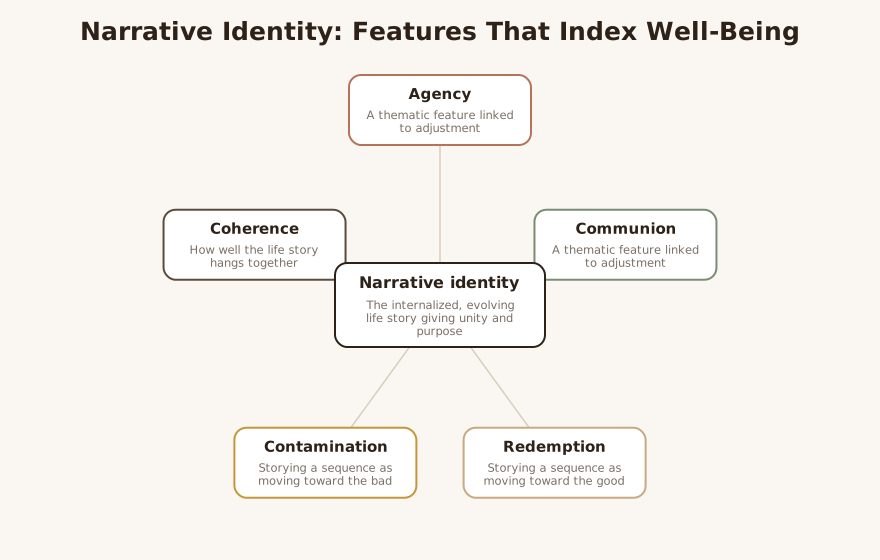
- Specific narrative features index well-being. It is not the events themselves but how they are storied — along dimensions such as agency, communion, redemption, contamination, coherence, and meaning-making — that correlates with adjustment.12
Two narrative sequences are especially well studied.1 A redemption sequence moves from a demonstrably bad scene to a good or growth-bringing outcome (“that loss is what set me on this path”), whereas a contamination sequence moves from good to bad (“everything was fine until it was ruined”).17 McAdams’s work on Americans’ tendency toward “redemptive self” narratives — and the cultural scripts that supply them — is the most developed treatment of these forms.78
Interventions & Techniques
Narrative identity is a construct, so there is no single protocol; rather, clinicians assess it and work with it inside existing therapies.1 LLM The core assessment method is the Life Story Interview, in which the client narrates their life as if it were a book with chapters, identifies high points, low points, and turning points (nuclear scenes), and describes imagined future chapters; responses are then read or formally coded for thematic features.15 At a smaller grain, self-defining memories — vivid, emotionally significant, repeatedly recalled memories tied to enduring concerns — offer a focused window into the same themes and are a practical clinical entry point.3
Trained coders rate narratives on dimensions that double as clinical conversation targets: 12 LLM
- Agency — the degree to which the protagonist is an empowered actor who influences their own life (self-mastery, status, achievement, empowerment).12
- Communion — connection, love, belonging, and care for others within the story.12
- Redemption vs. contamination — the affective direction of key scenes.17
- Coherence — how well the narrative hangs together temporally, causally, and thematically.12
- Meaning-making / exploratory processing — the extent to which the narrator steps back to derive insight, lessons, or self-understanding from events, rather than simply recounting them.12
Clinically, the work is to help a client re-author along these dimensions: noticing a dominant contamination arc and looking for unstoried redemptive material, restoring a sense of agency to a story told entirely in the passive voice, or thickening meaning-making around a turning point that has only ever been recounted as raw event.12 LLM This dovetails with narrative therapy’s externalizing and re-authoring conversations, with the meaning-making emphasis of existential and emotion-focused work, and with structured life review in older adults.4 LLM
LLM-generated illustrative example (not a guideline): A client recounts being laid off as the moment “my career fell apart and never recovered” — a pure contamination arc with the self as passive object. Over several sessions the therapist invites him to narrate the same period as a chapter with a title, asking what he did next and what he learned; he begins to story a turning point in which he chose to retrain, recovering both agency and a tentative redemptive arc. LLM
Evidence Base
The maturity of narrative identity as a construct is best described as established: it is well theorized, reliably measured, and supported by a substantial empirical literature, even though it is not a treatment with efficacy trials.1 Reliable coding systems exist for agency, communion, redemption, contamination, coherence, and meaning-making, and these features show consistent associations with psychological well-being across cross-sectional studies.12 Redemptive narration and high agency, communion, coherence, and meaning-making tend to track with greater well-being; contamination sequences track with lower well-being and more distress.17
The strongest evidence for clinical relevance comes from longitudinal work showing that variation in narrative identity is associated with trajectories of mental health over several years, not merely concurrent status — suggesting the way people story their lives is prospectively linked to how their mental health unfolds.2 This is correlational evidence about a personality construct, however, and the field is careful not to overclaim direction of causation; narrative features may both shape and reflect well-being, and they are studied as part of personality rather than as a stand-alone intervention.12 LLM Honest framing for clinicians: narrative identity gives you a validated lens and set of targets, not an evidence-based protocol — its therapeutic payoff is realized when those targets are pursued within a recognized modality. LLM
Populations & Indications
Narrative identity becomes psychologically operative in adolescence and emerging adulthood, when the cognitive capacity for autobiographical reasoning and the developmental press toward identity converge, making these groups especially apt for narrative-identity work.15 It continues to develop across the lifespan and is clinically generative with adults navigating who they are and where they are headed, and with older adults, for whom life review and the integration of a whole life into a coherent, meaningful story is a central task.15 LLM
The construct is broadly applicable to clients in psychotherapy and is particularly indicated for people in life transitions — career change, divorce, illness, migration, bereavement, retirement — where an old self-story no longer fits and a new chapter must be authored.14 LLM Because the story is socially and culturally embedded, it is also a natural frame for clients negotiating identity against cultural master narratives, including those whose lived path diverges from the dominant scripts of their community.1 LLM
Problems-for-Work
- Identity concerns / “who am I?” — Eliciting the life story and its chapters externalizes the question and reveals where the narrative is thin, fragmented, or borrowed wholesale rather than authored.15 LLM
- Self-continuity disturbance — When clients feel discontinuous with their past or future selves, work on temporal and causal coherence rebuilds the felt sense of being one person over time.12 LLM
- Lack of meaning / existential concerns — Strengthening meaning-making (exploratory processing) around key scenes is a direct route to a more purposeful life narrative.12 LLM
- Depression and low self-esteem — Depressive self-stories are often saturated with contamination sequences and low agency; surfacing and re-authoring these is a coherent treatment target.12 LLM
- Adjustment difficulties / life transitions — Helping a client title and narrate the new chapter, including an imagined future chapter, restores forward momentum and a sense of authorship.14 LLM
- Personality integration needs — For clients whose self-experience feels fragmented, building a more coherent overarching narrative supports integration at the third layer of personality.15 LLM
LLM-generated illustrative example (not a guideline): An emerging adult presents with diffuse low self-esteem and no clear sense of direction. Asking her to name the chapters of her life so far, she realizes every chapter is titled after someone else’s expectations; the work becomes authoring a chapter she chooses, with herself as agent. LLM
Contraindications, Cautions & Cultural Humility
Narrative identity is descriptive, so the central caution is against misusing the norms.1 Redemption and high agency read as “healthy” partly because they reflect a culturally specific, individualistic, American “redemptive self” ideal; pressing every client toward a tidy redemptive arc can invalidate grief, minimize injustice, and impose a master narrative that does not fit the person’s culture or circumstances.178 LLM Cultural humility means treating the client’s storytelling conventions and cultural master narratives as part of the data, not as deviations from a norm.1 LLM
A second caution is timing and capacity: coherence-building and meaning-making presuppose enough safety and emotional regulation to revisit difficult scenes, so with acute trauma, active crisis, or severe dysregulation, stabilization should precede deep autobiographical work.2 LLM Forcing premature meaning-making on un-processed trauma risks re-traumatization and is not the same as the gradual, supported re-authoring the construct describes. LLM Finally, because this is not a stand-alone evidence-based treatment, it should not be offered as one; it is a lens and a set of targets delivered within a recognized therapy.1 LLM
Treatment-Plan Suggestions & SMART Objectives
| Goal | SMART objective (example) | Mechanism |
|---|---|---|
| Increase narrative agency | Over 8 weeks, client re-narrates 3 self-defining memories to identify and articulate their own choices/influence in each, reviewed in session | Restores agentic self-positioning, linked to well-being2 |
| Build temporal/causal coherence | Within 6 weeks, client produces a chaptered timeline of their life with named turning points and the links between them | Coherence supports self-continuity and integration1 |
| Shift dominant contamination arc | Over 10 weeks, client identifies one recurring “good-turned-bad” story and develops an alternative, evidence-based account that includes growth or learning | Reduces contamination, builds redemptive/meaning content17 |
| Strengthen meaning-making | Each session for 8 weeks, client practices exploratory processing of one event (“what did this teach me about who I am?”) and logs the insight | Exploratory processing is associated with adjustment2 |
| Increase communion content | Within 6 weeks, client narrates 3 memories of connection/care and names how relationships figure in their life story | Communion themes track with well-being and belonging12 |
| Author a forward chapter (transition) | Over 4 sessions, client drafts an imagined “next chapter” with a title, key scenes, and a desired ending | Restores purpose and forward direction in transition14 |
| Consolidate a coherent life story (older adults) | Across 6 sessions, client completes a structured life review yielding a chaptered narrative and names 3 sources of meaning | Integration/ego-integrity task of later life15 |
Illustrative; integrate with an evidence-based modality and appropriate measures. LLM
Common Misconceptions
- “Narrative identity is the same as narrative therapy.” The construct is a descriptive, measurable layer of personality from research psychology; narrative therapy is a clinical school. They are related and mutually informative but not identical.4 LLM
- “The life story is an accurate record of the past.” It is a reconstruction shaped by present needs and future hopes, continually revised — its function is meaning and unity, not historical accuracy.15
- “A healthy story must be a redemption story.” Redemptive arcs correlate with well-being in a particular cultural frame, but treating redemption as the required ending imposes a culturally specific master narrative.178 LLM
- “It’s fixed by adulthood.” Narrative identity keeps evolving across the lifespan, which is precisely what makes it a target for therapeutic change.15
- “It’s a soft add-on with no evidence.” It is a well-measured construct with longitudinal links to mental-health trajectories, even if it is not itself a trialed treatment.12
Training & Certification
There is no certification in “narrative identity”; it is taught within personality, developmental, and lifespan psychology curricula, and its methods (the Life Story Interview, self-defining memory protocols, and the associated coding systems) are learned from the primary literature and method papers.135 Clinicians typically acquire the applied skills through training in modalities that operationalize the work — narrative therapy, emotion-focused therapy, and structured life review — and through familiarity with McAdams’s life-story model and McLean’s developmental research.156 LLM
Key Terms
- Narrative identity — the internalized, evolving life story that integrates a reconstructed past and imagined future to provide unity and purpose.1
- Three-layer model of personality — dispositional traits, characteristic adaptations, and narrative identity as the integrative third layer.15
- Agency / communion — thematic dimensions of self-mastery/empowerment and connection/belonging within the story.12
- Redemption sequence — a narrative arc moving from a bad scene to a good or growth outcome.17
- Contamination sequence — a narrative arc moving from a good scene to a bad outcome.1
- Coherence — the temporal, causal, and thematic integration of the narrative.12
- Meaning-making / exploratory processing — deriving insight and self-understanding from narrated events rather than merely recounting them.12
- Self-defining memory — a vivid, emotionally significant, repeatedly recalled memory tied to enduring concerns.3
- Master narrative — a culturally available script for how a life is supposed to go, against which personal stories are told.1
Resources & Further Reading
▶ Watch — a video introduction to this concept:
- McAdams, D. P., & McLean, K. C. (2013). Narrative Identity. Current Directions in Psychological Science
- Adler et al. (2015). Variation in Narrative Identity Is Associated with Trajectories of Mental Health Over Several Years (PMC)
- Singer et al. — Narrative Identity: What Is It? What Does It Do? How Do You Measure It? (PDF)
- Narrative Identity — an overview (ScienceDirect Topics)
- McAdams, D. P. — Self and Identity (Noba Project)
- Dan P. McAdams / The Study of Lives Research Group (Northwestern)
- McAdams, D. P. — The Redemptive Self: Stories Americans Live By
- The two kinds of stories we tell about ourselves (ideas.ted.com)
Related wiki articles: Erikson’s Psychosocial Stages · Narrative Therapy · Life Story Theory · Personality Psychology (McAdams).
Reflective / Supervision Questions
- When I listen to this client’s story, which dimension is most striking — agency, communion, coherence, or meaning — and which is conspicuously absent?
- Am I helping this client re-author their story, or am I steering them toward a redemptive ending that fits my own (or my culture’s) master narrative?
- Does this client have enough stability and safety to revisit and re-narrate difficult scenes, or is stabilization the prior task?
- How is this client’s life story shaped by the cultural scripts available to them — and where might their lived path require authoring against those scripts?
- Within which billable modality am I actually delivering this work, and how am I documenting the identity, coherence, and meaning goals?