
Type & Discipline
Person-Centered Expressive Arts Therapy (PCEAT) is a humanistic, integrative modality that sits at the intersection of counseling and the creative arts therapies 6. It belongs to the broader family of expressive arts therapies, which use multiple art forms in combination rather than a single medium 1. What distinguishes PCEAT from discipline-specific creative arts therapies — art therapy, music therapy, dance/movement therapy — is that it is explicitly grounded in person-centered theory and deliberately moves across several expressive media within a single process 1. LLM In practice, this means a clinician trained in PCEAT is working as much from Rogerian relationship theory as from any particular art technique, treating the arts as vehicles for the client’s own self-directed discovery rather than as diagnostic products to be interpreted by the therapist.
The approach is best understood as a coherent practice tradition with its own training institutes and literature, rather than as a manualized protocol 6. LLM For practicing therapists, that framing matters: PCEAT is a set of principles and processes you integrate into your existing humanistic practice, not a step-by-step treatment package you administer.
Creators & Lineage
PCEAT was developed by Natalie Rogers (1928–2015), an American psychologist and the daughter of Carl Rogers, one of the founders of humanistic psychology 1. She grew up in a creative household — her mother, Helen Elliot, was a talented artist — and after relocating to California in 1970 she built an independent therapeutic practice that synthesized her father’s theory with her own lifelong engagement in the arts 1. She named the resulting synthesis “the creative connection” 1.
The direct theoretical lineage is Carl Rogers’s person-centered (client-centered) therapy and the wider humanistic psychology movement 1. Natalie Rogers also drew on the existing creative arts therapies — visual art, dance and movement, drama, and poetry — extending them beyond any single medium 1. In the 1970s she co-facilitated large encounter groups of 80 to 150 participants alongside her father, work that informed her later application of expressive arts to groups and communities 1.
She formalized the modality institutionally. In 1984 she established the Person-Centered Expressive Therapy Institute and founded Resources for Creativity and Consciousness, which operated until 2005 6. She served as faculty at Saybrook University and trained therapists across multiple institutes over roughly two decades 1. Her central texts are The Creative Connection: Expressive Arts as Healing (1993) and The Creative Connection for Groups (2011), preceded by her earlier Emerging Woman: A Decade of Midlife Transitions (1980) 1. Her contributions were recognized with a Lifetime Achievement Award from the International Expressive Arts Therapy Association (1993) and the Carl Rogers Award from the Society for Humanistic Psychology (2015) 1.
Core Principles
The foundation of PCEAT is the set of conditions Carl Rogers identified as facilitating growth, carried directly into the expressive work: empathy, congruence, and unconditional positive regard 1. The therapist’s central task is to create a safe, judgment-free environment in which the client can explore freely 1. LLM In PCEAT this is not abstract — the safety has to be robust enough that a client will risk moving, drawing, or vocalizing in front of another person, which is often more exposing than talking.
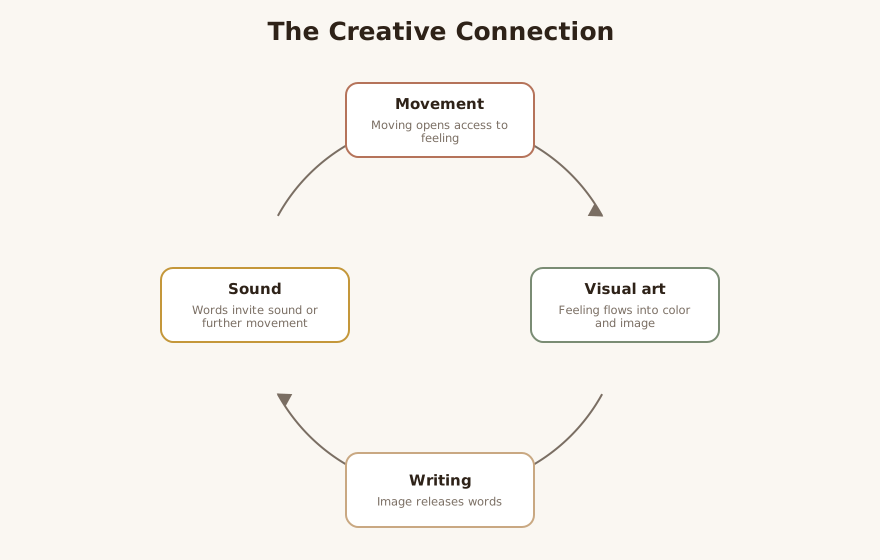
The signature principle is the creative connection itself: the idea that one expressive modality stimulates and frees another 1. Movement may open access to feeling that then flows into color and image; image may release words; words may invite sound or further movement 1. LLM The clinical wager is that this cross-modal flow reaches material that verbal processing alone leaves untouched, including pre-verbal, somatic, and unconscious content. Rogers’s method is explicitly aimed at facilitating access to both conscious and unconscious material through creative expression and at combining self-expression with personal development goals 1.
Several humanistic commitments follow. The process is client-directed: the client, not the therapist, is the authority on the meaning of their work 6. LLM The therapist resists interpreting the art and instead invites the client to dialogue with their own images, movements, and words — a stance that protects the client’s self-determination and keeps the locus of evaluation internal. The arts are understood as healing in themselves, not merely as a route to insight, and the emphasis is on process over aesthetic product 3.
Interventions & Techniques
The working materials of PCEAT are movement, visual art, writing, and sound, used in combination 1. The core technique is to sequence these media so that each loosens the next — the creative connection in action 1. LLM A common flow is a grounding or warm-up, free movement or gesture to access bodily feeling, transition to color and image on paper, then writing or spontaneous sound, and finally verbal reflection and dialogue with what emerged. The order is responsive to the client rather than fixed.
Specific media in the tradition include dance and movement, drawing and painting, sculpture, poetry and expressive writing, drama, and psychodrama 1. Vocal and sound improvisation are part of the repertoire as well 1. LLM Concrete techniques a clinician can adopt include free-drawing to music, gesture or movement that gives the body a “shape” for a feeling, and reflective writing prompts such as letting an image speak in the first person.
LLM-generated illustrative example (not a guideline): A bereaved client who keeps describing grief in flat, abstract terms is invited to move the way the grief “sits” in her body; she curls inward, then is offered oil pastels and fills a page with heavy gray and a single thread of yellow. Asked to write a few lines as the yellow thread, she writes about a memory of her father’s laugh. The verbal processing that follows is markedly more alive than the talk that preceded the arts work LLM.
Throughout, the therapist offers the Rogerian conditions and refrains from interpreting 1. LLM The intervention is as much relational as it is technical: holding non-judgmental presence is what makes the expressive risk possible.
Evidence Base
Honesty about maturity is important here. PCEAT is an established practice tradition — it has a coherent theory, a founder-authored literature, dedicated training institutes, and decades of clinical use 16. That institutional and conceptual maturity should not be confused with a mature controlled-trial evidence base. LLM There is no body of randomized controlled trials specific to PCEAT demonstrating efficacy against active comparators, and the published literature leans toward theory, case description, and conversation rather than outcome research 2.
What can be said with more confidence rests on lineage. The parent modality, person-centered therapy, is among the most studied humanistic approaches, and its core relational conditions have substantial empirical support as common factors across therapies 1. LLM PCEAT inherits that relational foundation, but the incremental benefit of adding the expressive arts — and the specific creative-connection mechanism — has not been rigorously isolated. Clinicians should therefore present PCEAT to clients as a humanistically grounded, experientially supported approach rather than as an empirically validated treatment for any specific diagnosis LLM.
Populations & Indications
Rogers applied the approach across a broad range: children, adults, families, and groups 6. The wider expressive arts tradition and Rogers’s own large-group work extend its use to communities 1. LLM The modality is particularly indicated where verbal access to emotion is limited — clients who intellectualize, who are alexithymic, or who lack the words for pre-verbal or somatic experience often reach feeling more readily through movement, image, or sound than through talk.
Reported and theoretically apt populations include trauma survivors, grieving individuals, people with limited verbal expression, and those engaged in identity exploration or personal growth 6. LLM It is well suited to clients seeking self-discovery and meaning rather than symptom reduction alone, and to group and family contexts where shared creative process can build cohesion and mutual empathy.
Problems-for-Work
LLM The following are clinically apt applications, framed honestly as practice-supported rather than trial-proven.
- Trauma / PTSD. LLM Expressive media can give form to experiences that resist narration; movement and image may approach somatic and pre-verbal trauma content while the relationship holds safety. Application: a client uses clay to externalize a body sensation tied to a flashback, then titrates how much to put into words.
- Grief and loss. LLM The arts allow mourning to move through the body and onto the page when words feel inadequate. Application: a memorial collage and a letter-poem to the deceased.
- Anxiety and stress. LLM Movement and breath-linked sound discharge activation; image-making externalizes worry. Application: drawing the “shape” of anxiety, then redrawing a calmer version.
- Depression and low self-esteem. LLM Self-directed creation rebuilds agency and an internal locus of evaluation. Application: a series of self-portraits across sessions tracking shifts in self-perception.
- Emotional suppression / alexithymia. LLM Cross-modal expression accesses affect that verbal channels miss. Application: color-coding felt states before naming them.
- Identity and self-expression. LLM The arts support exploration of who the client is becoming. Application: a “map of self” combining image, movement, and writing.
Contraindications, Cautions & Cultural Humility
LLM PCEAT is generally low-risk, but several cautions apply. Expressive arts can rapidly surface intense affect and trauma material; with clients who are dysregulated, dissociation-prone, or in acute crisis, the clinician must titrate the work, prioritize grounding, and avoid pushing into overwhelming content LLM. The modality is not a substitute for stabilization, risk management, or psychiatric care where those are indicated LLM.
LLM Because PCEAT lacks a robust efficacy trial base, it should not be offered as a first-line, evidence-based treatment for conditions that have well-validated protocols when a client specifically needs one. Informed consent should be honest about the nature of the evidence LLM. The non-interpretive stance is a safeguard: imposing the therapist’s reading on a client’s image risks misattunement and can replicate power dynamics the humanistic frame is meant to avoid 6.
LLM Cultural humility is essential. Movement, color, sound, and art carry culturally specific meanings; what feels expressive and freeing to one client may feel exposing, inappropriate, or transgressive to another. Some clients have bodily, religious, or cultural relationships to movement, the body, or representation that the clinician must respect rather than override. The remedy is to follow the client’s lead, offer media as invitations the client can decline, and treat the client as the sole authority on the meaning of their work 6.
Treatment-Plan Suggestions & SMART Objectives
| Goal | SMART objective (example) | Mechanism |
|---|---|---|
| Increase access to and naming of emotion | Within 8 sessions, client will identify and name a felt emotion in 3 of 4 sessions using an expressive medium (color, movement, or sound) before verbal labeling | Cross-modal creative connection bypasses verbal block, surfacing affect for naming 1 |
| Process grief | Over 6 weeks, client will complete two arts-based grief tasks (e.g., memorial image, letter-poem) and report reduced avoidance of grief-related cues on a 0–10 scale | Externalization and symbolic expression allow mourning to move and be tolerated LLM |
| Reduce physiological stress activation | By session 6, client will use a movement-and-breath warm-up and rate post-session tension at or below 4/10 in 3 consecutive sessions | Embodied expression discharges autonomic activation LLM |
| Strengthen internal locus of evaluation / self-esteem | Over 10 sessions, client will create a self-directed art series and articulate their own meaning without seeking therapist evaluation in 4 sessions | Client-directed, non-interpreted creation restores self-determination 6 |
| Explore identity | Within 8 sessions, client will produce a multi-modal “self map” and verbally integrate 3 insights about identity | Self-discovery through combined media 1 |
| Approach trauma material safely | Across treatment, client will use titrated arts-based externalization for trauma cues while maintaining grounding, with no post-session dysregulation requiring intervention | Symbolic distance plus relational safety enable graded exposure LLM |
| Build group cohesion / empathy | Over an 8-week group, members will complete shared creative-connection exercises and rate group safety at 7/10 or higher by week 6 | Shared expressive process builds mutual empathy and belonging 1 |
Common Misconceptions
LLM “You have to be artistic.” PCEAT is process-, not product-, oriented; aesthetic skill is irrelevant and the work is the client’s own self-expression 3. “The therapist interprets the art.” The reverse: the client is the authority on meaning, and the therapist offers Rogerian conditions rather than interpretations 61. “It’s just art therapy.” PCEAT is distinguished by its deliberate movement across multiple media — the creative connection — and its explicit grounding in person-centered theory, not a single visual medium 1. “It’s an evidence-based protocol.” It is an established practice tradition with a thin controlled-trial base; its strongest empirical support is inherited from person-centered theory, not from PCEAT-specific outcome trials 2LLM.
Training & Certification
Natalie Rogers institutionalized training through the Person-Centered Expressive Therapy Institute (founded 1984) and related programs, and she trained therapists across multiple institutes over about two decades 61. LLM The credentialing pathway in the broader field is the Registered Expressive Arts Therapist (REAT) designation, which Rogers herself held 4. Clinicians seeking competence typically pursue experiential expressive-arts training, supervision, and personal engagement in the creative-connection process, layered on top of existing licensure as a counselor, social worker, psychologist, or marriage and family therapist LLM. A clinical training video documenting Rogers’s method is available for practitioners who want to see the approach demonstrated 4.
Key Terms
LLM Creative connection — Rogers’s central concept: the principle that one expressive modality stimulates and frees the next (movement to image to word to sound), reaching material that talk alone misses 1. Core conditions — Carl Rogers’s facilitative conditions (empathy, congruence, unconditional positive regard) that PCEAT carries into expressive work 1. Unconditional positive regard — the therapist’s non-judgmental acceptance of the client, foundational to the safe environment 1. Internal locus of evaluation — the humanistic principle that the client, not the therapist, is the authority on the meaning and worth of their experience and their art 6. Process over product — the focus on the act and experience of creating rather than the artistic quality of the result 3.
Resources & Further Reading
▶ Watch — a video introduction to this concept:
- Natalie Rogers — Wikipedia
- Rogers, N. The Creative Connection: Expressive Arts as Healing
- The Development and Evolution of Person-Centered Expressive Art Therapy: A Conversation With Natalie Rogers
- Natalie Rogers: Person-Centered Expressive Arts Therapy (training video)
- Person-Centered Expressive Arts Therapy: Meet the Expert (Natalie Rogers)
Reflective / Supervision Questions
- LLM How comfortable am I sitting with a client’s expressive material without interpreting it, and where do I feel the pull to assign meaning? LLM
- When a creative task surfaces intense affect, can I tell the difference between productive processing and dysregulation that needs grounding? LLM
- How do I hold the honest evidence status of PCEAT in my informed-consent conversations and treatment planning? LLM
- What are my own assumptions about movement, the body, and art-making, and how might they differ from a given client’s cultural or personal relationship to those media? LLM
- Am I offering each medium as a genuine invitation the client can decline, or am I steering toward the modalities I personally favor? LLM
- How do I document expressive-arts sessions so that the clinical rationale and treatment-goal linkage are clear?