
Type & Discipline
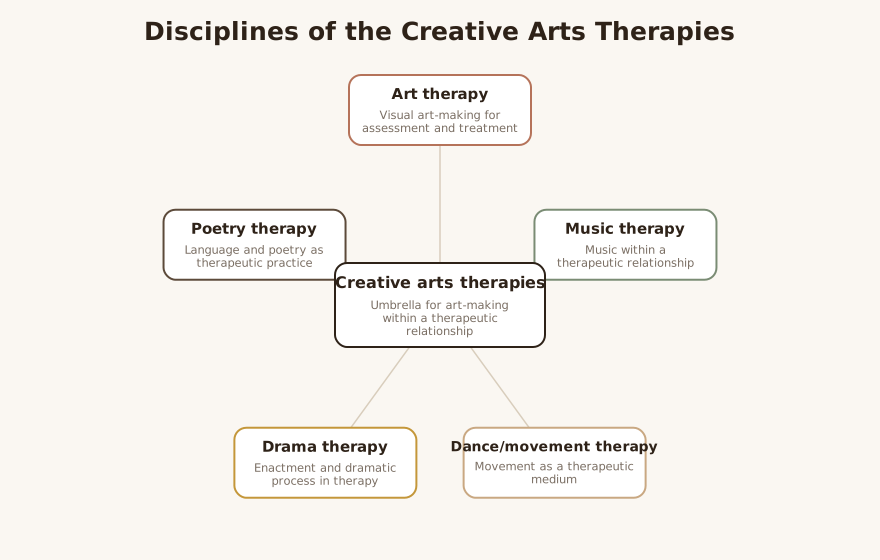
Creative Arts Therapies (CATs) is not a single therapy but an umbrella designation for a group of established healthcare professions that use the creative process of art-making, within a therapeutic relationship, for assessment and treatment 2. The recognized member disciplines, coordinated in the United States under the National Coalition of Creative Arts Therapies Associations (NCCATA), are art therapy, music therapy, dance/movement therapy, drama therapy, and poetry therapy 2. Psychodrama, the action-based method developed by Jacob L. Moreno, is frequently grouped alongside drama therapy in the wider literature on expressive therapies 6.
Each discipline is a distinct profession with its own legally defensible scope of practice, code of ethics, academic competencies, supervised clinical training requirement, and credentialing system 2. This matters clinically: a creative arts therapist is “a trained mental health and healthcare professional whose work integrates arts-based processes within a therapeutic relationship,” not a generalist clinician who occasionally hands a client a sketchpad 2. Within psychology, the field is recognized under the study of aesthetics, creativity, and the arts as a legitimate domain of practice and research 3. LLM
A terminological distinction worth holding: “creative arts therapy” usually refers to a clinician working within a single modality (an art therapist, a music therapist), whereas “expressive arts therapy” describes the intentional, intermodal combination of multiple art forms within psychotherapy, counseling, rehabilitation, or medicine 4. When several modalities are deliberately combined in one session, the work is described as integrative expressive therapy 4. For the referring or collaborating generalist, the practical implication is that these are credentialed adjacent professions you refer to and coordinate with, not interventions you are licensed to deliver by virtue of a counseling or social-work license alone. LLM
Creators & Lineage
The creative arts therapies emerged in the mid-twentieth century as practitioners across the arts and mental health converged on the idea that people can process experience and heal through creative expression 6. Art therapy’s foundational figures include Margaret Naumburg, often called the “mother of art therapy,” who treated art-making as a route to unconscious material in a broadly psychoanalytic frame, and Edith Kramer, who emphasized the inherently healing and integrative properties of the creative act itself 6. Hanna Kwiatkowska and Elinor Ulman are also recognized as early pioneers who helped formalize the discipline 6.
In the action and movement traditions, Jacob L. Moreno developed psychodrama as an action-based psychotherapy in the early twentieth century, seeding the lineage that drama therapy later extended 6. Dance/movement therapy and music therapy developed in parallel through clinicians working in psychiatric hospitals and rehabilitation settings, and poetry/bibliotherapy through the therapeutic use of written and read language 4. The common assumption uniting these lineages is that creative engagement lets a person examine body, feelings, emotions, and thought processes in ways verbal exchange alone may not reach 6. LLM
The broader expressive arts movement built on these single-modality roots by foregrounding the deliberate, intermodal use of art, music, movement, drama, and writing together 4. The orientations a creative arts therapist may draw on are often grouped as “arts as therapy” (the creative process itself is curative), “arts psychotherapy” (the artwork is material for verbal psychotherapeutic exploration), and the use of arts within traditional healing practices 4.
Core Principles
A first principle is that the creative arts therapies are both nonverbal and verbal 4. A persistent misconception treats them as wordless; in practice, creative expression is typically integrated with verbal reflection inside a recognized psychotherapeutic framework — psychodynamic, humanistic, cognitive, and others 4. The art-making opens material; the therapeutic relationship and dialogue metabolize it. LLM
A second principle is multi-level engagement. These therapies are described as engaging individuals on physical, emotional, cognitive, and social levels simultaneously, which is part of why they reach people for whom ordinary verbal communication is difficult or threatening 1. They are framed as offering a non-threatening, non-judgmental space for expression 1. The arts can give form to experience that a client cannot yet, or may never, put into words — a property that recurs as the clinical rationale across trauma, dementia, developmental disability, and pediatric populations 1. LLM
A third principle is collaboration and tailoring. Creative arts therapists work collaboratively with clients, adapting interventions to specific needs and contexts rather than applying a fixed protocol 1. The work is delivered across the full continuum of care — clinics, hospitals, mental health facilities, rehabilitation centers, schools, and community programs — and across the lifespan 1. LLM
A fourth, more provisional principle concerns mechanisms. The literature increasingly investigates the neurocognitive aspects of art-making and the physiological changes associated with arts interventions, treating these as the underlying mechanisms of change rather than incidental side effects 1. This is an active research frontier, not a settled account. LLM
Interventions & Techniques
Interventions are modality-specific, but share a structure: an invitation to create, the creative process itself, and reflective integration. LLM In art therapy, the client makes visual work (drawing, painting, collage, clay) and the image becomes both expression and shared material for exploration 4. Music therapy uses music-making — improvisation, song, listening, rhythm — within the therapeutic relationship 6. Dance/movement therapy uses movement as the primary medium for assessment and intervention, working from the premise that body and mind are interconnected 6. Drama therapy blends theatre techniques such as role, enactment, and story with psychotherapeutic aims, and psychodrama uses structured action methods to externalize and rework relational scenes 6. Poetry therapy uses written and spoken language — reading, writing, and responding to text — for therapeutic ends 2.
Across modalities, the arts are used in two broad ways that map onto the orientations above: the creative process as directly therapeutic (“arts as therapy”), and the created product as a focus for verbal psychotherapeutic work (“arts psychotherapy”) 4. Integrative expressive work intentionally moves between modalities within a session — for instance, from movement into image into spoken reflection — to follow where a client’s expression most readily flows 4.
LLM-generated illustrative example (not a guideline): A nine-year-old who freezes when asked to “talk about the night the police came” is invited by an art therapist to build the safest room in the world from clay. Over three sessions the room acquires walls, then a door, then a small figure inside; the therapist’s verbal reflections track the child’s growing sense of agency without ever requiring a narrative the child cannot yet produce. LLM
Evidence Base
Maturity is best described as established as professions, with condition-specific evidence ranging from strong to emerging. The creative arts therapies are mature healthcare disciplines with decades of clinical application, credentialing, and a research foundation 2. Research and clinical evidence have demonstrated impacts on physical, emotional, cognitive, and social wellness, and have begun to characterize the underlying mechanisms of change 1.
Honesty requires distinguishing the establishment of the professions from the strength of evidence for any single indication. LLM The field’s own literature frames mechanism investigation — neurocognitive and physiological correlates of art-making — as an ongoing research agenda rather than a closed question 1. In clinical terms, the strongest support tends to cluster where the modality matches the deficit (for example, music engaging procedural and affective systems in dementia), while for other conditions the evidence is supportive but more heterogeneous in design and rigor 1. LLM Practitioners and referrers should treat creative arts therapies as legitimate, professionally delivered interventions whose specific indication-level evidence should be checked against current condition-specific reviews rather than assumed uniform across all populations. LLM
Populations & Indications
The creative arts therapies are used across the lifespan and across the continuum of care 1. Populations frequently served include children and adolescents, for whom nonverbal expression is developmentally natural; trauma survivors, where the arts give form to experience that resists narration; and people with serious mental illness, including schizophrenia spectrum conditions, served in psychiatric and community settings 1. Older adults and people with dementia are a major population, where music and movement can engage capacities that decline later than verbal ones 1. LLM
People with developmental disabilities and autism spectrum conditions are served by modalities that reduce reliance on verbal demand and offer structured, embodied engagement 1. Medical and palliative care patients use the arts for expression, meaning-making, and symptom-related distress in hospital and hospice settings 1. Veterans are a recognized population, frequently in the context of trauma and reintegration. LLM The unifying indication across these groups is the value of a non-threatening, expressive channel when verbal communication is constrained, painful, or developmentally limited 1.
Problems-for-Work
The problems these therapies address map onto the populations above. LLM
- PTSD and trauma: the arts externalize and contain traumatic material without forcing premature verbal disclosure, working within a trauma-informed psychotherapeutic frame 4.
- Major depressive disorder, anxiety disorders, and stress: the non-judgmental creative space supports affect expression and regulation, and arts engagement is associated with measurable wellness change 1.
- Grief: image, music, and writing give form to loss when words feel inadequate. LLM
- Dementia and cognitive decline: music and movement engage preserved affective and procedural capacities to support connection and reduce distress 1.
- Autism spectrum disorder and developmental disabilities: structured, embodied modalities lower verbal demand and build communication and social engagement 1.
- Emotional dysregulation and low self-esteem: the creative process offers mastery experiences and a tolerable distance from overwhelming affect. LLM
- People with chronic illness adjustment and schizophrenia spectrum disorders: the arts support coping, meaning-making, and social-cognitive engagement across medical and psychiatric settings 1.
LLM-generated illustrative example (not a guideline): A veteran with combat-related PTSD who shuts down in exposure work agrees to a dance/movement therapy referral. Working with grounding and gradual range-of-motion expansion, he begins to notice and name bodily states; this interoceptive vocabulary is later reused by his individual therapist to make trauma-focused verbal work tolerable. LLM
Contraindications, Cautions & Cultural Humility
The most important caution is scope. Creative arts therapies are delivered by credentialed professionals with discipline-specific training and supervision; a generalist clinician should refer to or co-treat with a qualified creative arts therapist rather than represent unsupervised arts activities as creative arts therapy 2. Arts activities run by non-therapists — valuable as they may be — are not the same as therapy delivered within a clinical scope of practice 1. LLM
Clinically, expressive work can surface intense affect and trauma material rapidly; pacing, containment, and stabilization are required, particularly with trauma survivors and people with serious mental illness. LLM As with any psychotherapy, the suitability of a given modality depends on the individual, and what helps one person may not suit another — a routine caveat in patient-facing guidance on arts therapies 5. LLM
Cultural humility is integral. The arts are culturally embedded: musical idioms, movement vocabularies, imagery, and narrative forms carry specific meanings, and the therapist must not impose a dominant-culture aesthetic as the standard of health. The same orientation that situates arts within traditional healing practices should be approached as a frame to respect on the client’s terms, not to appropriate 4. Tailoring interventions to the client’s context is a stated core of the work and should explicitly include cultural context 1. LLM
Treatment-Plan Suggestions & SMART Objectives
| Goal | SMART objective (example) | Mechanism |
|---|---|---|
| Improve affect expression in a client who shuts down verbally | Within 8 weekly art therapy sessions, client will produce and verbally reflect on one image of a current feeling-state in ≥6 sessions | Nonverbal channel opens material; verbal reflection integrates it 4 |
| Reduce trauma-related distress without premature disclosure | Over 10 sessions, client will use a chosen creative modality to externalize one trauma-linked theme and report a ≥2-point drop in in-session distress (0–10) by session 10 | Externalization and containment within a trauma-informed frame 4 |
| Increase social engagement in autism spectrum client | Within 12 weeks of group music therapy, client will initiate ≥2 reciprocal musical exchanges per session in ≥8 sessions | Structured, low-verbal-demand interaction builds reciprocity 1 |
| Support connection in moderate dementia | Over 6 weeks, client will show observable positive engagement (vocalizing, movement, eye contact) in ≥80% of music therapy sessions per caregiver log | Music engages preserved affective/procedural systems 1 |
| Build emotion-regulation skills | Within 8 sessions, client will identify and use one creative grounding strategy during distress and report using it ≥1×/week outside session | Mastery and tolerable distance from affect 1 |
| Process grief | Over 10 sessions, client will complete one expressive piece representing the lost relationship and articulate one shift in its meaning | Symbolization gives form to loss 4 |
| Improve coping with chronic illness | Within 12 weeks, client will report a ≥20% increase on a self-efficacy or wellness measure linked to weekly arts engagement | Multi-level engagement supports adjustment and wellness 1 |
Common Misconceptions
“Creative arts therapy is just doing art to relax.” It is therapy delivered by credentialed professionals within a clinical scope, structured around assessment and treatment goals, not an unstructured activity 2. LLM
“It’s a wordless / purely nonverbal therapy.” It is both verbal and nonverbal; creative expression is typically integrated with verbal reflection in a psychotherapeutic framework 4.
“Creative arts therapy and expressive arts therapy are the same thing.” Creative arts therapy generally denotes single-modality practice; expressive arts therapy denotes intentional intermodal combination 4.
“It’s the same as play therapy.” It requires knowledge of the art form combined with principles of psychotherapy and is not interchangeable with play therapy 4.
“It’s only for children, or only for people who can’t talk.” It is applied across the lifespan and across many populations and settings, including adults in medical, psychiatric, and palliative contexts 1. LLM
“Any clinician can call what they do creative arts therapy.” The title corresponds to specific professions with training, supervision, ethics, and credentialing standards 2.
Training & Certification
Each creative arts therapy profession maintains rigorous standards: defined academic competencies and coursework, supervised clinical training, professional codes of ethics, legally defensible scopes of practice, and a credentialing system — administered through its respective national association 2. In the U.S., these associations include the American Art Therapy Association, the American Music Therapy Association, the American Dance Therapy Association, the North American Drama Therapy Association, and the National Association for Poetry Therapy, coordinated under NCCATA 2.
Practically, a clinician seeking to practice within a modality pursues that modality’s master’s-level training and credential; a generalist instead builds collaborative relationships for referral and co-treatment 2. LLM Professional bodies such as the American Art Therapy Association also maintain public-facing educational content that can orient referrers and trainees to the field 7.
Key Terms
- Creative arts therapies (CATs): umbrella term for the established professions using art-making within a therapeutic relationship — art, music, dance/movement, drama, and poetry therapy 2.
- Expressive arts therapy: intentional use of multiple art forms within psychotherapy/counseling/rehabilitation/medicine; intermodal by definition 4.
- Integrative expressive therapy: deliberate combining of more than one modality within a single session 4.
- Arts as therapy vs. arts psychotherapy: the creative process itself as curative, vs. the artwork as material for verbal psychotherapeutic exploration 4.
- Psychodrama: action-based psychotherapy developed by J. L. Moreno, related to drama therapy 6.
- Arts in health / community arts: arts engagement for wellbeing that is not therapy delivered within a clinical scope by a credentialed therapist 1. LLM
Resources & Further Reading
- Arts-based therapies, practices, and interventions in health (PMC) 1
- NCCATA — National Coalition of Creative Arts Therapies Associations 2
- Creative Arts Therapies — Society for the Psychology of Aesthetics, Creativity, and the Arts (APA Division 10) 3
- Creative Arts Therapy and Expressive Arts Therapy — Psychology Today 4
- Arts and creative therapies — Mind (UK) 5
- Expressive therapies — Wikipedia 6
- The American Art Therapy Association — YouTube channel 7
Reflective / Supervision Questions
- When I describe what I do as “using art” or “using music” in session, am I working within my own trained scope, or am I describing work that warrants referral to a credentialed creative arts therapist? 2 LLM
- For a given client, what is my clinical rationale for choosing an expressive modality over (or alongside) verbal work — and how does that map to a documented treatment goal? 4 LLM
- How am I integrating verbal reflection so that the creative process becomes therapeutic rather than merely diverting? 4 LLM
- Am I matching the modality to the client’s cultural context and aesthetic vocabulary, or importing my own? 1 LLM
- With trauma or serious-mental-illness clients, how am I pacing and containing the affect that expressive work can surface quickly? 5 LLM
- Where the evidence for a specific indication is still emerging, how am I communicating that honestly to the client and the referring team? 1 LLM