
Type & Discipline
Psychodrama is an action-based group psychotherapy that sits at the intersection of group psychotherapy and drama therapy, in which clients explore problems through guided dramatic enactment rather than purely verbal discussion 4. It belongs to the family of Morenian action methods, a body of practice that also includes sociometry (the measurement of interpersonal relationships within a group) and sociodrama (the enactment of shared social themes) 3. The defining move of the discipline is to externalize internal and relational material onto a “stage” so that it can be seen, felt, and reworked in the room, rather than only described 4.
Sociodrama is the group-focused sibling of psychodrama: it uses the same action techniques but takes as its subject a social situation common to the participants rather than one individual’s intrapsychic story 7. Where psychodrama centers on a single protagonist’s personal material, sociodrama addresses group-level and intergroup phenomena, shared roles, and collective ideologies 7. In practice, clinicians often blend the two — opening with sociometric or sociodramatic work to build cohesion before moving to protagonist-centered psychodrama 3.
Creators & Lineage
Psychodrama, sociodrama, and sociometry were developed by Jacob L. (J.L.) Moreno, a psychiatrist who conceived of them as interconnected approaches to group therapy and the study of social structure 3. Moreno’s work originated in early experiments with spontaneous theater and gradually formalized into a clinical method during the first half of the twentieth century 8. His collaborator and wife, Zerka Moreno, codified and extended the techniques and is widely credited with refining and disseminating the method internationally LLM.
Lineage-wise, psychodrama is a foundational ancestor of the broader group psychotherapy and drama therapy traditions, and several action techniques migrated into adjacent modalities 4. The empty-chair work familiar to Gestalt therapists, for example, shares conceptual roots with psychodramatic role-play and the externalization of inner figures onto a physical space 4. Sociometry, Moreno’s method for mapping attractions, rejections, and relational structures within a group, remains both a stand-alone assessment tool and an integral warm-up resource inside psychodrama practice 3.
Core Principles
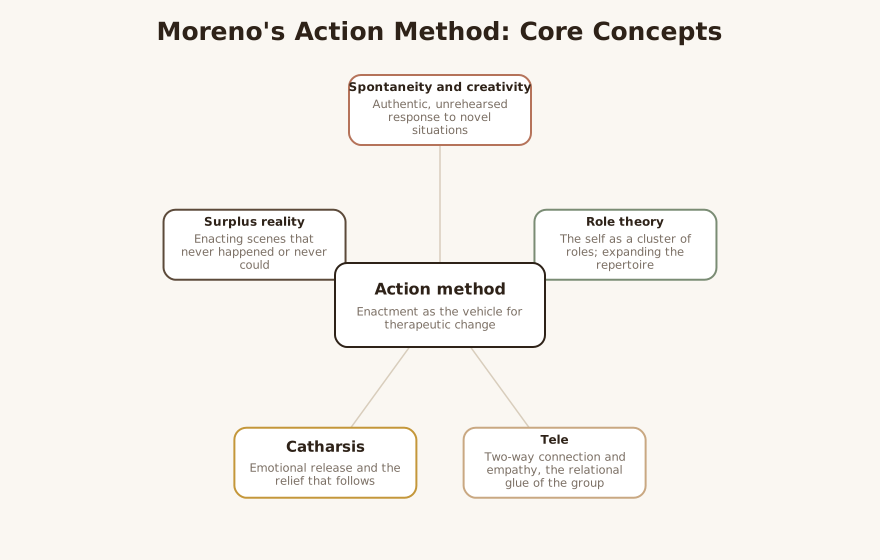
The theoretical engine of psychodrama is the pairing of spontaneity and creativity: Moreno held that psychological health is tied to the capacity for authentic, unrehearsed response to novel situations, and that rigid, “stereotyped” responses signal stuckness 3. Enactment is the vehicle for rehearsing and recovering that spontaneity in a protected setting 3. Role theory underpins this — the self is understood as a cluster of roles that a person adopts and performs, and therapeutic change often means expanding a constricted role repertoire or practicing roles that are feared or underdeveloped 3.
Tele describes the genuine two-way connection and empathy that flows between group members and is considered the relational glue of effective group work 3. Catharsis — emotional release and the relief that follows — is a recognized aim of the action phase, though contemporary practice treats it as one ingredient rather than the goal in itself 3. Surplus reality refers to enacting scenes that never happened or never could — a conversation with a deceased parent, a confrontation that was too dangerous in real life — giving clients access to material and resolution beyond ordinary experience 3.
Every session is structured into three phases. The warm-up builds group cohesion and surfaces a theme; the action phase is the enactment itself, where the protagonist’s scene unfolds using specific techniques; and the sharing phase brings the group back together for integration and feedback rather than analysis or advice-giving 4. This arc is non-negotiable scaffolding: the warm-up creates the safety that makes action possible, and the sharing closes the emotional exposure of the action phase 4.
Interventions & Techniques
Psychodrama is delivered through five core instruments — the stage (the designated action space), the protagonist (the person whose situation is explored), the director (the trained therapist who guides the process), the auxiliary egos (group members who portray significant others or aspects of the protagonist), and the audience (witnessing group members who later share) 3. A systematic review of the literature identified 11 consensus core techniques out of 56 candidate techniques, with role reversal being the most frequently cited across texts 4.
- Role reversal — the protagonist exchanges roles with another figure in the scene to experience that person’s viewpoint; the review describes it as the foundation of Moreno’s theory and the most consistently endorsed technique 4.
- Doubling — an auxiliary ego stands beside or behind the protagonist and voices unspoken thoughts and feelings, helping surface suppressed material 4.
- Mirroring — an auxiliary ego imitates the protagonist’s behavior so the protagonist can step out and observe themselves, useful when self-image and outward presentation diverge 4.
- Soliloquy — the protagonist thinks aloud, externalizing hidden feelings to deepen self-knowledge and catharsis 4.
- Sculpture and the social atom — the protagonist arranges group members in space to represent relationships and significant others, making relational distance and conflict visible 4.
- Role training — practicing a feared or poorly performed role under protected, lifelike conditions, which also serves a diagnostic function 4.
- Intermediate objects — puppets, masks, or fabrics that enable communication and emotional distance when direct verbal contact is too activating 4.
Sociodrama draws on the same action vocabulary — aside, doubling, soliloquy, role reversal, and mirroring — but directs it at a shared situation, engaging participants’ bodies, emotions, and cognition simultaneously to clarify values, resolve conflict, and rehearse collective problem-solving 7.
LLM-generated illustrative example (not a guideline): In a residential addiction-recovery group, the director invites a protagonist to set up a “social atom,” placing group members as his partner, his sponsor, and his drug of choice at varying distances. Through role reversal he speaks as his partner (“I never know which version of you I’m getting”), and a doubling member voices the shame he cannot say aloud. The scene is closed in sharing, where peers reflect their own resonance rather than offering advice LLM.
Evidence Base
Psychodrama is best characterized as an established and mature method — nearly a century old, with a defined set of techniques, professional bodies, and a certification pathway — but with an empirical evidence base that remains modest and uneven by contemporary standards 4. The most detailed technique review concluded that “almost 100 years after its foundation” Morenian psychodrama “still lacks theoretical and technical coherence,” even while documenting its sustained clinical use across European hospitals and mental health services 4.
The strongest quantitative signal comes from a systematic review and meta-analysis of randomized and controlled trials in mainland China, pooling 7 trials, 332 participants, and 25 effect sizes 5. It reported a significant overall effect (SMD = 0.768, 95% CI [0.591, 0.946]), with reductions in symptoms such as depression and anxiety (illness-reduction SMD = −0.711) and improvements in well-being constructs such as hope, resilience, and self-esteem (health-promotion SMD = 0.889) 5. These are encouraging effect sizes, but the authors flagged serious limitations: small samples (15–100 per study), a dearth of longitudinal follow-up, inconsistent randomization reporting, heterogeneous outcome measures, unstandardized practitioner qualifications, and evidence of publication bias 5.
The honest clinical read is that psychodrama has promising but methodologically limited trial support concentrated in specific cultural and population contexts, alongside a long tradition of clinical and qualitative endorsement 5. Clinicians should present it to clients as a well-developed, widely practiced method rather than a first-line, RCT-saturated intervention, and should not overstate the durability of effects given the follow-up gaps 5.
Populations & Indications
Psychodrama is fundamentally a group modality and is most natural with group therapy participants, though its techniques are also adapted for families and couples where relational enactment is the point 4. The trial literature has examined diverse age groups, including youth (for problems such as internet addiction and social withdrawal), adults (frequently depression linked to childhood trauma), and older adults (for example, patients with Parkinson’s disease) 5. Adolescents are a commonly cited population because action methods can engage clients who resist sit-and-talk formats 6.
The method is applied with trauma survivors, adults with interpersonal difficulties, and people in addiction recovery, where role work and surplus reality allow rehearsal of difficult encounters and reworking of relational wounds 6. Indications cluster around interpersonal and relational presentations — situations where the problem lives between people and benefits from being made visible and re-enacted — more than around isolated, internally contained symptoms 4.
Problems-for-Work
Psychodrama and sociodrama are clinically indicated across a range of problems where enactment, perspective-taking, and relational rehearsal carry therapeutic leverage 6.
- Interpersonal / relationship conflict and unresolved relational conflict — role reversal lets a client experience the other party’s stance, often softening rigid positions; a social atom externalizes who is close, distant, or absent 4.
- Posttraumatic stress disorder and grief and loss — surplus reality enables a protagonist to say what was never said to a person who is gone or unreachable, supporting catharsis within a contained structure 3.
- Low self-esteem and social anxiety — role training and mirroring let clients observe and rehearse competence in feared social roles under protected conditions 4.
- Emotional dysregulation and anger / aggression — doubling and soliloquy give language to under-articulated affect, slowing the gap between impulse and action 4.
- Communication problems and role confusion — sociodramatic enactment of common scenarios helps a group clarify roles, values, and skills 7.
- Substance use disorders — recovery groups use enactment to rehearse refusal, repair relationships, and externalize the “voice” of the substance 6.
LLM-generated illustrative example (not a guideline): In a bereavement group, a protagonist who could not attend her father’s funeral is offered an empty chair representing him. With the director’s pacing and a doubling member to voice her grief, she completes the goodbye she never had; the group then shares their own resonant losses, normalizing her experience LLM.
Contraindications, Cautions & Cultural Humility
Psychodrama is an emotionally activating, exposure-forward method, and its power to mobilize affect quickly is also its principal risk 4. Action techniques such as soliloquy and surplus reality are designed to access suppressed and deeply painful material, so directors must be trained to titrate intensity, secure adequate warm-up, and never leave a protagonist emotionally exposed without a thorough sharing phase 4. Working with trauma survivors carries a real possibility of re-traumatization or flooding if scenes are enacted before sufficient safety and regulation are established LLM.
Because the method depends on group exposure, careful screening matters: acute psychosis, severe dissociation, or marked emotional instability may make full enactment inappropriate, and intermediate objects or lower-intensity techniques may be safer entry points 4. Confidentiality and informed consent are heightened concerns in any group format, and clients should understand what enactment may bring up before they step onto the stage LLM.
Cultural humility is essential: the most robust meta-analytic evidence comes from Chinese samples and may not transfer cleanly to other cultural contexts, and norms around emotional expression, physical proximity, and public disclosure vary widely 5. Directors should adapt the degree of physical contact, the framing of catharsis, and role assignments to clients’ cultural backgrounds rather than assuming the standard format fits everyone LLM.
Treatment-Plan Suggestions & SMART Objectives
| Goal | SMART objective (example) | Mechanism |
|---|---|---|
| Improve perspective-taking in a conflicted relationship | Within 8 group sessions, client will complete at least 2 role-reversal enactments and report a shift in understanding of the other party on a 0–10 scale | Role reversal builds cognitive and affective empathy by embodying the other’s viewpoint 4 |
| Increase emotional articulation | Over 6 sessions, client will use soliloquy or accept doubling in at least 3 scenes, verbalizing previously unspoken affect | Soliloquy and doubling externalize suppressed feeling, supporting catharsis and self-knowledge 4 |
| Reduce social anxiety in a feared role | Within 10 sessions, client will complete role training for a specific feared interaction and rate anticipatory anxiety pre/post | Role training rehearses competence under protected, lifelike conditions 4 |
| Process unresolved grief | Across 4–6 sessions, client will complete a surplus-reality scene with a significant other and report reduced distress in sharing | Surplus reality permits completion of unfinished relational business 3 |
| Improve self-observation and self-image | Within 8 sessions, client will participate in at least 2 mirroring scenes and identify one discrepancy between self-image and presentation | Mirroring enables stepping out to observe the self objectively 4 |
| Strengthen group cohesion and reduce isolation | Over the first 3 sessions, client will engage in sociometric warm-ups and identify at least 2 supportive group connections | Sociometry and tele surface relational ties that reduce isolation 3 |
| Build conflict-resolution and communication skills | Within 6 sessions, the group will enact 2 sociodramas of a shared conflict and generate at least 1 action plan each | Sociodrama clarifies values and rehearses collective problem-solving 7 |
Common Misconceptions
A frequent misconception is that psychodrama is “just acting” or theater for catharsis; in fact it is a structured group psychotherapy with defined phases, instruments, and trained direction, in which catharsis is one mechanism among several rather than the endpoint 3. Another error is conflating psychodrama with sociodrama — they share techniques, but psychodrama explores one protagonist’s personal material while sociodrama works a situation common to the whole group 7.
Clinicians sometimes assume the protagonist must relive events exactly as they happened; surplus reality explicitly allows enactment of scenes that never occurred or never could, which is part of the therapeutic value 3. A further misconception is that the evidence base is as deep as the method is old — in reality, the controlled-trial literature is comparatively small, culturally concentrated, and methodologically limited 5. Finally, doubling and auxiliary-ego work are sometimes treated as improvisation, when they are deliberate, director-guided techniques aimed at surfacing specific suppressed material 4.
Training & Certification
In the United States, formal credentialing is overseen by the American Board of Examiners in Psychodrama, Sociometry and Group Psychotherapy, which offers the Certified Practitioner (CP) and the Trainer, Educator, Practitioner (TEP) credentials, with a Supervised Practitioner designation as an initial step 2. Certification involves a written examination administered annually on the third Saturday of October, with candidates emailing intent to sit by June 1 and submitting applications by July 15 2. The Board publishes competency study guides and past examinations to orient candidates to required knowledge areas 2.
The American Society for Group Psychotherapy and Psychodrama (ASGPP) is the principal professional organization for the field and a hub for training, conferences, and community among practitioners 1. Because directing carries real clinical risk, clinicians should pursue supervised training before leading full protagonist-centered enactments rather than improvising action methods from reading alone LLM.
Key Terms
- Protagonist — the group member whose situation is explored in the enactment 3.
- Auxiliary ego — a group member who plays a significant other or an aspect of the protagonist 3.
- Director — the trained therapist who guides the drama 4.
- Tele — the genuine, reciprocal interpersonal connection and empathy within a group 3.
- Spontaneity — the capacity for authentic, adequate, unrehearsed response to new situations 3.
- Surplus reality — enacted scenes beyond ordinary experience, including events that never happened 3.
- Doubling — an auxiliary ego voicing the protagonist’s unspoken thoughts and feelings 4.
- Role reversal — exchanging roles with another figure to experience their perspective 4.
- Social atom — a spatial map of the protagonist’s significant relationships 4.
- Sociodrama — enactment of a social situation shared by the group rather than one person’s story 7.
Resources & Further Reading
▶ Watch — a video introduction to this concept:
- The American Society for Group Psychotherapy and Psychodrama (ASGPP) — professional organization, training, and community 1.
- American Board of Examiners — Psychodrama, Sociometry & Group Psychotherapy Certification — CP/TEP credentialing and examination details 2.
- A Concise Introduction to Psychodrama, Sociodrama and Sociometry (ASGPP PDF) — foundational concepts and phases 3.
- The Core Techniques of Morenian Psychodrama: A Systematic Review — consensus techniques and their definitions 4.
- Effectiveness of Psychodrama on Mental Health Outcomes: Systematic Review and Meta-Analysis of RCTs — pooled effect sizes and limitations 5.
- Psychodrama: Benefits, Techniques & How It Works (GoodTherapy) — accessible overview 6.
- Sociodrama (British Psychodrama Association) — sociodrama aims, applications, and techniques 7.
- Psychodrama (Wikipedia) — general background and history 8.
Reflective / Supervision Questions
- How do I assess a client’s readiness for enactment, and what concrete cues tell me to choose a lower-intensity technique (such as intermediate objects) over full action work? LLM
- When I direct, am I pacing the warm-up adequately, or am I rushing to the action phase before the group has the cohesion to hold it? 4
- How do I ensure the sharing phase genuinely closes a protagonist’s emotional exposure rather than drifting into analysis or advice-giving? 4
- Given that the controlled-trial evidence is concentrated in specific populations, how honestly am I representing the strength of the evidence to clients and referrers? 5
- How am I adapting physical contact, role assignment, and the framing of catharsis to the cultural backgrounds of the clients in my group? LLM
- Where am I in my own training trajectory, and which enactments am I qualified to direct unsupervised versus those that warrant consultation? 2