
Type & Discipline
Dance/Movement Therapy (DMT) is a modality within the family of creative arts therapies, alongside art, music, and drama therapy 6. The American Dance Therapy Association (ADTA) defines it as “the psychotherapeutic use of movement to promote emotional, social, cognitive and physical integration of the individual” 1. Its defining premise is that body and mind are in continuous, reciprocal interaction, so that movement is not merely expressive output but a direct channel into emotional and relational life 5. A distinctive feature of the discipline is that body movement “simultaneously provides the means of assessment and the mode of intervention,” collapsing the usual separation between observing a problem and treating it 1. As a discipline it sits at the intersection of psychotherapy, somatics, and the performing arts, and it is practiced by specifically credentialed clinicians rather than by dance instructors 1.
Creators & Lineage
DMT emerged in the United States in the 1940s, with Marian Chace widely regarded as its founding figure 6. A dancer and teacher, Chace began working with psychiatric patients—including at St. Elizabeths Hospital in Washington, D.C.—after observing that students sought her classes for emotional rather than technical reasons 6. Her work established core ideas that endure today, including the use of movement to build therapeutic rapport with patients who were difficult to reach verbally 6. The field professionalized with the founding of the ADTA in 1966, which formalized training standards and credentialing 6. DMT draws on several lineages: the broader creative arts therapies tradition, body psychotherapy, somatic and sensorimotor approaches, and the Jungian-influenced practice of Authentic Movement, in which a mover follows internal impulses while a witness holds attention LLM. These roots give DMT a dual heritage—part depth-psychological and expressive, part embodied and neurophysiological LLM.
Core Principles
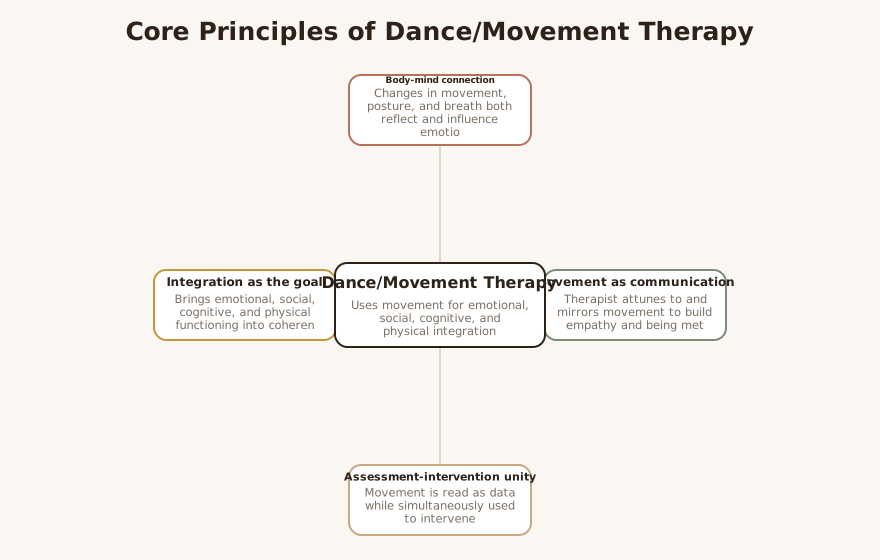
Several principles organize DMT practice across schools and settings LLM. First is the body-mind connection: changes in movement quality, posture, and breath are understood to both reflect and influence emotional states, so working at the level of the body can shift psychological experience 5. Second is the idea that movement is communicative and relational; the therapist attunes to and mirrors a client’s movement to establish empathy and a felt sense of being met LLM. Third is the assessment-intervention unity noted above—the clinician reads movement as ongoing data while simultaneously using it to intervene 1. Fourth is integration as the goal: DMT explicitly aims to bring emotional, social, cognitive, and physical functioning into greater coherence rather than targeting a single symptom in isolation 1. Practically, this often means helping clients widen their movement repertoire, develop a more flexible relationship to their bodies, and translate nonverbal experience into shareable meaning LLM.
Interventions & Techniques
DMT is delivered in individual, group, couples, and family formats across mental health, rehabilitation, medical, educational, forensic, and long-term-care settings 1. A signature group technique is the Chace-derived “circle,” in which participants move together to build cohesion before exploring individual themes LLM. Mirroring—the therapist reflecting a client’s movement qualities—is a foundational empathic technique used to establish attunement and safety LLM. Kinesthetic empathy refers to the therapist’s use of their own body to sense and resonate with the client’s internal state LLM. Clinicians also use rhythmic synchrony, breath and grounding work, improvisation and expressive movement, and the shaping or amplifying of spontaneous gestures so that emerging affect can be witnessed and named LLM. Many DMT clinicians use observational frameworks such as movement-quality analysis to assess and track change over a course of treatment LLM. Verbal processing is typically interwoven, so that movement experiences are reflected on and integrated rather than left purely nonverbal 5.
LLM-generated illustrative example (not a guideline): A trauma survivor who freezes when describing an event might be invited to notice where in the body the “stuckness” lives, then to make a small, voluntary movement—shifting weight, pressing the feet down—to restore a felt sense of agency before any further verbal exploration LLM.
Evidence Base
It is important to distinguish two things that the single word “established” can blur LLM. As a profession and discipline, DMT is well established: it has a defined scope of practice, a national association, formal training pathways, and credentialing dating back decades 1. As an empirical evidence base, however, the controlled-trial literature is still limited, heterogeneous, and of mixed quality LLM. The most encouraging synthesis is Koch and colleagues’ meta-analysis update, which pooled 41 controlled studies (2,374 participants) and found a medium overall effect (d ≈ 0.60), with effects on interpersonal skills (d ≈ 0.85), quality of life (d ≈ 0.67), psychomotor skills, affect, and cognitive skills, and medium effects for depression and anxiety sub-clusters 4. Notably, in that analysis the DMT-specific effect was smaller and more consistent (d ≈ 0.35, low heterogeneity) than the larger but far more variable effect of recreational dance interventions, a distinction clinicians should keep in mind when reading “dance” research 4.
The Cochrane reviews are more cautious LLM. The Cochrane review of DMT for depression concluded that the evidence was low-quality and insufficient to draw firm conclusions about effectiveness 2. The Cochrane review in cancer patients pooled only a handful of small trials, rated the certainty of evidence as very low, and found no clear effect on depression, stress, anxiety, fatigue, or body image; a single moderate-quality trial suggested a large benefit for quality of life, but the authors stressed that the limited number of studies prevented firm conclusions 3. The honest summary: DMT is a mature, credentialed field whose effectiveness signal is promising for quality of life, affect, and interpersonal functioning, but whose high-quality randomized evidence remains thin and should be communicated to clients as such LLM.
Populations & Indications
DMT is used with people of all ages and backgrounds presenting with developmental, medical, social, physical, and psychological needs 1. Commonly served populations include children and adolescents, trauma survivors, older adults and people with dementia, individuals on the autism spectrum, people with eating disorders, people living with serious mental illness, and people with developmental disabilities LLM. It is frequently chosen when verbal processing alone is insufficient or inaccessible—for example with clients who are preverbal, cognitively impaired, severely traumatized, or alexithymic—because movement offers an alternative route to expression and connection LLM. The meta-analytic finding that DMT yields consistent (if modest) effects with severely impaired patients in healthcare settings supports its use as an adjunctive modality in inpatient, rehabilitation, and long-term-care contexts 4.
Problems-for-Work
DMT is applied to a broad range of clinical problems, generally as one component of an integrated plan LLM. Depression and anxiety are common targets, with meta-analytic medium effects but cautious Cochrane conclusions 42. PTSD, trauma, and somatic dissociation are frequent indications, where movement is used to restore a tolerable, agentic relationship to the body LLM. Body image disturbance and eating disorders are addressed through work on embodiment and self-perception, though pooled cancer-population data did not show a body-image effect 3. Other problems-for-work include emotion dysregulation, social and communication deficits (e.g., in autism), dementia-related agitation, stress, and negative symptoms of schizophrenia LLM.
LLM-generated illustrative example (not a guideline): In a dementia care unit, a clinician might use familiar music and gentle seated rhythmic movement in a circle to reduce afternoon agitation and re-engage withdrawn residents, framing the work around connection and regulation rather than symptom elimination LLM.
Contraindications, Cautions & Cultural Humility
DMT has no absolute contraindications as a category, but clinical judgment is essential LLM. Physical and medical limitations must be screened—cardiac, orthopedic, post-surgical, or fall-risk concerns require movement to be adapted and, where relevant, medically cleared LLM. With trauma survivors, body-based work can be activating; pacing, titration, and explicit attention to the window of tolerance are necessary to avoid flooding or re-traumatization LLM. For clients with eating disorders or acute body-image distress, movement and mirror exposure should be introduced carefully and collaboratively LLM. Cultural humility matters acutely here: meanings of touch, proximity, gendered movement, and public bodily expression vary widely across cultures, faith traditions, and individuals, and a movement the therapist reads as “freeing” may feel exposing or transgressive to the client LLM. Informed consent should make clear that participation in any movement is voluntary, and the clinician should continuously check that interventions fit the client’s values, abilities, and comfort LLM.
Treatment-Plan Suggestions & SMART Objectives
| Goal | SMART objective (example) | Mechanism |
|---|---|---|
| Improve emotion regulation | Within 8 weekly sessions, client will use one movement-based grounding strategy to down-regulate distress in 3 of 5 logged episodes | Bottom-up regulation via breath, grounding, and rhythm LLM |
| Increase body awareness / reduce dissociation | Over 6 sessions, client will identify and name body sensations linked to emotion in at least 2 sessions per week | Interoceptive attention and reconnection to bodily cues LLM |
| Reduce social isolation / improve interpersonal skills | In an 8-week movement group, client will initiate one nonverbal interaction per session by week 4 | Mirroring and synchrony build attunement and connection 4 |
| Improve quality of life / affect | Over 10 sessions, client will report a measurable increase on a QoL/affect self-report measure | DMT effects on QoL and affect 4 |
| Restore sense of agency after trauma | Within 6 sessions, client will perform one self-directed grounding movement when activated, in 2 of 3 sessions | Voluntary movement reinstates agency within the window of tolerance LLM |
| Reduce agitation (dementia) | Over 4 weeks, staff will log a reduction in observed agitation episodes during/after movement sessions | Rhythmic, familiar movement supports co-regulation and engagement LLM |
| Improve mood (depression) | Across 12 weeks, client will engage in expressive movement and report reduced depressive symptoms on a standardized scale | Behavioral activation and affect expression through movement 4 |
Common Misconceptions
A frequent misconception is that DMT is “just dancing” or a recreational exercise class; in fact it is a credentialed psychotherapeutic practice in which movement is used assessmentally and therapeutically toward defined clinical goals 1. A second is that clients must be skilled dancers or physically able—DMT meets clients at any level of mobility and adapts to seated, small, or minimal movement LLM. A third misconception is that “established” means strongly evidence-based; the discipline is established while the controlled-trial evidence remains limited and mixed 23. A fourth is that recreational dance research and clinical DMT research are interchangeable—the meta-analytic data show they behave differently, with DMT producing smaller, more consistent clinical effects 4. Finally, some assume DMT is purely nonverbal; in practice movement experiences are usually integrated through verbal reflection 5.
Training & Certification
In the United States, DMT is a master’s-level profession credentialed by the ADTA 1. The entry-level credential is the Registered Dance/Movement Therapist (R-DMT), which signifies foundational competence and requires graduate-level training 1. The advanced credential is the Board-Certified Dance/Movement Therapist (BC-DMT), which qualifies the holder to teach, provide supervision, and engage in independent private practice 1. Training combines DMT theory and technique, supervised clinical work, and movement-observation skills, and the ADTA maintains standards for approved education routes 1. Clinicians who are not credentialed dance/movement therapists may still ethically incorporate movement-based and somatic techniques within their own scope of licensure, provided they do not represent themselves as DMTs and seek appropriate consultation or additional training LLM.
Key Terms
Body-mind connection — the core DMT premise that bodily and psychological processes continuously and reciprocally influence one another 5. Mirroring — the therapist’s reflection of a client’s movement qualities to build empathy and attunement LLM. Kinesthetic empathy — using one’s own embodied sensing to resonate with and understand a client’s internal state LLM. Integration — the explicit DMT goal of bringing emotional, social, cognitive, and physical functioning into greater coherence 1. Authentic Movement — a Jungian-influenced practice of moving from internal impulse while being witnessed, part of DMT’s lineage LLM. R-DMT / BC-DMT — the ADTA’s registered (entry-level) and board-certified (advanced) credentials 1.
Resources & Further Reading
▶ Watch — a video introduction to this concept:
- ADTA FAQ: What is Dance/Movement Therapy? — the profession’s definition, scope, and credentials 1
- Koch et al. (2019), Effects of Dance Movement Therapy and Dance on Health-Related Psychological Outcomes: A Meta-Analysis Update — the most comprehensive effect-size synthesis 4
- Cochrane review: Dance movement therapy for depression (Meekums et al., 2015) — cautious, low-quality evidence appraisal 2
- Cochrane review: DMT for psychological and physical outcomes in cancer patients (2015) — very-low-certainty evidence in oncology 3
- Lukin Center for Psychotherapy: What Is Dance/Movement Therapy? — accessible clinical explainer 5
- Dance therapy (Wikipedia) — history, lineage, and overview 6
Reflective / Supervision Questions
- How do I distinguish, in my own documentation and case conceptualization, between DMT as a credentialed modality and the adjunctive movement techniques I am licensed to use? LLM
- When I introduce body-based work with a trauma survivor, how do I monitor for activation and stay within the client’s window of tolerance? LLM
- Whose meanings of movement, touch, and bodily expression am I assuming, and how do I check those assumptions against my client’s cultural and personal frame? LLM
- Given the mixed evidence base, how do I describe expected benefits to clients without over-promising? LLM
- How do I know whether the movement work is producing the integrative change I intend, and what would tell me to adjust or stop? LLM