
Art therapy occupies an unusual position in the behavioral health landscape: it is a mature, well-organized profession with its own graduate training, credentialing board, and state licenses, yet its randomized-trial evidence base is comparatively thin and uneven. LLM This article aims to help referring and collaborating clinicians understand what art therapy actually is, where the evidence supports it, and where claims outrun the data. LLM
Type & Discipline
Art therapy is a distinct mental health profession rather than a craft activity or an adjunct hobby program. LLM The American Art Therapy Association (AATA) defines it as “a mental health profession that enriches the lives of individuals, families, and communities through active art-making, creative process, applied psychological theory, and human experience within a psychotherapeutic relationship.” 1 It sits within the broader family of creative arts therapies, alongside music, dance/movement, and drama therapy, all of which use a creative medium as the central vehicle of treatment. LLM The defining elements are the use of visual art media, an applied psychological framework, and a treatment relationship — not the production of aesthetically accomplished work. 1
Creators & Lineage
The modern field is most often traced to two contrasting figures who shaped its theoretical poles in the mid-20th century. LLM Margaret Naumburg is associated with the “art as therapy in psychotherapy” tradition, in which the image functions as a route to unconscious material to be verbally interpreted within a psychodynamic frame. LLM Edith Kramer is associated with the “art as therapy” tradition, in which the act of making — sublimation through the creative process itself — is understood as inherently healing, with less emphasis on verbal interpretation. LLM These lineages connect art therapy to psychodynamic psychotherapy and to Jungian analytical psychology, with its attention to symbol and imagery, while later humanistic and expressive-therapy influences added an emphasis on growth and self-actualization. LLM The profession was institutionalized in the United States with the founding of the American Art Therapy Association in 1969. 7
Core Principles
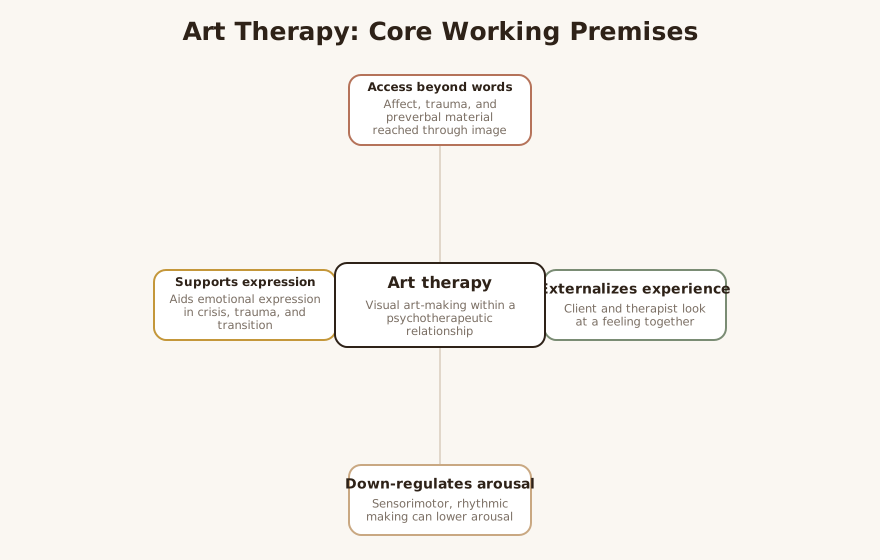
The foundational premise is that some material — particularly affect, trauma, and preverbal experience — is more accessible through image than through speech. LLM AATA frames this as helping clients “express themselves beyond words,” integrating nonverbal cues and metaphor through the creative process when language fails them. 1 A second principle is that the art object externalizes inner experience, allowing the client and therapist to look at a feeling together rather than the client being submerged in it. LLM A third is that the sensorimotor and rhythmic qualities of making (mark-making, repetition, tactile engagement) can themselves down-regulate arousal, which has obvious relevance to trauma and anxiety work. LLM Stated treatment goals across the field include helping people feel more in control, relieving anxiety and depression, managing pain, and facilitating emotional expression during crisis, trauma, or significant life transitions. 1
Interventions & Techniques
In practice, art therapy is delivered by credentialed clinicians in hospitals, cancer centers, psychiatric facilities, schools, wellness settings, and independent practice, including crisis-intervention contexts. 1 Common directives include free or open studio work, structured drawing tasks (for example, depicting a safe place or a timeline), collage for clients who find drawing exposing, clay and sculpture for tactile grounding, and bridge or “before/after” drawings for transition and change work. LLM Sessions typically move through a making phase and a reflecting phase, where the clinician helps the client notice the image and their relationship to it rather than imposing a fixed interpretation. LLM Process choices are deliberate: more containing, structured media (collage, pre-cut shapes) for highly dysregulated clients, and more fluid media (wet paint) where the goal is loosening and expression. LLM Both group and individual formats are used, and much of the trial literature has studied group delivery. 3
LLM-generated illustrative example (not a guideline): A grieving adult who “goes blank” when asked to describe their loss is invited to build a small clay container “for what you’re carrying.” The making slows their breathing and gives a concrete object to discuss; in reflection, they note the lid they added unprompted, opening a conversation about needing to keep grief contained at work. LLM
Evidence Base
Honesty about maturity requires separating two things: art therapy is an established discipline, but it has a limited and heterogeneous efficacy evidence base. LLM A NIHR Health Technology Assessment systematic review identified 15 randomized controlled trials in people with non-psychotic disorders and reported statistically significant positive effects versus control in a number of studies, with improvement in most trials. 3 However, the same review concluded that the included RCTs “are generally of low quality,” with small samples (mean of roughly 52 participants), unreported allocation concealment, and high attrition, and cautioned that the results “should be interpreted with caution.” 3 For trauma specifically, a 2024 systematic review and meta-analysis pooled 21 RCTs and 868 participants and found visual arts therapy effective for reducing PTSD-specific outcomes in children, for improving positive outcomes in group-based delivery, and for reducing negative outcomes after acute traumas such as combat or sexual abuse. 4 That review also emphasized substantial heterogeneity and the need for additional RCTs and standardized protocols before strong claims can be made. 4 The picture is least favorable in schizophrenia: the large pragmatic MATISSE trial found no significant benefit of group art therapy, and a Lancet Psychiatry analysis used those findings to question whether the NICE recommendation to offer art therapies to all people with schizophrenia can be justified, noting little quantitative evidence for psychosis. 5 The defensible summary is cautious optimism for some non-psychotic and trauma populations, and clear discouragement of overstating benefit in psychotic disorders. LLM
Populations & Indications
Art therapy has been applied across a wide range of populations, reflecting its flexibility rather than uniform proof of benefit. LLM AATA describes work with children who have behavioral challenges or autism spectrum presentations, trauma survivors, military service members, older adults with dementia, people with cancer and other chronic illness, and individuals coping with grief and major life transitions. 1 The trauma evidence is strongest, on current data, for children and for group-based delivery. 4 Among adults with non-psychotic difficulties, the targeted outcomes that showed improvement in the HTA-reviewed trials included depression, anxiety, low mood, trauma, distress, poor quality of life, inability to cope, and low self-esteem. 3 Indications are therefore best framed around access and engagement — clients who struggle to verbalize, who are alexithymic, or who are guarded in talk therapy — as much as around any single diagnosis. LLM
Problems-for-Work
The modality is most naturally suited to problems where verbal access is the bottleneck. LLM For difficulty verbalizing emotions and alexithymia, image-making provides an indirect channel to name and externalize feeling states. 1 For trauma processing and PTSD, structured visual work can support titrated approach to traumatic material with the image as a buffer, with the strongest pooled support in children and acute-trauma populations. 4 For grief and bereavement, creating a tangible object can give form to loss and support continuing-bonds work. LLM For emotional dysregulation and stress, the rhythmic, tactile qualities of media can be used as in-session down-regulation. LLM For depression, anxiety, and low self-esteem, the small non-psychotic RCT literature reported positive movement, albeit from low-quality trials. 3 For behavioral problems in children and dementia-related symptoms, art therapy is widely applied as an engagement and expression strategy, though the controlled evidence here is correspondingly thinner. 1
Contraindications, Cautions & Cultural Humility
Art therapy is rarely physically contraindicated, but several cautions matter clinically. LLM The clearest evidence-based caution is in schizophrenia and psychosis, where the best trial data show no demonstrable benefit, so it should not be presented to patients or families as an established treatment for those conditions. 5 With trauma survivors, uncontained expressive work can be activating, and the literature’s own emphasis on protocol standardization underscores the need for pacing, grounding, and a stabilization-first stance rather than open catharsis. 4 Clinically, the image can surface material faster than a client is ready to process, and clinicians should avoid imposing symbolic interpretations the client does not endorse. LLM Cultural humility is essential because color, symbol, figure, and even the act of depicting persons carry culturally and religiously specific meanings, so directives and interpretations should be co-constructed rather than read from a fixed key. LLM Finally, art therapy delivered by clinicians without art-therapy training is not equivalent to credentialed art therapy, and outcomes should not be generalized across those very different conditions. 2
Treatment-Plan Suggestions & SMART Objectives
| Goal | SMART objective (example) | Mechanism |
|---|---|---|
| Build affect vocabulary | Within 8 sessions, client will identify and label at least 3 distinct emotions per session using a created image, in 4 consecutive sessions | Externalization; nonverbal-to-verbal bridging |
| Reduce physiological arousal | Over 6 weeks, client will use a tactile media exercise (e.g., clay) to lower self-rated distress by 2+ points (0–10) within session, in 5 of 6 sessions | Sensorimotor/rhythmic down-regulation |
| Titrated trauma approach | Within 10 sessions, client will depict and discuss one trauma-linked memory using image-as-buffer without dissociating, with stabilization steps completed first | Narrative distancing; graded exposure with containment |
| Support grief processing | Over 8 sessions, client will create and narrate one object representing the loss, articulating a continuing bond, in 2 reviews | Symbolization; continuing-bonds expression |
| Increase self-esteem / agency | Within 12 sessions, client will complete a self-directed series and identify 3 statements of competence or value, documented in session | Mastery experience; positive self-representation |
| Improve emotion regulation | Over 6 weeks, client will produce a “coping resources” visual map and use it between sessions at least twice weekly, self-reported | Cognitive structuring; externalized coping plan |
| Increase engagement (guarded clients) | Within 4 sessions, client will participate in image-based work and disclose one previously unspoken concern | Indirect/nonverbal access; reduced verbal pressure |
Common Misconceptions
“You have to be good at art” is the most common myth; the field is explicit that art therapy targets expression and process, not artistic skill. 1 “Art therapy is just a relaxing activity” understates it: it is a psychotherapeutic practice delivered within a treatment relationship by trained clinicians, not a recreational craft session. 1 “The evidence is strong across the board” is inaccurate; the controlled literature is small, often low-quality, and explicitly negative in schizophrenia. 35 “There is a fixed dictionary of symbols” is misleading, because meaning is co-constructed with the client and varies by culture and individual. LLM Finally, “any therapist who hands out markers is doing art therapy” conflates an in-session technique with the credentialed profession, which requires specific graduate training. 2
Training & Certification
Art therapy is delivered by credentialed mental health professionals with master’s-level or higher degrees, holding credentials such as ATR (Registered Art Therapist) or ATR-BC (board-certified). 1 Credentialing is administered by the Art Therapy Credentials Board (ATCB), an organization independent from AATA whose stated mission is to protect the public by establishing and upholding standards for competent practice and which supports more than 12,000 credential holders. 6 The ATCB administers a credential ladder: the ATR-P (Provisional Registered Art Therapist) for those completing post-graduate supervised practice, the ATR (Registered Art Therapist) confirming graduate education plus supervised experience, the ATR-BC (Board Certified) earned by passing a national examination, and the ATCS (Art Therapy Certified/Credentialed Supervisor) for qualified supervisors. 26 As of June 2024, the ATR-P became a required step before applying for the ATR. 2 Regulation at the state level is uneven: roughly twelve states have dedicated art therapy licenses, several others regulate the practice under related counselor or creative-arts-therapist licenses, and a few recognize the title for hiring purposes. 2
Key Terms
Art as therapy vs. art psychotherapy — the two poles described above: healing located in the making itself (Kramer-influenced) versus the image as material for verbal/psychodynamic exploration (Naumburg-influenced). LLM Externalization — placing inner experience into a concrete object that client and clinician can view together. LLM Sublimation — channeling difficult drives or affect into the creative product, a key concept in the art-as-therapy tradition. LLM Directive vs. non-directive — the degree to which the clinician structures the art task. LLM Studio approach — open, less-directed making within a supportive setting. LLM ATR / ATR-BC — the registered and board-certified credentials for art therapists. 2
Resources & Further Reading
▶ Watch — a video introduction to this concept:
- American Art Therapy Association — What Is Art Therapy? 1
- American Art Therapy Association — Credentials and Licensure 2
- NIHR HTA — Clinical effectiveness of art therapy: quantitative systematic review (NCBI Bookshelf) 3
- Maddox et al. (2024) — On the Effectiveness of Visual Arts Therapy for Traumatic Experiences: Systematic Review and Meta-Analysis 4
- The Lancet Psychiatry — NICE guidelines for schizophrenia: can art therapy be justified? 5
- Art Therapy Credentials Board (ATCB) 6
- American Art Therapy Association — Wikipedia 7
Reflective / Supervision Questions
- When I use image-making in session, am I delivering it as a technique inside my own licensed modality, or am I implying a credentialed “art therapy” I am not trained to provide? LLM
- How do I distinguish a client’s own meaning for an image from my interpretive projection onto it? LLM
- For trauma clients, have I sequenced stabilization and grounding before expressive or trauma-focused art directives? LLM
- Given the negative evidence in psychosis, how do I describe expected benefit honestly to clients and families with serious mental illness? LLM
- What cultural, religious, or personal meanings might this client attach to color, figure, or the act of depiction that I should ask about rather than assume? LLM
- When should I refer to a credentialed, licensed art therapist rather than incorporate art techniques myself? LLM