
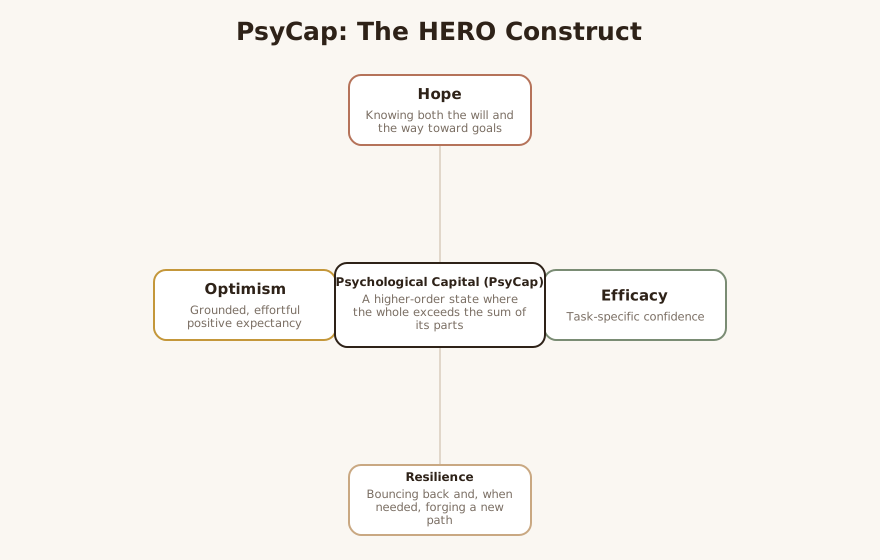
Psychological Capital (PsyCap) is a higher-order positive psychological state defined by four developable resources: Hope, Efficacy, Resilience, and Optimism — the so-called “HERO within.” 4 For practicing therapists, PsyCap is best understood as an organizational-behavior construct that has begun migrating into clinical and health contexts, offering a strengths-based vocabulary for goals, agency, and recovery that complements deficit-focused diagnostic work. LLM
Type & Discipline
PsyCap is a psychological construct rather than a packaged therapy or a standalone treatment modality. LLM It originates in the discipline of organizational behavior, specifically the subfield of Positive Organizational Behavior (POB), which studies measurable, developable psychological resources that affect employee outcomes. 4 It sits within the broader family of positive psychology, sharing that movement’s emphasis on building strengths rather than only remediating dysfunction. 3
The defining feature of PsyCap is that it is state-like — malleable and open to development through structured experience, yet relatively more stable than transient moods or emotions. 5 This positions it between fixed traits and momentary affect, which is precisely what makes it a target for intervention rather than a static personality descriptor. 5 A second defining feature is that PsyCap is a higher-order construct: the combined HERO factor is theorized to carry explanatory weight beyond any single component, an empirical claim established in its foundational measurement work. 1
Creators & Lineage
PsyCap was developed by Fred Luthans and colleagues, who drew on positive psychology research to assemble the four resources into a single measurable construct. 4 The foundational measurement and validation paper was authored by Luthans, Avolio, Avey, and Norman, establishing the Psychological Capital Questionnaire and the higher-order factor structure. 1 Carolyn Youssef-Morgan is a central figure in extending the construct’s predictive and applied scholarship, including its additive value over individual components. 2
Each HERO component carries its own theoretical lineage. LLM Efficacy descends directly from Bandura’s self-efficacy theory — confidence in one’s capability to mobilize effort and execute tasks in a specific situation. 5 Hope reflects Snyder’s hope theory, combining agency (goal-directed determination) with pathways (the capacity to generate alternative routes when blocked). 5 Optimism draws on Seligman’s work on explanatory style, here framed as a realistic and flexible expectancy rather than blind positivity. 5 Resilience, the fourth resource, is the capacity to recover and adapt following stress, conflict, failure, or increased responsibility. 4 The integrative move — treating these as one combinable form of “capital” — is what distinguishes PsyCap from its four parents. LLM
Core Principles
First, the four resources are conceptualized as a single underlying capacity. 1 Hope is the motivational state of knowing both the will and the way toward goals. 5 Efficacy is task-specific confidence. 5 Resilience is the ability to bounce back and, when needed, forge a new path. 5 Optimism is grounded, effortful positive expectancy. 5
Second, PsyCap is developable. 3 Because it is state-like rather than trait-like, it responds to brief, structured training, distinguishing it from interventions aimed at stable personality. 5
Third, the whole is theorized to exceed the sum of its parts. LLM The higher-order PsyCap factor relates to performance and satisfaction, and predicts work attitudes and behaviors with additive value beyond its individual facets. 12
Fourth, PsyCap is explicitly positive and non-stigmatizing — it builds on previously untapped psychological resources rather than cataloguing deficits, a framing the construct’s authors have argued is especially suited to mental-health contexts. 7
Interventions & Techniques
PsyCap is developed through a short, structured protocol — historically the PsyCap Intervention (PCI) — that targets each HERO resource with distinct exercises. 5 In clinical adaptation, these map naturally onto familiar therapeutic techniques. LLM
Hope: goal-setting and pathways. Clients establish clear, realistic goals and then deliberately generate multiple routes toward them; process goals focused on specific actions tend to be more effective than distal outcome goals. 5
Efficacy: mastery experiences and modeling. Confidence is built through progressively challenging tasks with a reasonable probability of success, with each milestone marked, and through observing or recalling competent performance in self or others. 5
Resilience: asset and obstacle work. Clients inventory their resources, anticipate obstacles, and rehearse adaptive responses so that setbacks become navigable rather than catastrophic. 5
Optimism: explanatory-style coaching. The therapist helps the client examine whether a setback is temporary, bounded, and controllable, cultivating a realistic optimistic style rather than denial. 5
LLM-generated illustrative example (not a guideline): With a demoralized client returning to work after medical leave, a clinician might co-construct a graded return ladder (hope/pathways), schedule small, winnable first tasks (efficacy/mastery), name in advance the moments most likely to trigger overwhelm and a coping plan for each (resilience), and reframe a difficult first day as “one hard day, not proof I can’t do this” (optimism). LLM
These same training components are described as applicable in therapeutic, leadership, team, and wellness settings, underscoring that the techniques are transferable rather than workplace-bound. 5
Evidence Base
The maturity of the evidence depends heavily on the setting. LLM In organizational contexts the base is established: the foundational paper validated PsyCap measurement and demonstrated its relationship with job performance and satisfaction. 1 Subsequent work showed that the higher-order PsyCap construct predicts work attitudes (such as satisfaction and commitment) and behaviors with additive value beyond the four individual resources. 2 The APA summarizes a converging literature linking PsyCap to higher performance, engagement, and satisfaction, and to lower turnover intention and burnout, with effects observed across education, military, and healthcare sectors. 3 A meta-analysis of 51 independent samples confirmed these relationships across organizational contexts. 4
The clinical evidence is far younger and largely adapted rather than independently trialed. LLM The principal bridge to mental-health practice is Broad and Luthans, who argue for building patient- and family-focused psychological capital using evidence-based, non-stigmatizing, strengths-based applications in psychiatry. 7 This is a conceptual and translational argument, not a body of randomized clinical trials in psychotherapy populations, and clinicians should treat therapeutic PsyCap as a promising framework rather than an empirically settled treatment. LLM
Populations & Indications
PsyCap research has concentrated on working adults and employees, leaders and managers, students, entrepreneurs, healthcare workers, and athletes — populations defined by performance demands and recurring adversity. 34 For clinicians, the construct is most indicated when presenting concerns center on agency, motivation, and adaptive recovery rather than acute symptom crisis. LLM
Indicated targets include work-related burnout, occupational stress, low self-efficacy, job dissatisfaction, hopelessness or low optimism, demoralization, low resilience, adjustment difficulties, and performance or motivation problems. LLM The authors’ translational work specifically positions PsyCap as a resource for patients and families navigating illness and uncertainty, extending its reach beyond the workplace. 7
Problems-for-Work
PsyCap maps cleanly onto several problems-for-work that surface in adult outpatient practice. LLM
- Work-related burnout. PsyCap is inversely associated with burnout in organizational samples, and its resources give a structured target for rebuilding agency at work. 3
- Low self-efficacy. The efficacy component, drawn from Bandura, is directly addressed through graded mastery experiences. 5
- Hopelessness / low optimism. Hope-pathways work and explanatory-style coaching give concrete handles on stuck, defeated thinking. 5
- Demoralization and adjustment difficulties. A strengths-based, non-stigmatizing frame can re-engage clients who feel reduced to a diagnosis. 7
- Performance and motivation problems. Goal-setting with multiple pathways and milestone tracking supports re-engagement with valued activity. 5
LLM-generated illustrative example (not a guideline): An entrepreneur presenting with occupational stress and eroding confidence after a failed product launch might work in session to inventory transferable wins (efficacy), map three alternative next moves rather than one all-or-nothing bet (hope/pathways), and pre-script a recovery response for the next inevitable setback (resilience). LLM
Contraindications, Cautions & Cultural Humility
PsyCap is a strengths framework, not a treatment for acute psychopathology, and it should not substitute for indicated care of depression, trauma, or risk. LLM Several cautions deserve explicit attention. LLM
Optimism can curdle into toxic positivity. Because the construct’s authors define optimism as realistic and effortful, clinicians must guard against an optimism push that invalidates legitimate distress or grief. 5
“Capital” and “resilience” can individualize structural problems. Burnout is frequently driven by workload, understaffing, and organizational conditions; framing it solely as a deficit in personal capital risks placing the burden of a systemic problem onto the client. LLM The honest clinical stance is to build resources while naming the environmental contributors. LLM
Cultural humility. PsyCap was developed and validated largely in corporate and Western (WEIRD) samples, so its assumptions about goal-striving, individual agency, and optimism may not transfer cleanly across cultural and socioeconomic contexts. 4 Clinicians should adapt the language to the client’s values rather than impose a productivity-oriented frame. LLM
Treatment-Plan Suggestions & SMART Objectives
| Goal | SMART objective (example) | Mechanism |
|---|---|---|
| Rebuild self-efficacy | Client will complete 3 graded mastery tasks of increasing difficulty over 4 weeks and rate confidence before/after each | Mastery experiences strengthen task-specific efficacy 5 |
| Restore hope and agency | Client will define one valued goal and generate at least 2 alternative pathways to it within 2 sessions | Hope = agency plus pathways thinking 5 |
| Reduce work-related burnout | Client will identify 2 controllable and 2 environmental burnout drivers and implement one boundary action weekly for 4 weeks | Distinguishes personal resources from structural load 3 |
| Develop realistic optimism | Client will reframe 1 setback per week using the temporary/bounded/controllable check, logged in a worksheet | Optimistic explanatory style coaching 5 |
| Strengthen resilience | Client will create a written obstacle-and-response plan for an anticipated stressor before the next session | Pre-planned adaptive responses buffer setbacks 5 |
| Counter demoralization | Client will record 3 strengths or past wins weekly and review them in session for 4 weeks | Strengths-based, non-stigmatizing engagement 7 |
| Improve motivation/performance | Client will set weekly process goals and track milestone completion for 6 weeks | Process goals and milestone tracking sustain engagement 5 |
Common Misconceptions
“PsyCap is just positive thinking.” It is a measurable, higher-order construct with specific components and a validated questionnaire, not a slogan; its optimism component is explicitly defined as realistic rather than blind. 15
“PsyCap is a fixed trait you either have or don’t.” It is state-like and developable through brief structured intervention — that malleability is its defining clinical value. 5
“The four components are interchangeable or redundant.” They have distinct theoretical roots, and research shows the combined construct adds predictive value beyond any single resource. 2
“It’s only for the workplace.” Although born in organizational behavior, the construct has been deliberately extended to patient, family, and health contexts. 7
Training & Certification
There is no clinical licensure or formal certification specific to PsyCap; it is a research construct rather than a credentialed therapy. LLM Practitioners typically learn it through the academic literature and through structured PsyCap development protocols described in the applied positive-psychology literature. 5 Foundational orientation is available directly from the construct’s originator in introductory talks. 6 For therapists, competence is best built by integrating the HERO techniques into modalities they are already trained and licensed to deliver, such as cognitive behavioral or solution-focused work. LLM
Key Terms
PsyCap — Psychological Capital; the higher-order state composed of Hope, Efficacy, Resilience, and Optimism. 4
HERO — the acronym for the four component resources. 5
State-like — malleable and developable, yet more stable than momentary emotion; the property that makes PsyCap trainable. 5
Higher-order construct — a combined factor whose predictive value exceeds that of its individual facets. 12
PCQ — the Psychological Capital Questionnaire, the validated self-report measure (24- and 12-item forms). 5
Positive Organizational Behavior (POB) — the parent subfield emphasizing measurable, developable psychological resources. 4
Resources & Further Reading
▶ Watch — a video introduction to this concept:
- Luthans, Avolio, Avey & Norman (2007), Positive psychological capital: Measurement and relationship with performance and satisfaction
- Avey, Luthans & Youssef (2010), The additive value of positive psychological capital
- APA — Psychological capital: What it is and why employers need it now
- Positive psychological capital (Wikipedia)
- Psychological Capital (PsyCap): Your Guide to the HERO Within (PositivePsychology.com)
- PSYCAP — Fred Luthans (YouTube)
- Broad & Luthans (2020), Positive resources for psychiatry in the fourth industrial revolution
Reflective / Supervision Questions
- When a client frames burnout as a personal failing, how do I build their PsyCap resources without colluding in the erasure of structural and organizational drivers? LLM
- Where is the line, for this particular client, between cultivating realistic optimism and inadvertently invalidating their grief or anger? LLM
- Does the goal-striving, individual-agency framing of PsyCap fit this client’s cultural and economic reality, or am I importing a productivity frame that does not serve them? LLM
- Am I treating PsyCap as the established organizational construct it is while staying honest with myself and my client about how young the clinical evidence remains? LLM
- Which HERO resource is this client’s actual bottleneck, and am I targeting it specifically rather than defaulting to generic encouragement? LLM