
Few psychological constructs have traveled as far, as fast, from the lab into classrooms, locker rooms, and self-help shelves as growth mindset. LLM For the clinician, that popularity is a double-edged inheritance: clients arrive already fluent in the language of “fixed” versus “growth,” often with a flattened, motivational-poster version of an idea that is more precise and more contested than the slogans suggest. LLM Used well, the construct gives therapists a clean way to name and work with a specific class of self-appraisals—beliefs about whether one’s abilities can change—that sit underneath fear of failure, perfectionism, and the avoidance of challenge. LLM Used carelessly, it becomes one more way to tell struggling people that their problem is their attitude. LLM
Type & Discipline
Growth mindset is a construct, not a therapy or a manualized intervention; it names a belief a person holds about the nature of their own abilities. 1 It originates in educational and motivational psychology and belongs to the family of implicit theories—lay beliefs about whether human attributes are fixed or malleable. 1 Carol Dweck’s framing contrasts a growth mindset, the belief that ability can be developed through effort, strategy, and learning, with a fixed mindset, the belief that ability is a static trait one either has or lacks. 1 Because it is a construct rather than a treatment, growth mindset functions clinically as a lens for case formulation and as a target for cognitive work delivered within established modalities, not as a standalone billable therapy. LLM The underlying scientific object is the implicit theory of intelligence, the more technical term researchers use when they measure where a person falls on the fixed-to-malleable continuum. 3
Creators & Lineage
The construct is inseparable from Carol Dweck, the Stanford psychologist whose program of research on motivation, personality, and development gave rise to it. 6 Dweck’s early work examined how children’s beliefs about the causes of their successes and failures shaped their persistence, growing out of and alongside attribution theory and the study of learned helplessness. 6 Over decades she reframed these beliefs as implicit theories—entity (fixed) versus incremental (growth) theories of intelligence—before the popular term “mindset” took hold with her 2006 trade book, Mindset: The New Psychology of Success. 16
The lineage runs through several adjacent traditions. LLM Attribution theory supplied the focus on how people explain outcomes; Bandura’s self-efficacy theory supplied the emphasis on beliefs about one’s own capability as a driver of behavior; and the cognitive tradition that became cognitive behavioral therapy supplied the broader premise that appraisals, not events alone, shape emotional and behavioral response. LLM Within education and, increasingly, professional training, the construct has been mapped and adapted across settings, including a body of work characterizing growth mindset theory in health professions education. 7 Dweck herself has publicly revisited and refined the idea, warning against the distortions that accompanied its fame—most notably the “false growth mindset” that reduces it to praising effort regardless of outcome. 4
Core Principles
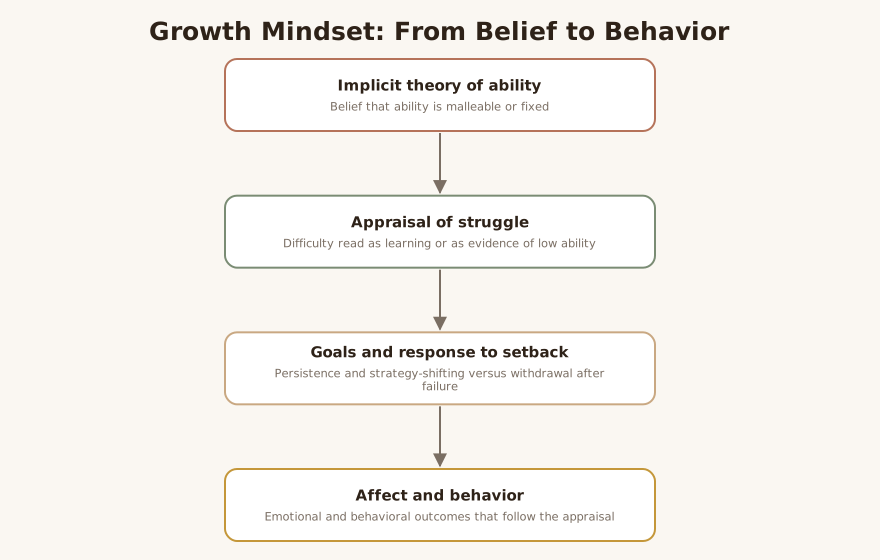
The first principle is that a person’s implicit theory of ability shapes how they interpret and respond to difficulty. 1 Someone holding a fixed theory tends to read effort and struggle as evidence of low ability—“if I were really smart, this wouldn’t be hard”—while someone holding a growth theory reads the same struggle as part of learning. 1 This is the clinically load-bearing claim: the belief is upstream of the appraisal, and the appraisal drives affect and behavior. LLM
A second principle is that mindsets shape goals and responses to setbacks. 1 Fixed beliefs tend to orient a person toward proving ability and avoiding situations that risk exposing its limits, which predicts withdrawal after failure. 1 Growth beliefs tend to orient a person toward developing ability, which predicts persistence and strategy-shifting after failure. 1 A third principle is that mindset is understood as malleable in principle—a belief that can itself be changed—which is what makes it a candidate for intervention rather than a fixed personality trait. 1
A fourth principle, emphasized more in Dweck’s later writing, is that nobody is purely one or the other. 4 Mindsets are domain- and situation-specific and triggered by context; a person can hold a growth mindset about athletic skill and a fixed one about mathematics, and the same person can be tipped toward a fixed stance under threat, criticism, or comparison. 4 Finally, the construct insists that process matters more than the appearance of effort: the genuine version involves effort plus strategy, help-seeking, and learning from feedback, not effort as a consolation prize. 4
Interventions & Techniques
Growth mindset does not prescribe a fixed protocol, but its principles translate into recognizable clinical moves, most of which are cognitive in character. LLM The first is mindset assessment: listening for fixed-theory language in how a client explains setbacks (“I’m just not a math person,” “I don’t have a creative bone in my body”) and locating the domains where that language is most rigid. 1 Because implicit theories of intelligence can be measured on a continuum, this is less a binary diagnosis than a mapping of where, and how strongly, a client treats ability as unchangeable. 3
A second move is psychoeducation on malleability, drawing on the premise that abilities develop through learning, to loosen the assumption that current performance fixes future ceiling. 1 A third is reframing struggle and error: helping a client reinterpret difficulty and mistakes as information and as part of skill-building rather than as verdicts on worth, which maps closely onto cognitive restructuring within cognitive behavioral therapy. LLM A fourth is process-focused language: shifting self-talk and external feedback from trait labels (“I’m smart/stupid at this”) toward strategy and effort that lead to learning—while avoiding the “false growth mindset” trap of praising effort that is not actually working. 4
LLM-generated illustrative example (not a guideline): A client studying for a licensing exam fails a practice test and concludes, “This proves I’m not cut out for this.” The therapist treats the statement as a fixed-mindset appraisal, examines it as an automatic thought, and helps the client distinguish “I cannot do this” from “I have not yet built this skill and my current strategy isn’t working.” Together they identify a concrete strategy change rather than a verdict on ability, and the client re-engages with study. LLM
Evidence Base
Honesty about the evidence is essential here, because the gap between the construct’s popularity and the strength of its intervention effects is large. LLM As a construct, growth mindset is well established and heavily studied; it is anchored in a long research program and a validated measurement tradition. 13 An item-level meta-analysis of the Implicit Theories of Intelligence Scale supports that the underlying belief can be measured reliably, while also surfacing measurement nuances that complicate simple interpretations. 3
The intervention literature is where the claims must be tempered. LLM A large systematic review and meta-analysis by Macnamara and Burgoyne found that growth mindset interventions have, on average, weak and often non-significant effects on students’ academic achievement, with apparent benefits concentrated in particular subgroups and frequently absent when studies use stronger methods. 2 The same analysis raised concerns about publication bias and study quality, suggesting that the most optimistic early estimates were inflated. 2 This sits within a broader and public scientific debate about whether teaching growth mindset reliably improves outcomes at all. 5 Dweck and colleagues have responded that effects are real but small, targeted, and dependent on faithful implementation and supportive context, rather than a universal lever. 45 The construct has also been adapted into professional domains such as health professions education, where reviews map its use but the outcome evidence remains developing rather than definitive. 7 The defensible clinical summary: the distinction between fixed and growth appraisals is robust and useful as a formulation tool, while the promise that a brief mindset intervention reliably changes outcomes is not well supported, especially as a standalone. 25
Populations & Indications
The construct was developed in educational contexts, so its most natural fit is with people whose distress is organized around learning, performance, and ability. 1 Students and children and adolescents are the populations in which it was elaborated, given the centrality of grades, comparison, and ability beliefs in school. 1 Athletes and coaching clients are a second cluster, where beliefs about whether skill is “natural” or trainable shape persistence and response to plateaus. LLM Educators are relevant both as recipients and as people who shape the climate around ability for others. 7 For adults in psychotherapy, the indications are presentations where a rigid fixed-ability appraisal—about intelligence, talent, social skill, or capacity to change—is fueling avoidance, self-criticism, or hopelessness. LLM The lens is most indicated when suffering is tied less to a deficit in actual ability and more to a belief that ability is unchangeable. LLM
Problems-for-Work
Growth mindset gives traction on several presenting problems, always as a cognitive target within a broader treatment. LLM With academic underachievement, the lens reframes a self-protective disengagement (“why try if I’m just not smart”) as a modifiable belief rather than a fixed limit. 1 With fear of failure, it names the mechanism directly: when ability is seen as fixed, failure becomes a permanent verdict, so the work is to make failure mean “data” rather than “diagnosis.” 1 With perfectionism, the fixed belief that any error exposes a deficient self can be surfaced and challenged, loosening the all-or-nothing standard. LLM
With low self-efficacy, growth-mindset work overlaps with and reinforces the Bandura tradition by treating capability as buildable through mastery experience rather than as a fixed trait. LLM For performance anxiety, reframing an evaluated task as an occasion for learning rather than a test of fixed worth can lower the stakes that drive the anxiety. LLM In learned helplessness, the construct’s lineage is most direct: helplessness is partly the belief that effort cannot change outcomes, and growth-oriented reattribution targets exactly that. 6 With avoidance of challenge, low resilience, and procrastination, the common thread is a fixed appraisal that makes effort feel exposing and futile, so the intervention is to restore a sense that struggle is part of growth rather than evidence against the self. 1
LLM-generated illustrative example (not a guideline): A young adult repeatedly drops out of courses the moment material gets hard, describing himself as “someone who just isn’t academic.” Formulation identifies a fixed-ability belief that converts early difficulty into a foregone conclusion of failure. Work centers on catching the moment of difficulty, relabeling it as the expected start of learning, and committing to one strategy adjustment before deciding the course is impossible. Over weeks, the avoidance of challenge softens. LLM
Contraindications, Cautions & Cultural Humility
There are no procedural contraindications to using a conceptual lens, but there are serious cautions about misuse. LLM The gravest is victim-blaming: implying that a person’s difficulties stem from a bad attitude can compound shame and ignore real structural, economic, and biological constraints on what effort can achieve. LLM Dweck herself has warned against the “false growth mindset”—praising effort divorced from strategy and outcome, or treating mindset as a free, individual fix for problems rooted in environment. 4 The honest evidence base reinforces this caution: because intervention effects are small and inconsistent, a clinician should not promise that “changing your mindset” will resolve a presenting problem. 25
A second caution is over-application: not every difficulty is a mindset problem, and some performance limits are real, so insisting on a growth frame can be invalidating. LLM Cultural humility matters because the construct was developed largely in Western, individualistic, achievement-oriented educational settings, and beliefs about ability, effort, and the meaning of struggle are culturally shaped. 1 What looks like a “fixed mindset” may reflect realistic appraisals of constrained opportunity or culturally specific values around modesty, collective achievement, or destiny. LLM The therapist should treat the client’s beliefs about ability as data to understand in context, hold the construct’s intervention claims lightly given the disputes in the literature, and never deploy “growth mindset” in a way that relocates systemic problems into the individual’s character. 5
Treatment-Plan Suggestions & SMART Objectives
| Goal | SMART objective (example) | Mechanism |
|---|---|---|
| Build awareness of fixed-mindset appraisals | Within 4 sessions, client will identify and record 3 instances per week of fixed-ability self-talk across at least 2 domains | Surfacing implicit theory of ability 1 |
| Reframe failure as information | Over 6 weeks, after each setback, client will write one “what this teaches me” reframe instead of a global self-verdict, on 4 of 5 occasions | Reattribution from trait to process 1 |
| Reduce challenge avoidance | Within 8 weeks, client will begin one previously avoided difficult task within 48 hours of identifying it, weekly | Reinterpreting struggle as learning, not deficit 1 |
| Shift to process-focused self-talk | Within 6 weeks, client will replace trait labels with strategy/effort statements in session 80% of prompts | Process-focused (not false-effort) framing 4 |
| Lower performance anxiety in evaluated settings | Before the next 2 evaluated events, client will rehearse a learning-framed appraisal and rate anxiety pre/post (target reduction of 2+ points on 0-10) | Reconstrual of evaluation as learning occasion LLM |
| Counter learned-helplessness beliefs | Over 8 weeks, client will log 1 weekly instance where a strategy change altered an outcome | Restoring effort-outcome contingency 6 |
| Loosen perfectionistic all-or-nothing standards | Over 6 weeks, client will complete one “good-enough/learning” task without rechecking, weekly | Decoupling worth from flawless performance LLM |
Common Misconceptions
A first misconception is that growth mindset is simply positive thinking or praising effort; the genuine construct requires effort paired with strategy, help-seeking, and learning from feedback, and Dweck explicitly distinguishes it from the “false growth mindset” of empty effort praise. 4 A second is that it is a fixed personality trait; the construct treats mindset as situational, domain-specific, and changeable, which is precisely what makes it a clinical target. 4 A third is that brief mindset interventions reliably boost achievement; the strongest meta-analytic evidence shows small, inconsistent, and heavily moderated effects, not a dependable lever. 25 A fourth is that a person is entirely fixed or growth; everyone holds a mix that shifts with context and threat. 4 A fifth is that growth mindset is itself a therapy—it is a construct that informs cognitive work within established modalities, not a treatment protocol. LLM
Training & Certification
There is no certification in growth mindset, because it is an academic construct rather than a credentialed clinical method. LLM Clinicians develop competence by reading the primary and review literature—Dweck’s foundational work on mindset, her own later cautions about how it has been misapplied, and the meta-analytic appraisals that temper the intervention claims. 142 Familiarity with the measurement tradition behind implicit theories of intelligence helps a clinician avoid overstating what the construct captures. 3 Practical skill comes from integrating the lens into modalities the therapist is already trained and credentialed in—most naturally cognitive behavioral therapy and related cognitive approaches—rather than from any mindset-specific credential. LLM
Key Terms
- Growth mindset: The belief that abilities can be developed through effort, strategy, and learning. 1
- Fixed mindset: The belief that abilities are static traits one either has or lacks. 1
- Implicit theory of intelligence: The technical construct—an entity (fixed) versus incremental (malleable) theory of ability—that mindset operationalizes and that can be measured on a continuum. 3
- Entity vs. incremental theory: The original terminology for fixed versus growth beliefs about a human attribute. 6
- False growth mindset: Dweck’s term for the distortion that reduces growth mindset to praising effort regardless of strategy or outcome. 4
- Process praise: Feedback focused on effort, strategy, and learning rather than fixed traits. 4
Resources & Further Reading
▶ Watch — a video introduction to this concept:
- Dweck, C.S. (2006). Mindset: The New Psychology of Success (APA PsycNet record)
- Macnamara & Burgoyne (2023). Do growth mindset interventions impact students’ academic achievement? (Psychological Bulletin, PDF)
- Measuring those who have their minds set: an item-level meta-analysis of the Implicit Theories of Intelligence Scale (2022, ScienceDirect)
- Carol Dweck Revisits the ‘Growth Mindset’ (Education Week)
- Debate Arises over Teaching ‘Growth Mindsets’ to Motivate Students (Scientific American)
- Carol Dweck (Wikipedia)
- A review to characterise and map the growth mindset theory in health professions education (PubMed)
Reflective / Supervision Questions
- For this client, am I treating a fixed-ability belief as a modifiable appraisal, or am I quietly agreeing that the limit is real—and how would I know the difference? 1
- Where might a “growth mindset” reframe slide into blaming the client for structural, economic, or biological constraints outside their control? LLM
- Am I overselling what the construct can do, given that the intervention evidence is small and inconsistent? 2
- Is my work targeting genuine process change—strategy, feedback, help-seeking—or have I drifted into the “false growth mindset” of praising effort that isn’t working? 4
- Whose definition of ability and effort shaped this client’s beliefs—family, culture, institution—and am I attending to that context with humility? 1
- Which modality am I actually delivering this within, and does my formulation treat growth mindset as a cognitive target rather than as a therapy in itself? LLM