
Pragmatism is not a therapy, and its founders were arguing about truth and meaning, not about clinical change LLM. It is the distinctively American philosophical tradition holding that the meaning of an idea lies in its practical bearings and that its truth is a matter of how well it works in experience rather than how faithfully it copies a fixed reality 13. For clinicians it matters anyway, because a great deal of modern, outcome-oriented psychotherapy breathes a pragmatist air: the question is rarely “is this belief metaphysically correct?” and almost always “does holding it, or acting on it, help this person live the life they want?” LLM. Knowing the tradition by name — its real insight and its genuine hazards — lets a clinician use the pragmatic test deliberately rather than slide into a shallow “whatever works” relativism by default LLM.
Type & Discipline
Pragmatism is a philosophical tradition within Western philosophy, usually identified as the most influential movement native to American philosophy, originating in the late nineteenth century 14. It is best understood not as a single doctrine but as a method and a family of related theories of meaning, truth, knowledge, and inquiry 13. Its signature move is to evaluate ideas by their experiential and practical consequences: an idea’s meaning is fixed by the difference it would make in conduct and experience, and its truth is bound up with its workability and verifiability in the long run of inquiry 12. James put the temper plainly when he described the pragmatic method as turning away from “first things, principles, ‘categories,’ supposed necessities” and toward “last things, fruits, consequences, facts” 6.
It is emphatically not a clinical model, a developmental theory, or a treatment protocol, and it generates no outcome data of its own LLM. Its place in behavioral health is as an epistemic posture that sits inside clinical reasoning: a disciplined preference for consequences over correspondence, for workability over abstract correctness, and for treating beliefs as tools to be tested rather than as pictures to be matched against reality LLM. Held loosely, that posture is the philosophical undercurrent of the functional, present-focused, “does it work?” wing of psychotherapy; held carelessly, it collapses into the misconception that anything a person finds convenient is therefore true LLM.
Creators & Lineage
Pragmatism is usually said to have three classical figures: Charles Sanders Peirce, William James, and John Dewey 13. Peirce is the originator of the core idea, the pragmatic maxim, a rule for clarifying the meaning of a concept by tracing the practical, experimental consequences we would expect its object to have 13. Peirce was a logician and scientist, and for him the maxim was a tool for making ideas clear and for tying meaning to potential experimental verification, not a loose license to believe what suits us 13. He later grew uneasy enough with how the term was being used that he renamed his own position “pragmaticism,” a word he hoped was “ugly enough to be safe from kidnappers” 1.
William James took Peirce’s maxim and broadened it into a general theory of meaning and of truth, and through his vivid lectures he made pragmatism famous 156. Trained in medicine and physiology and the author of the foundational Principles of Psychology, James brought a psychologist’s interest in the lived, felt difference an idea makes, and he extended the pragmatic test to religious and moral beliefs, asking what concrete value they have in the conduct of a life 56. His 1907 lectures, subtitled A New Name for Some Old Ways of Thinking, are the tradition’s most-read primary text and the source of its most-quoted (and most-abused) formulations about truth 6. John Dewey, the third classical figure, reframed pragmatism as instrumentalism, treating ideas and theories as instruments for resolving problematic situations, and carried the method into education, democracy, and social reform 13.
The tradition did not end with the classics: it was revived in the late twentieth century by figures associated with neopragmatism, keeping the family alive as a live option in contemporary philosophy 13. The lineage that matters for clinicians runs sideways rather than forward: the pragmatist insistence that the test of an idea is its function in a context is the same intellectual instinct that animates functional contextualism, the explicit philosophy of science behind acceptance and commitment therapy, and it resonates with the outcome-focused, empirical spirit of cognitive behavioral therapy and the workability-over-cause stance of solution-focused therapy LLM. That linkage is a reasonable intellectual genealogy, not a claim the philosophical sources make; the sources establish the philosophy, and the clinical bridge is interpretive LLM.
Core Principles
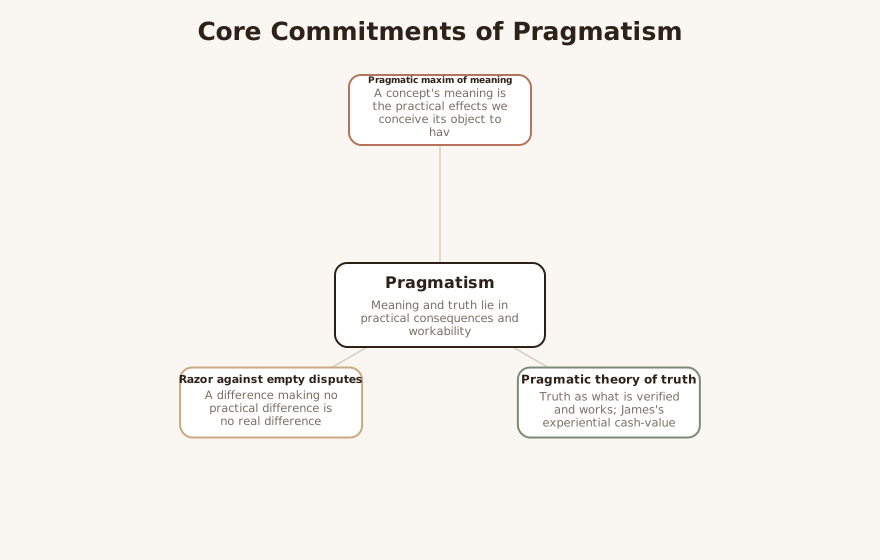
Pragmatism is a bundle of related commitments, and pulling them apart is the key to using it carefully 1. The first is the pragmatic maxim of meaning: to grasp what a concept means, consider the practical effects we conceive its object to have, because “our conception of these effects is the whole of our conception of the object” 13. On this view a difference that makes no conceivable practical difference is no real difference at all, which is a powerful razor against empty disputes 13.
The second is the pragmatic conception of truth. Classical pragmatists treated truth not primarily as a static correspondence between a belief and the world but in terms of how beliefs function — whether they are verified, whether they “work,” whether they prove useful and reliable as we act on them and continue inquiry 12. James spoke of the “cash-value” of an idea in experiential terms and held, controversially, that “the true is only the expedient in the way of our thinking” 26. The Stanford account of the pragmatic theory of truth stresses that this was meant to capture truth’s practical role — its connection to inquiry, assertion, and action — rather than to reduce truth to whatever any individual happens to find handy 2. That distinction is exactly the one a careless reader loses, and it is the one clinicians must keep 2LLM.
A third principle is anti-foundationalism and fallibilism: pragmatists are skeptical of fixed first principles and certain foundations, treating all our beliefs as revisable in light of further experience 13. A fourth is the primacy of practice and inquiry: knowing is something we do, an active, experimental engagement with problems, not a passive mirroring of a ready-made world 13. Dewey’s instrumentalism makes this explicit — ideas are tools forged to transform an indeterminate, troubling situation into a resolved one 13. Underlying all of it is a continuity between thought and action and a refusal to separate knowing from living 14.
Interventions & Techniques
Because pragmatism is a philosophy rather than a therapy, “techniques” here means structured ways of importing the pragmatic temper into recognized clinical activities; none of these is owned by pragmatism, and the philosophical sources do not prescribe them LLM. The most direct import is workability-testing: instead of debating whether a client’s belief is true or false in the abstract, the clinician and client examine what believing and acting on it actually produces in the client’s life — a near-literal application of the pragmatic maxim and the “does it work?” criterion to a thought 1LLM. This is the recognizable family resemblance between pragmatism and the acceptance-and-commitment-therapy question “Is this thought workable, given what you care about?” LLM.
A second import is the criterion-versus-license distinction, which is the single most important guardrail the tradition offers the clinic LLM. The pragmatic theory of truth was offered as an account of how truth functions, not as permission to call any comforting belief true; sophisticated pragmatists tie “what works” to disciplined inquiry, verification, and the long run, not to momentary convenience 2. Translated into practice, this means workability is judged against the client’s stated values and against reality-testing over time, not against whatever reduces discomfort this minute 2LLM.
A third import is problem-framing in Dewey’s sense: treating a stuck client’s situation as an indeterminate, problematic one to be reconstructed through active inquiry — defining the problem, generating candidate actions as hypotheses, trying them, and revising — which maps closely onto structured problem-solving and behavioral experimentation 13LLM. A fourth is fallibilist reframing, where the clinician helps a rigid client hold beliefs as revisable working hypotheses rather than fixed truths, loosening the grip of certainty without demanding the client adopt an opposite certainty 1LLM.
LLM-generated illustrative example (not a guideline): A client insists “I have to know for certain my decision is the right one before I can act,” and is frozen. Rather than argue the belief is false, the clinician runs a pragmatic test: what does holding that rule actually produce? (Paralysis, missed opportunities, mounting self-criticism.) They reframe the pending choice as a Deweyan experiment — a reversible action taken as a hypothesis, with a plan to gather evidence and revise — and the demand for prior certainty is treated as one unworkable belief among several the client could hold LLM.
Evidence Base
The honest maturity label for pragmatism is established — but, as with any imported philosophy, “established” means historically central, rigorously developed, and continuously debated within its own discipline, not validated as a clinical intervention 1. As a philosophical tradition it is foundational: it is the principal home-grown American movement in philosophy, with a continuous scholarly lineage from Peirce, James, and Dewey through to a vigorous contemporary neopragmatism, and a large critical literature 134. There is, however, no body of outcome research showing that “applying pragmatism” improves clinical outcomes, because it is not a treatment and has never been studied as one; its standing is philosophical, not empirical LLM.
Its clinical relevance is therefore indirect and interpretive. The pragmatic spirit is widely recognized as part of the philosophical background of functional, workability-focused therapies, but that influence is a matter of intellectual genealogy rather than something the philosophy sources document or that controlled trials have isolated LLM. When acceptance and commitment therapy, cognitive behavioral therapy, or solution-focused work show efficacy, the credit belongs to those modalities and their evidence, not to “pragmatism”; the philosophy at most supplies a coherent rationale for caring about workability in the first place LLM.
Intellectual honesty also requires naming the tradition’s well-documented objections, because each maps onto a real clinical risk LLM. The classic charge against the pragmatic theory of truth is the wishful-thinking objection: if “true” just means “useful to believe,” then comforting falsehoods could count as true, which is absurd — and critics pressed exactly this against James 2. Pragmatists answer by distinguishing momentary expediency from what works in the long run and under continued inquiry, but the objection marks a permanent hazard 2. A second is the worry that pragmatism slides into relativism or subjectivism, dissolving the difference between truth and mere agreement or satisfaction; the better pragmatist replies tie truth to public verification and the constraints of experience, but the slope is real 23. These are not fringe complaints; they are the standard reasons the field does not treat the pragmatic theory of truth as obviously correct, and they are precisely the failure modes a clinician must guard against when “whatever works” thinking enters the room LLM.
Populations & Indications
Pragmatism is not indicated for a diagnosis; the posture is most useful for situations in which a client is stuck on the truth or rightness of a belief when the live question is really its workability LLM. It is broadly relevant across clients across diagnostic categories, because the move from “is this thought true?” to “does holding it help me live as I want?” is diagnosis-neutral LLM. It is especially apt with adults and people seeking practical change, for whom an outcome-and-action orientation fits the work, and with help-seeking individuals whose distress is organized around rumination on unanswerable questions LLM.
The posture is also valuable for clinicians and trainees themselves, as a corrective to two opposite errors: the temptation to win abstract arguments with clients about whether a belief is “rational,” and the temptation to treat any short-term relief as proof a belief is sound LLM. The indication is always adjunctive: the pragmatic temper clarifies how a clinician and client evaluate beliefs and actions, while the actual treatment is delivered through whatever evidence-based modality the presentation requires LLM.
Problems-for-Work
Several presenting problems map naturally onto a pragmatic lens, always as an organizing frame rather than a treatment LLM. For cognitive rigidity and maladaptive beliefs, the pragmatic maxim and fallibilism let a clinician shift the target from the truth of a rigid belief to its workability, and to hold beliefs as revisable hypotheses rather than fixed facts — often more movable than a head-on dispute about accuracy 1LLM. For rumination, the maxim’s razor — a difference that makes no practical difference is idle — gives a principled basis for redirecting a client away from unanswerable “what is really true about me?” loops toward consequences and action 1LLM.
For indecision and goal-setting difficulties, Dewey’s instrumentalism reframes choices as experiments: actions taken as hypotheses, evaluated by results and revised, which loosens the demand for prior certainty that fuels paralysis 13LLM. For avoidance, the workability test turns the question from “is avoiding dangerous/justified?” to “what does avoiding actually produce over time?”, aligning with the functional logic of exposure-based and acceptance-based work LLM. For problem-solving deficits and adjustment difficulties, Dewey’s cycle — define the problematic situation, generate options, test, revise — supplies a transferable structure for active, experimental coping 13LLM.
LLM-generated illustrative example (not a guideline): A client adjusting to a job loss ruminates on whether the layoff “proves” they were never good enough. The clinician declines the debate over that verdict and instead applies a pragmatic frame: what does treating the layoff as proof of worthlessness do to the client’s next steps? Together they reframe the situation as a problem to be worked — define the actual constraints, list candidate actions as experiments, run one, review the result — converting an unanswerable truth-question into a workable course of action LLM.
Contraindications, Cautions & Cultural Humility
Pragmatism has no contraindications in the pharmacological sense, but it carries cautions that are unusually important because its central idea is so easy to cheapen LLM. The first is the wishful-thinking trap: a clinician who lets “true means useful” run unguarded can quietly validate a client’s comforting distortions, or collude with a self-serving belief, on the grounds that it “works” — the very move critics used to discredit the pragmatic theory of truth 2LLM. The corrective is the pragmatists’ own qualification: workability must be tied to honest, ongoing inquiry and to consequences over the long run, not to momentary relief, and it must answer to reality, which keeps pushing back 2LLM.
A second caution is the relativism slide: an undisciplined “whatever works for you is your truth” abandons the clinician’s responsibility to reality-test and can leave a client stranded in a private world 23LLM. A third is more subtle: not every human concern is well captured by a consequence-and-workability metric, and treating questions of meaning, dignity, grief, or the sacred as merely instrumental can feel — and be — reductive LLM. Some clients are helped precisely by being allowed to dwell with a truth that does not “pay,” and a clinician who pragmatizes everything risks missing that LLM.
Cultural humility is essential. Pragmatism is a product of late-nineteenth-century American thought, secular, individualistic, and oriented to practical results and progress, and those assumptions are not culturally neutral 4LLM. Many traditions hold that some truths are to be honored, transmitted, or submitted to regardless of their practical payoff, and that obligations, ancestors, or the sacred carry a weight a workability calculus cannot price LLM. Treating such commitments as irrational because they do not “work” in instrumental terms is itself an error of the kind cultural humility is meant to prevent LLM. The pragmatic posture is best offered as one lens among several, useful for loosening rigidity, not as a universal solvent for every belief a client holds LLM.
Treatment-Plan Suggestions & SMART Objectives
The pragmatic posture can help structure measurable objectives around belief-flexibility, decision-making, and action within a broader, evidence-based treatment plan; the examples below are illustrative templates to adapt, not prescriptions, and none is a treatment in its own right LLM.
| Goal | SMART objective (example) | Mechanism |
|---|---|---|
| Shift from truth-debate to workability on a rigid belief | Within 3 sessions, client will identify, for one core belief, what holding it produces in three concrete life domains | Workability-testing applies the pragmatic maxim to a thought 1 |
| Loosen demand for certainty driving indecision | Over 4 weeks, client will take one reversible action as an “experiment” and review its results before judging it | Dewey’s instrumentalism reframes choices as testable hypotheses 13 |
| Interrupt rumination on unanswerable questions | Within 5 sessions, client will redirect from one “what is really true about me?” loop to a consequence-and-action question in 3 logged instances | The pragmatic razor discounts differences with no practical bearing 1 |
| Reduce avoidance via functional review | Over 6 sessions, client will log what one avoidance strategy actually yields over time, weekly | Workability test reorients from justification to consequences LLM |
| Hold beliefs as revisable hypotheses | By week 6, client will restate two fixed beliefs as working hypotheses with disconfirming evidence noted | Fallibilism treats beliefs as revisable in light of experience 1 |
| Build a Deweyan problem-solving routine | Within 4 sessions, client will apply a define–generate–test–revise cycle to one stuck problem | Inquiry-as-instrument structures active coping 13 |
| Guard “what works” against self-deception | By week 8, client will check each “this belief helps me” against one reality-test and one values-check | Ties workability to inquiry, not momentary expediency 2 |
Common Misconceptions
The most common misconception is that pragmatism means “anything goes” or “true is whatever you feel like believing” LLM. The classical pragmatists tied workability to verification, experience, and the long run of inquiry, and the wishful-thinking objection — that pure usefulness cannot be truth — was raised precisely to block that reading; serious pragmatists answer it rather than embrace it 26. A second misconception is that pragmatism is hostile to truth altogether; in fact it offers a theory of truth — one that locates truth in how beliefs function in inquiry and action — not a dismissal of it 2.
A third misconception is that pragmatism is a single doctrine. It is a family with real internal disagreement: Peirce’s verification-and-logic-oriented pragmaticism, James’s broader extension to religious and moral belief, Dewey’s instrumentalism, and later neopragmatism are not interchangeable, and Peirce coined “pragmaticism” specifically to distance his view from James’s looser popularizations 13. A fourth, clinically important misconception is that the pragmatic test is anti-intellectual or hostile to evidence; on the contrary, Peirce grounded the maxim in scientific, experimental thinking, and the tradition’s quarrel is with idle abstraction, not with rigor 13. A final misconception is that because “does it work?” sounds like common sense, it can be applied unreflectively; its best-documented feature is exactly the set of objections — wishful thinking, relativism — that show why unreflective use is hazardous 2.
Training & Certification
There is no certification in pragmatism, and none would be appropriate, because it is a public philosophical tradition rather than a proprietary clinical method LLM. Clinicians typically meet it within graduate coursework in philosophy of science or the history of ideas, within the theoretical foundations of functional and behavioral therapies, and through the philosophy-of-science literature that underpins acceptance and commitment therapy and related approaches LLM. Authoritative, freely available primers are maintained by academic encyclopedias of philosophy, which lay out the tradition’s history, its theory of meaning, and its theory of truth in depth, and the foundational primary text — James’s 1907 lectures — is in the public domain 136. Competence to use the posture responsibly comes not from a credential but from understanding its mechanics and, crucially, its failure points — the wishful-thinking and relativism objections — and from holding it as one lens among several rather than as a master key 2LLM. In practice that competence is built in supervision, where a trainee learns to distinguish a disciplined workability test from a lazy “whatever helps” rationalization LLM.
Key Terms
Pragmatism — the American philosophical tradition that ties the meaning of ideas to their practical consequences and assesses beliefs by their workability in experience 13. Pragmatic maxim — Peirce’s rule for clarifying a concept by considering the practical effects we conceive its object to have, those effects being “the whole of our conception” 1. Pragmatic theory of truth — the view that truth is to be understood through how beliefs function in inquiry, verification, and action rather than through static correspondence to reality 2. Cash-value (of an idea) — James’s metaphor for an idea’s concrete, experiential difference and usefulness 26. Instrumentalism — Dewey’s version of pragmatism, treating ideas and theories as tools for resolving problematic situations 13. Inquiry — the active, experimental process of moving from a doubtful, indeterminate situation to a settled one, central to Peirce and Dewey 13. Fallibilism — the stance that all beliefs are revisable in light of further experience and that certainty is not required for warranted belief 13. Anti-foundationalism — skepticism toward fixed first principles and certain foundations for knowledge 13. Pragmaticism — Peirce’s relabeling of his own position to distinguish it from looser popular versions, “ugly enough to be safe from kidnappers” 1. Neopragmatism — the late-twentieth-century revival that kept pragmatism a live philosophical option 13. Wishful-thinking objection — the central criticism that if usefulness equaled truth, comforting falsehoods would count as true 2.
Resources & Further Reading
▶ Watch — a video introduction to this concept:
- Pragmatism — Stanford Encyclopedia of Philosophy
- The Pragmatic Theory of Truth — Stanford Encyclopedia of Philosophy
- Pragmatism — Internet Encyclopedia of Philosophy
- Pragmatism — Britannica (summary)
- William James: Career in Philosophy — Britannica
- James, W. (1907). Pragmatism: A New Name for Some Old Ways of Thinking — Project Gutenberg
Reflective / Supervision Questions
- When a client is locked in a debate about whether a belief is true, do you notice the moment when the more useful question is whether holding it works for the life they want — and can you make that pivot without dismissing their concern for truth? 1LLM
- Where in your practice might “but it helps them feel better” be quietly licensing a comforting distortion you would otherwise reality-test — the wishful-thinking trap turned clinical? 2LLM
- How do you tie “what works” to honest, ongoing inquiry and the client’s stated values, rather than to whatever lowers distress in the session? 2LLM
- For a client frozen by a demand for certainty, can you help them treat a next action as a Deweyan experiment — reversible, hypothesis-like, revised by results — rather than a verdict that must be right in advance? 13LLM
- When does a client’s belief deserve to be honored as meaningful even though it does not “pay” practically, and how do you keep a pragmatic temper from flattening grief, dignity, or the sacred into mere instrument? LLM
- How do you hold the pragmatic lens alongside a client’s culturally rooted commitments to truths that are to be honored or transmitted regardless of their practical payoff? 4LLM