
Mindfulness and meditation have moved from the periphery of behavioral health into its mainstream, and most clinicians now recommend some form of contemplative practice. What has lagged behind is a clinical vocabulary for what happens when meditation goes wrong. “Meditation-Related Adverse Effects” is the construct that fills that gap — a research-derived map of the difficulties practitioners can encounter, so clinicians can recognize, screen for, and respond to them rather than dismiss them or pathologize them by default. LLM
Type & Discipline
This is a descriptive construct and taxonomy, not a treatment modality or a discrete diagnosis. LLM It sits at the intersection of clinical psychology and contemplative science, drawing on phenomenology, qualitative interview methods, and psychiatric symptom language to characterize a class of experiences. 1 Its purpose is to give meditators, clinicians, researchers, and meditation teachers a shared resource for understanding the broader effects of contemplative practice — including the difficult ones. 1 For a practicing therapist, the construct functions less as something you “deliver” and more as a lens through which you assess and frame a client’s relationship to their practice. LLM
Creators & Lineage
The construct was articulated most fully by Jared Lindahl and Willoughby Britton in the Varieties of Contemplative Experience (VCE) study, with co-authors Nathan Fisher, David Cooper, and Rochelle Rosen, published in PLOS ONE in 2017. 1 The work emerged from Britton’s “Dark Night Project,” an effort to take seriously the long-documented but clinically neglected reports of difficult meditation experiences, named in deliberate echo of the Buddhist and Christian contemplative literature on stages of difficulty in practice. 6 The research program is housed in the Britton Lab at Brown University, which frames the VCE study as an investigation into the full range of meditation’s effects rather than only its benefits. 2
The clinical and translational arm of this lineage is Cheetah House, a nonprofit that provides evidence-based support and resources for meditators in distress, offering psychoeducation, referrals, and information for both practitioners and providers. 3 Conceptually, the construct is downstream of the older contemplative traditions — Theravāda, Zen, and Tibetan Buddhism among them — that long described disorienting or distressing passages in practice; the VCE work translates that experiential literature into a systematic, secular, clinically legible framework. 1
Core Principles
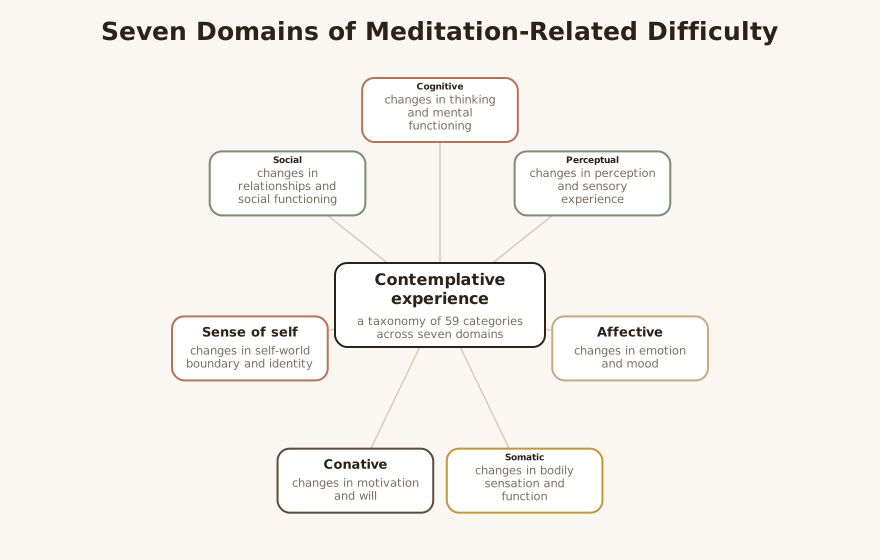
The first principle is that meditation produces a wide and heterogeneous range of experiences, not a uniform calming effect. 1 The VCE study organized practitioner reports into a taxonomy of 59 experience categories spanning seven domains: cognitive, perceptual, affective, somatic, conative, sense of self, and social. 1 Practitioners in the sample reported, on average, roughly twenty of these categories, and many reported experiences across all seven domains, underscoring how multidimensional these difficulties can be. 1
The second principle is that valence is not intrinsic to the experience. 1 The same or similar phenomenon — a dissolution of the self–world boundary, say — was reported by different practitioners as anywhere from profoundly positive to profoundly distressing, with the difference depending on appraisals, interpretive frameworks, and context rather than on the raw experience alone. 1 This is why the researchers favored the language of “challenging” or “difficult” experiences over a blanket label of “adverse.” 1
The third principle is that these experiences are shaped by modifiable context. 1 The study identified 26 categories of influencing factors across practitioner-level history, practice variables, relationships, and health behaviors — including trauma history, the intensity and amount of practice, the presence of a teacher, sleep, and concurrent psychotherapy. 1 For clinicians, this is the actionable core: the same factors that shape onset and trajectory are levers for prevention and management. LLM
The fourth principle is duration and functional impact. 1 In this sample, difficulties were frequently not fleeting — median symptom duration ranged from one to three years, the large majority of participants reported the experiences spilling into daily life, and a substantial proportion reported moderate-to-severe functional impairment. 1
Interventions & Techniques
Because this is a construct rather than a protocol, the “interventions” are assessment, framing, and management moves rather than a manualized sequence. LLM
The foundational technique is structured inquiry into the practice itself. When a meditator presents with distress, ask about the type, amount, intensity, and consistency of practice, the stage they are at, how they respond to difficult experiences when they arise, and whether they have teacher or community support — the influencing factors the VCE study found to shape trajectory. 1 A meditator doing ten-day silent retreats with no instructor contact is in a very different situation from one doing ten minutes a day with an app. LLM
A second technique is differential framing of sense-of-self phenomena. Cheetah House’s account of the sense-of-self domain distinguishes experiences that are integrated, transient, and accompanied by meta-awareness — often framed by practitioners as insight or freedom — from those marked by loss of meta-awareness, enduring impairment, emotional blunting, or terror. 4 Helping a client locate their experience on that continuum is itself a clinical intervention, because it determines whether you are supporting integration or addressing harm. LLM
A third move is titration and modification of practice. Reducing intensity, shifting from concentration-heavy or self-dissolving techniques toward grounding and embodiment, restoring sleep and basic health behaviors, and re-establishing contact with a teacher are all consistent with the influencing-factor framework, even though the study does not prescribe them as a tested protocol. 1 Psychoeducation — normalizing that meditation can produce difficult states and that these are documented, not a sign of personal failure — is a low-risk staple, and Cheetah House and the Britton Lab provide accessible explanatory materials for exactly this purpose. 3 5
LLM-generated illustrative example (not a guideline): A client returns from a month-long retreat reporting that they feel “eight inches outside” their body and cannot fully re-enter it, with rising panic. Rather than treating this only as a panic disorder, the clinician maps it to the embodiment/sense-of-self domain, asks about practice intensity and teacher contact, pauses formal sitting, and prioritizes grounding, sleep restoration, and gradual reintegration while monitoring safety. LLM
Evidence Base
The honest summary is that this is an emerging evidence base built on rich description, not on controlled trials. LLM The anchoring study is mixed-methods: semi-structured qualitative interviews with 60 Western Buddhist practitioners, plus 32 meditation experts (teachers and clinicians), followed by a quantitative questionnaire. 1 Recruitment was purposive and deliberately targeted people who had encountered challenging experiences (“deviant case sampling”), and the sample was overwhelmingly White, highly educated, US-based, and drawn from Theravāda, Zen, and Tibetan lineages. 1
This design has two consequences clinicians must hold onto. First, the study cannot generate a prevalence rate. Because participants were selected precisely because they had difficulties, the within-sample figures — such as fear/anxiety being reported by a large majority, or notable rates of impairment, suicidality, and even hospitalization — describe this population of affected practitioners, not the base rate of harm among all meditators. 1 Second, causal attribution is constrained. The authors applied standardized causality criteria and found that the reports met them, and they note cross-modal consistency between practitioners and experts, but interview-based, retrospective, self-selected data cannot establish that meditation caused these states in the way a randomized trial could. 1
There is also genuine definitional debate baked into the maturity of the field: the study’s own framing resists the word “adverse,” and the same experience can be benign or harmful depending on interpretation, so what “counts” as an adverse effect is itself contested. 1 There is, at present, no validated screening instrument specific to meditation-related difficulty and no consensus diagnostic threshold — clinicians should treat the taxonomy as a vocabulary and a prompt list, not as a scored measure. LLM
Populations & Indications
The construct is most relevant for intensive and retreat practitioners, who carry the highest documented load of difficult experiences and the longest durations. 1 It is clinically salient for people with trauma histories, since trauma history is an identified influencing factor and trauma re-experiencing appears within the affective domain. 1 It warrants particular caution with clients who have psychosis or bipolar vulnerability, given the perceptual disturbances, delusional-belief and worldview categories, and affective lability documented in the taxonomy — though the study does not formally test risk in these groups. 1 LLM
It is also increasingly relevant to clients using apps or self-guided programs without instructor support, because the absence of a teacher or community is among the modulating relational factors the study flags. 1 Finally, the construct is indicated for the clinician’s own practice of recommending mindfulness: any therapist who prescribes meditation should be able to recognize when it is making a client worse. LLM
Problems-for-Work
Meditation-induced depersonalization/derealization. A client describes thoughts and feelings that feel unreal or “not mine”; the clinician maps this to the sense-of-self and perceptual domains, assesses meta-awareness and impairment, and frames it as a recognized phenomenon while addressing safety and grounding. 4
Fear, panic, and anxiety arising in practice. Fear/anxiety/panic was the most frequently reported category in the affective domain of the study; with a client who panics each time they sit, the work is to reduce intensity, add grounding, and decouple practice from the threat response. 1
Sleep disruption and parasomnias. The somatic domain includes sleep changes and parasomnias, and sleep is also a health-behavior influencing factor; restoring sleep is often both a target and a lever. 1
Somatic dysregulation. Involuntary movements, “energy” phenomena, thermal changes, and pain appear in the somatic domain; the clinician validates these as documented, rules out medical causes, and titrates practice. 1
Trauma re-experiencing. When silent practice surfaces traumatic material, the work is to pause uncovering techniques, stabilize, and integrate trauma-informed care before any return to intensive meditation. 1 LLM
Post-retreat reintegration difficulty. The social domain documents difficulty reintegrating after retreat and occupational impairment; the focus is on graded return to functioning and re-establishing support. 1
Contraindications, Cautions & Cultural Humility
There are no absolute, empirically established contraindications from this descriptive literature, but several prudent cautions follow from it. LLM Recommending high-intensity, long-duration, or self-dissolving practice to clients with significant trauma histories, active psychosis or mania, or fragile affect regulation should be approached conservatively, given that these populations map onto the very domains and influencing factors the study highlights. 1 LLM Clinicians should avoid two opposite errors: pathologizing experiences that the client (and the contemplative tradition) understand as meaningful insight, and conversely, spiritualizing or minimizing experiences that are causing genuine functional impairment and distress. 4
Cultural humility is essential here. The anchoring sample was narrow — predominantly White, Western, highly educated, and Buddhist — so the taxonomy’s language and salience may not transfer cleanly to practitioners from the living traditions and cultures in which these practices originated, or to secular app users. 1 These experiences sit inside religious, cultural, and meaning-making frameworks; respecting the client’s own interpretive context, rather than imposing a purely psychiatric reading, is part of competent care. 1 LLM
Treatment-Plan Suggestions & SMART Objectives
| Goal | SMART objective (example) | Mechanism |
|---|---|---|
| Reduce panic during practice | Within 6 weeks, client reports a ≥50% drop in panic episodes during meditation, by ≤10 minutes of grounded practice daily | Titration of intensity; decoupling practice from threat response 1 |
| Re-establish embodiment | Within 8 weeks, client rates sense of being “in” their body ≥7/10 on ≥5 days/week | Shift from self-dissolving to grounding/embodiment techniques 4 |
| Restore sleep | Within 4 weeks, client achieves ≥7 hours sleep on ≥5 nights/week | Sleep is both a symptom domain and a modifiable influencing factor 1 |
| Build accurate appraisal | Within 3 sessions, client can name and contextualize their experience using the domain framework | Psychoeducation reduces catastrophic interpretation 3 |
| Re-establish support | Within 2 weeks, client re-contacts a qualified teacher or support resource | Teacher/community is a protective relational factor 1 |
| Stabilize before trauma work | Client demonstrates 2 reliable grounding skills before resuming any uncovering practice | Prevents trauma re-experiencing during practice 1 |
| Restore functioning post-retreat | Within 6 weeks, client returns to ≥80% of baseline occupational/social activity | Graded reintegration addresses social-domain impairment 1 |
Common Misconceptions
“Meditation is uniformly safe and relaxing.” The VCE taxonomy documents a wide range of difficult cognitive, perceptual, affective, somatic, and self-related experiences, sometimes lasting years and impairing function. 1
“Difficult experiences mean the person is doing it wrong or is mentally ill.” The study found the same experiences reported by experienced practitioners and even by teachers/experts, and valence depended on context and appraisal, not on pathology per se. 1
“These difficulties are vanishingly rare.” The data cannot speak to rarity at all — the sample was selected for having difficulties, so it neither proves nor rules out a meaningful base rate; claims of “very rare” are not supported by this evidence. 1 LLM
“All altered self-experience is dissociative pathology.” Cheetah House distinguishes integrated, meta-aware self-changes that practitioners experience as freeing from impairing, distressing ones — the clinical task is to tell them apart, not to collapse them. 4
Training & Certification
There is no formal certification in “meditation-related adverse effects,” and clinicians should be wary of anyone claiming a credential in it. LLM The practical path is familiarity with the primary literature, the Britton Lab’s materials describing the VCE study, and Cheetah House’s psychoeducational resources and video library, which translate the research into accessible explanations for providers and meditators. 2 3 5 Clinicians who recommend or supervise meditation benefit from pairing this construct with trauma-informed and trauma-sensitive mindfulness training, so that practice can be modified rather than abandoned when difficulties arise. LLM
Key Terms
Challenging / difficult experiences — the study’s preferred, non-pathologizing term for the phenomena, chosen because the same experience can be positive or negative depending on context. 1
The seven domains — cognitive, perceptual, affective, somatic, conative, sense of self, and social; the top-level structure of the taxonomy. 1
Influencing factors — practitioner history, practice variables, relationships, and health behaviors that shape onset and trajectory of difficulties. 1
Sense-of-self domain — alterations in narrative self, embodiment, self–world boundaries, agency, ownership, and basic/minimal self. 4
Dark Night Project — Britton’s research program, named for traditional contemplative accounts of difficult stages, from which this work grew. 6
Resources & Further Reading
▶ Watch — a video introduction to this concept:
- Lindahl, Fisher, Cooper, Rosen & Britton (2017), PLOS ONE — The Varieties of Contemplative Experience
- Britton Lab, Brown University — The VCE Study overview
- Cheetah House — support and resources for meditators in distress
- Cheetah House — Adverse Effects of Meditation: Changes in Sense of Self
- Cheetah House — Videos
- Mind & Life Institute — The Dark Knight (of the Soul)
Reflective / Supervision Questions
- When a client describes an altered sense of self in meditation, how do I decide whether I am witnessing integration or harm — and what would change my mind? LLM
- Do I routinely ask about meditation type, intensity, and teacher support before recommending or continuing practice? LLM
- How might my own assumptions about meditation as benign lead me to miss, or to over-pathologize, a client’s contemplative distress? LLM
- Given the narrow sample behind this construct, how do I adapt its language for clients from different cultural or religious traditions? LLM
- When meditation appears to be making a client worse, can I modify the practice rather than reflexively endorsing or abandoning it? LLM