
Type & Discipline
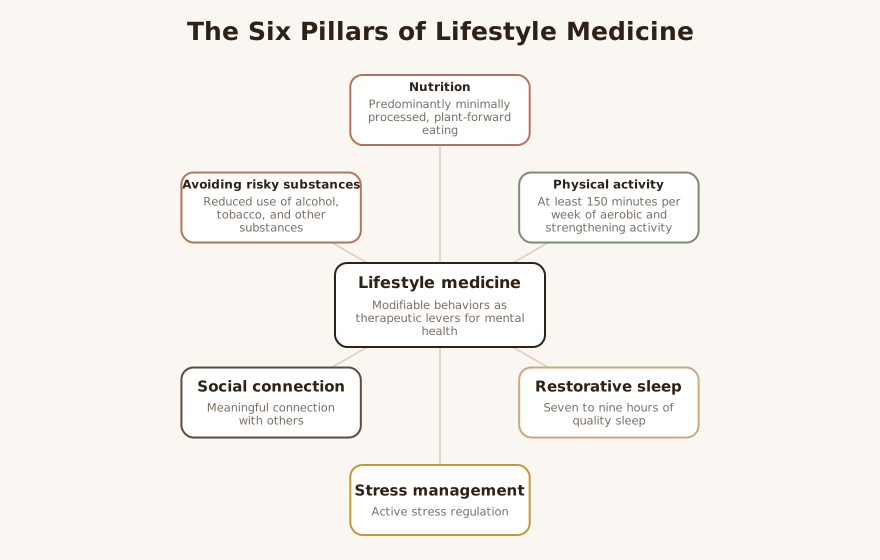
Lifestyle psychiatry is a framework, not a single branded technique, that applies the evidence-based methods of lifestyle medicine to the prevention and treatment of mental health conditions 2. Lifestyle medicine itself is an evidence-based medical specialty that uses therapeutic lifestyle interventions to treat, reverse, and prevent chronic conditions such as cardiovascular disease, type 2 diabetes, and obesity 1. When this approach is turned toward the mind, it organizes care around six pillars — optimal nutrition, physical activity, restorative sleep, stress management, social connectedness, and avoidance of risky substances 1. For the practicing clinician, the discipline sits at the intersection of preventive medicine, behavioral medicine, and health psychology, and it is best understood as a structured way of treating modifiable behavioral and physiological drivers of psychiatric symptoms rather than a replacement for psychotherapy or medication 2.
Conceptually, lifestyle psychiatry occupies a middle ground between depth-oriented psychotherapy and pharmacology, capitalizing on lifestyle domains while still accounting for personality, lifespan stage, and social determinants of health 2. It folds mental health, cognitive health, and well-being into an overarching framework of brain health 2. This positioning matters clinically: lifestyle interventions are not framed as “alternative” but as first-line or adjunctive medical treatment with their own evidence base 1.
Creators & Lineage
The term lifestyle psychiatry was coined by Douglas Noordsy, MD, who edited the foundational textbook Lifestyle Psychiatry, published by American Psychiatric Association Publishing in 2019 6. Noordsy is a Clinical Professor and Director of Lifestyle Psychiatry in the Department of Psychiatry and Behavioral Sciences at Stanford University School of Medicine, where he subsequently established a dedicated lifestyle psychiatry clinic 6. His work consolidated a scattered evidence base into a single clinical paradigm and gave psychiatry a shared vocabulary for behavioral and physiological interventions 6.
The lineage of the framework draws on several established traditions LLM. Behavioral medicine and health psychology supply the theory of how behavior change is initiated and sustained, while preventive medicine supplies the population-level logic of modifying risk factors before disease becomes entrenched 3. Cognitive behavioral therapy for insomnia (CBT-I) is a direct ancestor of the sleep pillar and remains the first-line treatment for primary insomnia 2. The broader lifestyle medicine specialty, codified by organizations such as the American College of Lifestyle Medicine around its six pillars, provides the structural backbone that lifestyle psychiatry adapts for mental health 1.
Core Principles
The organizing premise is that modifiable lifestyle behaviors are not merely supportive of mental health but are themselves therapeutic levers capable of changing the course of psychiatric illness 2. Each of the six pillars maps onto specific, measurable behavioral targets: a predominantly minimally processed, plant-forward eating pattern; at least 150 minutes per week of moderate aerobic and muscle-strengthening activity; seven to nine hours of quality sleep; active stress regulation; meaningful social connection; and reduced use of alcohol, tobacco, and other substances 1.
A second principle is the expansion of the biopsychosocial model into a biopsychosocial-lifestyle model, in which a structured lifestyle history is gathered alongside the standard diagnostic formulation 2. This expanded formulation clarifies treatment options and surfaces barriers to sustainable behavior change that a symptom-only assessment would miss 2. The framework explicitly assesses both internal factors — emotional regulation, internalized trauma, cognitive patterns, and personality traits — and external factors such as environmental barriers and work-related burnout, because these determine a patient’s actual capacity to change behavior 2.
A third principle is that behavior change is itself a clinical skill requiring psychiatric and psychological expertise, not an add-on that any provider can deliver casually 3. High levels of motivation and self-efficacy are necessary for effective change, and the cognitive processes by which patients attend to and interpret information directly shape their capacity to engage and sustain modifications 3. The therapeutic alliance is treated as a mechanism, not a courtesy: the patient-provider relationship is a documented predictor of treatment engagement and adherence, including adherence to dietary change 3.
Interventions & Techniques
In practice, interventions are pillar-specific and dosed like any other treatment LLM. For the activity pillar, structured exercise is prescribed toward the 150-minute weekly target, with the dose and modality individualized to the patient’s baseline and preferences 1. For the nutrition pillar, the clinician guides a shift toward a minimally processed, vegetable-, fruit-, whole-grain-, legume-, nut-, and seed-forward eating pattern, often delivered through brief counseling rather than restrictive dieting 1. For sleep, CBT-I is the technique of choice and the first-line intervention for insomnia 2.
Behavior-change techniques drawn from psychology operationalize each pillar 3. Cognitive behavioral methods, described as the current gold standard of psychotherapy, integrate thoughts and behaviors and translate naturally to lifestyle change 3. Behavioral strategies such as contingency management — including reward systems and positive reinforcement — have proven effective even for individuals with severe mental illness, helping overcome the low motivation that flows from symptoms and medication side effects 3. Humanistic and strengths-based methods reinforce social connectedness and well-being rather than focusing on deficits alone, while attention to adverse childhood experiences informs culturally sensitive, individualized intervention design 3.
LLM-generated illustrative example (not a guideline): A 47-year-old primary care patient with moderate depression and a sedentary routine collaborates with the clinician to build a graded walking plan starting at 10 minutes three times weekly, paired with a simple sleep-window protocol and one shared meal per week with a friend. Targets are reviewed each session, and reinforcement is tied to attendance rather than weight or mood, lowering the threshold for engagement. LLM
Evidence Base
The evidence base is emerging but, for several pillars, already substantial 2. The strongest signal is for exercise in depression: a meta-analysis of 41 studies reported a number needed to treat (NNT) of 2.1 for improvement in depressive symptoms, an effect size that rivals or exceeds many first-line treatments 2. For nutrition, the SMILES trial found that short-term dietary counseling alone produced remission of moderate-to-severe depression in 32.3% of the intervention group versus 8% of controls, an NNT of 4.1 2. For sleep, CBT-I is established as first-line for primary insomnia and effectively improves depression-related sleep disturbance 2.
Beyond these, individuals meeting the 150-minute weekly activity target show notable reductions in anxiety symptoms relative to those who exercise less, and social-prescribing interventions reduce depressive symptoms and emotional loneliness 2. The authors who synthesize this literature describe the data as compelling while candidly acknowledging that many psychiatric conditions remain inadequately controlled by available treatments, leaving real room for lifestyle approaches 2.
Honesty about maturity is warranted LLM. Much of the supporting literature is heterogeneous, trials are often short-term, and the field risks a “streetlight effect” — over-relying on readily available research while neglecting rigorous psychiatric and psychological evidence 3. Lifestyle medicine as a whole has historically under-integrated established psychiatric science, which weakens its mental health claims where that integration is missing 3. The clinician should therefore treat lifestyle psychiatry as a well-supported adjunct and, for depression specifically, a credible primary option, while remaining alert to the limits of the data 2.
Populations & Indications
The framework is broadly applicable across adult populations and is particularly suited to patients whose psychiatric presentation is entangled with chronic medical disease 1. Adults and older adults with mood disorders, generalized anxiety, and insomnia are core candidates given the direct evidence for exercise, nutrition, and sleep interventions in these conditions 2. People with chronic illness, metabolic syndrome, obesity, type 2 diabetes, and elevated cardiovascular risk are strong indications because the same pillars simultaneously address their psychiatric and physical comorbidities 1.
Primary care patients are an especially important population, since up to 70 percent of mental health concerns are assessed and treated by primary care physicians, making lifestyle approaches a natural fit for that setting 3. The framework is also relevant to patients facing access barriers, because some lifestyle interventions can be initiated without the delays and costs associated with specialty psychotherapy or medication 2.
Problems-for-Work
Several discrete clinical problems map cleanly onto lifestyle-psychiatry intervention LLM. Major depressive disorder is addressed primarily through prescribed exercise and dietary change, both with direct trial support 2. Insomnia is addressed through CBT-I and sleep-window regulation 2. Generalized anxiety responds to meeting the 150-minute activity threshold 2.
LLM-generated illustrative example (not a guideline): For a client whose presenting problem-for-work is chronic stress with associated fatigue, the clinician and client co-design a brief daily stress-management routine, anchor it to an existing habit, and add one weekly social contact to counter isolation; progress is tracked against the behavioral target rather than against symptom severity alone. LLM
Obesity, type 2 diabetes, and cardiovascular disease risk are addressed through the combined nutrition and activity pillars, which target the psychiatric and metabolic burden at once 1. Sedentary behavior and chronic stress are themselves named targets within the activity and stress-management pillars 1. Substance use is engaged through the risky-substance-avoidance pillar 1. For cognitive decline, the brain-health framing positions the pillars as protective levers, though the clinician should be candid that this is an area of emerging rather than settled evidence 2.
Contraindications, Cautions & Cultural Humility
Lifestyle psychiatry has few absolute contraindications, but it has important cautions LLM. It should never be offered as a substitute for indicated acute psychiatric care; a patient in crisis, with active suicidality, psychosis, or severe malnutrition requires standard intervention first, with lifestyle work layered in once stabilized LLM. Exercise prescription in patients with cardiac or other medical risk requires appropriate medical clearance, and dietary change in patients with eating disorders demands specialist coordination rather than generic nutrition advice LLM.
A central caution is that low motivation and self-efficacy are often symptoms of the very disorder being treated, so framing lifestyle change as a matter of willpower can shame patients and rupture the alliance that predicts adherence 3. Adverse childhood experiences are strong predictors of adult health behaviors and must inform a culturally sensitive, individualized approach rather than a one-size-fits-all prescription 3. Stigma is also a structural barrier — up to half of patients referred for mental health care never follow up — which argues for integrating lifestyle work into accessible, lower-stigma settings 3. Cultural humility further requires recognizing that food traditions, access to safe spaces for activity, and social structures vary widely, and that the plant-forward, 150-minute templates are starting points to be adapted, not mandates to be imposed LLM.
Treatment-Plan Suggestions & SMART Objectives
| Goal | SMART objective (example) | Mechanism |
|---|---|---|
| Increase physical activity for depression | Client will complete 3 moderate-intensity walks of 20 minutes each per week for 8 weeks, building toward 150 weekly minutes | Exercise shows an NNT of 2.1 for depressive symptom improvement 2 |
| Improve sleep continuity | Client will follow a consistent sleep window and CBT-I protocol nightly for 6 weeks, targeting 7-9 hours | CBT-I is first-line for insomnia and improves depression-related sleep 2 |
| Shift dietary pattern | Client will replace 5 processed meals per week with minimally processed, plant-forward meals over 12 weeks | Dietary counseling alone produced 32.3% depression remission in trial conditions 2 |
| Reduce anxiety via activity | Client will reach 150 minutes of weekly moderate activity within 10 weeks, logged daily | Meeting the 150-minute target is associated with notable anxiety reduction 2 |
| Strengthen social connection | Client will initiate 2 meaningful social contacts per week for 8 weeks | Social-prescribing interventions reduce depressive symptoms and loneliness 2 |
| Build stress-management routine | Client will practice a 10-minute daily stress-regulation skill, anchored to an existing habit, for 6 weeks | Chronic stress exacerbates mood and cardiovascular conditions 1 |
| Reduce risky substance use | Client will track and reduce alcohol use to within target limits across 8 weeks | Risky-substance avoidance is a core lifestyle-medicine pillar 1 |
Common Misconceptions
A frequent misconception is that lifestyle psychiatry is “alternative” or non-medical; in fact lifestyle medicine is an evidence-based specialty positioned as first-line treatment in chronic disease guidelines 1. A second is that it is merely generic wellness advice, when in practice each pillar carries specific, dosed targets and several carry trial-grade evidence in depression, anxiety, and insomnia 2. A third is that it replaces medication and psychotherapy; the framework is explicitly a middle ground that complements, and is integrated with, those modalities 2.
Another misconception is that delivering lifestyle change is simple and requires no specialized skill, when the literature shows that motivation, cognition, alliance, and trauma history all mediate success and demand genuine psychiatric and psychological expertise 3. Finally, some assume the evidence is uniformly mature; it is honestly characterized as emerging, strongest for exercise and diet in depression and for CBT-I in insomnia, and thinner elsewhere 2.
Training & Certification
Formal grounding comes through lifestyle medicine credentialing pathways anchored to the six pillars, which establish the core competencies the framework adapts for mental health 1. The foundational psychiatric text edited by Noordsy provides the discipline-specific knowledge base for clinicians extending these competencies into psychiatry 6. The literature recommends that interprofessional education spanning psychiatry, psychology, and primary care begin early in training and continue throughout, deliberately breaking down the medical silos that have left mental health under-integrated within lifestyle medicine 3. For practicing therapists, this points toward supplementing existing behavior-change training with structured exposure to the pillar-specific evidence rather than treating lifestyle work as intuitive LLM.
Key Terms
Six pillars — nutrition, physical activity, restorative sleep, stress management, social connectedness, and avoidance of risky substances 1. Biopsychosocial-lifestyle model — an expanded formulation adding a structured lifestyle history to the standard diagnostic assessment 2. Brain health — the overarching frame uniting mental, cognitive, and well-being outcomes in lifestyle psychiatry 2. Number needed to treat (NNT) — a measure of intervention efficacy; exercise in depression carries an NNT of 2.1 2. Contingency management — a behavioral technique using reinforcement to support behavior change, effective even in severe mental illness 3. Streetlight effect — the risk of over-relying on readily available research while neglecting rigorous psychiatric evidence 3.
Resources & Further Reading
▶ Watch — a video introduction to this concept:
- What is Lifestyle Medicine? — American College of Lifestyle Medicine
- The Power of Lifestyle Psychiatry: A New Approach to Mental Health (PMC)
- Applying Psychiatry and Psychology Principles to Lifestyle Approaches for Mental and Behavioral Health (PMC)
- Lifestyle Psychiatry — American Psychiatric Association Publishing (Noordsy, ed.)
- Lifestyle Psychiatry: Through the Lens of Behavioural Medicine — Merlo & Fagundes (textbook)
- Lifestyle Psychiatry: Evidence-Based Lifestyle Interventions for Mental and Physical Health — Psychiatric Times
Reflective / Supervision Questions
- When a client presents with low motivation, how do I distinguish a symptom of their disorder from a barrier requiring a different behavior-change strategy, and does my framing risk implying willpower failure? 3
- For which of my current clients is the strongest evidence — exercise and diet in depression, or CBT-I in insomnia — directly applicable, and am I dosing those interventions with the same rigor I apply to medication or formal psychotherapy? 2
- How does the patient’s adverse-childhood-experience history and cultural context shape which pillars are realistic, and where am I imposing a template rather than adapting one? 3
- Where in my caseload am I treating lifestyle change as simple advice rather than as a skilled clinical intervention that depends on alliance, cognition, and reinforcement? 3
- How honestly am I communicating the emerging maturity of this evidence to clients, and have I ensured lifestyle work is layered onto, not substituted for, indicated acute psychiatric care? 2