
Type & Discipline
The biopsychosocial (BPS) model is a conceptual framework rather than a discrete intervention, and it sits at the intersection of medicine, psychiatry, and clinical psychology 1. It proposes that health and illness are best understood as products of interacting biological, psychological, and social factors rather than biology alone 4. Methodologically it draws on general systems theory, treating the patient as one level within a continuous hierarchy that runs from molecules and cells through the person to family, community, and society 1. For practicing therapists, the most accurate way to categorize it is as a formulation and treatment-planning lens that organizes assessment and case conceptualization across recognized modalities, not as a standalone, manualized, billable therapy LLM. It is foundational to behavioral medicine and health psychology, fields that operationalize its premises into specific clinical methods 5.
Creators & Lineage
The model was articulated by the American internist and psychiatrist George Engel in a 1977 paper in Science titled “The need for a new medical model: a challenge for biomedicine” 1. Engel argued that the dominant biomedical model was reductionist and dualist, reducing disease to deviations from biological norms while leaving no systematic place for the psychological and social dimensions of suffering 1. To remedy this he imported general systems theory, the idea that nature is arranged as a hierarchy of nested systems in which each level is both a whole and a part of a larger whole 1. Engel’s framework was deliberately programmatic, naming what a more adequate medical science would require without supplying the detailed mechanisms by which psychological and social factors causally influence biology 2. Its intellectual lineage therefore runs from general systems theory into Engel’s synthesis, and forward into behavioral medicine and health psychology, the applied disciplines that have carried the model into routine clinical practice 5. More recently, theorists such as Derek Bolton have proposed a “revitalized” version that grounds Engel’s vision in contemporary regulatory biology, cognitive science, and social epidemiology 2.
Core Principles
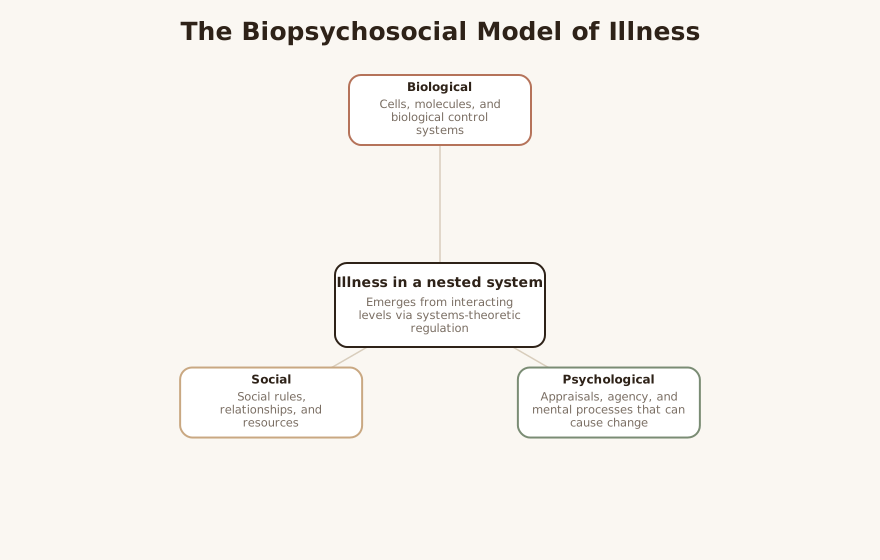
The model’s central claim is that illness emerges from interacting levels of a nested system, so that a complete clinical account must attend to biological, psychological, and social contributions simultaneously 1. A corollary is anti-reductionism: explaining a presentation purely at the level of cells and molecules omits causally relevant information at the psychological and social levels 1. The model also rejects mind-body dualism, insisting that mental and social processes are not mere epiphenomena but can themselves be causes of physiological change 2. In the revitalized formulation, the conceptual glue across the three domains is systems-theoretic regulation and dysregulation: biological control systems, psychological appraisals and agency, and social rules and resources all involve information processing and feedback rather than mere energy transfer, which is what allows them to interact within a shared causal space 2. Practically, this implies that the same outcome can have multiple, layered determinants, and that intervention may be effective at any level rather than only at the biological one 2. The model thus reframes the clinician’s task from identifying a single lesion to mapping a web of interacting contributors LLM.
Interventions & Techniques
Because the BPS model is a framework rather than a technique, its main clinical product is a structured multi-axis formulation in which the clinician maps predisposing, precipitating, perpetuating, and protective factors across the biological, psychological, and social domains 5. From that map flows a treatment plan that may combine modalities at different levels, for example pharmacotherapy plus a psychological therapy plus a social intervention such as mobilizing support or addressing housing or work 2. Common applied techniques include behavioral medicine methods, health-behavior change strategies, and collaborative goal setting that explicitly names targets in each domain 6. The model also reshapes the clinical encounter itself, foregrounding the patient’s agency, beliefs about control, and the interpersonal quality of care as active ingredients rather than background 2.
LLM-generated illustrative example (not a guideline): A clinician seeing a patient with persistent low back pain and depressed mood might map nociceptive and deconditioning factors (biological), catastrophizing and fear-avoidance beliefs (psychological), and a disability claim plus loss of work role (social), then plan graded activity, cognitive work on pain appraisals, and a return-to-function conversation rather than treating any single axis in isolation LLM.
A practical caution is that, without documentation, BPS formulation tends to be skipped under time pressure; one reason proposed for its inconsistent use is that formulations are often treated as secondary to diagnosis and medication and are not written down 7.
Evidence Base
Honesty about maturity matters here. The BPS model is established in the sense that it is foundational, widely taught, and broadly adopted across medicine and psychology, but “established” is not the same as “empirically validated treatment” 4. It is a framework, so it does not generate the kind of effect sizes a manualized therapy does, and it has drawn sustained critique on exactly this point 3. The most influential criticism, associated with Nassir Ghaemi, is that in practice the model collapses into “additive eclecticism” and vagueness, having “come to mean, in practice, being allowed to do whatever one wants to do” 7. Critics including Ghaemi and McManus have gone further and called the original model “theoretically vacuous,” arguing it added little scientific content beyond the empirical observation that biology, psychology, and society all matter 2. A separate, practical concern is implementation: surveys suggest clinicians often regard biopsychosocial formulation as secondary to diagnosis and pharmacotherapy and abandon it when time is short 7. Defenders respond that the model was never meant to be a treatment but a corrective to reductionism, and that its empirical anchor lies in findings such as the social gradient in health from Michael Marmot’s Whitehall studies, which are anomalous for purely biological models 2. The contemporary “revival” literature exists precisely because of these tensions: Bolton’s revitalized model attempts to supply the missing mechanisms through regulatory biology, cognitive science, and psychoneuroendocrinology, moving the framework, in the words of the revival literature, “from the realm of handwaving to that of concrete plans” 7. The fair summary for clinicians is that the BPS model is a robustly useful organizing framework whose specific interventions inherit their evidence from the modalities through which they are delivered, not from the framework itself LLM.
Populations & Indications
The model is most clearly indicated where single-axis explanations break down, which is much of routine clinical work 5. It is especially apt for people with chronic illness and the adjustment burdens that accompany it, where biological disease, mood, beliefs, and social role losses intertwine 5. It is a standard frame for chronic pain, where neurobiological processing and negative appraisals jointly shape the experience and where purely structural explanations underperform 2. It applies well across adults and older adults, and is particularly valuable for people with comorbid medical and psychiatric conditions, where the interaction between somatic disease and mental health is the clinical problem 5. More broadly, it is intended as a general-purpose lens for general clinical populations rather than a niche tool 4.
Problems-for-Work
The model gives clinicians a way to formulate and sequence work across a wide range of presenting problems by asking what each domain contributes LLM. In major depressive disorder it directs attention beyond neurotransmitter accounts to losses, appraisals, and social context 2. In anxiety disorders and health anxiety it situates catastrophic appraisal and avoidance alongside physiological arousal 2. It is the default frame for chronic pain, somatic symptom disorder, and medically unexplained symptoms, where the model’s refusal to split mind from body is clinically essential 2. In substance use disorders it locates reinforcement and neuroadaptation within psychological motivation and social environment 5. For chronic illness adjustment and disability it foregrounds the social determinants and role changes that drive distress and outcomes 2. And across comorbid conditions it provides a shared map so that medical and psychiatric care are planned together rather than in parallel silos 5.
LLM-generated illustrative example (not a guideline): For a patient with somatic symptom disorder and high health anxiety, a biopsychosocial formulation might pair brief medical reassurance and monitoring (biological), cognitive work on symptom interpretation and reassurance-seeking (psychological), and reducing illness-reinforcing dynamics at home and at work (social), delivered within a CBT episode of care LLM.
Contraindications, Cautions & Cultural Humility
There are no contraindications to thinking biopsychosocially, but there are real cautions about how the framework is used LLM. The chief risk is the “eclecticism” critique made concrete in the clinic: because the model permits intervention at any level, it can license unfocused, kitchen-sink treatment if it is not disciplined by a specific case formulation and clear targets 7. A second caution is that the framework’s breadth can become an excuse to defer or skip rigorous diagnosis and documentation, which is one reason its formulations are inconsistently applied in practice 7. Cultural humility is intrinsic to the social axis rather than an add-on: what counts as a meaningful social determinant, an acceptable role, or appropriate support is culturally situated, and the social epidemiology behind the model shows that power, resources, and social status materially shape health 2. Clinicians should therefore treat the social domain as requiring the patient’s own framing rather than the clinician’s assumptions, and should avoid pathologizing culturally normative responses to adversity LLM.
Treatment-Plan Suggestions & SMART Objectives
| Goal | SMART objective (example) | Mechanism |
|---|---|---|
| Build a shared biopsychosocial formulation | Within 2 sessions, collaboratively complete a written 3-domain formulation the patient endorses as accurate | Externalizes interacting contributors and aligns patient and clinician on targets 5 |
| Reduce pain-related disability | Over 8 weeks, increase tolerated daily walking from 5 to 20 minutes without symptom-driven avoidance | Targets deconditioning (bio) and fear-avoidance appraisal (psych) simultaneously 2 |
| Address depressive role loss | Within 6 weeks, re-engage in 2 valued weekly activities tied to social role | Acts on social determinants and behavioral activation rather than mood alone 2 |
| Lower health anxiety | Reduce reassurance-seeking contacts from daily to ≤1/week over 4 weeks | Modifies catastrophic symptom appraisal and reinforcing checking behavior 2 |
| Coordinate comorbid care | Within 30 days, establish one shared plan documented with the medical provider | Integrates medical and psychiatric axes instead of parallel silos 5 |
| Strengthen self-management agency | Over 8 weeks, complete a daily self-monitoring log on ≥5 days/week | Builds beliefs about control and agency as causal regulators of behavior 2 |
| Mobilize social support | Within 4 weeks, identify and contact 2 concrete support resources | Engages the social-resource level as an active treatment lever 2 |
Common Misconceptions
A first misconception is that “biopsychosocial” simply means “be holistic” or “add a bit of everything”; this is the very eclecticism the model is criticized for, and it misses the systems-theoretic claim that the levels causally interact within one framework 2. A second is that the model is a treatment with its own evidence base; it is a framework, and its interventions borrow their evidence from the modalities that deliver them 4. A third is that it downgrades biology in favor of “the psychosocial”; the model insists biology remains essential and only argues that it is insufficient on its own 1. A fourth is that the social axis means demographics on an intake form; the social epidemiology behind the model concerns active determinants such as control, status, and resources, not static categories 2. Finally, some assume the model is fully matured and uncontested, when in fact a substantial literature debates whether it is valid, useful, and actually used, which is why “revival” and “revitalization” frame the recent discourse 7.
Training & Certification
There is no biopsychosocial certification and no credentialed “BPS therapist,” because the model is foundational training rather than a proprietary method LLM. It is taught as core content in medical, psychiatric, psychological, nursing, and social work curricula and is embedded in the standard frameworks of behavioral medicine and health psychology 5. Clinicians build competence in it by learning structured case formulation and by training in the specific modalities through which biopsychosocial plans are delivered, such as CBT and behavioral medicine 6. For deeper grounding, the most useful study material is the primary and revival literature itself, including Engel’s original paper and the contemporary revitalized accounts that supply the mechanisms Engel left programmatic 12. The practical implication is that “training” here means foundational education plus modality-specific skill, not a separate certificate to obtain LLM.
Key Terms
Biopsychosocial model — a framework treating health and illness as products of interacting biological, psychological, and social factors 4. General systems theory — the view that nature is organized as a hierarchy of nested systems, each both a whole and a part, which Engel imported into medicine 1. Reductionism — explaining phenomena solely at their lowest level, e.g., disease as biology alone, which the model rejects as incomplete 1. Dualism — the separation of mind and body that the model rejects by treating mental and social processes as potential causes 2. Regulation/dysregulation — the systems-theoretic concept used in the revitalized model to describe how biological, psychological, and social control systems interact and fail 2. Additive eclecticism — Ghaemi’s critique that, in practice, the model can become an unprincipled mix of whatever the clinician prefers 7. Social gradient in health — the finding, from work such as Marmot’s Whitehall studies, that health outcomes track social status, cited as empirical support for the model 2. Formulation — the structured multi-domain case conceptualization that is the model’s main clinical product 5.
Resources & Further Reading
▶ Watch — a video introduction to this concept:
- Engel GL (1977). The need for a new medical model: a challenge for biomedicine. Science — PubMed
- A revitalized biopsychosocial model: core theory, research paradigms, and clinical implications (PMC)
- The Biopsychosocial Model 40 Years On — NCBI Bookshelf
- The biopsychosocial model: not dead, but in need of revival (PMC)
- Biopsychosocial Model — ScienceDirect Topics
- Biopsychosocial Model in Action: 12 Tips & Resources — PositivePsychology.com
- Biopsychosocial model — Wikipedia
Reflective / Supervision Questions
- When you write a biopsychosocial formulation, can you name a specific, testable contributor in each domain, or does the social axis default to demographics? LLM
- Where in your current caseload are you at risk of Ghaemi’s “additive eclecticism,” adding interventions across levels without a disciplined rationale linking each to a target? 7
- How consistently do you document the formulation, given that undocumented formulations are the ones most often skipped under time pressure? 7
- For your chronic-pain or somatic-symptom patients, can you articulate how psychological appraisal and physiological processing interact in this specific person, rather than asserting that both “matter”? 2
- Finally, whose framing defines the social domain in your formulations, yours or the patient’s, and how would you know if you got it wrong? LLM