
Type & Discipline
Sleep health as a transdiagnostic target is a framework within behavioral sleep medicine rather than a single branded therapy LLM. Its central operationalization is cognitive behavioral therapy for insomnia (CBT-I), a structured multicomponent treatment that combines behavioral and cognitive techniques 3. The framework belongs to the transdiagnostic / behavioral-medicine family because it treats sleep disturbance as a shared mechanism cutting across mood, anxiety, trauma, and pain conditions rather than as a downstream symptom of each 4. Clinically, it sits at the intersection of CBT, behavioral medicine, and chronobiology, and it can be delivered by any appropriately trained mental-health or behavioral-health clinician LLM.
Creators & Lineage
The behavioral lineage begins with Richard Bootzin’s stimulus control therapy, which reframed insomnia as a conditioned arousal problem and built the now-standard rules for re-pairing bed with sleep LLM. Charles Morin consolidated the behavioral and cognitive elements into the structured, manualized CBT-I protocols that anchor modern guidelines LLM. The explicit transdiagnostic turn — the argument that sleep should be treated in its own right because it maintains psychiatric disorders broadly — was articulated by Allison Harvey, who proposed that insomnia and related sleep disruption operate across diagnostic boundaries 4. Harvey and colleagues later extended this into a neurobiological account linking sleep disturbance to shared mechanisms across disorders 5. Harvey and Daniel Buysse subsequently formalized a transdiagnostic treatment protocol intended to address the full range of sleep and circadian problems seen in clinical populations 7. The framework draws directly on cognitive behavioral therapy, stimulus control therapy, sleep restriction therapy, and the broader discipline of behavioral sleep medicine 34.
Core Principles
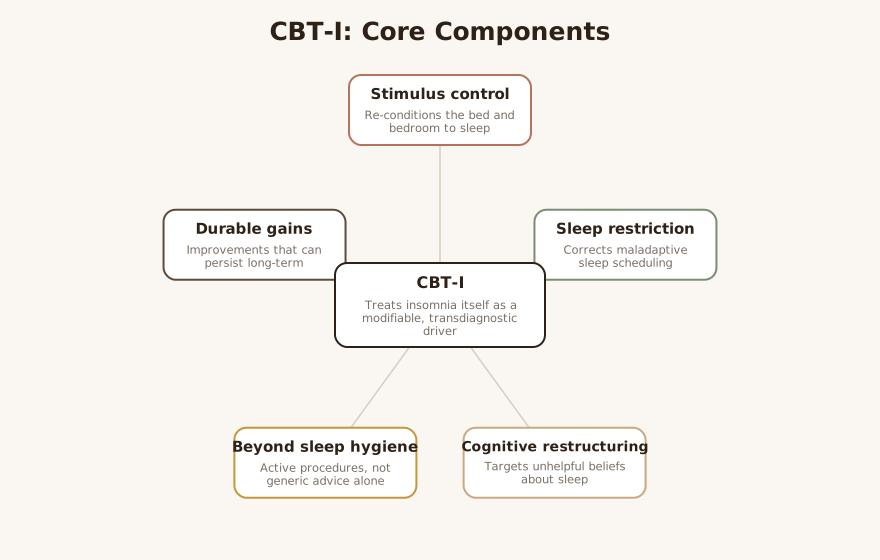
The foundational premise is that chronic insomnia is maintained by behavioral and cognitive factors — conditioned arousal, maladaptive sleep scheduling, and unhelpful beliefs about sleep — that are modifiable independent of any comorbid disorder 3. A second principle is that sleep disturbance is genuinely transdiagnostic: it appears across, predicts, and helps maintain a wide span of psychiatric conditions, so targeting it can yield benefits beyond sleep alone 4. Shared neurobiological mechanisms, including disrupted emotion regulation and altered arousal and reward circuitry, plausibly mediate these cross-disorder links 5. A third principle is that the treatment is mechanistic and component-based rather than purely educational: the active ingredients are behavioral and cognitive procedures, not generic advice 6. Finally, the framework holds that effective sleep treatment is durable — multicomponent CBT-I produces improvements that can persist long-term without ongoing intervention 3.
Interventions & Techniques
The behavioral core comprises stimulus control and sleep restriction. Stimulus control re-associates the bed and bedroom with sleep by limiting in-bed behaviors and instructing the patient to leave bed when unable to sleep 3. Sleep restriction (sleep-scheduling) limits time in bed to consolidate sleep and raise sleep efficiency, with the window expanded gradually as efficiency improves 3. Cognitive restructuring identifies, challenges, and revises unhelpful beliefs about sleep, and in component analysis it carries the largest incremental effect of any single ingredient 6. Third-wave elements — mindfulness and acceptance-based strategies — also contribute meaningfully 6. Relaxation therapy is a recognized single-component option in guidelines, though component-level analysis raises the possibility that it can be counterproductive when it competes with sleep-restriction goals 36. Sleep hygiene education — advice on caffeine, light, and routines — is part of the clinical vocabulary but is not an effective active ingredient on its own 6. Delivery format matters: in-person, therapist-led programs were the most effective format in network meta-analysis, while self-help formats with human support warrant further study for scalability 6.
Evidence Base
The evidence for CBT-I as a treatment for insomnia itself is established and strong. The American College of Physicians recommends CBT-I as the initial treatment for chronic insomnia disorder in adults 1. The American Academy of Sleep Medicine issues a strong recommendation for multicomponent CBT-I, grounded in moderate-quality evidence from 49 studies showing clinically meaningful and potentially durable improvements 3. Individual components — stimulus control, sleep restriction, relaxation, and brief therapies — receive conditional recommendations as standalone options 38. Component network meta-analysis further clarifies which ingredients drive the effect, identifying cognitive restructuring, third-wave components, sleep restriction, and stimulus control as the beneficial elements 6. The transdiagnostic and adjunctive layer — using sleep treatment specifically to improve depression, anxiety, PTSD, or pain outcomes — is well-theorized and supported by mechanistic work, but is less mature than the insomnia-treatment evidence and continues to develop 45. Clinicians should therefore present CBT-I confidently as first-line for sleep while framing cross-disorder benefit as promising rather than guaranteed LLM.
Populations & Indications
The framework applies broadly across people with insomnia and those whose primary presentation is a comorbid psychiatric or medical condition with prominent sleep disruption 4. Indicated populations include people with depression and anxiety disorders, in whom sleep disturbance is both common and a maintaining factor 4. Veterans and others with PTSD frequently present with insomnia and nightmares that may persist even after trauma-focused treatment, making sleep a sensible adjunctive target LLM. People with chronic pain often have sleep that both worsens and is worsened by their pain, supporting integrated sleep treatment LLM. Older adults are an important group given age-related sleep change and the risks of long-term hypnotic use, which CBT-I can reduce LLM. Shift workers and others with circadian misalignment face sleep problems that behavioral and scheduling strategies can address LLM. The unifying indication is clinically significant sleep disturbance that is modifiable and contributing to distress or impairment 4.
Problems-for-Work
The framework targets a set of interlocking sleep and sleep-related problems. Insomnia disorder is the central indication and the condition for which CBT-I is first-line 1.
LLM-generated illustrative example (not a guideline): A client with major depressive disorder in CBT continues to report early-morning awakening and bedtime rumination after mood symptoms partially improve; adding stimulus control and a consolidated sleep window targets the residual insomnia rather than waiting for it to remit on its own LLM.
Generalized anxiety disorder and PTSD-related sleep disturbance, including nightmares, are common problems-for-work where pre-sleep hyperarousal and rumination keep the client awake 4.
LLM-generated illustrative example (not a guideline): A veteran with PTSD whose nightmares have lessened but who still lies in bed for two hours each night might work on stimulus control — getting out of bed when not sleeping — and cognitive restructuring of catastrophic beliefs about lost sleep LLM.
Other problems-for-work include chronic pain, circadian rhythm disruption, daytime fatigue, hyperarousal, substance use and sleep, and rumination at bedtime, each of which can be engaged through scheduling, conditioning, and cognitive techniques 36.
Contraindications, Cautions & Cultural Humility
Sleep restriction transiently reduces total sleep time and increases daytime sleepiness, so it requires caution — and often modification or deferral — in people with bipolar disorder (where sleep loss can precipitate mania), untreated seizure disorders, or occupational driving and safety demands LLM. Untreated sleep apnea, restless legs, and parasomnias should be screened for and addressed, because behavioral insomnia treatment alone will not resolve them LLM. Relaxation, despite its conditional guideline support, may undercut sleep-restriction goals for some clients and should be applied thoughtfully rather than reflexively 6. Sleep hygiene advice delivered as a standalone fix is a documented misstep and should not substitute for active treatment 3. Cultural humility matters: bedtimes, co-sleeping, shared bedrooms, shift and caregiving schedules, and the meaning of sleep vary across families and cultures, and rigid application of “rules” can be alienating or impractical LLM. Clinicians should collaboratively adapt the protocol to the client’s living situation, work constraints, and values rather than imposing a fixed schedule LLM.
Treatment-Plan Suggestions & SMART Objectives
| Goal | SMART objective (example) | Mechanism |
|---|---|---|
| Improve sleep efficiency | Client will follow a prescribed sleep window and reach sleep efficiency ≥85% over 7 consecutive nights within 6 weeks, tracked by sleep diary | Sleep restriction consolidates sleep and reduces time awake in bed 3 |
| Reduce conditioned arousal | Client will leave bed when awake longer than ~20 minutes and report doing so on ≥5 of 7 nights weekly for 4 weeks | Stimulus control re-associates bed with sleep 3 |
| Reduce sleep-related worry | Client will identify and reframe ≥3 catastrophic beliefs about sleep using a thought record by session 6 | Cognitive restructuring modifies unhelpful sleep beliefs 6 |
| Lower pre-sleep hyperarousal | Client will practice a chosen wind-down or acceptance-based strategy nightly and rate pre-sleep arousal ≤3/10 on ≥4 nights weekly within 8 weeks | Third-wave / arousal-reduction strategies lower cognitive-physiological activation 6 |
| Stabilize wake time | Client will maintain a fixed rise time (±30 min) 7 days a week for 4 weeks, logged in diary | Regularizing the circadian anchor reduces rhythm disruption 3 |
| Reduce daytime impact | Client will report a 30% reduction in self-rated daytime fatigue interference within 8 weeks | Improved sleep continuity reduces daytime symptom burden 3 |
| Reduce reliance on hypnotics | In coordination with the prescriber, client will track and discuss medication use weekly while CBT-I is established over 8 weeks | Durable behavioral gains can support medication reduction over time 3 |
Common Misconceptions
The most consequential misconception is that “sleep hygiene” is the treatment. The AASM guideline specifically suggests that clinicians not use sleep hygiene as a single-component therapy, because it is less effective than other treatments when used alone 3. Component analysis is consistent, finding sleep hygiene education to carry essentially no independent benefit 6. A second misconception is that insomnia will simply remit once the “real” disorder is treated; the transdiagnostic view holds that sleep often persists as an independent, maintaining problem and warrants direct attention 4. A third is that medication is the default first step, whereas guidelines position CBT-I as the initial and first-line treatment 1. A fourth is that more time in bed helps; sleep restriction shows the opposite, that limiting time in bed can consolidate sleep 3. Finally, relaxation is sometimes assumed to be universally helpful, but it may be counterproductive when it conflicts with stimulus-control and scheduling goals 6.
Training & Certification
CBT-I is a structured, manualized protocol that can be learned by clinicians already grounded in cognitive behavioral therapy, with training available through workshops, supervised practice, and treatment manuals LLM. The transdiagnostic treatment protocol of Harvey and Buysse provides a published, clinician-facing resource for extending sleep work across presentations 7. Guideline documents from the ACP and AASM serve as authoritative references for component selection and recommendation strength and should be consulted when building a protocol 13. Behavioral sleep medicine offers formal credentialing pathways for clinicians who wish to specialize, and supervised delivery of the core components is the practical route to competence LLM. The component network meta-analysis is a useful guide for prioritizing which ingredients to master first — cognitive restructuring, sleep restriction, and stimulus control 6.
Key Terms
CBT-I: Multicomponent cognitive behavioral therapy for insomnia, the strongly recommended treatment for chronic insomnia in adults 3. Stimulus control: Behavioral procedure that re-pairs the bed with sleep by restricting in-bed wakefulness 3. Sleep restriction: Behavioral procedure that limits time in bed to consolidate sleep and raise sleep efficiency 3. Sleep efficiency: The proportion of time in bed actually spent asleep, the key behavioral target for scheduling 3. Cognitive restructuring: Identifying and revising unhelpful beliefs about sleep, the highest-impact single component in analysis 6. Transdiagnostic: Describing a mechanism, such as sleep disturbance, that operates across multiple diagnostic categories 4. Sleep hygiene: General behavioral advice about sleep-promoting habits, not recommended as standalone therapy 3. Third-wave components: Mindfulness and acceptance-based strategies that contribute to CBT-I efficacy 6.
Resources & Further Reading
▶ Watch — a video introduction to this concept:
- Management of Chronic Insomnia Disorder in Adults: A Clinical Practice Guideline From the American College of Physicians
- Behavioral and psychological treatments for chronic insomnia disorder in adults: an AASM clinical practice guideline (JCSM)
- AASM clinical practice guideline — full text (PMC)
- Insomnia, Psychiatric Disorders, and the Transdiagnostic Perspective (Harvey, 2008)
- Sleep Disturbance as Transdiagnostic: Consideration of Neurobiological Mechanisms (PMC)
- Components and Delivery Formats of CBT for Chronic Insomnia: A Component Network Meta-Analysis (PMC)
- Treating Sleep Problems: A Transdiagnostic Approach (Harvey & Buysse, Guilford Press)
- New guideline supports behavioral, psychological treatments for insomnia (AASM)
Reflective / Supervision Questions
- When a client presents with both a mood or anxiety disorder and insomnia, how do you decide whether to treat sleep concurrently rather than waiting for the primary disorder to remit LLM?
- Are you defaulting to sleep-hygiene advice when an active, component-based intervention is indicated 3?
- How do you screen for sleep apnea, restless legs, parasomnias, and bipolar risk before initiating sleep restriction LLM?
- When prescribing a sleep window, how do you collaboratively adapt it to the client’s shift schedule, caregiving demands, and cultural context rather than imposing a fixed rule LLM?
- How do you talk with clients and prescribers about CBT-I as a first-line alternative to long-term hypnotic use 1?
- And how do you track sleep-specific outcomes so that you can tell whether the sleep work is actually moving the broader clinical picture 4?