
Type & Discipline
Desirable difficulties is a construct in cognitive psychology, within the science of learning and memory, that names a class of training conditions which depress performance during acquisition yet improve long-term retention and transfer.1 The term refers not to a single technique but to a family of manipulations – spacing, interleaving, retrieval practice, generation, and varying or reducing the conditions and feedback of practice – that share a common signature: they feel harder and slower in the moment but pay off later.45 It is a theory-laden description, not merely a list of study tips, because each manipulation is predicted by an underlying account of how memory storage and retrieval dissociate over time.1
For clinicians, the construct sits at the intersection of cognitive science and applied training. It is the conceptual backbone of evidence-informed approaches to skill acquisition, supervision, psychoeducation about study and rehabilitation, and the design of homework and between-session practice.3 It is descriptive and mechanistic rather than a branded therapy, so it is used inside therapeutic and educational frameworks rather than as a standalone modality.LLM
Creators & Lineage
The phrase “desirable difficulties” was coined by Robert A. Bjork, a cognitive psychologist at UCLA, in 1994.4 The canonical articulation for practitioners is the 2011 chapter by Elizabeth L. Bjork and Robert A. Bjork, “Making Things Hard on Yourself, But in a Good Way,” which synthesizes decades of laboratory work on memory and instruction.1 The work of the Bjork Learning and Forgetting Lab at UCLA continues to develop and disseminate the construct, including public-facing lectures and demonstrations.6
The lineage runs through twentieth-century learning and memory science – the spacing effect, the testing/retrieval-practice effect, and the generation effect – and connects to adjacent traditions such as deliberate practice and spaced retrieval training used in cognitive rehabilitation.41 The construct has since been imported into health professions education, where it is offered as a deliberate instructional-design framework for trainees who must acquire and retain large bodies of clinical knowledge and skill.3 This makes it directly relevant to psychotherapists in training and to supervisees building durable competencies.LLM
Core Principles
The central theoretical claim is that memory has two partly independent dimensions: storage strength (how well something is learned and embedded in long-term memory) and retrieval strength (how accessible it is right now).5 Crucially, conditions that maximize current retrieval strength – and therefore make practice feel fluent and successful – often add little to storage strength, whereas conditions that require effortful retrieval against some forgetting build durable storage.1 This is sometimes framed through the “New Theory of Disuse,” which formalizes how forgetting and relearning interact.3
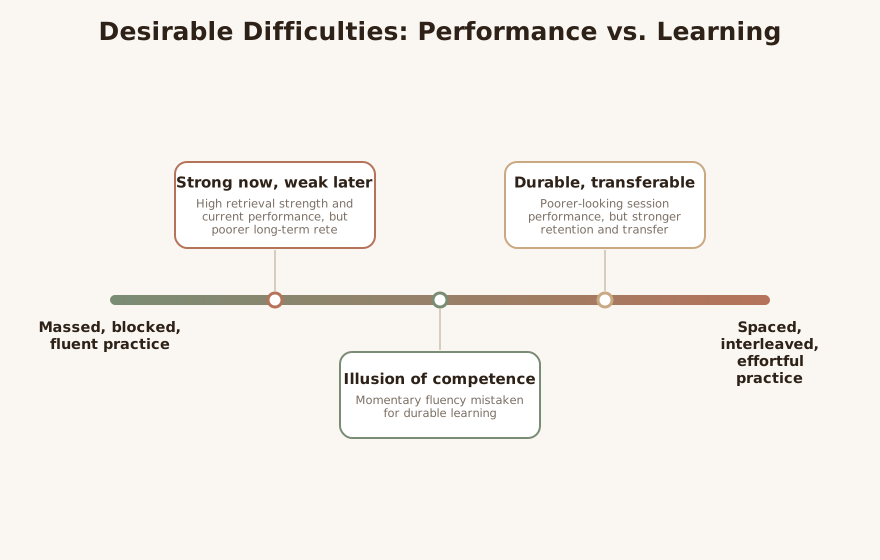
The second principle is the performance-learning distinction: performance during training is an unreliable index of learning.1 Massed, blocked, fluent practice produces strong performance during the session but weaker long-term retention; spaced, interleaved, effortful practice produces poorer-looking performance during the session but stronger retention and transfer later.5 This generates a pervasive “illusion of competence,” in which both learners and instructors mistake momentary fluency for durable learning.1
The third principle is that the difficulty must be desirable, not merely difficult. A difficulty is desirable only when the learner can, with effort, successfully engage the underlying retrieval or processing it demands.5 If the task simply confuses the learner or exceeds available background knowledge, the added effort does not strengthen memory and the difficulty becomes undesirable.5 The construct therefore presupposes calibration to the learner’s current capacity rather than maximal hardness.LLM
Interventions & Techniques
Five manipulations are most commonly cited.5 First, spacing (distributed practice): separating study or rehearsal across days or weeks rather than massing it, so that some forgetting occurs and retrieval must work harder.1 Second, interleaving: mixing different problem types, categories, or skills within a session rather than practicing one in a block, which forces the learner to discriminate between approaches and choose, not just execute.5 Third, retrieval practice (the testing effect): actively recalling material – via low-stakes quizzing, free recall, or blank-page summaries – rather than re-reading, because the act of recalling itself enhances later storage and retrieval.5
Fourth, generation: attempting an answer, prediction, or solution before being shown the correct one, which improves encoding even when the initial attempt fails, provided the learner has enough foundation to make a reasonable attempt.5 Fifth, varying the conditions of practice and reducing or delaying feedback: practicing across contexts, formats, and settings, and not providing immediate feedback after every trial, which supports transfer and schema abstraction rather than context-bound performance.54
In applied clinical training, the practical translations are concrete.3 Replace re-reading with brief free-recall exercises; distribute practice of a clinical skill across multiple short sessions instead of one long block; interleave related conditions or techniques so the trainee must decide which applies; and ask supervisees to formulate a hypothesis before the answer is supplied.5
LLM-generated illustrative example (not a guideline): A supervisor teaching diagnostic reasoning stops blocking practice by disorder. Instead, she presents short mixed vignettes across sessions, asks the supervisee to commit to a formulation before discussion, and waits a week before revisiting cases. The supervisee’s in-session accuracy dips at first but their unaided recall and discrimination improve over the rotation. LLM
Evidence Base
The maturity of this construct is best described as established. The core phenomena – spacing, retrieval practice, and the dissociation between training performance and long-term retention – rest on a large and replicated laboratory literature spanning decades, summarized authoritatively in the Bjork and Bjork 2011 synthesis.1 Retrieval practice and spacing in particular are among the most robust findings in the science of learning.5
The evidence extends beyond young college students. A study of paired-associate learning in both young adults and community-dwelling older adults found that benefits of effortful, spaced retrieval generally held across age groups, with older adults showing larger spacing effects, though some patterns differed (for example, only younger adults benefited from repeated massed testing).2 That study also illustrates the honest limits of the literature: methods such as using different retention intervals across age groups to equate performance, and analyzing only items successfully retrieved during acquisition, introduce confounds that temper strong generalizations.2
Two honest caveats matter clinically. First, much of the strongest evidence concerns verbal/declarative material and laboratory tasks; transfer to complex, real-world clinical competencies is plausible and supported in health professions education but is less densely evidenced than the core memory effects.3 Second, the construct carries an acknowledged circularity: in current theory we often cannot identify in advance whether a given difficulty will prove desirable, and can confirm it only retrospectively from learning outcomes.7 This is a genuine theoretical limitation, not a fatal one, but it should temper confident prescription.7
Populations & Indications
The construct is indicated wherever durable learning, retention, or skill maintenance is a goal. Students and learners across ages are the prototypical population, with the caveat that younger learners and novices typically need explicit scaffolding before these strategies help.5 Psychotherapists in training and supervisees are an especially apt clinical population: they must consolidate large bodies of knowledge and procedural skill, and instructional design built on spacing, retrieval, and interleaving supports that consolidation.3
Older adults are a population of specific interest for cognitive maintenance, since effortful spaced retrieval continues to benefit memory into later life, with age-sensitive calibration.2 People with learning challenges may benefit, but they are also the group most at risk of difficulties tipping from desirable to undesirable without adequate scaffolding and prior knowledge.5 Coaching clients working on habit formation, performance skills, or study systems are a natural fit, since the same principles apply to motor and procedural domains as to verbal ones.7
Problems-for-Work
The construct maps onto several presenting problems in education-adjacent and coaching-adjacent clinical work.LLM
- Ineffective study habits and poor knowledge retention. A client who re-reads and highlights but cannot recall material under pressure is relying on retrieval-strength fluency that does not build storage; shifting to spaced retrieval practice targets the actual deficit.1
- Skill deficits. A trainee whose skills are strong in a blocked practice setting but collapse when situations are mixed benefits from interleaving and varied-condition practice to support transfer.5
- Academic underachievement. A student whose effort feels productive but whose grades lag may be caught in the illusion of competence; psychoeducation about the performance-learning distinction reframes the struggle.1
- Cognitive decline (prevention). Structured spaced-retrieval routines support memory maintenance in older adults as a non-pharmacological cognitive activity.2
- Low self-efficacy in learning. Clients who interpret effortful struggle as evidence of inability can be reframed: the felt difficulty is often the mechanism of learning, not a sign of failure.5
Contraindications, Cautions & Cultural Humility
The primary caution is calibration. A difficulty is only desirable if the learner has enough prior knowledge and capacity to engage it successfully; imposed on a novice without scaffolding, the same manipulation produces frustration and disengagement rather than learning.5 Generation tasks, in particular, fail when foundational learning is absent.5 Clinicians should not prescribe maximal difficulty and should watch for the learner being confused rather than productively challenged.5
A second caution is the affective and motivational cost. Effortful practice feels worse than fluent practice, so without explicit framing learners may abandon the more effective strategy in favor of one that feels successful.1 Part of the intervention is therefore metacognitive: helping the learner expect and tolerate the discomfort and understand why it signals learning.5
Cultural humility applies in several ways. Beliefs about effort, struggle, intelligence, and the meaning of difficulty are culturally shaped, and reframing struggle as desirable must be done without pathologizing a learner’s existing approach or implying that difficulty alone is virtuous.LLM Access matters too: spaced, sustained practice presupposes time, stability, and resources that not every client has, and a learner facing acute stress, food or housing insecurity, or untreated attention or mood difficulties may need those addressed before added cognitive load is appropriate.LLM The construct is also not a treatment for psychiatric disorders; it is a learning principle to be embedded within an appropriate therapeutic or educational frame.LLM
Treatment-Plan Suggestions & SMART Objectives
| Goal | SMART objective (example) | Mechanism |
|---|---|---|
| Improve durable knowledge retention | Over 4 weeks, client replaces re-reading with three 10-minute free-recall sessions per topic, spaced across the week, logging recall accuracy | Spacing + retrieval practice strengthen storage strength1 |
| Build transferable skill, not blocked fluency | Within 6 weeks, client practices three related skills in interleaved sets rather than blocks for 4 of 5 practice sessions | Interleaving forces discrimination and supports transfer5 |
| Reduce illusion of competence | By session 4, client can describe the performance-learning distinction and identify two of their own past false-fluency study habits | Metacognitive correction of monitoring error1 |
| Increase tolerance of effortful learning | Over 8 weeks, client rates and reframes practice-related discomfort weekly, reducing avoidance of effortful study by a self-rated 50% | Reappraisal of difficulty as signal of learning5 |
| Support cognitive maintenance (older adult) | For 6 weeks, client completes a spaced-retrieval routine 4 days/week on personally meaningful material | Spaced effortful retrieval benefits memory across age2 |
| Strengthen clinical-reasoning skill (trainee) | Within a rotation, supervisee commits to a formulation before discussion in 80% of mixed case vignettes | Generation + interleaving improve encoding and discrimination5 |
| Improve self-efficacy in learning | Over 5 weeks, client documents three instances where effortful practice produced measurable later gains | Disconfirming “struggle = inability” belief5 |
Common Misconceptions
A first misconception is that harder is always better. The construct specifies desirable difficulty: an unscaffolded, confusing, or overwhelming task is undesirable and does not aid learning.5 A second is that smooth, fluent practice means strong learning; in fact, fluency during acquisition is a poor predictor of long-term retention and frequently produces an illusion of competence.1 A third is that desirable difficulties are merely study hacks; they are predictions from a theory of memory storage and retrieval, which is why the same principles recur across verbal, motor, and clinical domains.4
A fourth misconception is that the benefits are limited to young students; the effects extend to older adults and to professional skill acquisition, with appropriate calibration.2 A fifth is that we can always tell in advance which difficulties will help. We often cannot, and the field acknowledges that whether a difficulty was desirable can sometimes be confirmed only after observing the learning outcome.7
Training & Certification
There is no certification in desirable difficulties; it is a research construct, not a licensed modality.LLM Practitioner-level fluency comes from primary and synthesizing literature – chiefly the Bjork and Bjork 2011 chapter – and from the publicly available lectures and demonstrations of the UCLA Bjork Learning and Forgetting Lab.16 For applied translation into professional education, the health-professions literature offers structured guidance on embedding retrieval, spacing, and interleaving into curricula and supervision.3 Accessible practitioner-oriented explainers, such as teacher guides and the Learning Scientists’ resources, help bridge theory into concrete instructional moves.57
Key Terms
- Desirable difficulty: a training condition that requires considerable but achievable effort, depressing short-term performance while improving long-term retention.4
- Storage strength vs. retrieval strength: the distinction between how deeply something is learned versus how accessible it is at the moment.5
- New Theory of Disuse: the theoretical account of how forgetting and relearning interact that underpins the construct.3
- Performance-learning distinction / illusion of competence: the principle that training performance is an unreliable index of durable learning.1
- Spacing, interleaving, retrieval practice, generation, varied practice: the principal manipulations that operationalize desirable difficulty.5
Resources & Further Reading
▶ Watch — a video introduction to this concept:
- Bjork & Bjork (2011), Making Things Hard on Yourself, But in a Good Way
- Retrieval Practice and Spacing Effects in Young and Older Adults (PMC4480221)
- Desirable Difficulty: Theory and Application of Intentionally Challenging Learning (PubMed 35950522)
- Desirable difficulty (Wikipedia)
- Robert Bjork: A Teacher’s Guide to Desirable Difficulties (Structural Learning)
- Videos — Bjork Learning and Forgetting Lab (UCLA)
- Weekly Digest #68: Desirable Difficulties (The Learning Scientists)
Reflective / Supervision Questions
- Where in my own teaching, supervision, or homework design am I optimizing for in-session fluency at the expense of durable learning?1
- How do I distinguish, for a given client or supervisee, a difficulty that is desirable from one that is simply overwhelming given their current knowledge?5
- When a learner reports that effortful practice “isn’t working,” how do I tell whether that is the productive discomfort of learning or a genuine signal to scaffold more?5
- How might cultural beliefs about effort and struggle – mine and the client’s – shape whether reframing difficulty as desirable lands as empowering or invalidating?LLM
- Given the acknowledged limits of predicting desirable difficulty in advance, what outcome would tell me my approach is or is not working for this learner?7
1: Bjork, E. L., & Bjork, R. A. (2011). Making things hard on yourself, but in a good way: Creating desirable difficulties to enhance learning. https://bjorklab.psych.ucla.edu/wp-content/uploads/sites/13/2016/04/EBjork_RBjork_2011.pdf 2: Retrieval practice and spacing effects in young and older adults. PMC4480221. https://pmc.ncbi.nlm.nih.gov/articles/PMC4480221/ 3: Desirable difficulty: Theory and application of intentionally challenging learning. PubMed 35950522. https://pubmed.ncbi.nlm.nih.gov/35950522/ 4: Desirable difficulty. Wikipedia. https://en.wikipedia.org/wiki/Desirable_difficulty 5: Robert Bjork: A teacher’s guide to desirable difficulties. Structural Learning. https://www.structural-learning.com/post/robert-bjork-teachers-guide-desirable 6: Videos — Bjork Learning and Forgetting Lab (UCLA). https://bjorklab.psych.ucla.edu/videos/ 7: Weekly Digest #68: Desirable difficulties. The Learning Scientists. https://www.learningscientists.org/blog/2017/7/16/weekly-digest-68