
Neuroception names one of the most clinically useful ideas to come out of autonomic neuroscience: that the body decides whether a situation is safe, dangerous, or life-threatening before the conscious mind has a chance to weigh in 1. For trauma-informed clinicians, the construct reframes symptoms such as hypervigilance, shutdown, and reactivity not as cognitive distortions or willful behaviors but as the output of an ancient, automatic risk-detection system 2. This article unpacks the construct, its lineage, the interventions it informs, and—importantly—an honest accounting of how mature the evidence actually is.
Type & Discipline
Neuroception is a theoretical construct, not a treatment modality, a diagnosis, or a technique LLM. It originates in autonomic neuroscience and is the perceptual mechanism at the heart of polyvagal theory, the broader framework Stephen Porges developed to explain how the autonomic nervous system regulates physiological state in response to environmental and social context 3. Porges coined “neuroception” specifically to distinguish this subcortical, reflexive risk-detection process from “perception,” which implies conscious awareness 2. In clinical use, neuroception functions as an explanatory frame—a way of understanding why a client’s body responds to threat or safety in patterns that seem disconnected from the objective situation LLM.
Creators & Lineage
The construct was introduced by Stephen W. Porges in a 2004 article in Zero to Three, written for an infant–early childhood audience, in which he described neural circuits that “distinguish whether situations or people are safe, dangerous, or life threatening” 1. Neuroception sits inside polyvagal theory, which Porges built on a hierarchical model of the mammalian autonomic nervous system comprising three evolutionarily layered circuits: a primitive immobilization system, a sympathetic mobilization system, and a phylogenetically newer social-communication system 1.
Polyvagal theory in turn draws on classical autonomic nervous system theory, extending it by proposing that the vagus has two functionally distinct branches rather than a single parasympathetic “rest and digest” function 3. The construct also intersects with attachment theory—Porges argued that a neuroception of safety is a precondition for the social engagement behaviors that underpin secure bonding 1. Within the trauma field, neuroception has been adopted by somatically oriented approaches such as Somatic Experiencing, which share its premise that defensive states are body-based and largely non-volitional LLM.
Core Principles
The first principle is that neuroception is distinct from perception. Porges defines it as “a neural process, distinct from perception, capable of distinguishing environmental and visceral features that are safe, dangerous, or life-threatening” 2. It operates reflexively, outside conscious awareness, through brain structures that evolved earlier than the cortex 5.
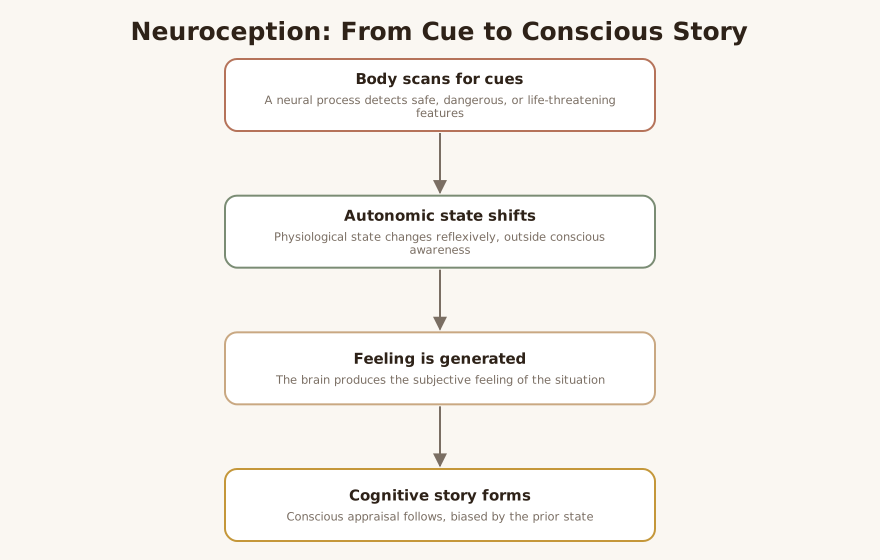
The second principle is that neuroception sets autonomic state, which then shapes feeling and behavior. The body scans for cues, shifts physiological state accordingly, and only afterward does the brain generate the subjective feeling and the cognitive story about what is happening 5. In this sequencing, autonomic state precedes—and biases—conscious appraisal LLM.
The third principle is the hierarchy of states. When a neuroception of safety is present, the ventral vagal social-engagement system is online, supporting calm and connection via what Porges calls the “vagal brake” 3. When danger is detected, the sympathetic system mobilizes fight-or-flight; when life-threat is detected, the most primitive dorsal vagal circuit drives immobilization and metabolic shutdown 6.
The fourth principle is that cues come from three sources: the external environment, internal visceral sensations (interoception), and—crucially—social signals exchanged between nervous systems, such as facial expression and vocal prosody 5. Safety cues such as warm tone, welcoming gestures, and prosodic voice downregulate defense, while threat cues recruit it 2.
The fifth principle is co-regulation: nervous systems regulate one another, and feeling safe in the presence of a trusted other is a primary route to shifting state 3. This is why the therapeutic relationship itself, not merely its content, is treated as an active ingredient LLM.
Interventions & Techniques
Neuroception is a construct rather than a manualized protocol, so “interventions” here means the clinical strategies that flow from taking it seriously LLM. The throughline is the same across approaches: rather than arguing a client out of a threat response, the clinician works to change the cues the client’s nervous system is detecting 2.
Delivering cues of safety. Because prosody, facial warmth, and unhurried pacing are themselves neuroceptive inputs, clinicians are encouraged to attend to their own vocal tone, expression, and pacing as active interventions, not just bedside manner 2. Porges frames this as helping clients recognize that defensive reactions are reflexive survival responses, not volitional choices, and then introducing safety cues and co-regulation to downregulate threat-based states 2.
Interoceptive and bottom-up regulation. Approaches in this family build a client’s capacity to notice internal state and to shift it through breath, movement, and vagal pathways rather than through cognition alone 6. Practical strategies discussed in the popular and clinical literature include controlled breathing, self-soothing practices that recruit the parasympathetic system, and trauma-focused somatic therapies 6.
Attunement and movement. In dance/movement therapy with autistic individuals, neuroception has been used as a frame for building safety through nonverbal attunement and shared movement, engaging the social engagement system through the body rather than through language 4. This illustrates a more general clinical move: meeting the nervous system where it is, through its own sensorimotor channels LLM.
LLM-generated illustrative example (not a guideline): A clinician notices a client’s voice flatten and gaze drop mid-session. Rather than pressing the content, the clinician slows their own speech, lowers volume, and names the shift gently—“Let’s pause; we don’t have to keep going there.” The intent is to supply cues of safety so the client’s neuroception can register the room as safe again before resuming. LLM
Evidence Base
Honesty here is essential: as a clinical construct, neuroception is emerging, and clinicians should hold it accordingly LLM. Neuroception was introduced as a theoretical proposal in a practitioner-facing journal, not as a finding from a controlled study, and it remains primarily a conceptual mechanism rather than a directly measured variable 1. There is no single accepted instrument that operationalizes “neuroception” itself LLM.
What does have measurable physiological grounding is the autonomic machinery polyvagal theory invokes. Porges anchors the ventral vagal pathway in respiratory sinus arrhythmia (RSA)—a heart-rate component synchronized with breathing that indexes vagal tone—and in newer metrics such as vagal efficiency 2. These are real, quantifiable measures 2. However, the inference from such measures to the existence of a discrete “neuroceptive” detector, and several of polyvagal theory’s phylogenetic and anatomical claims, have drawn substantive criticism from comparative physiologists; clinicians should be aware that the broader theory is contested in the basic-science literature LLM.
The pragmatic stance most defensible for practice is this: neuroception is a clinically generative heuristic with strong face validity and growing adoption, supported by an autonomic framework that is partly measurable, but it should not be presented to clients or in documentation as settled neuroscience LLM. Treat it as a useful map, not the territory LLM.
Populations & Indications
Neuroception is most clinically resonant with populations whose presenting problems involve a mismatch between objective safety and the body’s threat response LLM. Trauma survivors and people with complex PTSD often show a nervous system locked into defensive states, where benign cues are neuroceived as dangerous 6. Adults with anxiety disorders present with chronic sympathetic activation and difficulty registering safety cues 5.
Children with attachment disruptions are a population Porges himself highlighted, noting that faulty neuroception may underlie conditions including Reactive Attachment Disorder 1. People with autism are another population of explicit interest: Porges proposed that a neuroception of safety is necessary before social engagement can occur, and clinical applications such as dance/movement therapy use attunement to support that safety 1 4.
Problems-for-Work
The construct maps onto a recognizable cluster of clinical problems, each of which can be reframed as an output of neuroception LLM.
- Hypervigilance and threat misperception. When the system over-detects danger, neutral stimuli—a tone of voice, a low-frequency sound—are read as threatening 6. The clinical aim is to widen the client’s capacity to register and trust safety cues 5.
- Dissociation. Shutdown and immobilization map onto the dorsal vagal, life-threat response, helping clinicians frame dissociation as a protective biological state rather than a deficit 6.
- Emotional dysregulation and panic. Rapid shifts into sympathetic mobilization correspond to panic and reactivity; the work targets the vagal brake and co-regulation 3.
- Social withdrawal. Without a neuroception of safety, the social engagement system stays offline, and connection feels unavailable—reframing withdrawal as a state problem rather than a motivation problem 1.
LLM-generated illustrative example (not a guideline): A client with complex PTSD reports “going blank” whenever their partner raises their voice. Framed neuroceptively, the raised voice is a cue the body reads as life-threat, triggering a dorsal vagal shutdown. Work focuses on building interoceptive awareness of the onset and on rehearsing access to safety cues before the shutdown completes. LLM
Contraindications, Cautions & Cultural Humility
Neuroception is a frame, not a procedure, so the cautions concern how it is used LLM. First, avoid biological determinism: presenting a client’s responses as hardwired and fixed can foster helplessness; the more accurate and useful message is that neuroceptive patterns become heightened or rigid but are not “broken” and can become more flexible 5. Second, do not overstate the science—framing polyvagal claims as established fact misleads clients and overlooks legitimate scientific controversy LLM.
Cultural humility matters in how “cues of safety” are read. Facial expression, eye contact, vocal prosody, and physical proximity carry different meanings across cultures, neurotypes, and individual trauma histories, so a clinician’s assumptions about what should feel safe may not match the client’s nervous system LLM. This is especially salient with autistic clients, for whom typical social-engagement cues such as sustained eye contact may themselves be dysregulating rather than safety-signaling 4. The bottom-up, somatic strategies the construct invites should also be paced carefully, as interoceptive focus and breathwork can intensify distress in some trauma survivors LLM.
Treatment-Plan Suggestions & SMART Objectives
The construct is not billed or delivered on its own; it informs goals within an established trauma or somatic treatment LLM. The table below offers example objectives and the proposed mechanism of change LLM.
| Goal | SMART objective (example) | Mechanism |
|---|---|---|
| Build interoceptive awareness | Client will identify and name 3 bodily signals of shifting autonomic state in 4 of 5 sessions over 8 weeks | Increases conscious access to neuroceptive output, supporting earlier regulation 5 |
| Expand capacity to register safety | Client will report noticing at least 2 felt cues of safety per day, logged daily, by week 6 | Re-trains over-defended neuroception toward flexibility 5 |
| Reduce hypervigilant reactivity | Client will use a paced-breathing skill at onset of activation in 3 documented instances weekly over 6 weeks | Recruits the vagal brake to downregulate sympathetic mobilization 3 |
| Interrupt dissociative shutdown | Client will apply one grounding strategy at early signs of “going blank” in 70% of identified episodes | Targets dorsal vagal immobilization with orienting/safety cues 6 |
| Strengthen co-regulation | Client will engage in one structured co-regulation exercise with a trusted other weekly for 8 weeks | Uses relational safety cues to shift autonomic state 3 |
| Increase social engagement | Client will initiate one low-demand social contact per week, rated for felt safety, over 8 weeks | Brings the ventral vagal social engagement system online 1 |
| Reframe symptoms non-judgmentally | Client will reframe one defensive reaction as a protective autonomic response in session weekly for 4 weeks | Reduces shame by recasting reflexive states as survival responses 2 |
Common Misconceptions
“Neuroception is the same as perception or intuition.” It is explicitly defined as distinct from perception—a subcortical, reflexive process, not a conscious read or a gut hunch 2. “Neuroception is a proven, measurable brain mechanism.” The construct is a theoretical proposal; what is measurable is associated autonomic activity such as RSA, not neuroception itself 1 2. “A faulty neuroception means the client is broken.” The more accurate framing is that protective patterns become heightened or rigid, not that the system is defective 5. “You can think your way out of a threat state.” The model’s whole point is that state is set bottom-up, so cognitive reframing alone often cannot override a body already in defense; cues of safety and co-regulation are needed 2. “Polyvagal theory is settled neuroscience.” Several of its claims are actively contested in basic science, and clinicians should present it as a useful frame rather than established fact LLM.
Training & Certification
There is no credential in “neuroception” as such; it is learned as part of polyvagal-informed and somatic training LLM. The Polyvagal Institute, co-founded by Porges, provides educational programming and clinical resources on the theory and its applications 3. Clinicians more commonly encounter the construct embedded within trainings for established trauma modalities—such as Somatic Experiencing and other body-oriented or attachment-focused approaches—where it serves as a unifying rationale LLM. As with any emerging frame, the most defensible path is to pair conceptual learning with rigorous training in an evidence-based modality rather than treating “polyvagal-informed” as a standalone competency LLM.
Key Terms
- Neuroception — subconscious neural detection of safety, danger, or life-threat that is distinct from conscious perception 2.
- Polyvagal theory — Porges’s framework describing hierarchical autonomic regulation across three circuits 3.
- Ventral vagal / social engagement system — the newest circuit, supporting calm and connection via the “vagal brake” 3.
- Sympathetic mobilization — the danger response driving fight-or-flight 6.
- Dorsal vagal immobilization — the most primitive circuit, driving shutdown and freeze under life-threat 6.
- Co-regulation — the process by which one nervous system helps regulate another through relational safety cues 3.
- Respiratory sinus arrhythmia (RSA) — a breathing-linked heart-rate measure indexing ventral vagal tone 2.
- Faulty neuroception — heightened or rigid threat-detection patterns that misread safety as danger or vice versa 5.
Resources & Further Reading
▶ Watch — a video introduction to this concept:
- Porges, S. W. (2004). Neuroception: A subconscious system for detecting threats and safety. Zero to Three, 24(5), 19-24 (ERIC)
- Porges, S. W. (2022). Polyvagal Theory: A Science of Safety. Frontiers in Integrative Neuroscience
- Polyvagal Institute — What is Polyvagal Theory?
- Devereaux, C. (2017). Neuroception and Attunement in Dance/Movement Therapy with Autism. American Journal of Dance Therapy
- Khiron Clinics — Polyvagal Theory: Neuroception, the Fundament of Feeling
- Apollo Neuro — Neuroception: How your body detects threat before you
Reflective / Supervision Questions
- When a client shifts into a defensive state in session, how do I attend to my own prosody, pacing, and expression as neuroceptive cues, and what is my evidence that it helps? LLM
- How do I distinguish, in practice, between a cognitive distortion and a bottom-up autonomic state—and does that distinction change my intervention? LLM
- Where might my assumptions about what “should” feel safe diverge from this particular client’s culture, neurotype, or trauma history? LLM
- Am I presenting polyvagal concepts to this client as a helpful frame or as established fact, and is that framing honest? LLM
- For a client with autism, am I reflexively pushing typical social-engagement cues that may themselves be dysregulating? 4
- How do I hold the construct’s clinical usefulness alongside the genuine scientific uncertainty about it without confusing the client—or myself? LLM