
Type & Discipline
Interoceptive inference is a construct, not a therapy. LLM It belongs to affective neuroscience and the broader predictive-processing tradition, and it describes how the brain senses, predicts, and models the physiological condition of the body—heartbeat, respiration, gut state, temperature, arousal—rather than prescribing anything to do in session. 2 The core proposal is that the brain does not passively read off bodily signals but actively infers the causes of those signals, generating predictions about internal states and updating them against incoming interoceptive evidence. 1 Within this framing, emotions are recast as the brain’s inferences about the causes of interoceptive change, integrated with context and prior experience, rather than as fixed, hardwired reactions released from dedicated circuits. 2
For practicing therapists, the useful framing is that interoceptive inference is a mechanistic lens that sits underneath several body-oriented and emotion-focused approaches you may already use, not a standalone intervention with its own manual or trial program. LLM Its present clinical value is conceptual: it gives a vocabulary that links bodily sensation, prediction, and emotion in a way that can sharpen case formulation. LLM
Creators & Lineage
The construct draws on several strands. The neuroanatomy of interoception was mapped most influentially by A.D. Craig, whose work on the insular cortex established a substrate for a felt sense of the physiological body. LLM The predictive reformulation—interoception as inference rather than mere sensation—was articulated by Anil Seth, first in a 2013 synthesis proposing interoceptive inference as the basis of emotion and the embodied self, and then in a 2016 extension with Karl Friston that brought active inference into the account. 2 1 Hugo Critchley’s program on insular function and bodily awareness contributed much of the human imaging evidence that the framework rests on. LLM
The lineage runs through predictive processing and the free-energy tradition, applying to the body’s internal milieu the same Bayesian-brain logic that predictive coding had applied to vision and audition. 4 It connects directly to Lisa Feldman Barrett’s theory of constructed emotion, which formalizes emotions as active-inference categorizations built from interoceptive predictions, learned concepts, and context. 3 It also overlaps conceptually with affective-neuroscience accounts of allostasis—the brain’s anticipatory regulation of the body—since interoceptive prediction is what allostatic regulation requires. 3 More loosely, body-focused clinical models such as polyvagal theory share the intuition that internal physiological state shapes emotion and behavior, though they rest on different mechanistic claims. LLM
Core Principles
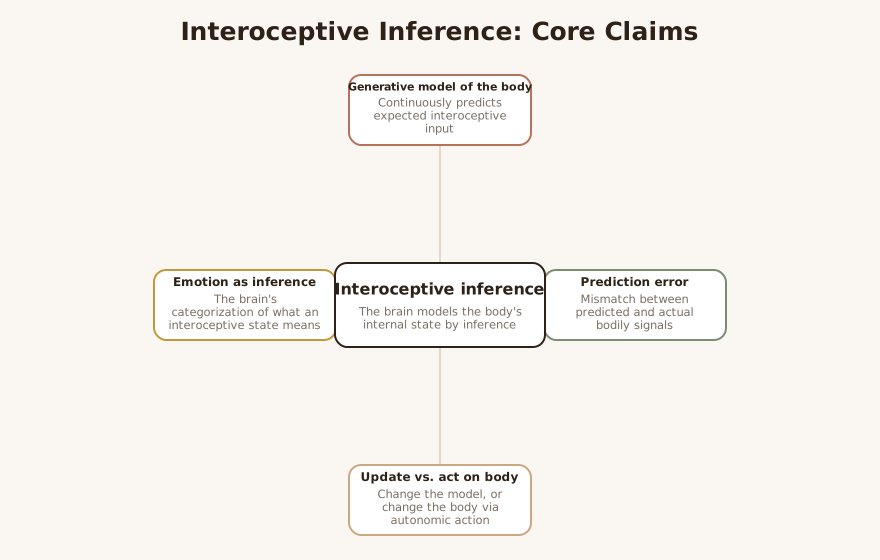
The central claim is that interoception is inferential. 1 The brain carries a generative model of its own body and continuously issues predictions about expected interoceptive input; what reaches awareness is not the raw afferent signal but the brain’s best explanation of it. 2 Interoceptive prediction errors—mismatches between predicted and actual bodily signals—drive either an update of the model (perceptual change) or, in the active-inference extension, autonomic and behavioral actions that change the body itself to bring it back in line with predictions. 1 This second route reframes physiological regulation as a form of inference: reflexes and autonomic adjustments become ways of fulfilling interoceptive predictions rather than mere outputs of a separate control system. 7
A signature consequence is the reconception of emotion. 2 On this view an emotion is the brain’s categorization of an interoceptive state—an inference about what a pattern of bodily change means in a given context—rather than the direct perception of a pre-given feeling. 3 Subjective feeling states, including the sense of being a bodily self, are construed as controlled inferences, which is the thrust of Seth’s broader claim that conscious experience is a kind of structured “best guess” the brain constantly tests against evidence. 5
Two further constructs do clinical work. The first is precision, the brain’s estimate of how reliable a given interoceptive signal or prediction is; mis-set precision—placing too much confidence in threat-related bodily predictions, or too little on corrective signals—is a candidate mechanism for several disorders. 1 The second is interoceptive accuracy and sensibility: how well a person detects internal signals and how they relate to them, dimensions that vary across people and map onto vulnerability to anxiety and somatic symptoms. LLM
Interventions & Techniques
Interoceptive inference supplies no techniques of its own; it supplies a reading of why certain existing techniques work, which can guide how you deploy them. LLM Several mappings are serviceable in the consulting room. LLM
First, interoceptive exposure can be understood as deliberately generating strong, survivable bodily prediction errors—through hyperventilation, spinning, or exercise—so that the patient’s catastrophic predictions about bodily sensations are disconfirmed and the underlying model updates. LLM On this account, the avoidance of bodily sensation is itself a prediction-fulfilling action that keeps the feared model intact. 1
Second, practices that cultivate interoceptive awareness—mindful body scanning, paced breathing, heartbeat-attention exercises—can be framed as recalibrating the precision and accuracy of interoceptive inference, helping a patient attend to and reinterpret signals they had been over- or under-weighting. 2 The goal is not simply “more body awareness” but better-calibrated inference about what bodily signals mean. LLM
Third, affect-labeling and emotion-differentiation work can be read as enriching the conceptual repertoire the brain draws on when it categorizes an interoceptive state, which the constructed-emotion account predicts should change the emotion that is inferred. 3
LLM-generated illustrative example (not a guideline): A patient with panic disorder predicts that a pounding heart signals an impending heart attack. An interoceptive-inference reading suggests two leverage points: an interoceptive exposure (e.g., brief, structured cardiovascular activity) that supplies vivid bodily evidence against the catastrophic prediction, and labeling work that gives the patient competing, benign interpretations—“this is exertion,” “this is anxiety arousal”—so the brain has more than one concept available when it categorizes the sensation. The habit of checking the pulse and sitting down is reframed not as harmless coping but as an action that keeps the body consistent with the feared model. LLM
Evidence Base
Honesty about maturity is required: this is an emerging framework. LLM The construct is theoretically rich and supported by a substantial neuroscience literature on interoception, insular function, and predictive coding, but its clinical evidence base is indirect. 4 The foundational papers are conceptual and integrative—Seth’s 2013 and 2016 syntheses and the 2014 predictive-codes account—proposing how interoceptive prediction could underlie emotion and selfhood and marshalling existing imaging and physiological findings in support. 2 1 4 Barrett’s 2017 paper similarly advances a theory and reviews convergent evidence rather than reporting a clinical trial. 3
There is no body of randomized controlled trials testing an “interoceptive inference therapy,” because no such discrete therapy exists. LLM What clinical traction the framework has comes by adoption: interoceptive exposure has strong trial support within cognitive-behavioral treatment of panic, and interoceptive-awareness training appears in several body-oriented programs, but these were validated on their own terms and are reinterpreted—not generated—by the inference account. LLM The framework should therefore be presented to colleagues and patients as a promising explanatory model with strong basic-science support and weak direct clinical-trial support, used to inform formulation rather than to claim an evidence-based treatment. LLM It is also worth noting that the constructed-emotion account on which much of this rests remains actively debated within affective neuroscience. 6
Populations & Indications
The populations where interoceptive inference is most often invoked are those whose presentations foreground the body. LLM In people with anxiety disorders and especially panic disorder, the framework models excessive precision on threat-related bodily predictions and the self-reinforcing role of bodily avoidance and safety behaviors. 1 In people with eating disorders, disturbed interoception—altered detection and interpretation of hunger, satiety, and arousal—has been proposed as a maintaining factor, which the inference lens frames as miscalibrated interoceptive predictions. LLM In people with somatic symptom disorders and health anxiety, symptoms are modeled as high-precision interoceptive priors that the brain actively realizes and over-interprets, fitting the clinical picture of distressing, genuine symptoms without proportionate structural disease. 7
In people with chronic illness and chronic pain, the framework helps explain why predicted bodily states can amplify or sustain symptoms beyond peripheral input, supporting a non-stigmatizing rehabilitation rationale. LLM In trauma survivors and people with posttraumatic stress disorder, altered interoception and a chronically threat-biased read of bodily arousal are common, and the inference account links these to predictions learned under danger. LLM Across these groups, alexithymia and broader emotion-regulation difficulties can be reframed as impoverished or poorly calibrated inference from interoceptive signals to emotion concepts. 2
The “indication” is thus a formulation question rather than a diagnosis: interoceptive inference is most useful where the clinical problem can be read as a mismatch between over-confident bodily predictions and the evidence the patient is allowing in. LLM
Problems-for-Work
- Panic disorder. Reframe bodily avoidance and checking as prediction-fulfilling actions that protect a catastrophic interoceptive model; the work is to deliver survivable bodily prediction errors through interoceptive exposure. 1
- Somatic symptom disorder / health anxiety. Validate symptoms as products of high-precision interoceptive priors rather than fabrication, supporting a rehabilitation rather than reassurance-seeking stance. 7
- Eating disorders. Treat distorted hunger, satiety, and arousal signals as miscalibrated interoceptive inference, and pair re-feeding or regulation work with structured attention to internal cues. LLM
- Alexithymia / emotion dysregulation. Build emotion concepts and granularity so the brain has richer categories to apply when inferring meaning from bodily states. 3
- Posttraumatic stress disorder. Address threat-biased interpretation of bodily arousal learned under danger, gradually supplying safe-context evidence to update the prediction. LLM
- Chronic pain / chronic illness. Explain symptom persistence in terms of predicted bodily states, supporting graded re-engagement that generates corrective interoceptive and sensorimotor evidence. LLM
Contraindications, Cautions & Cultural Humility
As a descriptive construct, interoceptive inference has no contraindications in the clinical sense, but its use carries hazards. LLM The interventions it is most often used to motivate do: interoceptive exposure, for instance, requires medical caution in people with cardiac or respiratory conditions, pregnancy, or other physical vulnerabilities, and should not be undertaken without appropriate screening. LLM The first conceptual hazard is overreach—because the framework can be applied to almost any bodily symptom, it is easy to produce an “interoceptive prediction” story that adds no testable content and creates a false sense of mechanism. LLM
The second caution is communication. LLM Telling a patient that their symptoms are “predictions” or “inferences” can be heard as a claim that the symptoms are imaginary, which is the opposite of the intended meaning; the framework holds that the predicted state is genuinely realized in the body and felt. 7 Language should foreground that the distress and the sensations are real and that the model explains mechanism, not blame. LLM
Cultural humility matters because interoceptive priors are learned from a person’s history and environment, including experiences of racism, marginalization, illness, and threat. LLM What looks like a miscalibrated, over-vigilant read of bodily arousal may be an accurate model of a genuinely unsafe world, and pathologizing it as faulty inference would be a clinical and ethical error. LLM Norms for attending to and expressing bodily states also vary across cultures, so “low interoceptive awareness” must not be read as deficit without that context. LLM
Treatment-Plan Suggestions & SMART Objectives
| Goal | SMART objective (example) | Mechanism |
|---|---|---|
| Reduce catastrophic interpretation of bodily sensations | Patient completes 3 interoceptive-exposure trials per week for 6 weeks, logging predicted vs. actual outcome each time | Generates bodily prediction errors the catastrophic model cannot absorb, forcing belief update 1 |
| Lower precision on threat-related bodily predictions | Within 8 sessions, patient generates and rates >=2 benign explanations for a feared bodily sensation on >=80% of occurrences | Reweights confidence so corrective interpretations can compete 1 |
| Improve interoceptive awareness and accuracy | Patient completes a daily 10-minute body-scan or breath-attention practice for 4 weeks, tracking adherence | Recalibrates attention to and interpretation of internal signals 2 |
| Increase emotional granularity | Patient logs daily emotion experiences using a differentiated emotion vocabulary for 4 weeks | Enriches the concepts available when the brain categorizes interoceptive states 3 |
| Reduce bodily avoidance and safety behaviors | Patient eliminates one identified safety behavior (e.g., pulse-checking) for 3 weeks, recording distress at 0 and 30 minutes | Removes prediction-fulfilling actions that keep the feared model intact 1 |
| Re-engage activity despite symptom prediction (chronic pain) | Patient follows a graded activity plan, increasing the target 10% weekly for 8 weeks | Supplies corrective interoceptive and sensorimotor evidence against high-precision symptom priors 7 |
| Restore attunement to hunger/satiety cues (eating disorder) | Patient completes structured pre- and post-meal internal-cue ratings at >=80% of planned meals for 4 weeks | Rebuilds calibrated inference from internal signals to action LLM |
Common Misconceptions
A frequent error is treating interoceptive inference as a therapy you can “do.” LLM It is a construct that reframes mechanism; the actual intervention is always a recognized modality such as exposure-based cognitive-behavioral therapy or a structured body-awareness practice. LLM A second misconception is that “interoception is inference” means bodily symptoms are not real—the framework holds the opposite, that the predicted state is genuinely instantiated and felt. 7 A third is conflating interoceptive accuracy (objective detection of signals) with sensibility (subjective confidence or attention); the two dissociate, and improving one does not guarantee the other. LLM A fourth is assuming the framework is settled science, when both the interoceptive-inference account and the constructed-emotion theory it supports remain actively debated. 6 A fifth is treating emotions as straightforward readouts of bodily states, when the account specifies that context and learned concepts co-determine which emotion is inferred. 2
Training & Certification
There is no certification in interoceptive inference and no credentialing body, because it is a theoretical construct rather than a treatment. LLM Clinicians should instead maintain competence in the empirically supported modalities through which the ideas are delivered—exposure-based cognitive-behavioral therapy for panic, and validated body- and emotion-focused programs—pursuing supervision and continuing education in those. LLM For conceptual self-study, Seth’s 2013 Trends in Cognitive Sciences synthesis and the 2016 active-interoceptive-inference paper with Friston are the standard primary texts, and the 2014 Frontiers in Psychology paper offers an accessible integration of interoception, emotion, and the self. 2 1 4 Barrett’s 2017 paper is the key reference for the constructed-emotion extension. 3 For an accessible audiovisual entry point, Seth’s TED talk introduces the broader “controlled hallucination” view of perception and the self. 5
Key Terms
- Interoception: the sensing of the internal physiological state of the body, including cardiac, respiratory, visceral, and arousal signals. 2
- Interoceptive inference: the proposal that interoceptive experience is the brain’s prediction-based best explanation of internal signals, not a direct readout. 1
- Active interoceptive inference: the extension in which autonomic and behavioral actions change the body to fulfill interoceptive predictions. 1
- Interoceptive prediction error: the mismatch between predicted and actual bodily signals that drives model update or regulatory action. 7
- Precision (in interoception): the estimated reliability of an interoceptive signal or prediction, functioning as a confidence/attention gain. 1
- Constructed emotion: the view that an emotion is the brain’s context-sensitive categorization of an interoceptive state using learned concepts. 3
- Embodied self: the sense of being a bodily subject, construed as a controlled inference grounded in interoceptive prediction. 2
Resources & Further Reading
▶ Watch — a video introduction to this concept:
- Active interoceptive inference and the emotional brain — Seth & Friston (Phil. Trans. R. Soc. B, 2016) 1
- Interoceptive inference, emotion, and the embodied self — Seth (Trends Cogn. Sci., 2013) 2
- The theory of constructed emotion: an active inference account of interoception and categorization — Barrett (SCAN, 2017) 3
- Predictive codes of interoception, emotion, and the self (Frontiers in Psychology, 2014) 4
- Anil Seth: Your brain hallucinates your conscious reality (TED, 2017) 5
- Theory of constructed emotion — Wikipedia 6
- Interoceptive active inference (Oxford) 7
Reflective / Supervision Questions
- When I formulate a patient’s symptom as a high-precision interoceptive prediction, does that change which intervention I prioritize, or am I relabeling what I already do? LLM
- How can I explain “interoception is inference” to this patient without implying their symptoms are imagined? 7
- Where, in this case, might an apparently over-vigilant read of bodily arousal actually be an accurate model of a genuinely unsafe environment? LLM
- Have I screened adequately for the medical contraindications of any interoceptive-exposure work I am planning? LLM
- Which recognized modality am I actually delivering, and does my documentation name it rather than the construct? LLM
- How will I know whether the patient’s interoceptive predictions are actually updating, rather than just assuming the model fits? LLM