
Type & Discipline
Central sensitization is a neurophysiological construct rather than a therapy, a diagnosis, or a discrete syndrome LLM. It belongs to the field of pain neuroscience and clinical neurophysiology, sitting at the intersection of basic neuroscience, rheumatology, neurology, physiotherapy, and behavioral health LLM. Formally, it denotes an increase in the responsiveness of nociceptive neurons in the central nervous system to their normal or subthreshold afferent input 3. The practical consequence is that the relationship between an incoming stimulus and the resulting pain becomes uncoupled, so pain is no longer a faithful readout of tissue damage 3.
For a behavioral-health clinician, the value of the construct is conceptual leverage: it provides a mechanistic vocabulary for explaining why a patient can hurt severely in the absence of ongoing injury, and why pain can spread, persist, and amplify LLM. Because the construct describes a state of the nervous system rather than a structural lesion, it implies that psychological, behavioral, and educational interventions can plausibly influence the pain experience LLM. This article treats central sensitization as the organizing model behind several established pain-management approaches that therapists may use or coordinate around, while remaining honest that the construct itself is not a treatment LLM.
Creators & Lineage
The construct originates with Clifford Woolf, whose 1983 paper in Nature provided the first experimental evidence that post-injury pain hypersensitivity has a central component, not merely a peripheral one 1. Woolf demonstrated that following peripheral injury, changes in the excitability of spinal cord neurons could account for an expansion and amplification of pain sensitivity, challenging the prevailing assumption that pain intensity simply mirrored peripheral input 1. This reframed persistent pain as in part a product of central neural plasticity 1.
The construct was substantially elaborated in the comprehensive 2009 review by Latremoliere and Woolf, which synthesized the molecular and cellular mechanisms by which central sensitization generates pain hypersensitivity through plasticity in the dorsal horn and beyond 2. Woolf’s 2011 paper then translated the laboratory construct into clinical implications, arguing that central sensitization should inform how pain is diagnosed and treated across conditions 3. Within rehabilitation and behavioral pain management, Jo Nijs is widely associated with operationalizing central sensitization for clinicians and integrating it with pain neuroscience education LLM. The clinician-facing translation of these ideas into patient-friendly education owes much to Lorimer Moseley and colleagues, whose public resources frame sensitization as a “protective system” that has become overprotective 6.
Core Principles
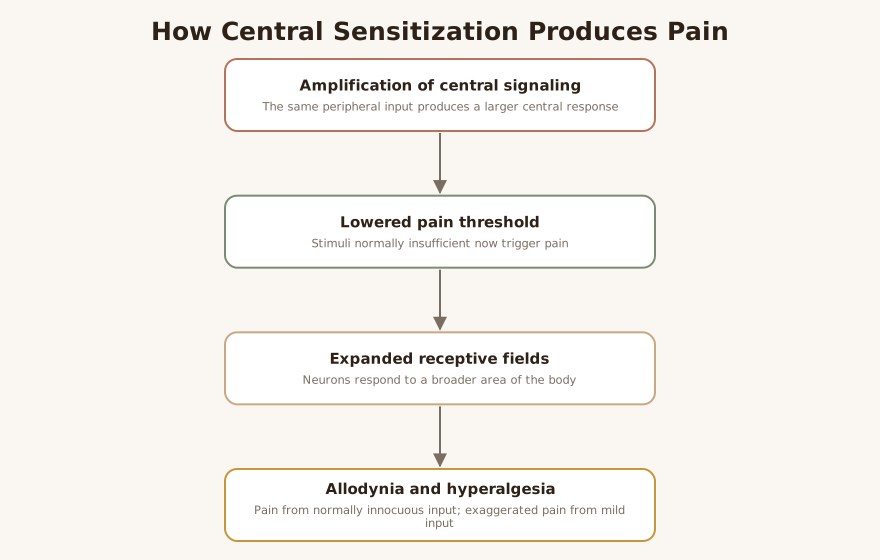
The first principle is amplification: persistent or intense nociceptive input can increase the gain of central nociceptive pathways, so the same peripheral signal produces a larger central response 2. A second principle is the expansion of receptive fields, meaning that neurons begin to respond to inputs from a broader area of the body than they originally did, which helps explain why pain spreads beyond the site of original injury 2. A third is a reduction in pain threshold, such that stimuli normally insufficient to be painful now trigger pain 3.
Two clinical hallmarks follow directly. Allodynia is pain in response to a normally non-painful stimulus, such as light touch or clothing on the skin 7. Hyperalgesia is an exaggerated pain response to a stimulus that is normally only mildly painful 7. Both reflect that the nervous system, not the tissue, has changed its sensitivity 7. A related laboratory phenomenon is wind-up, a progressive increase in the response of dorsal horn neurons to repeated stimulation, which is mechanistically linked to the early stages of sensitization 5.
The unifying idea for clinicians is that central sensitization decouples pain from injury 3. Pain becomes a less reliable indicator of harm, and the nervous system itself becomes the relevant target 3. The IASP frames this as a shift in understanding pain as something the brain and spinal cord produce rather than simply detect 4.
LLM-generated illustrative example (not a guideline): A patient who sprained an ankle eighteen months ago now reports that the whole foot, and sometimes the opposite leg, burns when the bedsheet brushes it. Imaging is unremarkable. Framed through central sensitization, the spread, the persistence, and the painfulness of light touch are signs of a sensitized nervous system rather than evidence of a missed structural injury LLM.
Interventions & Techniques
Central sensitization is not itself an intervention, but several established approaches are built on or informed by it LLM. The most direct is pain neuroscience education, which teaches patients how sensitization works in order to reduce the threat value of pain and to support re-engagement with activity 6. The “Tame the Beast” resource is a widely used example, reframing the pain system as overprotective and recoverable rather than broken 6.
Because sensitization heightens the threat value of movement, graded exposure and graded activity are core behavioral techniques: the patient gradually approaches feared or avoided movements to recalibrate the protective response without overwhelming it LLM. Cognitive behavioral therapy for chronic pain targets catastrophic appraisals and unhelpful pain beliefs that can maintain hypervigilance, while acceptance and commitment therapy shifts the goal from pain elimination toward values-based living alongside pain LLM. These behavioral strategies are conceptually justified by the premise that central processing, not peripheral tissue state, is the modifiable variable 3.
Pharmacological and physiotherapeutic approaches are often coordinated with behavioral care. Agents acting on central pain processing, alongside graded movement and aerobic exercise, are commonly used because peripherally directed treatments alone tend to underperform when sensitization dominates the clinical picture 4. For the therapist, the practical takeaway is interdisciplinary: behavioral interventions are most effective when the patient genuinely understands the sensitization model and when movement re-engagement is supported across the care team LLM.
LLM-generated illustrative example (not a guideline): A clinician introduces the “overprotective alarm” metaphor, then collaboratively builds a stepwise plan to return to a ten-minute walk the patient has avoided for months. Each session pairs a brief review of the sensitization model with reflection on what the patient noticed during the walk, gradually loosening the link between movement and threat LLM.
Evidence Base
The neurophysiological evidence base is mature and well-established LLM. The existence of a central component to pain hypersensitivity has been demonstrated experimentally since Woolf’s foundational work 1. The cellular and molecular mechanisms of central sensitization — including changes in synaptic efficacy and neuronal excitability in the dorsal horn — are characterized in detail in the major review literature 2. There is broad consensus that central sensitization is a real and clinically relevant phenomenon, and the IASP describes it as central to contemporary understanding of chronic pain 4.
The honest qualification is that translating this robust basic science into specific clinical answers is less settled LLM. Central sensitization is inferred clinically from signs such as widespread pain, allodynia, and hyperalgesia rather than measured directly at the bedside, and Woolf himself framed its diagnostic and treatment implications as an agenda rather than a finished protocol 3. There is no single confirmatory test that establishes central sensitization in an individual patient LLM. Consequently, the construct is best treated as an established and explanatory mechanism whose clinical operationalization — how reliably to identify it and how best to reverse it — remains an area of active development 3.
Populations & Indications
Central sensitization is most strongly implicated in conditions where pain is widespread, persistent, and disproportionate to identifiable tissue pathology 4. Fibromyalgia is the prototypical example, often described as a condition in which central amplification is a defining feature 7. Complex regional pain syndrome is another, characterized by intense, often spreading pain with prominent allodynia 7.
Beyond these, sensitization is invoked across a range of chronic pain presentations, including chronic low back pain, chronic widespread pain, osteoarthritis with pain out of proportion to joint changes, chronic headache, and persistent post-surgical pain 4. The clinical signal that the construct is relevant is a mismatch: pain that is more severe, more widespread, or more persistent than the visible tissue findings would predict, frequently accompanied by allodynia and hyperalgesia 3. For behavioral-health clinicians, the indication is less a specific diagnosis than this profile of disproportionate, persisting pain in a patient who is distressed, fearful of movement, or hypervigilant to bodily sensation LLM.
Problems-for-Work
The construct maps cleanly onto several behavioral targets. Kinesiophobia, the fear of movement, is a natural consequence of a sensitized system that interprets ordinary movement as dangerous, and it is a primary target for graded exposure LLM. Fear-avoidance behavior more broadly — withdrawing from activities, roles, and relationships to prevent pain — maintains deconditioning and disability and can be addressed through graded re-engagement LLM.
Pain catastrophizing, the tendency to ruminate on, magnify, and feel helpless about pain, is a well-recognized maintaining factor that cognitive and educational interventions directly address LLM. Hypervigilance to bodily sensation keeps attention locked on pain and can be worked with through attentional and acceptance-based strategies LLM. Finally, the distress of allodynia and hyperalgesia — the bewilderment and fear that arise when light touch hurts — is itself a problem-for-work, because a credible explanatory model can reduce the threat value of these experiences 4.
LLM-generated illustrative example (not a guideline): A patient avoids hugging their children because contact triggers pain, then feels guilt and isolation. The work targets both the fear-avoidance (graded, tolerable contact) and the catastrophic appraisal (“this means I’m being damaged”), using the sensitization model to reframe the pain as a false alarm rather than evidence of harm LLM.
Contraindications, Cautions & Cultural Humility
The foremost caution is invalidation. Explaining pain as “central” or as a nervous-system phenomenon can be heard by a patient as “the pain is not real” or “it is all in your head,” which is both clinically false and harmful to the alliance LLM. The model holds that the pain is entirely real; what has changed is the sensitivity of the system producing it 4. Education must be delivered with explicit validation of the patient’s suffering LLM.
A second caution is premature closure: attributing pain to central sensitization must never substitute for appropriate medical assessment, because new or changing pain can signal serious underlying pathology that requires investigation LLM. The construct supplements, rather than replaces, careful clinical evaluation LLM.
Culturally, beliefs about the body, pain, and the mind–body relationship vary widely, and a mechanistic neuroscience explanation may land very differently across patients depending on background, language, and prior experiences with healthcare LLM. Clinicians should adapt metaphors and pacing to the individual, check understanding rather than assume it, and remain alert to histories of dismissal that make patients reasonably wary of psychological framing LLM. Trauma history warrants particular care, since interoceptive focus and movement exposure can be activating and may need to be titrated LLM.
Treatment-Plan Suggestions & SMART Objectives
| Goal | SMART objective (example) | Mechanism |
|---|---|---|
| Build an accurate pain model | Within 4 sessions, client will accurately describe central sensitization in their own words and identify one personal “false alarm” example | Pain neuroscience education reduces the threat value of pain 6 |
| Reduce fear of movement | Over 6 weeks, client will resume one previously avoided daily movement for 10 minutes, 5 days per week | Graded exposure recalibrates the protective response 3 |
| Decrease catastrophic appraisals | Within 8 weeks, client will reduce pain-catastrophizing self-statements by using a reframe in 4 of 5 logged flare-ups | Cognitive restructuring targets maintaining appraisals LLM |
| Re-engage with values | Within 8 weeks, client will participate in one valued social activity weekly despite pain | Acceptance-based action restores function alongside pain LLM |
| Reduce hypervigilance | Over 6 weeks, client will complete a daily 5-minute attentional or grounding practice 5 days per week | Attentional retraining loosens fixation on bodily threat LLM |
| Improve activity pacing | Within 4 weeks, client will follow a paced activity plan that avoids boom-and-bust cycles on 4 of 7 days | Pacing prevents flare-driven avoidance and deconditioning LLM |
| Strengthen the care team model | Within 2 sessions, client will articulate how behavioral and physical care fit a shared sensitization model | Coherent interdisciplinary framing supports adherence 4 |
Common Misconceptions
A first misconception is that central sensitization means the pain is imaginary or psychological in origin LLM. The construct asserts the opposite: the pain is genuine, and the change is in how the central nervous system processes signals, not in the patient’s honesty or imagination 4. A second is that sensitization is purely peripheral, when the defining contribution of the construct is precisely that a central component exists independent of ongoing peripheral input 1.
A third misconception is that central sensitization is permanent and fixed LLM. Because it reflects neural plasticity, the system that became sensitized retains the capacity to change, which is the rationale for education and graded re-engagement 6. A fourth is conflating central sensitization with a specific disease; it is a mechanism that cuts across many conditions rather than a diagnosis in itself 3. Finally, clinicians sometimes assume sensitization can be confirmed by a single test, whereas in practice it is inferred from a clinical pattern of disproportionate, widespread pain with allodynia and hyperalgesia 3.
Training & Certification
There is no certification in “central sensitization” as such, because it is a construct rather than a credentialed therapy LLM. Clinicians instead develop competence through training in the broader fields that apply it: pain neuroscience education, interdisciplinary pain management, and behavioral approaches such as cognitive behavioral therapy and acceptance and commitment therapy for chronic pain LLM. Foundational fluency can be built from the primary and review literature on the mechanism and from professional bodies such as the IASP, which publishes accessible educational material on the topic 4.
For behavioral-health practitioners specifically, the most useful preparation is twofold: a working grasp of the neurophysiology so that patient education is accurate, and supervised experience delivering graded exposure and cognitive-behavioral methods within a chronic-pain population LLM. Patient-facing tools such as Tame the Beast can also serve as a model for how to communicate the construct clearly without oversimplifying it 6.
Key Terms
Central sensitization — increased responsiveness of central nociceptive neurons to normal or subthreshold input, lowering pain thresholds and amplifying pain 3. Allodynia — pain evoked by a normally non-painful stimulus, such as light touch 7. Hyperalgesia — an exaggerated pain response to a normally mildly painful stimulus 7. Receptive field expansion — the enlargement of the body area from which a neuron can be activated, helping explain pain spread 2. Wind-up — progressive escalation of dorsal horn neuron responses to repeated stimulation 5. Neural plasticity — the nervous system’s capacity to change its structure and function, the basis for both the onset and the potential reversal of sensitization 2. Nociplastic pain — pain arising from altered nociception without clear evidence of tissue damage, a category closely associated with central sensitization LLM.
Resources & Further Reading
▶ Watch — a video introduction to this concept:
- Woolf (1983) — Evidence for a central component of post-injury pain hypersensitivity (Nature)
- Latremoliere & Woolf (2009) — Central Sensitization: A Generator of Pain Hypersensitivity by Central Neural Plasticity
- Woolf (2011) — Central sensitization: implications for the diagnosis and treatment of pain
- IASP — Everything you wanted to know about Central Sensitisation
- Physiopedia — Central Sensitisation
- Tame the Beast — Prof. Lorimer Moseley (pain neuroscience education video)
- Wikipedia — Central sensitization
Reflective / Supervision Questions
- How do I currently explain persistent pain to patients, and does my language inadvertently imply that pain without visible injury is less real? LLM
- When a patient’s pain is disproportionate to their imaging or examination, do I notice myself searching harder for a structural cause, and how might that shape the patient’s beliefs? LLM
- How do I balance validating a patient’s suffering with introducing a model that reframes their pain as a sensitized alarm rather than ongoing damage? LLM
- Where in my caseload might fear-avoidance and catastrophizing be maintaining disability more than the underlying pain itself? LLM
- How comfortable am I coordinating with physical and medical providers around a shared sensitization model, and what would strengthen that collaboration? LLM
- For patients with trauma histories, how do I titrate interoceptive and movement-based work so that re-engagement does not become overwhelming? LLM
- How do I adapt the metaphors I use so the construct lands across patients with different cultural and personal beliefs about pain and the body? LLM