
Dual-process models are among the most portable ideas in psychology: a single, simple architecture that explains why a person can know exactly what they want to do and reliably do the opposite. The claim is that behavior is the joint product of two systems — one fast, automatic, and associative, the other slow, deliberate, and rule-based — that often pull in different directions 4. For a clinician, this is not abstract theory. The gap between a patient’s stated intention and their actual conduct — the relapse after the resolution, the binge after the meal plan, the snapped reply after the commitment to stay calm — is precisely the territory these models were built to describe LLM.
Type & Discipline
Dual-process models are a family of descriptive theories drawn from cognitive and social psychology, not a therapy, a diagnosis, or a protocol 4. The shared core is that information is processed in two qualitatively different ways: a Type 1 process that is fast, automatic, high-capacity, and does not require working memory, and a Type 2 process that is slow, effortful, sequential, and tied to working memory and general intelligence 4. Daniel Kahneman’s popularization labeled these “System 1” and “System 2,” language that has spread far beyond academic psychology 5.
It is worth being precise about terminology, because the field has been. Many theorists now prefer “Type 1 / Type 2 processing” over “System 1 / System 2,” because the latter implies two anatomically distinct systems, whereas the defining feature is really the kind of processing — automatic versus controlled — not a fixed location in the brain 4. The reflective-impulsive distinction is therefore best understood as a contrast between modes of operation rather than between two literal organs LLM. For clinical purposes the useful invariant is the asymmetry: one route is cheap, fast, and always running; the other is expensive, slow, and easily depleted or bypassed 5.
Creators & Lineage
The dual-process tradition has many parents, which is part of why it feels both ubiquitous and loosely defined 4. The contrast between rapid, intuitive judgment and slow, analytic reasoning runs back through the heuristics-and-biases program and was crystallized for a wide audience by Daniel Kahneman’s System 1 / System 2 framing 5. Parallel lineages include Seymour Epstein’s experiential-versus-rational systems and Keith Stanovich and Richard West’s original “System 1 / System 2” coinage, all converging on the same basic two-mode picture LLM.
The version most directly useful to therapists is Fritz Strack and Roland Deutsch’s Reflective-Impulsive Model (RIM), published in 2004, which was built specifically to explain social behavior as the joint output of two distinct systems 1. Strack and Deutsch named these the impulsive system and the reflective system and, crucially, specified how they interact rather than treating them as separate boxes 1. Their model has since been extended into applied behavior-change science: a chapter in the Cambridge Handbook of Behavior Change lays out how the RIM can be used to design interventions, which is the bridge from social-psychology theory to clinical practice 3. The clinical inheritance flows naturally into cognitive behavioral therapy, self-regulation theory, and the behavioral-economics account of why people act against their own long-term interest LLM.
Core Principles
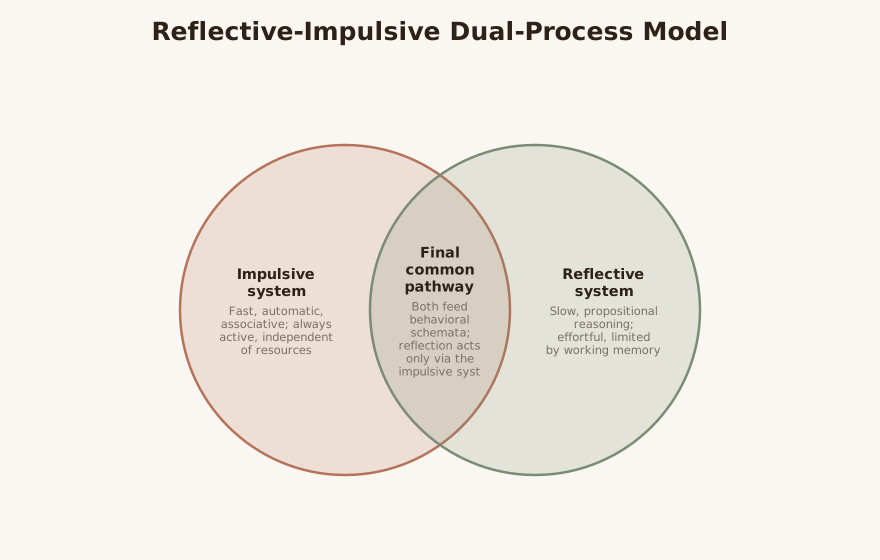
In the Reflective-Impulsive Model, the impulsive system operates through associative links built up by learning: stimuli activate associated concepts and behavioral tendencies automatically, regardless of whether the person endorses them 1. It is always active, fast, and does not depend on cognitive resources or intention 1. The reflective system, by contrast, generates behavior through propositional reasoning — it represents states of affairs as true or false, weighs them, and forms intentions and decisions 1. It is slow, effortful, and dependent on working-memory capacity that can be exhausted, distracted, or impaired 1.
The most clinically important principle is how these systems relate. Both feed into a final common pathway: behavior is enacted when behavioral schemata reach a threshold of activation, and both systems can supply that activation 1. The reflective system can only act through the impulsive system — its intentions must ultimately recruit the same behavioral schemata — which is why “deciding” to change is necessary but rarely sufficient 1. When reflective resources are high, deliberate intentions dominate; when those resources are depleted, distracted, or intoxicated, the impulsive system’s associations and motivational orientations win by default 1.
This yields a third principle: the systems can agree or conflict, and clinical distress clusters at the points of conflict LLM. A patient may reflectively value sobriety while the sight of a particular bar automatically activates approach tendencies and craving; the behavior that results depends on which system controls the final pathway at that moment 1. The impulsive system is also organized by a basic approach-versus-avoidance motivational orientation that biases behavior before any deliberate appraisal occurs 1.
Interventions & Techniques
Because there are two systems, there are two broad routes to behavior change, and the Handbook of Behavior Change organizes intervention strategies around exactly this distinction 3. The practical insight is that strengthening reflective resolve and reshaping impulsive associations are different jobs requiring different tools 3.
Strengthening the reflective system. Interventions here aim to make deliberate intentions more robust and more likely to control behavior under pressure 3. Implementation intentions — specific if-then plans that pre-commit a response to a cue (“if I see the bar, then I call my sponsor”) — are a central technique, because they pre-load a deliberate plan so it can fire more automatically when reflective capacity is low 3. Reducing the load on reflective resources, anticipating depletion, and removing the need for in-the-moment willpower all belong to this family 3.
Retraining the impulsive system. Because deliberate insight does not directly rewrite associations, a second class of techniques targets the impulsive system itself 3. Approach-avoidance training, evaluative conditioning, and attentional-bias modification attempt to weaken automatic approach tendencies and positive associations toward problem cues, or to strengthen them toward healthier alternatives 3. These methods change the impulsive inputs to behavior rather than the reflective ones 3.
Changing the environment. A third strategy sidesteps the internal contest by altering the cues that drive the impulsive system in the first place — removing triggers, restructuring choice architecture, and managing exposure to high-risk contexts 3. This is often the most reliable lever, because it reduces the frequency of moments in which a depleted reflective system has to overpower a fully activated impulse LLM.
LLM-generated illustrative example (not a guideline): A patient in early recovery keeps relapsing on weekday evenings. Rather than exhorting him to “want it more,” the clinician maps the two systems: reflectively he is committed, but exhaustion at 8 p.m. depletes reflective control while the route home past a liquor store fully activates the impulse. They write an implementation intention (“if it’s 5 p.m., then I take the train route that avoids the store”) and remove the in-home supply, shrinking the number of moments in which willpower has to win LLM.
Evidence Base
The honest summary is that dual-process theory is established as a description of cognition, while dual-process interventions are a younger and more uneven applied literature LLM. As a framework, the two-mode architecture is supported by decades of work across reasoning, judgment, social cognition, and decision-making, and the Reflective-Impulsive Model is a heavily cited synthesis of that tradition 1. There is also suggestive neuroscience: one account links the fast, automatic “Type 1” mode to the brain’s default mode network, proposing a possible neural foundation for intuitive thinking, though this remains a hypothesis rather than a settled mapping 6.
Several honest caveats matter for clinicians. First, dual-process theory has been criticized within psychology — the clean two-system picture may oversimplify a more continuous reality, and “System 1 / System 2” risks reifying processes into entities 4. Many researchers have moved to the more cautious “Type 1 / Type 2” language precisely to avoid implying two literal brain systems 4. Second, the applied behavior-change evidence is mixed: impulsive-system retraining methods such as approach-avoidance training and attentional-bias modification have shown inconsistent and sometimes small effects across trials, and the Handbook treats them as a developing rather than a definitive toolkit 3. Third, much of the foundational evidence comes from laboratory and Western samples, so generalization to clinical populations and real-world settings is an inference, not a guarantee LLM. The framework’s clinical value is as an organizing lens that already underlies CBT and relapse-prevention work, not as a freestanding evidence-based therapy LLM.
Populations & Indications
The model is most directly indicated where the gap between intention and behavior is the presenting problem LLM. Adults with substance use disorders are the paradigm case: the reflective commitment to abstinence repeatedly loses to automatically activated craving and approach tendencies, which is exactly the conflict the RIM formalizes 1. People with other addictive and behavioral-addiction patterns — gambling, compulsive online behavior — fit the same structure of strong impulsive pull against reflective intent 3.
Individuals with impulse-control problems and people with eating disorders, particularly binge eating, are well-served by the framework because food cues and emotional states can activate impulsive eating schemata that override dietary intentions 3. Adolescents are a developmentally important population: the reflective, controlled system relies on capacities that are still maturing, which helps explain the heightened susceptibility to impulsive, cue-driven behavior in that age group LLM. More broadly, general clinical populations benefit whenever automatic patterns — habitual avoidance, reflexive reassurance-seeking, automatic negative thoughts — conflict with stated therapeutic goals LLM.
Problems-for-Work
The two-system vocabulary gives clinicians a precise way to formulate a cluster of common problems LLM.
- Craving and relapse. Craving is an impulsive-system phenomenon: cues automatically activate approach tendencies and associated behavioral schemata that can override reflective commitment, especially when reflective resources are depleted 1. Treatment works on both sides — strengthening reflective plans and weakening or avoiding the cues 3.
- Substance use and behavioral addictions. These are formulated as chronic dominance of impulsive over reflective control of the final behavioral pathway, which directs intervention toward both environmental restructuring and reflective pre-commitment 13.
- Binge eating. Emotional states and food cues activate impulsive eating schemata; stimulus control and implementation intentions target the impulsive inputs while reflective work supports the longer plan 3.
- Impulsivity and self-regulation failure. When reflective capacity is taxed — by stress, fatigue, or strong emotion — behavior defaults to impulsive control; naming this depletes shame and points to anticipatory planning 1LLM.
- Habit-driven behavior. Habits are largely impulsive-system products, cue-triggered and resistant to mere insight, which is why behavioral and environmental techniques outperform exhortation 3.
- Cognitive distortions and automatic negative thoughts. Automatic appraisals can be framed as impulsive-system outputs that the reflective system can learn to catch and re-evaluate, which is the engine of cognitive restructuring LLM.
LLM-generated illustrative example (not a guideline): A patient with binge eating describes feeling “possessed” at night. Reframing through the two systems removes the mystery: a stressful day depletes the reflective system while loneliness and the sight of the pantry activate an over-learned impulsive schema. The clinician and patient target the impulsive inputs (rearranging the kitchen, a pre-planned evening routine) rather than relying on midnight willpower LLM.
Contraindications, Cautions & Cultural Humility
The first caution is conceptual: the model is a useful map, not the territory, and presenting “two systems” as literal brain regions overstates the science 4. Clinicians should hold the dichotomy loosely, since the field itself has retreated from strong two-system claims toward more cautious “Type 1 / Type 2” language 4. Over-relying on impulsive-system retraining techniques is also unwise given their inconsistent evidence base; they are adjuncts, not replacements for established treatment 3.
A relational caution: the language of an “impulsive system” can be used either to reduce shame (“this is an automatic process, not a character flaw”) or, badly handled, to imply the patient is governed by a primitive, untrustworthy self LLM. The therapeutic framing should externalize the impulse as a learned association to be worked with, not as evidence of the patient’s weakness LLM. The model must never be used to imply that someone “just needs to use System 2 more,” which collapses back into the willpower exhortation the framework was meant to replace LLM.
Culturally, what counts as an impulse versus a reasoned choice, and which cues carry approach or avoidance value, is shaped by context, community, and meaning LLM. The associative contents of the impulsive system are learned, so they reflect a person’s environment and culture rather than a universal template, and interventions should be built around the patient’s actual cues and values rather than a generic list 1LLM.
Treatment-Plan Suggestions & SMART Objectives
| Goal | SMART objective (example) | Mechanism |
|---|---|---|
| Reduce cue-driven relapse | Within 4 weeks, the client will identify their top 5 high-risk cues and write an if-then implementation intention for each, reviewed in session | Pre-loads a reflective plan so it fires when reflective capacity is low 3 |
| Lower exposure to triggers | By session 6, the client will restructure 2 daily routines to remove or avoid identified impulsive cues | Environmental restructuring reduces impulsive-system activation 3 |
| Anticipate reflective depletion | Within 5 weeks, the client will log times of day and states (fatigue, stress) when control fails, and pre-plan one coping action for each | Targets the resource-dependence of the reflective system 1 |
| Weaken automatic approach to a substance | Over 8 weeks, the client will practice a clinician-guided approach-avoidance or attention exercise as an adjunct and rate craving before/after | Attempts to retrain impulsive associations and biases 3 |
| Catch and re-evaluate automatic thoughts | Daily for 2 weeks, the client will record 1 automatic negative thought and one reflective re-appraisal | Strengthens reflective override of impulsive outputs LLM |
| Reduce binge episodes | Within 6 weeks, the client will implement stimulus-control changes in the home and pre-plan an evening routine, tracking episode frequency | Removes impulsive cues and supports the reflective plan 3 |
| Build self-regulation under emotion | By week 8, the client will use a brief planned pause-and-plan step in 3 high-emotion situations per week | Recruits reflective control before the impulsive pathway fires 1 |
Common Misconceptions
“System 1 is bad and System 2 is good.” Neither system is the enemy; the impulsive system is fast and adaptive in most of life, and the reflective system is slow and easily overwhelmed — the goal is alignment, not the suppression of one mode 5.
“There are two literal systems in the brain.” The field increasingly favors “Type 1 / Type 2 processing” precisely because the defining feature is the kind of processing, not two anatomically separate organs 4.
“Insight changes impulsive behavior directly.” Understanding a pattern does not rewrite the underlying associations; impulsive-system change usually requires behavioral retraining or environmental change, not deliberate resolve alone 3.
“Willpower is the answer.” Because the reflective system is resource-limited and the impulsive system never sleeps, relying on in-the-moment willpower is exactly the strategy that fails under stress, fatigue, or intoxication 1.
“The interventions are proven and powerful.” Impulsive-system retraining methods have shown inconsistent and often small effects; they are promising adjuncts within a broader treatment, not standalone cures 3.
Training & Certification
There is no certification in dual-process or reflective-impulsive models; they are conceptual frameworks rather than credentialed therapies LLM. Competence comes from familiarity with the source literature and from skill in the host modalities that operationalize the ideas LLM. Clinicians can ground themselves in Strack and Deutsch’s original RIM paper for the architecture, the Handbook of Behavior Change chapter for how to translate it into intervention design, and the broader dual-process literature for the conceptual debates 134. The applied competencies — implementation intentions, stimulus control, relapse prevention, and cognitive restructuring — are trained within standard cognitive behavioral therapy and addiction-treatment pathways rather than through a dedicated course LLM.
Key Terms
- Impulsive system — the fast, automatic, associative mode that activates behavioral tendencies through learned associations, independent of intention or resources 1.
- Reflective system — the slow, effortful, propositional mode that reasons, judges truth value, and forms intentions, dependent on working-memory capacity 1.
- Type 1 / Type 2 processing — the more cautious terminology for automatic versus controlled processing, preferred over “two systems” 4.
- System 1 / System 2 — Kahneman’s popular labels for fast/automatic versus slow/deliberate thinking 5.
- Behavioral schema — a representation of behavior that, once activated past threshold by either system, produces action 1.
- Approach-avoidance orientation — the basic motivational bias of the impulsive system that pulls behavior toward or away from cues before deliberate appraisal 1.
- Implementation intention — a specific if-then plan that pre-commits a response to a cue, helping reflective goals survive low-resource moments 3.
- Reflective depletion — the loss of reflective control under fatigue, stress, distraction, or intoxication, allowing the impulsive system to dominate 1.
- Default mode network — a brain network proposed as a possible neural substrate for fast, automatic thinking 6.
Resources & Further Reading
▶ Watch — a video introduction to this concept:
- Strack & Deutsch (2004), “Reflective and Impulsive Determinants of Social Behavior,” Personality and Social Psychology Review
- Strack & Deutsch (2004), “Reflective and Impulsive Determinants of Social Behavior” — Semantic Scholar (open PDF)
- Changing Behavior Using the Reflective-Impulsive Model — The Handbook of Behavior Change (Cambridge, Ch. 12)
- Dual process theory — Wikipedia
- System 1 and System 2 Thinking — The Decision Lab
- Dual Process Theory of Thought and Default Mode Network (PMC)
Reflective / Supervision Questions
- When a patient repeatedly “fails” at a behavior change, do I formulate it as a reflective-impulsive conflict, or do I quietly attribute it to weak motivation? LLM
- For this patient, am I targeting the reflective inputs, the impulsive inputs, or the environment — and have I chosen the lever most likely to work under depletion? 3
- How do I introduce the “impulsive system” so it reduces shame rather than implying the patient is governed by an untrustworthy self? LLM
- Am I overstating the science by talking about “two brain systems,” when the more accurate frame is two modes of processing? 4
- Where in my caseload am I relying on in-the-moment willpower as the plan, when an implementation intention or environmental change would carry the load instead? 13
- Are the cues and associations I am targeting drawn from this patient’s actual lived context, or from a generic template that may not fit their culture and circumstances? LLM