
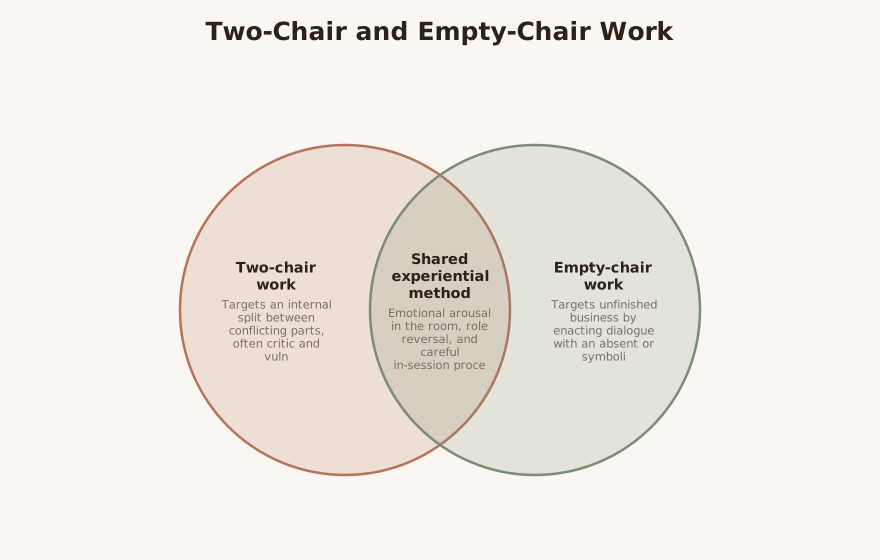
Empty-chair and two-chair work are among the most recognizable experiential interventions in psychotherapy: the client speaks, out loud and in the present tense, to an empty chair that holds either an absent person or a disowned part of the self. LLM What looks theatrical to the uninitiated is, in skilled hands, a precise method for activating and transforming emotion in real time rather than only talking about it. LLM This article orients practicing clinicians to where the techniques come from, what they actually do, what the evidence supports, and how to deploy them responsibly within a recognized course of treatment. LLM
Type & Discipline
Empty-chair and two-chair work are techniques, not standalone treatment models — discrete experiential interventions embedded within larger humanistic and process-experiential frameworks. LLM They belong to the family of experiential techniques in which the physical positioning of chairs is used to facilitate internal and interpersonal dialogue. 1 The defining feature is enactment: instead of narrating a conflict, the client engages it as a live encounter, which is intended to access restricted feelings and allow them to run their course and be restructured within the safety of the therapy setting. 5 Because the active ingredient is emotional arousal and its in-session processing, these methods sit squarely in the humanistic-experiential tradition rather than the cognitive or psychodynamic ones, even though they can be adapted into other modalities. LLM
Creators & Lineage
The lineage runs through three figures. Jacob Levy Moreno, a contemporary of Freud, first developed chair-and-role enactment within psychodrama in 1921; Gestalt therapists, and Fritz Perls in particular, later adapted and popularized the empty chair for one-on-one therapeutic use. 7 Gestalt therapy supplied the conceptual home — its emphasis on present-moment contact, awareness, and the completion of “unfinished business.” 5 The modern systematization came from Leslie Greenberg, identified as the pioneer of Emotion-Focused Therapy (EFT), who studied how people change across nearly three decades and made chairwork a core, manualized technique. 4 In EFT, Greenberg uses dialogue with an empty chair to symbolize different aspects of the self or imagined others, turning a Gestalt improvisation into a structured, marker-guided procedure. 4 Sandra Paivio, working with Greenberg, helped extend and test empty-chair dialogue for unresolved interpersonal injuries, anchoring the technique in controlled research. 3
Core Principles
The methods rest on a small set of premises. First, emotions are treated as central to identity and as adaptive information, so the therapeutic task is to help clients access, understand, regulate, and express them rather than argue with them. 4 Second, change requires emotional arousal in the room — activating a feeling so it can be experienced, differentiated, and restructured, not merely discussed. 5 Third, much psychological distress reflects either an internal split (two parts of the self in conflict) or unfinished business (an unexpressed emotional response to a significant other). 4 Two-chair work targets the split by alternating the client between a chair representing one part — often a harsh inner critic — and a chair representing the vulnerable, experiencing self. 4 Empty-chair work targets unfinished business by enacting dialogue with the absent or symbolized other. 5 Across both, perspective-taking through role reversal and careful in-session processing of what emerges are essential, not optional, steps. 7
Interventions & Techniques
The basic empty-chair sequence is straightforward to describe and demanding to deliver well. The therapist sets up two facing chairs, clarifies the purpose and what the empty chair represents, guides the client into direct address of the imagined person or part, switches roles for perspective-taking when appropriate, and then processes the insights in a debrief. 5 A parallel four-step framing — identify the focus, conduct the dialogue, switch roles, debrief — is used in client-facing descriptions of the method. 7
Two-chair dialogue follows a distinct logic for conflict splits: the client speaks from the critic chair (“you’ll never manage this”), then physically moves to the other chair to respond from the experiencing self, often surfacing an unmet need such as “I need you to understand and support me.” 4 In EFT this is organized into recognizable dialogue types, including self-critical splits, self-interruption splits, and the unfinished-business dialogue. 4
LLM-generated illustrative example (not a guideline): A client paralyzed by perfectionism is invited to voice the critic from one chair (“nothing you do is good enough”), then move to the other chair. From the vulnerable seat she first collapses, then, after the therapist directs her attention to the bodily impact, asserts: “I’m exhausted, and I need you to ease up.” The softening of the critic in response is the in-session shift the technique aims to produce. LLM
Evidence Base
The evidence base is best described as established but uneven. A 2026 systematic review by Ottingerová, Halamová, and Szitás pooled 22 randomized controlled trials of chairwork across depression, childhood trauma, unfinished business, OCD, PTSD, social anxiety, eating disorders, and decision-making problems. 1 Effect sizes ranged from small (d = 0.20) to large (d = 1.73), with EFT incorporating chairwork showing large effects in depression and binge-eating disorder, and superior long-term outcomes versus client-centered approaches alone. 1 For unfinished business specifically, empty-chair dialogue proved significantly more effective than psychoeducation alone — a finding consistent with the Paivio and Greenberg line of work. 13 Two-chair dialogue has also been studied as an intervention to increase self-compassion. 2
Honesty about maturity matters here. In the same review, only 2 of 22 trials demonstrated low risk of bias while 14 showed high risk, with recurring problems of incomplete outcome data, inadequate handling of missing data, and absent pre-registered protocols. 1 The reviewers concluded chairwork is a promising intervention whose evidence remains constrained by methodological limitations. 1 In short: the signal is real and at times large, but it should be communicated to clients and supervisors as well-supported rather than definitively settled. LLM
Populations & Indications
The techniques were developed for and tested mainly with adults in individual psychotherapy. 1 Indicated presentations include unresolved grief and loss, depression and anxiety, trauma and inner conflict, and negative self-perception. 7 Empty-chair work is the method of choice when the clinical core is an unexpressed emotional response toward another person — a deceased parent, an estranged partner, an abuser — i.e., clients carrying unfinished business with others. 5 Two-chair work fits clients dominated by self-criticism or by internal conflict and ambivalence, where two parts of the self are at war. 4 The chairwork trials also span trauma survivors, including those with childhood maltreatment sequelae, and people facing decisional conflict such as career or partnership ambivalence. 1 Adolescent applications — for guilt, anxiety, and bullying-related trauma — and use with couples and families have been described, though the adult individual-therapy base is strongest. 5
Problems-for-Work
The methods map onto specific clinical problems, and choosing the right enactment for the right problem is the core competency. LLM
- Unfinished business / interpersonal injuries: empty-chair dialogue with the person who caused the injury, where the comparison evidence is strongest. 13
- Self-criticism: two-chair work confronting the inner critical voice and surfacing the experiencing self’s needs. 4
- Internal conflict and ambivalence: two-chair dialogue between the conflicting parts to clarify and integrate them. 4
- Unresolved grief and anger toward others: empty-chair address to the absent figure to give the avoided feeling expression and movement. 5
- Depression: chairwork delivered within EFT, where large effects and durable gains have been observed. 1
LLM-generated illustrative example (not a guideline): For a bereaved client stuck in unspoken anger at a father who died before reconciliation, the therapist seats the father in the empty chair. The client moves from rehearsed grievance to a previously inaccessible “I needed you to be proud of me,” and the therapist helps her stay with and name the longing underneath the anger. LLM
Contraindications, Cautions & Cultural Humility
These are high-arousal techniques and should not be used reflexively. They require a strong therapeutic alliance and genuine client readiness, and the work can be emotionally intense, demanding careful, continuous therapist monitoring. 5 They may be inappropriate for clients who are emotionally unstable or strongly avoidant, where activation can overwhelm rather than restructure. 5 The intensity can also place unexpected stress on family relationships, and the method tends to suit clients open to a potentially intense therapeutic experience. 7 Trauma applications warrant particular caution: imaginal-confrontation approaches have shown higher dropout than gentler empathic-exploration approaches even when symptom reduction is comparable, so pacing and titration matter. 1 These methods also depend on physical space and work best in face-to-face settings, which constrains telehealth and group adaptations. 5
Cultural humility is essential. Direct, expressive enactment of feeling toward elders, parents, or the deceased may carry very different meanings across cultural and religious frameworks, and the therapist should never assume that emotionally expressive confrontation is universally appropriate or healing. LLM Informed consent, an explicit rationale, and an explicit option to decline or pause should precede any enactment. LLM
Treatment-Plan Suggestions & SMART Objectives
| Goal | SMART objective (example) | Mechanism |
|---|---|---|
| Process unfinished business with a significant other | Within 8 sessions, client completes at least 2 empty-chair dialogues and reports reduced distress related to the unresolved relationship | Enactment gives avoided emotion expression and allows restructuring 51 |
| Soften harsh self-criticism | Over 6 sessions, client engages 3 two-chair dialogues and identifies one unmet need voiced from the experiencing self | Splits the critic from the self and surfaces underlying needs 4 |
| Resolve internal ambivalence about a decision | Within 4 sessions, client articulates both sides via two-chair dialogue and states a clarified preference | Externalizes the conflict for differentiation and integration 4 |
| Reduce depressive symptoms within EFT | Across 12-16 sessions, client uses chairwork at identified markers and shows measurable symptom reduction on a standardized measure | EFT-with-chairwork has shown large depression effects 1 |
| Express and process grief-related anger | Within 6 sessions, client completes an empty-chair dialogue addressing the deceased and reports the feeling as more bearable | Allows restricted grief and anger to run their course 5 |
| Increase self-compassion | Over 6 sessions, client engages two-chair self-compassion dialogues and rates increased self-kindness | Two-chair dialogue studied as a self-compassion intervention 2 |
| Process childhood maltreatment sequelae | Within a titrated 12-session arc, client engages empathic-exploration chairwork with close affect monitoring | Empathic exploration carries lower dropout than confrontation in trauma 1 |
Common Misconceptions
A persistent misconception is that the empty chair is mainly a catharsis exercise — getting feelings “out.” LLM The intended mechanism is not venting but accessing restricted emotion so it can be restructured, with role reversal, perspective-taking, and debrief as integral parts. 57 A second misconception is that it is a quaint Gestalt relic; in fact it has been operationalized and tested within EFT and carries a 22-trial randomized base. 14 A third is that more intensity is always better — yet in trauma work the more confrontational variant has produced higher dropout without superior symptom outcomes. 1 Finally, clinicians sometimes assume the technique is broadly applicable; the sources are explicit that it requires alliance, readiness, and may be unsuitable for emotionally unstable or avoidant clients. 5
Training & Certification
There is no single certifying body for “chairwork” as an isolated technique; competence is typically acquired within training in its parent models. LLM The most direct path is formal training in Emotion-Focused Therapy, the tradition in which Greenberg manualized chairwork and specified the dialogue types and markers that govern its use. 4 Gestalt-therapy training provides the original experiential grounding for empty-chair enactment. 5 Given the emotional intensity and the monitoring the method demands, supervised practice — observing dialogues, conducting them under observation, and reviewing recordings — is the realistic route to competence rather than reading alone. 5 Continuing-education explainer and video resources can orient a clinician but do not substitute for supervised experiential training. 67
Key Terms
- Empty-chair work: enacted dialogue with an imagined or symbolized other (or a disowned part) seated in an empty chair, used chiefly for unfinished business. 5
- Two-chair work: dialogue between two conflicting parts of the self across two chairs, used chiefly for internal splits such as self-criticism. 54
- Unfinished business: an unexpressed or incomplete emotional response toward a significant other that continues to generate distress. 4
- Conflict split: an internal division — e.g., critic versus experiencing self — that two-chair dialogue is designed to resolve. 4
- Marker: an in-session indicator that a particular client problem (e.g., a self-critical split) is active and that a corresponding chairwork task is indicated. 4
- Role reversal / perspective-taking: switching chairs to enact the other side, a structural step in both methods. 7
Resources & Further Reading
▶ Watch — a video introduction to this concept:
- Experiential therapies including chairwork: a systematic review of randomized controlled trials (Ottingerová, Halamová & Szitás)
- The effect of the two-chair dialogue intervention on self-compassion (Stiegler et al., 2023)
- Empty chair work for unfinished interpersonal issues (Paivio & Greenberg)
- Leslie Greenberg and Emotion-Focused Therapy
- The Empty Chair Technique: How It Can Help Your Clients (PositivePsychology.com)
- What is chair work in Emotion-Focused Therapy (EFT)? — Les Greenberg (video)
- Empty chair technique (PsychCentral)
Reflective / Supervision Questions
- How do I distinguish a client who is ready for high-arousal enactment from one for whom activation will overwhelm rather than restructure, and what would I look for in the room? LLM
- When I propose chairwork, am I clear in my own mind whether the target is unfinished business (empty-chair) or an internal split (two-chair), and does the enactment match it? LLM
- How do I track whether the dialogue is producing genuine emotional restructuring versus repetitive venting, and what would prompt me to stop? LLM
- What cultural, religious, or familial meanings might this client attach to addressing an elder, parent, or the deceased, and have I made declining genuinely safe? LLM
- Given the mixed risk-of-bias picture in the evidence, how do I describe the support for this method to clients and supervisors without overselling it? 1LLM