
Type & Discipline
The Bonny Method of Guided Imagery and Music (GIM) is a receptive music therapy modality within the broader discipline of music therapy LLM. “Receptive” denotes that the client listens to music rather than producing it, distinguishing GIM from active or improvisational music therapy methods LLM. AMI describes it as a “music-centered, consciousness-expanding therapy” that uses classical music to stimulate imaginative experience and facilitate integration of the mental, emotional, physical, and spiritual aspects of well-being 1. Appalachian State University similarly frames it as “a music-centered depth approach to transformational therapy,” in which programmed classical music functions as both catalyst and container for the client’s inner experience 5. It is a depth-oriented, individually delivered method rather than a brief or purely symptom-focused intervention 5. The defining clinical feature is that spontaneous imagery, evoked in a relaxed and expanded state of consciousness, becomes the primary therapeutic material to be explored 1.
Creators & Lineage
GIM was developed by Helen Bonny, and the credentialing body that maintains the method bears her name through the Association for Music and Imagery (AMI) 1. The method’s theoretical lineage is explicitly multi-rooted: Appalachian State describes it as grounded in Jungian psychology, experiential therapy, and transpersonal psychology 5. The depth/Jungian thread is reflected in the use of spontaneous imagery as meaningful psychic material, while the transpersonal thread appears in the method’s attention to spiritual dimensions of experience and “consciousness-expanding” states 15. The method also sits within the wider family of guided imagery and receptive music approaches, but is distinguished from suggestion-driven imagery work: in GIM the programmed music, not the therapist’s verbal suggestions, drives the unfolding experience 5. This combination — depth-psychological framing, transpersonal orientation, and music-as-driver — situates GIM at the intersection of music therapy and humanistic-depth psychotherapy traditions LLM.
Core Principles
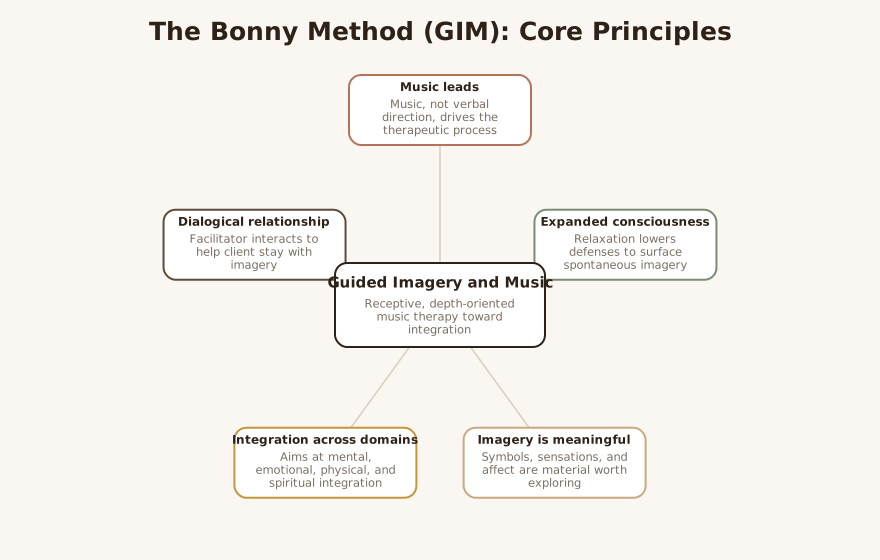
The first principle is that music, not verbal direction, leads the therapeutic process 5. The therapist selects and programs the music but then steps back into a facilitating and witnessing role while the client narrates what arises 5. The second principle is the deliberate use of an altered or expanded state of consciousness, induced through relaxation, to lower defenses and allow spontaneous imagery to surface 1. Third, imagery is treated as clinically meaningful — symbols, bodily sensations, memories, and affect that emerge are regarded as material worth exploring rather than distraction 1. Fourth, the method aims at integration across domains: mental, emotional, physical, and spiritual 1. Fifth, the therapeutic relationship is dialogical and collaborative; the facilitator interacts verbally during music listening to help the client develop and stay with the imagery rather than to interpret or instruct 1. Together these principles position GIM as an insight- and integration-oriented modality rather than a directive skills-training one LLM.
Interventions & Techniques
A full Bonny Method session follows a consistent four-phase structure and can last up to roughly two hours 1. The prelude is a conversation in which the therapist and client discuss the client’s current life situation and the focus for the session, and the therapist assesses the client’s state to select appropriate music 15. The induction is a guided relaxation that brings the client into a reclined, focused, deepened state 15. During the music listening phase — commonly around 35 to 45 minutes of programmed classical music — the client describes emerging imagery, feelings, and bodily sensations aloud, while the therapist facilitates and witnesses, interacting verbally to help the experience develop 15. The postlude brings the client back from the deepened state and reinforces insight, often through reflective discussion and sometimes other expressive means such as drawing 15. The music itself is the central technique: pre-designed sequences (programs) of Western classical works are matched to therapeutic intent 5.
LLM-generated illustrative example (not a guideline): A clinician working with a client in protracted grief might select a music program with a gradual emotional arc. During listening, the client reports an image of standing at the edge of water; the therapist supports the client to stay with the image and notice sensation rather than narrate or interpret, and in the postlude they connect the imagery to the client’s unspoken longing to “say goodbye” LLM.
Evidence Base
The maturity label for GIM is established — but that describes its institutional standing, not the strength of its outcome data, and the distinction matters clinically LLM. GIM is supported by a decades-long body of both qualitative and quantitative peer-reviewed work, including randomized controlled trials with wait-list controls, case studies, phenomenological analyses, mixed-methods studies, and music-analytic research, conducted by teams across the United States, Sweden, Denmark, and Australia 12. Reported findings include reduced depression, anxiety, and total mood disturbance on standardized measures (e.g., POMS, HADS); significant reductions in systolic and diastolic blood pressure versus verbal therapy and no-treatment controls; lowered cortisol with effects sustained weeks post-treatment; and improvements in rheumatoid arthritis pain, walking speed, and joint counts 2. However, the literature’s principal limitation is small samples — many studies enrolling roughly 8 to 30 participants — with much of the early work conducted as master’s or doctoral projects rather than large, well-powered trials 2. One review-level dosage observation is that a minimum of around 10 sessions may be required to demonstrate significant change 2. A registered randomized controlled trial designed to test GIM for mild-to-moderate depression (NCT03917979) planned 10 biweekly individual sessions against a 26-week wait-list control, with IDS-SR, DASS, and WEMWBS outcomes in 30 adults; as of its last known status it was recruiting and has not posted results 4. The honest summary: a long, internationally active tradition with promising but methodologically modest evidence, awaiting larger confirmatory trials LLM.
Populations & Indications
GIM has been applied across a wide range of populations, including adults, adolescents, children, persons in recovery, psychiatric inpatients, and terminally ill patients 1. In practice it is most associated with adults engaged in depth-oriented work, including trauma survivors, people experiencing grief, and those living with chronic illness LLM. It is also used by people pursuing personal and spiritual growth rather than treating a discrete disorder, consistent with its transpersonal orientation 15. Older adults and people in medical or palliative contexts appear in both the clinical and research literature, the latter reflected in studies with cancer-recovery, coronary-care, and post-surgical cardiac patients 12. Indications skew toward clients who can tolerate and use an inner, imagery-rich experience and who have sufficient ego strength and reality-testing to move into and out of a deepened state safely LLM.
Problems-for-Work
GIM’s evidence and clinical use cluster around mood, stress, trauma-related, and adjustment-type presentations 2. Depression and mood disturbance are the most directly studied targets, including the registered depression RCT and multiple mood-outcome studies 24. Grief is a common application, where music-evoked imagery can give nonverbal form to loss that is difficult to articulate LLM. Stress and stress-physiology are supported by the blood-pressure and cortisol findings 2. Anxiety disorders and performance-related anxiety appear in the research record 2. Trauma-related presentations, including PTSD and complex trauma, are clinically common applications of depth music-imagery work, though they require careful stabilization and pacing given the affective intensity involved LLM. Existential distress and adjustment difficulties fit the method’s integrative, meaning-oriented aims, particularly in chronic-illness and end-of-life contexts 1LLM. Emotional dysregulation may be addressed indirectly, by building capacity to contact and stay with affect within a contained, music-held experience LLM.
LLM-generated illustrative example (not a guideline): For a client with adjustment distress following a serious medical diagnosis, a clinician might use a brief, supportive music-and-imagery format to help the client locate an internal “safe place” image and rehearse returning to it, prioritizing resourcing and containment over uncovering LLM.
Contraindications, Cautions & Cultural Humility
Caution is warranted wherever an altered state and intense, uncovering imagery could destabilize a client LLM. The registered depression RCT explicitly excluded people with a history of psychosis, bipolar or schizoaffective disorder, and severe depression — a useful, sourced signal of the populations for whom standard GIM may be inappropriate or require substantial adaptation 4. By clinical extension, fragile reality-testing, active psychosis, acute dissociation, and unstabilized acute trauma call for caution, modification, or deferral LLM. The deepened, relaxation-induced state can surface strong affect, so containment, pacing, and a reliable postlude are not optional 1LLM. There are also practical access considerations: a session lasting up to two hours demands time, stamina, and a private reclined setting that not every client or setting can accommodate 1LLM. Cultural humility is especially relevant because the programmed repertoire is drawn from the Western classical canon, which may not resonate with — or may feel alien to — clients from other musical and cultural traditions 5LLM. Clinicians should hold the music’s cultural specificity openly, monitor each client’s response, and avoid assuming universal meaning in particular works or images LLM.
Treatment-Plan Suggestions & SMART Objectives
| Goal | SMART objective (example) | Mechanism |
|---|---|---|
| Reduce depressive symptom burden | Over 10 biweekly GIM sessions, client reduces self-reported depression score (e.g., IDS-SR or DASS-depression) by a clinically meaningful margin from baseline 24 | Music-evoked imagery and affective processing in a supported, expanded state 1 |
| Process grief | Within 8 sessions, client identifies and verbalizes at least 2 grief-related images/themes during postlude and links them to the loss 1 | Nonverbal imagery gives form to inarticulable loss; postlude integration 1 |
| Lower physiological stress reactivity | Over 8 weeks, client reports reduced subjective stress (e.g., DASS-stress) and practices a relaxation induction between sessions weekly 24 | Relaxation induction and receptive listening reduce arousal; some studies report cortisol/BP effects 2 |
| Build affect tolerance | By session 6, client stays with a distressing image for the full music piece without terminating, then resources in postlude 1 | Contained exposure to affect within music-held structure LLM |
| Increase sense of meaning / integration | Over 12 sessions, client articulates 1+ shift in self-narrative or values connected to recurring imagery 15 | Depth/transpersonal integration of emerging symbolic material 5 |
| Reduce anxiety | Within 10 sessions, client reduces anxiety score (e.g., DASS-anxiety) and reports using a learned safe-place image during 1+ high-anxiety episode/week 24 | Relaxation, imagery resourcing, and processing reduce anxious arousal 2 |
| Support adjustment to chronic illness | Over 8 sessions, client reports improved coping and 1+ adaptive meaning attributed to the illness experience 12 | Integrative processing in medical/palliative contexts 12 |
Common Misconceptions
A frequent misconception is that GIM is the therapist guiding the client’s imagery with verbal suggestion; in fact, the programmed music drives the experience and the therapist primarily facilitates and witnesses 5. Another is that any relaxing playlist will do — GIM uses specific, pre-designed programs of classical works matched to therapeutic purpose, not arbitrary background music 5. A third is conflating GIM with light relaxation or stress-relief listening; it is a depth-oriented method intended to surface and process significant emotional material 15. A fourth is assuming the modality’s “established” standing means strong, large-trial efficacy data — the controlled evidence base is real but small and methodologically modest 2LLM. Finally, some assume it can be self-administered from recordings; the structured prelude, induction, dialogical music phase, and postlude depend on a trained facilitator 1.
Training & Certification
GIM is delivered by specifically trained and credentialed practitioners, not by any clinician who happens to use music 1. In the AMI system, the qualifying designation is FAMI — Fellow of the Association for Music and Imagery — earned by satisfying AMI competencies, completing the membership application, and obtaining approval from trainers and AMI 1. Training programs are built around the “Core Elements of the Bonny Method” and develop the concepts, applications, skills, and ethics required for safe practice 1. Representative training pathways include university-based programs such as Appalachian State’s Levels I–III certification through the Appalachian GIM Institute, which is AMI-endorsed and leads toward AMI Fellow registration 5. In Europe, the European Association for Music and Imagery (EAMI) provides a parallel structure: successful completion of an endorsed Bonny Method training programme qualifies a practitioner for professional membership and to apply to become an EAMI-accredited GIM Therapist, with related but separate Music & Imagery (MI) methods courses also available 6. EAMI specifies that trainers must be EAMI-accredited Bonny Method trainers or AMI primary trainers 6.
Key Terms
Receptive music therapy — music therapy in which the client listens rather than plays; GIM is a receptive method LLM. Prelude — the opening conversation that sets the session focus and informs music selection 1. Induction — the guided relaxation that brings the client into a deepened state 1. Music listening / imaging phase — the core period (roughly 35–45 minutes) of programmed classical music during which the client narrates spontaneous imagery 5. Postlude — the closing phase of return and insight integration 1. Programs — pre-designed sequences of classical works matched to therapeutic intent 5. FAMI — Fellow of the Association for Music and Imagery, the AMI practitioner credential 1. EAMI-accredited GIM Therapist — the European credential for qualified practitioners 6. Music & Imagery (MI) methods — related, often briefer or more supportive imagery-and-music approaches distinct from full Bonny Method GIM 6.
Resources & Further Reading
▶ Watch — a video introduction to this concept:
- Association for Music and Imagery (AMI) — Home / FAQ 1
- An Overview of Research in the Bonny Method of GIM — Voices: A World Forum for Music Therapy 2
- The Bonny Method of GIM: A Mini Review of Theory, Process, and Therapeutic Practice (ResearchGate) 3
- GIM in the Treatment of Depression — ClinicalTrials.gov NCT03917979 4
- The Bonny Method of GIM — Appalachian State University, Hayes School of Music 5
- Training — European Association for Music and Imagery (EAMI) 6
Reflective / Supervision Questions
- How do I assess a client’s ego strength, reality-testing, and stabilization before introducing an altered-state, imagery-rich method, and what would make me defer it 4LLM?
- When the programmed repertoire is drawn from the Western classical canon, how do I check whether the music actually resonates with this particular client’s cultural and musical world 5LLM?
- Given that the controlled evidence base is small, how do I describe GIM’s likely benefits to clients honestly without overstating efficacy 2LLM?
- Am I genuinely facilitating and witnessing the client’s spontaneous imagery, or am I slipping into directing it 5LLM?
- How am I attending to the postlude and containment so that strong affect surfaced in session is integrated rather than left open 1LLM?
- And do I hold the credential and supervision appropriate to practice this method, or do I need to refer to a FAMI-trained or EAMI-accredited practitioner 16?