
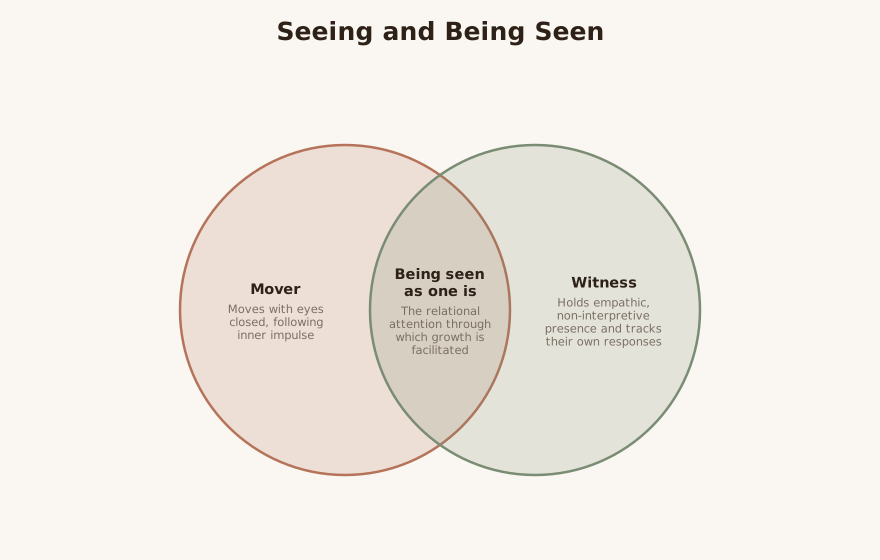
Authentic Movement (AM) is an expressive, depth-oriented movement practice in which a person moves with the eyes closed, following internal impulse rather than choreography, while another person — the witness — observes with nonjudgmental, benevolent attention 1. For practicing clinicians it sits at an unusual intersection: it is simultaneously a somatic technique, a relational discipline of attention, and a contemplative practice with explicit Jungian roots 14. This article orients you to what it is, what it is not, where the evidence stands, and how to use elements of it responsibly inside a recognized billable therapy.
Type & Discipline
Authentic Movement is a modality within dance/movement therapy (DMT), grounded in depth-psychological somatics — the lineage of approaches that treat the moving body as a route to unconscious and preverbal material 14. It is sometimes described as “Active Imagination in Movement,” signaling its direct descent from Jung’s technique of active imagination translated from image into kinesthetic experience 4. The defining structure is dyadic and minimal: a mover and a witness, often working in silence, with movement arising from inner sensation rather than external instruction 1. Unlike most DMT interventions, AM is not primarily therapist-led or goal-directed in the moment; the mover follows impulse and the witness restrains interpretation, which makes it as much a discipline of attention and restraint as a movement form 13.
It is useful to hold a clinical distinction at the outset. AM as practiced in its formal lineage is a personal-growth and contemplative discipline as often as it is a clinical treatment 14. When clinicians import it, they typically borrow its principles and structure into an established psychotherapy rather than delivering “Authentic Movement therapy” as a standalone licensed treatment LLM.
Creators & Lineage
The practice originates with Mary Starks Whitehouse (1911–1979), a dancer trained under Martha Graham and Mary Wigman who studied at the C.G. Jung Institute and fused modern dance with Jungian depth psychology 14. Whitehouse’s core insight was that movement must be “found” in the body rather than imposed from outside, and that movement becomes authentic when it reflects a genuine inner impulse rather than a conscious decision 14. Her formulation is the seed of everything that follows LLM.
Two students extended her work along complementary lines. Janet Adler, a dance/movement therapist, articulated and formalized the mover–witness structure and named the resulting practice “The Discipline of Authentic Movement,” drawing increasingly on Buddhist psychology, mysticism, and the development of a collective or “long” body in group practice 13. Joan Chodorow, a Jungian analyst, anchored the work explicitly in active imagination, archetype, and developmental psychology 1. Adler founded the Mary Starks Whitehouse Institute in 1981 — described as the first school devoted to the study of Authentic Movement — and later created “Circles of Four,” a post-graduate program for teaching the discipline internationally 6. Contemporary teacher-clinicians such as Tina Stromsted, who trained in this lineage, have further integrated AM with somatic psychotherapy and trauma-informed practice 46.
Core Principles
The foundational relationship is seeing and being seen: the practice holds that healing and growth are facilitated through being seen, as one is, in the presence of a witness 4. This is the engine of the work — not the movement itself, but the movement held within a particular quality of relational attention 4.
A second principle is the primacy of inner impulse over conscious direction. The mover closes the eyes and moves in response to sensation, emotion, memory, and impulse, deliberately reducing visual orientation and intellectual steering so that less-conscious material can surface 14. Whitehouse framed authenticity as the difference between movement that is genuinely found and movement that is “put on like a dress or a coat” 4.
Third is the disciplined restraint of the witness. The witness offers empathic, non-interpretive presence and tracks the mover’s experience while also tracking their own inner responses, projections, and judgments — rather than narrating, fixing, or analyzing the mover 14. The witness is understood to be actively engaged with their own sensations, not passively watching 1.
Fourth is the idea that the somatic unconscious becomes more available for awareness and reflection through the practice, restoring authority to a person’s own bodily knowing 4. In group forms, these principles extend to a collective body in which multiple movers and witnesses share a single field of attention 3.
Interventions & Techniques
The basic unit is the mover–witness dyad. The mover moves with eyes closed for a bounded period; the witness sits at the edge of the space, watching with benevolent, nonjudgmental attention 14. After the movement, the two typically speak, with the witness offering their experience in carefully owned, first-person language (“I saw… I noticed in myself…”) rather than interpretation of the mover 1.
Common structural elements drawn from the tradition and adaptable to clinical settings LLM:
- Eyes-closed moving to inner impulse, with permission to be still; stillness is treated as legitimate movement 14.
- Witnessing as a trained stance — attending to the mover while noticing one’s own arising sensations, images, and judgments, and holding them rather than discharging them onto the mover 1.
- Verbal sharing afterward, in which language is used to honor experience without collapsing it into diagnosis or analysis 1.
- Group / collective forms, scaling the dyad into a shared field with multiple movers and witnesses 3.
- Bracketing the session in time and space, which contains the regression and emergence the practice can evoke LLM.
LLM-generated illustrative example (not a guideline): A clinician adapting AM within a body-oriented session invites a client with chronic stress to stand, close the eyes, and “let the body move only if it wants to” for three minutes while the clinician witnesses. The client’s hands begin to press outward repeatedly. In the verbal phase the clinician says, “I noticed a pressing-away gesture, and I felt my own breath tighten watching it.” The client recognizes the gesture as connected to setting limits at work. The clinician keeps the meaning-making with the client rather than supplying an interpretation LLM.
Evidence Base
Honesty about maturity matters here. Authentic Movement is established as a practice tradition — it has a clear historical lineage, formal training institutes, foundational texts, and decades of clinical and contemplative use 136. That institutional maturity should not be confused with a mature outcome-trial evidence base LLM. Notably, general reference coverage of AM does not cite empirical studies or controlled evidence of therapeutic efficacy for the modality itself 1.
The defensible clinical position is therefore two-tiered LLM. The broader umbrella — dance/movement therapy and body-oriented psychotherapy — has a developing research literature, and AM borrows from mechanisms (interoception, embodied awareness, attuned relational presence) that are studied elsewhere 4. But AM as a discrete, manualized intervention has not accumulated the randomized controlled trials, effect sizes, and replication that would let a clinician describe it as evidence-based for a specific diagnosis 1LLM. Present it to clients and payers accordingly: as an experiential technique nested within an evidence-based therapy, not as a proven standalone treatment LLM.
Populations & Indications
In its lineage, AM has been offered to therapists, artists, educators, and “seekers” — people pursuing personal transformation and authentic self-expression as much as symptom relief 4. Its most natural clinical fit is with adults in creative arts therapy contexts and with clients explicitly seeking personal growth 4. It has a notable history of use with women and in group formats, where the collective body is part of the method 13.
Clinicians also describe applications for trauma survivors, because the practice can make preverbal and somatic material available and can restore a sense of bodily authority that trauma erodes 4. The same property is precisely why caution is required (see below) LLM. Indications most consistent with the method are mind–body disconnection, difficulty with self-expression, and stress, where re-establishing access to embodied, impulse-level experience is itself the therapeutic aim 4LLM.
Problems-for-Work
The following are application sketches, not efficacy claims LLM:
- Mind–body disconnection / dissociation (sub-clinical): AM’s eyes-closed attention to sensation can rebuild interoceptive contact and “bodily knowing,” with the witness providing the external safety that lets a client tolerate inner experience 4LLM.
- Difficulty with self-expression: Moving from impulse bypasses the verbal-performative self-monitoring that inhibits expression, while being witnessed without judgment provides corrective relational experience 14.
- Stress and emotional dysregulation: Bounded, attended movement followed by reflection can down-regulate arousal and build a noticing stance toward internal states 4LLM.
- Body image disturbance: Shifting from how the body looks to how it moves and feels from within can interrupt appearance-based self-evaluation 4LLM.
- Anxiety and depression (as adjunct): As an experiential adjunct inside a primary therapy, AM can offer behavioral activation, interoceptive exposure, and relational attunement LLM.
LLM-generated illustrative example (not a guideline): A client in psychotherapy for depression reports feeling “numb and far from herself.” Within sessions, the clinician introduces brief witnessed movement to help her notice small impulses (a turn of the head, a reach) and name what she feels. Over weeks this becomes a route into interoceptive awareness that the clinician folds back into the primary treatment plan LLM.
Contraindications, Cautions & Cultural Humility
The features that make AM powerful for trauma are the same that make it risky LLM. Eyes-closed, impulse-led movement can evoke regression, flooding, dissociation, or abreaction, especially in clients with PTSD, severe dissociative presentations, or fragile affect regulation 14LLM. AM should not be used to “open” trauma material without an established alliance, grounding/stabilization skills, and a clear plan for containment and return to window-of-tolerance LLM. With acutely dysregulated, actively psychotic, or severely dissociative clients, unstructured eyes-closed work is generally inappropriate without substantial modification LLM.
Competence is a real constraint: the witness role is a trained stance, not simply watching, and clinicians should not improvise it from a description alone 16. Power, gender, and the intimacy of being watched while moving require explicit consent and attention to safety, particularly given the practice’s history with women’s groups 1LLM. Cultural humility applies to the body itself — norms about touch, eye contact, modesty, and expressive movement vary widely, and the practice’s Jungian and Buddhist framing is not neutral or universal 13LLM. Offer it as an invitation, normalize declining, and adapt (eyes open, smaller range, seated) to client comfort LLM.
Treatment-Plan Suggestions & SMART Objectives
| Goal | SMART objective (example) | Mechanism |
|---|---|---|
| Improve interoceptive awareness | Client will identify and name at least 3 distinct bodily sensations during witnessed movement in 4 of 5 sessions over 6 weeks | Eyes-closed attention to sensation restores access to bodily knowing 4 |
| Increase tolerance of internal experience | Client will sustain 5 minutes of witnessed movement without leaving window-of-tolerance, using a grounding cue if needed, by week 8 | Bounded movement plus benevolent witnessing builds affect tolerance 4LLM |
| Enhance nonjudgmental self-expression | Client will move from impulse and then describe the experience in first-person, value-neutral language in 3 consecutive sessions | Impulse-led movement bypasses self-monitoring; witnessing models nonjudgment 14 |
| Reduce stress reactivity | Client will report a ≥2-point drop on a 0–10 distress scale after witnessed movement in 4 of 6 sessions | Attended movement and reflection support arousal down-regulation 4LLM |
| Strengthen mind–body integration | Client will link a movement experience to an emotion or memory in session and record it between sessions, weekly for 6 weeks | Somatic unconscious becomes available for awareness and reflection 4 |
| Improve relational safety | Client will accept being witnessed without protective behaviors (e.g., opening eyes to check) in 3 of 4 sessions by week 10 | Corrective experience of being seen without judgment 4LLM |
| Reduce appearance-based self-evaluation | Client will describe the body in functional/sensory terms rather than appearance terms in 3 consecutive reflections | Shifting attention from how the body looks to how it feels from within 4LLM |
Common Misconceptions
- “It’s just free dance or improvisation.” The defining element is the witnessing relationship and the discipline of attention, not free movement; remove the witness and the disciplined restraint and it is no longer Authentic Movement 14LLM.
- “The witness interprets what the mover ‘really’ meant.” The witness explicitly restrains interpretation and offers owned, first-person experience; meaning stays with the mover 14.
- “It’s evidence-based for trauma/PTSD.” It is an established practice tradition, but general reference coverage cites no controlled efficacy studies; describe it honestly as an adjunctive experiential technique 1LLM.
- “Anyone can witness after reading about it.” The witness stance is trained and is the hardest part to do well 16LLM.
- “It’s a passive or purely relaxing exercise.” It can surface intense preverbal and unconscious material and requires containment 14LLM.
Training & Certification
Formal study of Authentic Movement runs through lineage institutions rather than a single licensing board 56. Janet Adler founded the Mary Starks Whitehouse Institute in 1981 and later the “Circles of Four” post-graduate program, and her “Discipline of Authentic Movement” maintains published resources including books, films, articles, and archives such as A Moving Journal (1994–2006) 56. The Authentic Movement Institute, co-founded by Neala Haze and Tina Stromsted, organizes faculty into co-founder, senior, core, and visiting tiers and traces its lineage directly to Whitehouse through Adler and Chodorow 6.
Faculty in these programs typically hold advanced degrees and clinical credentials such as BC-DMT (Board-Certified Dance/Movement Therapist) and LMFT, integrating Jungian, somatic, and depth-psychological training 6. The practical implication for clinicians: AM training supplements, but does not replace, your underlying license and scope; you practice it within the therapy you are already credentialed to provide 6LLM. Janet Adler’s Offering from the Conscious Body: The Discipline of Authentic Movement (2002) is a primary text for understanding the discipline’s structure and its mover, witness, and collective-body dimensions 3.
Key Terms
- Mover: The person moving with eyes closed, following inner impulse 1.
- Witness: The person observing with benevolent, nonjudgmental, non-interpretive presence while also tracking their own inner responses 14.
- Active imagination in movement: Whitehouse’s framing of AM as Jung’s active imagination expressed kinesthetically 4.
- Somatic unconscious: Less-conscious material that becomes available through attention to bodily experience 4.
- Collective / long body: The shared field formed when AM is practiced in groups with multiple movers and witnesses 3.
- Bodily knowing: The restored authority of a person’s own felt, internal experience 4.
Resources & Further Reading
▶ Watch — a video introduction to this concept:
- Authentic Movement — Wikipedia 1
- Authentic Movement: Benefits, Techniques & How It Works — GoodTherapy 2
- Offering from the Conscious Body: The Discipline of Authentic Movement (Janet Adler, 2002) — Inner Traditions 3
- Authentic Movement — Tina Stromsted, Body-Soul Center 4
- The Discipline of Authentic Movement (Janet Adler) — Resources 5
- Authentic Movement Institute — Faculty 6
Reflective / Supervision Questions
- When I witness a client moving, what am I doing with my own arising judgments, projections, and somatic responses — and have I been trained to hold rather than discharge them? 1LLM
- Can I articulate, for this specific client, why an impulse-led eyes-closed technique is indicated over a more structured intervention, and what my containment plan is if material floods? LLM
- Am I representing AM honestly to this client and in my documentation — as an experiential adjunct within an evidence-based therapy, not as a proven standalone treatment? 1LLM
- How do this client’s cultural, gender, and trauma-related relationships to being watched and to expressive movement shape consent and adaptation? 1LLM
- Where is the boundary, for me, between AM as personal-growth/contemplative practice and AM as clinical treatment, and am I staying inside my license and scope? 46LLM