
Type & Discipline
Drama therapy is a creative arts therapy defined by the North American Drama Therapy Association as “the intentional use of drama and/or theater processes to achieve therapeutic goals” 1. It is an embodied, active practice in which clients explore experience and rework relationships through enactment rather than through talk alone 1. The field is also referred to as dramatherapy in the United Kingdom and is sometimes called acting therapy 7. It sits within the broader family of creative arts therapies alongside art, music, and dance/movement therapy, and shares conceptual roots with expressive arts therapy and group psychotherapy LLM.
As a discipline, drama therapy is distinguished from recreational drama or theatre education by its therapeutic intentionality and its grounding in psychological theory and supervised clinical training 1. The work spans individual, family, group, and community formats and is practiced across mental health clinics, schools, hospitals, correctional facilities, and community centers 1.
Creators & Lineage
Drama therapy did not emerge from a single founder; it developed across several countries through the twentieth century as practitioners independently discovered the link between drama and healing 7. In North America, Robert Landy and Renee Emunah documented how early clinicians arrived at this connection and helped formalize it into a profession 7. Landy is associated with role theory and the role method as a model of drama therapy practice 7. In England, the field grew out of drama education and remedial drama in the 1960s, with influences from theatre innovators such as Stanislavski, Artaud, and Grotowski, and the founding of training institutes such as the Sesame Institute 7.
A defining tributary for the modality is Augusto Boal’s Theatre of the Oppressed, which Boal developed in Brazil in the 1970s and later extended in Europe 6. Boal was influenced by the educator Paulo Freire’s Pedagogy of the Oppressed and built a body of techniques designed to let audiences “explore, show, analyse and transform the reality in which they are living” as active “spect-actors” rather than passive observers 6. Boal later embraced these methods explicitly as theatre and therapy, articulating in The Rainbow of Desire: The Boal Method of Theatre and Therapy a set of exercises to help people “see” the oppressions they have internalized 46. The other major lineage feeding drama therapy is J.L. Moreno’s psychodrama, the action-based group method that pioneered role play and enactment in a therapeutic frame LLM.
Core Principles
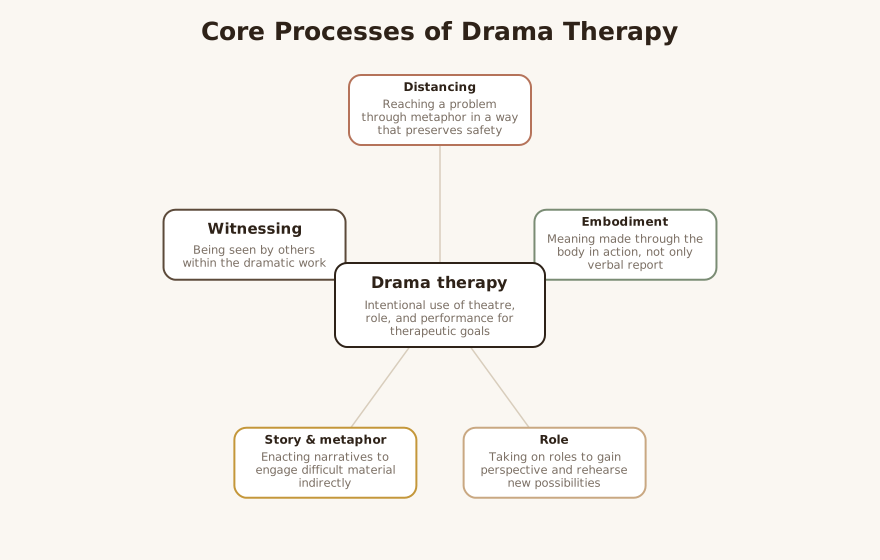
Drama therapists work through a recognizable set of core processes. The NADTA names the field’s working vocabulary as “play, embodiment, projection, role, story, metaphor, empathy, distancing, witnessing, performance, and improvisation” 1. Phil Jones articulated nine core processes for the field, including projective identification (experiencing feelings the client cannot directly access) and dramatic distancing (reaching a psychological problem through metaphor in a way that preserves safety) 7.
Distancing is central. By approaching a difficult experience through a role, a character, or a fictional scene, the client can engage material that would be overwhelming if addressed head-on, and can titrate how close to it they stand 7. Embodiment is a second principle: meaning is made through the body in action, not only through verbal report 1. A third is role: clients take on roles and, while in role, tell or enact a story, gaining perspective on themselves and rehearsing new possibilities 7. Additional elements that recur across the work include ritual, conflict, spontaneity, and catharsis 7.
In the Boalian strand, a further principle is the dismantling of passive spectatorship. Boal held that participants should “think and act for themselves” as equal performers rather than delegating agency to professional actors, a stance that prevents people from becoming “passive victims” of a narrative imposed on them 6. The therapeutic correlate is that clients rehearse and own alternative ways of acting in their own lives 5.
Interventions & Techniques
Sessions are tailored to the client and may incorporate theatre games, storytelling, enactments, and improvisations 1. Common techniques include role play, storytelling, projective work, and structured improvisation 17.
From Boal’s repertoire, Forum Theatre is among the most clinically transferable. A short scene depicting a problem (an “anti-model”) is performed, then replayed; participants intervene by stopping the action and replacing a character on stage to try out alternative solutions 5. A facilitator called the “Joker” moderates: staying impartial, ensuring each intervention is completed before the next begins, encouraging the group to evaluate what was tried, and flagging implausible “magic” solutions for discussion so the group keeps rehearsing realistic change 5. Boal framed Forum Theatre as “a chance to rehearse for revolution” without prescribing the correct answer 6.
Image Theatre uses wordless physical sculpting of bodies to communicate abstract states or relationships, bypassing the limits of language 6. The rainbow of desire and the related “cops in the head” technique externalize internalized oppression: the client’s competing internal voices and feared futures are made visible through screen images, images of feared futures, and image/counter-image exploration so that internal constraints can be recognized and worked through 46.
LLM-generated illustrative example (not a guideline): In a Forum Theatre group for adults recovering from interpersonal trauma, the therapist (as Joker) stages a brief scene in which a character is steamrolled by a demanding relative. Group members take turns stepping in to replay the protagonist, trying out a boundary-setting line, then a different tone, then walking away. The therapist names a “magic solution” when someone proposes the relative simply, instantly transforming, and redirects the group to rehearse changes within the protagonist’s actual control LLM.
Evidence Base
The maturity of drama therapy is best described as established as a credentialed discipline, with an empirical evidence base that is still emerging and heterogeneous 13. A general review of the empirical literature identified 89 empirical articles and concluded plainly that “there is no single approach or intervention that has a plethora of empirical support,” and that many forms of drama therapy lack any empirical research meeting the review’s criteria 3.
The research base is weighted toward qualitative and case-study methodologies, with randomized controlled trials appearing sparse 3. Studies concentrate in two areas: children and adolescents (23 articles) and trauma, including domestic violence, sexual abuse, and PTSD (12 articles), with additional clusters in psychiatric disorders (13), older adults (8), autism spectrum disorder (7), and forensic settings (5) 3. Findings are mixed and modest. The review notes that drama therapy “brought about mixed results” for severe mental illness, and that in dementia, qualitative findings showed positive experiences but “did not have a statistically significant impact on symptoms” 3.
Clinicians should also weigh the review’s stated limitations: it was English-language and peer-reviewed only, excluded more than 1,600 dissertations, and carried a “North American orientation” that may have omitted relevant international work 3. The honest summary is that drama therapy is a coherent, theory-rich, professionally regulated practice whose mechanisms are plausible and whose outcome literature is real but immature, with promising signals rather than robust confirmatory trials 3LLM.
Populations & Indications
Drama therapy is practiced across the full age range and in varied settings 1. Populations explicitly named by the field include trauma survivors, individuals with developmental disabilities, at-risk youth, older adults, and people facing addiction 1. The empirical literature adds children and adolescents, people with psychiatric disorders including severe mental illness, autistic individuals, and people in forensic and incarcerated settings 3.
The NADTA describes the work as beneficial for individuals, families, and communities struggling with transition, loss, social stigmatization, isolation, and conflict, and as effective in addressing anxiety, depression, and addiction while promoting mood change and healthier relationships 1. Group and community formats are a particular strength of the Boalian techniques, which were designed for collective exploration of shared and social problems 6. Indications therefore cluster around presentations where embodiment, perspective-taking, social rehearsal, and the safe approach to charged material through metaphor are likely to help 17LLM.
Problems-for-Work
Drama therapy can be brought to bear on a range of clinical problems, with the specific technique chosen for the mechanism it offers.
- PTSD and trauma: dramatic distancing lets survivors approach traumatic material through role and metaphor, regulating proximity to overwhelming content 7; the trauma cluster is one of the better-studied areas, though outcomes remain inconsistent 3.
- Social skills deficits and interpersonal difficulties: Forum Theatre and role play allow clients to rehearse new interpersonal responses and receive group feedback in a contained setting 51.
- Low self-esteem and identity disturbance: role method and image work let clients try on, examine, and expand the roles they inhabit, and externalize the internalized critical voices Boal called “cops in the head” 74.
- Depression and anxiety: embodiment, play, and improvisation activate spontaneity and positive mood states that the NADTA associates with the work 1.
- Grief and life transition: enactment, ritual, and witnessing provide structured ways to process loss and change 17.
- Emotional dysregulation and behavioral problems: distancing and the structure of dramatic form give clients a safer container in which to encounter and modulate strong affect 7LLM.
LLM-generated illustrative example (not a guideline): For an adolescent with social anxiety, a therapist uses brief improvised scenes of feared social situations, beginning with a fully fictional character to maximize distance, then gradually narrowing the gap toward the client’s own circumstances as tolerance builds LLM.
Contraindications, Cautions & Cultural Humility
Drama therapy is an active, exposing modality, and the same enactment that creates therapeutic reach can also flood a dysregulated or acutely psychotic client; clinicians should titrate distance carefully and have grounding and stabilization skills available LLM. Because the field’s outcome evidence is mixed and largely non-randomized, drama therapy should be offered with appropriate informed consent about the state of the evidence and is best positioned as part of a broader treatment plan rather than a sole intervention for serious conditions 3LLM.
Boal’s techniques originate as tools for examining oppression, power, and social context, which makes attention to culture, identity, and power dynamics integral rather than optional 6. The Joker’s discipline of impartiality and of not prescribing a “correct” solution is a built-in safeguard against a facilitator imposing their own values on a group 5. Clinicians should also note that the empirical review carried an explicit North American orientation, a reminder that the published evidence may not represent the cultural contexts of every client 3. Group enactment raises confidentiality and consent considerations that must be established before any scene work begins LLM.
Treatment-Plan Suggestions & SMART Objectives
| Goal | SMART objective (example) | Mechanism |
|---|---|---|
| Reduce trauma-related avoidance | Client will enact one trauma-adjacent scene through a fictional role in 3 of 4 sessions over 6 weeks, reporting distress under 6/10 | Dramatic distancing through role and metaphor 7 |
| Improve interpersonal assertiveness | Client will rehearse and complete 2 boundary-setting interventions in Forum Theatre scenes per session for 8 weeks | Behavioral rehearsal as spect-actor 5 |
| Increase emotional regulation | Client will identify and embody 3 distinct affect states using image work in each of 6 sessions | Embodiment and projection 17 |
| Strengthen self-concept / counter inner critic | Client will externalize and dialogue with one “cop in the head” voice in 4 of 6 sessions | Rainbow of desire / cops-in-the-head work 4 |
| Build social connection (group) | Client will offer or evaluate at least 1 intervention in each group enactment over 8 weekly sessions | Active spect-actorship and witnessing 65 |
| Process grief / life transition | Client will enact a ritual or witnessed scene addressing a specific loss in 3 sessions | Ritual, story, and witnessing 17 |
| Improve spontaneity / reduce anhedonia | Client will participate in improvisation warm-ups in 5 of 6 sessions, rating engagement after each | Play and spontaneity activating positive affect 1 |
Common Misconceptions
A frequent misconception is that drama therapy requires acting talent or that clients must “perform”; the NADTA’s framing centers play, story, and embodiment for non-actors and actors alike, and the work is participatory rather than a polished performance 17. A second is that it is simply theatre games or recreation; what distinguishes it is therapeutic intentionality, psychological theory, and supervised clinical training 1. A third is that Forum Theatre is about scripting a happy ending; in fact the Joker actively flags unrealistic “magic” solutions so the group rehearses change that lies within real control 5. A fourth is that the strong face validity of enactment equals strong outcome evidence; the empirical literature is genuinely mixed and dominated by qualitative and case-study designs 3.
Training & Certification
In North America the credential is Registered Drama Therapist (RDT), administered by the NADTA, which was established in 1979 1. The RDT requires either a master’s or doctoral degree in drama therapy from an NADTA-accredited program, or a graduate degree in theatre or mental health plus additional training through the association’s alternative training route; preparation includes psychology coursework, theatre experience, and supervised internships 1. Accredited master’s programs in North America include Antioch University (Seattle), Lesley University, NYU Steinhardt, the California Institute of Integral Studies, and Concordia University in Montreal 7. In the United Kingdom the profession is statutorily regulated by the Health and Care Professions Council, with training approved by the British Association of Dramatherapists, and the Netherlands has its own bachelor-level programs and professional body 7.
Key Terms
- Spect-actor: Boal’s term for a participant who is both spectator and actor, with the power to stop and change the performance 56.
- Forum Theatre: an interactive form in which an “anti-model” scene of a problem is replayed and audience members replace characters to rehearse alternatives 5.
- Joker: the impartial facilitator who moderates Forum Theatre, paces interventions, and names “magic” solutions 5.
- Dramatic distancing: accessing a psychological problem through metaphor or role to create safety 7.
- Rainbow of desire / cops in the head: Boal techniques for externalizing and working through internalized oppression and internal critical voices 46.
- Role method: a drama therapy model, associated with Landy, in which clients take on and examine roles 7.
- Embodiment: making meaning through the body in action rather than through verbal report alone 1.
Resources & Further Reading
▶ Watch — a video introduction to this concept:
- What is Drama Therapy? — North American Drama Therapy Association (NADTA)
- A snapshot of empirical drama therapy research: a general review of the literature — Journal of Applied Arts & Health
- The Rainbow of Desire: The Boal Method of Theatre and Therapy — Augusto Boal
- Forum theatre — Wikipedia
- Theatre of the Oppressed — Wikipedia
- Drama therapy — Wikipedia
Reflective / Supervision Questions
- When I use enactment, am I titrating dramatic distance to the client’s current regulation capacity, or am I assuming exposure is always tolerable 7LLM?
- In group work, how do I hold the Joker’s impartial stance without steering participants toward my own preferred solution 5LLM?
- Given that the outcome evidence is mixed and largely non-randomized, how am I framing drama therapy for clients and integrating it with evidence-based components of their plan 3LLM?
- Whose cultural frame is operating when we name an “oppression” or a “magic solution,” and how do I keep the work attuned to the client’s context rather than mine 6LLM?
- Am I documenting each enactment as a method serving an explicit therapeutic objective, in a way that would be defensible within my recognized billing modality 1LLM?