
Type & Discipline
Social integration and regulation are paired sociological constructs, not a therapy or a manualized intervention. LLM They originate in sociology — specifically the functionalist tradition that treats society as a system whose parts shape individual behavior — and were advanced by Émile Durkheim in his 1897 study Suicide. 1 Durkheim’s central methodological claim was that suicide, though it feels like the most private of acts, is a socially patterned phenomenon with collective causes that vary lawfully across groups rather than being explained purely by individual psychology. 5 For clinicians, the construct is best understood as a social-epidemiological lens: a way to read a person’s distress against the structure of their bonds and norms. LLM
The two forces are distinct. Integration refers to how strongly an individual is bound into groups — the density and meaning of social ties. 5 Regulation refers to how firmly shared norms bound and channel a person’s desires and expectations. 5 Durkheim’s signature insight is that both forces are pathogenic at either extreme: too little and too much of either is associated with elevated distress and suicide risk. 1
Creators & Lineage
Émile Durkheim (1858–1917), a founder of academic sociology, built the framework from comparative suicide-rate statistics across religions, marital statuses, regions, and historical periods. 1 Working in 1897, he pioneered what amounts to early multivariate analysis, examining several social variables simultaneously to isolate social causes — an approach that anticipated modern regression modeling. 5
The construct has a living lineage. Durkheim’s four-type Suicide Typology is its direct expression, and the concept of anomie — normlessness arising when regulation fails — is its most influential offspring. 2 In contemporary clinical-adjacent scholarship, Abrutyn and Mueller reenvisioned the “too much integration/regulation” side of the model for the sociology of mental health. 4 In public health, the Social Cure (social identity approach to health) and Antonovsky’s salutogenesis / sense of coherence are descendants that translate integration and regulation into health-protective resources, though each also inherits the original framework’s contested empirics. 3
Core Principles
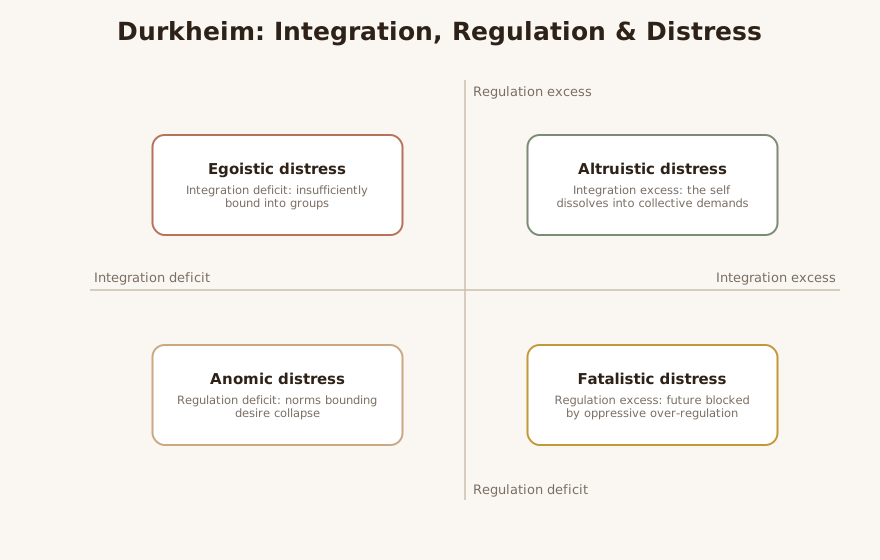
Integration deficit (egoistic distress). When a person is insufficiently bound into groups, they lose the collective sources of meaning and obligation that anchor the self; Durkheim linked this to higher suicide rates among the unmarried and the religiously detached. 1 His data showed Protestants, who were less tightly bound by communal religious structure than Catholics, had higher rates — and Jews, though highly educated, had among the lowest, because education there reinforced rather than dissolved community. 5
Integration excess (altruistic distress). When the group so thoroughly subsumes the individual that personal identity dissolves into collective demands, the self can be sacrificed for the group — Durkheim’s example was military self-sacrifice. 1
Regulation deficit (anomic distress). When norms that bound desire collapse — during rapid social change, economic boom, or economic crisis — people “do not know the limits on their desires and are constantly in a state of disappointment.” 1
Regulation excess (fatalistic distress). When the future is “pitilessly blocked and passions violently choked” by oppressive over-regulation, despair follows; Durkheim treated this type as largely theoretical. 1
The unifying principle is balance: well-being sits in a middle band, and both poles of each axis are pathogenic. LLM
Interventions & Techniques
There is no “Durkheimian therapy”; the construct supplies a formulation lens rather than a technique set, so clinical application means translating it into established modalities. LLM The deficit side maps cleanly onto Interpersonal Psychotherapy, whose problem areas — role transitions, grief, and interpersonal deficits — are operational restatements of integration loss. LLM Behavioral activation toward social contact and valued community roles directly targets integration deficits in depression. LLM Group therapy and social prescribing (linking clients to community resources, clubs, faith or peer communities) rebuild bonds at the level Durkheim identified as protective. LLM
The regulation side is subtler. For anomic, normless distress — common after job loss, retirement, migration, or faith deconversion — interventions that help a client rebuild a coherent narrative, re-bound expectations, and re-establish routines and values function as a clinical analogue to restoring regulation. LLM Because Durkheim’s framework warns that excess is also harmful, the clinician’s aim is calibration toward a healthy middle, not maximizing connection or norms in every case. 4
LLM-generated illustrative example (not a guideline): A 64-year-old man presents with low mood three months after mandatory retirement. Formulated through this lens, his work role had supplied most of his integration (colleagues, daily contact) and his regulation (structure, expectations). Treatment within Interpersonal Psychotherapy targets the role transition: grieving the lost role, building two new sources of connection, and re-establishing a weekly structure. LLM
Evidence Base
Honesty about maturity matters here. The construct is established — as a foundational sociological theory and a durable social-epidemiological framework, not as a clinical treatment validated by randomized trials. LLM Its core empirical observation — that social integration is associated with mental health and lower suicide risk — has been both theoretically argued and empirically verified across more than a century of sociology and is among the most-cited ideas in suicide research. 4
That said, the original evidence is genuinely contested, and clinicians should not overstate it. Kushner and Sterk argue Durkheim’s own data can be read to show the opposite of the protective-cohesion story, with suicide incidence high among some of the most group-subsumed populations. 3 They document that Durkheim ignored attempted suicides — which run roughly 2.3 times higher in women — and that he reclassified soldiers’ high rates as “altruistic” to preserve his framework rather than treat the data as disconfirming. 3 Abrutyn and Mueller add that the “too much integration” side was under-tested for decades, with one review finding only a single study operationalizing over-integration. 4 The framework is foundational and useful, but its predictions are population-level regularities, not individual-level certainties. LLM
Populations & Indications
The construct is most clinically illuminating for clients whose distress is organized around a rupture or absence of bonds or norms. LLM Recent retirees and the older adult / geriatric population often lose both the integration and regulation their work and social roles supplied. LLM Immigrants and first-generation individuals face anomic strain as the norms of origin and host cultures fail to align. 1 Recently unemployed or laid-off workers experience the economic-disruption pathway Durkheim tied to anomic distress. 1 Religious leavers and faith deconverts lose a dense source of both integration and regulation simultaneously, a combination the framework predicts is especially destabilizing. LLM Socially excluded or rejected individuals sit squarely in the integration-deficit zone, and the lens is a useful adjunct — never a substitute for direct risk assessment — for people living with chronic suicidality. 4
Problems-for-Work
- Loneliness / social isolation and belonging deficits: read as integration deficit; the work is rebuilding bonded, meaningful ties, not merely increasing contact frequency. 3
- Anomic / normlessness distress and loss of meaning / purpose: read as regulation deficit; the work is re-bounding expectations and reconstructing a coherent value structure after disruption. 1
- Demoralization and languishing / lack of flourishing: framed as the muted, sub-syndromal signature of a person whose integration or regulation has thinned without a discrete crisis. LLM
- Existential isolation and hopelessness: situated where Durkheim placed egoistic and fatalistic distress respectively — too few bonds, or a future felt to be blocked. 1
- Major depressive disorder and Adjustment Disorder With Depressed Mood: the construct does not replace these diagnoses but contextualizes them, especially when onset follows a social rupture such as migration, retirement, or deconversion. LLM
- Suicidal ideation: the lens informs formulation and never displaces standard risk assessment and safety planning. 4
Contraindications, Cautions & Cultural Humility
The most important caution is the ecological fallacy: Durkheim studied population rates (social facts), so applying group-level regularities to an individual is an inferential leap, not a deduction. LLM A given highly integrated person may be at more risk than a less integrated one — Durkheim’s framework cannot say which, a gap Abrutyn and Mueller name explicitly. 4
A second caution: integration is not reliably protective, and clinicians should resist prescribing “more social connection” as a generic remedy. 3 Kushner and Sterk stress that the quality of relationships is paramount and that participation alone “does not necessarily translate into acceptance, trust, or reciprocity.” 3 Social capital can mask power imbalances and should not substitute for material and structural resources. 3 Abrutyn and Mueller show how too much integration becomes harmful through three pathways — disruptions, the spread of negative emotions and ideas, and the circulation of negative suicide scripts — which is why connection can amplify risk in cluster and contagion contexts. 4
For cultural humility: norms of integration and regulation are culturally specific, and Durkheim’s original framing has been critiqued as carrying nostalgic and patriarchal assumptions. 3 What looks like “low integration” by one cultural standard may reflect a different, intact structure of belonging, so the clinician asks the client to define their own bonds and norms rather than imposing a template. LLM
Treatment-Plan Suggestions & SMART Objectives
| Goal | SMART objective (example) | Mechanism |
|---|---|---|
| Rebuild integration after isolation | Client will initiate two reciprocal social contacts per week for four weeks, logging each | Restores protective bonds (integration deficit) 3 |
| Re-establish regulation after disruption | Client will construct and follow a daily routine with three anchored activities, 5 of 7 days, for three weeks | Re-bounds expectations and structure (regulation deficit) 1 |
| Reduce anomic distress post-transition | Client will name three personal values and one concrete action per value within four sessions | Reconstructs a coherent norm/value structure 1 |
| Address belonging deficit | Client will join one ongoing community, peer, or faith group and attend three consecutive meetings | Builds bonded, meaningful ties beyond contact frequency 3 |
| Counter demoralization / languishing | Client will complete one mastery and one pleasure activity daily and rate mood, for two weeks | Behavioral activation toward valued roles LLM |
| Mitigate over-integration strain | Client will identify one role/relationship that feels engulfing and set one boundary, reviewed weekly | Calibrates toward a healthy middle band 4 |
| Support suicidality formulation | Client will co-develop a written safety plan and review it at each session | Integration/regulation lens informs, not replaces, risk care 4 |
| Process migration/retirement role loss | Client will complete an interpersonal inventory mapping lost and available ties within three sessions | Targets role transition and grief LLM |
Common Misconceptions
“More connection is always better.” The framework explicitly warns that excess integration and regulation are pathogenic, not just deficits. 1 Abrutyn and Mueller stress they do not consider high levels harmful in and of themselves, but show that under disruption, negative-emotion contagion, and suicide scripts, dense ties can lose their protective shield. 4
“Durkheim proved cohesion protects health.” His data are contested; the same evidence has been used to argue cohesion can co-occur with high suicide rates, and his framework rests on choices (excluding attempts, reclassifying soldiers) that protected the theory from disconfirmation. 3
“This is a therapy I can deliver.” It is a sociological construct and a formulation lens, applied clinically only by translating it into established modalities. LLM
“It explains an individual’s suicide.” It explains differences in population rates; using it to predict or explain a single case overreaches the construct’s logic. LLM
Training & Certification
There is no certification in Durkheimian integration and regulation, because it is a theoretical construct rather than a treatment. LLM It is taught within undergraduate and graduate sociology, social work, and public health curricula, and is accessible through open educational resources such as the Open Yale Courses lecture on Durkheim’s Suicide. 5 Clinicians typically encounter its applied descendants — interpersonal and social-context formulation, social prescribing, and suicidology — through training in those evidence-based pathways rather than through any Durkheim-specific credential. LLM
Key Terms
- Integration: the strength and meaningfulness of an individual’s bonds to groups. 5
- Regulation: the degree to which shared norms bound and channel desires and expectations. 5
- Egoistic (integration deficit), Altruistic (integration excess), Anomic (regulation deficit), Fatalistic (regulation excess): the four imbalance types. 1
- Anomie: normlessness arising when regulation fails, especially during rapid social change. 2
- Social fact: a group-level, collective phenomenon Durkheim treated as the proper unit of explanation. 5
- Suicide contagion / clustering: pathways by which integration can transmit risk. 4
Resources & Further Reading
▶ Watch — a video introduction to this concept:
- Suicide: A Study in Sociology (1897) — overview 1
- Durkheim, Émile: Anomie and Suicide — Encyclopedia of Criminological Theory (Sage) 2
- The Limits of Social Capital: Durkheim, Suicide, and Social Cohesion (Am J Public Health, 2005) 3
- When Too Much Integration and Regulation Hurts — Abrutyn & Mueller (2016) 4
- SOCY 151 Lecture 24 — Durkheim on Suicide (Open Yale Courses) 5
Reflective / Supervision Questions
- For this client, can I locate the distress on the integration axis, the regulation axis, or both — and at which pole? LLM
- Am I reflexively prescribing “more connection,” and have I checked whether the client’s existing ties offer genuine acceptance and reciprocity rather than mere participation? 3
- Where might excess integration or regulation — engulfment, contagion, oppressive norms — be operating, not just deficit? 4
- Am I committing an ecological fallacy by reasoning from population patterns to this individual’s risk? LLM
- Whose cultural definition of belonging and normality am I using — mine or the client’s? 3