
Type & Discipline
Individual Psychology (Adlerian) is a theory of personality and a clinically applied psychotherapy founded by the Austrian psychiatrist Alfred Adler, situated within clinical psychology and the broader psychodynamic / depth-psychology tradition 6. The name is frequently misread; “individual” derives from the Latin individuus, meaning indivisible, and signals Adler’s central commitment to holism — the person is treated as a unified, goal-directed whole rather than a set of warring drives or fragmented parts 56. Where Freudian psychoanalysis emphasized unconscious sexual drives and intrapsychic conflict, Adler reoriented the field toward how individuals consciously evaluate and respond to the social, vocational, and love-related demands of life 6. For the practicing clinician, this means the theory is fundamentally teleological (purpose-oriented) and social: behavior is understood by where it is heading and how it positions the person within community, not only by where it came from 46.
Creators & Lineage
Alfred Adler (1870–1937) was an early member of Freud’s circle who broke decisively from psychoanalysis, rejecting the primacy of libido in favor of conscious social motivation and individual responsibility for personality development 4. His 1924 volume The Practice and Theory of Individual Psychology (Adlerian) collected papers from roughly 1912–1914 and remains a foundational primary text for the approach 26. Adler’s collaborator and successor, Rudolf Dreikurs, popularized Adlerian ideas in North America, translating them into democratic education and parenting models and into accessible clinical practice 6.
The lineage runs forward as much as backward. StatPearls notes that while Adlerian therapy is “not commonly utilized as a first-line treatment,” it has exerted “significant influence on many common first-line psychotherapies,” particularly cognitive behavioral therapy, behavioral activation, and supportive psychotherapy 1. Its emphasis on conscious goals, subjective meaning, agency, and belonging also seeds humanistic, person-centered, and existential traditions 6. Clinicians who use cognitive restructuring, behavioral activation, or strengths-based encouragement are, in part, working in Adler’s debt 1LLM.
Core Principles
A handful of interlocking constructs organize the entire system.
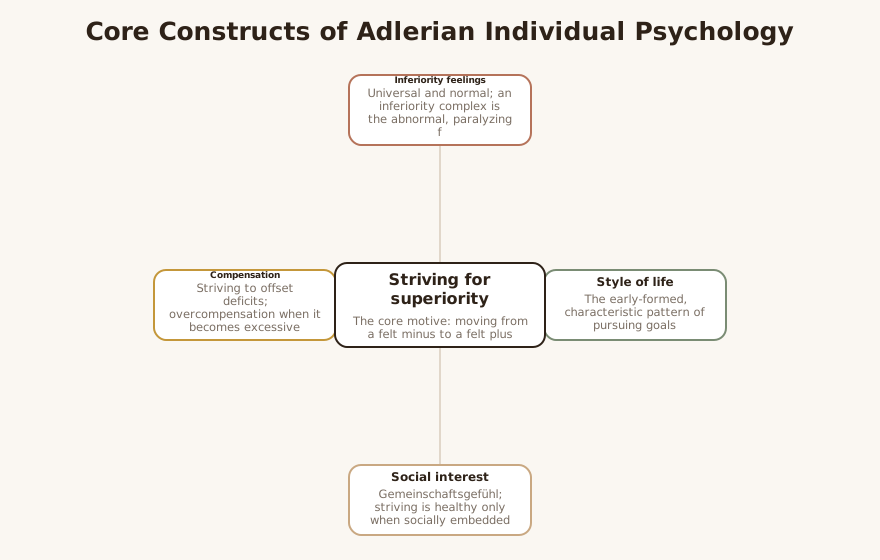
Inferiority feelings and the inferiority complex. All children begin life small, dependent, and inferior relative to adults and their environment, so inferiority feelings are universal and normal 15. The clinically important distinction is categorical: “inferiority feelings are normal, an inferiority complex is abnormal” — the latter being a persistent, paralyzing sense of inadequacy marked by doubt and hesitant behavior 14. Adler’s early work on organ inferiority described how the nervous system compensates for physical deficits (e.g., heightened auditory attention with impaired vision); overcompensation occurs when this striving becomes excessive 5.
Striving for superiority. The fundamental human motive is to move from a felt minus to a felt plus — to overcome inadequacy and pursue competence and self-realization 4. Adler insisted this striving is only healthy when socially embedded: “Striving is useless if it does not favor other people; it is healthy if it proceeds in the direction of social interest” 1. A superiority complex is not the opposite of inferiority but its mask — arrogance and domineering behavior covering an unresolved inferiority complex 45.
Style of life (lifestyle). By roughly age six, the child crystallizes a unified, characteristic pattern of beliefs, goals, and coping strategies — the style of life — which thereafter governs how novel situations are met 15. Adler described prototypical types, including the socially useful (healthiest), ruling, getting/dependent, and avoiding styles 1.
Social interest (Gemeinschaftsgefühl). “Community feeling” — a sense of belonging, interdependence, and cooperative contribution to the common good — is Adler’s index of mental health 16. It expresses itself across three life tasks: work, communal life/friendship, and love 5.
Fictional finalism and the creative self. Behavior is pulled by an imagined, future-oriented ideal — a “fictional final goal” that organizes conduct even when it bears little relation to reality 16. Crucially, the person is not determined by heredity or environment but creatively constructs meaning from them; what matters is “what we do with it” 5.
Interventions & Techniques
Adlerian treatment classically unfolds in four phases: (1) establishing an egalitarian therapeutic relationship, often using humor and small talk; (2) assessment of lifestyle, family constellation, early memories, and “basic mistakes”; (3) insight and interpretation of the purposive nature of behavior; and (4) reorientation toward new behavior and greater social interest 1.
Core techniques include:
- Encouragement — described as “the most powerful strategy for modifying a person’s assumptions,” building self-confidence and courage 1. This is the engine of Adlerian work, not mere praise 1LLM.
- The Question — asking variants of “How would your life be different if you no longer had this issue?” to clarify the function of symptoms and surface readiness for change 1.
- Acting as if — the client behaves “as if” a barrier did not exist, rehearsing a new role and bypassing resistance 1.
- Catching oneself — building awareness of self-defeating thoughts so the client can anticipate and interrupt the pattern 1.
- Pushbutton technique — alternately recalling pleasant and unpleasant memories to demonstrate that feelings and behavior are largely chosen 1.
- Style-of-life analysis — a structured interview into family of origin, birth order, childhood development, and early recollections 1.
- Task setting and brainstorming — homework such as pleasant-activity scheduling or community service, and generating alternative thoughts to replace discouraging beliefs 1.
LLM-generated illustrative example (not a guideline): A discouraged client says, “I’d love to apply for that promotion, but I’d just embarrass myself.” The clinician uses The Question — “If the fear of embarrassing yourself vanished overnight, what would tomorrow look like?” — then frames an acting as if experiment: spend one week behaving as if she were already the kind of colleague who speaks up in meetings, logging what happens. Encouragement focuses on effort and contribution rather than outcome. LLM
Evidence Base
Honesty about maturity matters here. Adlerian therapy is established in the sense of being a recognized, taught, and published modality with a century of clinical use — the American Psychological Association distributes a demonstration of Adlerian psychotherapy in its professional video series 3. It is not, however, supported by a large modern randomized-controlled-trial base, and StatPearls explicitly notes it is “not commonly utilized as a first-line treatment” 1.
What evidence exists is mixed and modest. Research has examined Adlerian approaches across anxiety, depression, schizophrenia, eating disorders, substance use, family dynamics, and personality disorders, and one controlled trial reported that individuals with eating disorders “significantly improved after Adlerian Parental Counseling compared to the baseline and the placebo groups” 1. Family-oriented work has been associated with changed patient perspectives and improved family functioning 1. The strongest claim the literature supports is influence: many of Adler’s constructs were absorbed into therapies — notably CBT — that do carry robust empirical support 1. The theory has also drawn the classic philosophical critique, associated with Karl Popper, that it is difficult to falsify 6. Clinicians should therefore present Adlerian work as a coherent, integrative framework rather than as an empirically first-line, manualized treatment 1LLM.
Populations & Indications
Adlerian methods are most strongly identified with children, families, couples, parents, and adolescents, reflecting Dreikurs’s legacy in democratic parenting and education 16. Family therapy applications aim to improve family dynamics and sense of belonging, with research suggesting they “will change patient perspectives, increase the family’s overall sense of humor, and increase the functioning of the family” 1. Among adults, the approach fits well with low self-esteem, discouragement, and inferiority feelings, and has been applied to anxiety (addressing excessive self-consciousness and fear of not belonging) and depression 1. With eating disorders, the framework reads symptomatic behavior as a symbolic communication of inadequacy 1. Its explicitly social and meaning-oriented stance also makes it relevant to social isolation, lack of purpose, and perfectionism 1LLM.
Problems-for-Work
- Low self-esteem / inferiority feelings. Reframe inferiority as a universal, workable starting point and mobilize encouragement to convert a felt minus into constructive striving 14.
- Discouragement and lack of purpose. Use The Question and life-task review (work, friendship, love) to locate where the person has retreated from contribution 15.
- Relationship and parenting conflict. Examine the style of life, family constellation, and the goals served by conflictual behavior; introduce democratic, cooperative alternatives 16.
- Anxiety. Target the underlying fear of not belonging and the safeguarding tendencies that maintain avoidance 1.
- Perfectionism / superiority striving. Surface the inferiority the perfectionistic “plus” is defending against, and redirect striving toward social usefulness 14.
- Behavioral problems in children. Read misbehavior as goal-directed and purposive, and shift the family system toward encouragement over correction 15.
LLM-generated illustrative example (not a guideline): In family work, an 8-year-old’s escalating tantrums are reframed not as “bad behavior” but as a goal-directed bid for belonging after a new sibling arrived — an echo of Adler’s “dethroning” of the firstborn. The plan emphasizes structured one-to-one time and encouragement of cooperative contribution rather than punishment. LLM
Contraindications, Cautions & Cultural Humility
StatPearls does not list formal contraindications, which itself signals that the approach should be used judiciously rather than assumed universally safe 1. Two cautions follow from its evidence profile and its constructs. First, because Adlerian therapy is not first-line for acute, high-acuity presentations — active suicidality, psychosis, severe eating disorders requiring medical stabilization — clinicians should pair or defer it in favor of evidence-based, often manualized care, using Adlerian methods as an integrative or adjunctive lens 1LLM. Second, birth-order theory must not be applied mechanically; Adler himself cautioned that parental behavior and individual circumstances modify these patterns, and the empirical support for his specific birth-order predictions is mixed 45.
On cultural humility, the framework has real strengths and real risks. Adlerian thought is explicitly attentive to “culture, ethnicity, gender, racism, sexual orientation, and social equality,” including spiritual and religious dimensions, and its construct of masculine protest reframed gendered dominance as a culturally produced response to inequality maintained “primarily through force… but also through indoctrination and education” rather than as inherent psychology 15. Yet the emphasis on social interest and cooperative “fitting in” can be misapplied as pressure to conform to a dominant culture’s norms; clinicians should hold belonging as defined by the client’s own communities 5LLM.
Treatment-Plan Suggestions & SMART Objectives
| Goal | SMART objective (example) | Mechanism |
|---|---|---|
| Reduce discouragement, increase courage to act | Within 6 weeks, client initiates one previously avoided task per week and logs it, raising a self-rated “courage” score from 3 to 6 of 10 | Encouragement; acting as if 1 |
| Strengthen social interest / belonging | Over 8 weeks, client engages in one contribution-oriented activity (volunteering, helping a peer) weekly and reports on its impact in session | Life-task activation (communal life) 15 |
| Convert inferiority feelings into adaptive striving | In 4 sessions, client identifies 3 inferiority-driven “basic mistakes” and reframes each into a usable strength statement | Style-of-life analysis; cognitive reframing 14 |
| Interrupt self-defeating cognitions | Daily for 3 weeks, client uses “catching oneself” to log and reframe one discouraging thought | Catching oneself; brainstorming alternatives 1 |
| Clarify symptom function and motivation | By session 3, client answers The Question and names one concrete way life would change without the symptom | The Question; insight phase 1 |
| Improve family belonging / reduce child behavior problems | Within 8 weeks, parents replace one punitive routine with a daily encouragement practice; caregiver-rated cooperation rises 30% | Democratic parenting; reorientation 16 |
| Reduce perfectionistic over-striving | Over 6 weeks, client completes 2 tasks “good enough” without revision and tolerates the distress, rated weekly | Reframing superiority striving toward usefulness 14 |
Common Misconceptions
- “Individual Psychology (Adlerian) means therapy focused on the lone individual.” It means the indivisible person — a holistic, and deeply social, theory 56.
- “It’s just early Freud.” Adler broke from Freud, demoting libido and elevating conscious social goals and agency 46.
- “Inferiority is pathological.” Inferiority feelings are normal and motivating; only the entrenched inferiority complex is dysfunctional 14.
- “A superiority complex means high self-esteem.” It is a defensive mask over unresolved inferiority 45.
- “Birth order rigidly determines personality.” Adler treated it as one influence among many and warned against mechanical application 45.
- “Encouragement is just praise.” It is the targeted building of courage and confidence, framed by Adler as the most powerful lever for changing assumptions 1.
Training & Certification
Standard mental-health licensure plus supervised psychotherapy training is the baseline for delivering Adlerian-informed care, and the APA’s distribution of an Adlerian psychotherapy demonstration reflects its standing as a recognized approach within professional training 3LLM. For formal credentialing, the North American Society of Adlerian Psychology (NASAP) sets a demanding bar: a minimum of a master’s degree plus 90 hours of Adlerian-focused study, 8 years of application, attendance at four NASAP conferences, two publications, and three years of leadership involvement 1. Most clinicians will integrate Adlerian constructs into existing practice rather than pursue full NASAP credentialing 1LLM.
Key Terms
- Inferiority feeling / inferiority complex — universal felt inadequacy vs. its entrenched, paralyzing form 14.
- Striving for superiority — the move from felt minus to plus, healthy only when socially oriented 14.
- Style of life (lifestyle) — the unified, early-formed pattern governing how one meets life’s tasks 15.
- Social interest (Gemeinschaftsgefühl) — community feeling; Adler’s marker of mental health 16.
- Fictional finalism — the imagined future goal that organizes behavior 16.
- Creative self — the person’s agency in constructing meaning from heredity and circumstance 5.
- Family constellation / birth order — the psychological environment of one’s position among siblings 45.
- Masculine protest — culturally produced striving against gendered role constraints 5.
- Basic mistakes — overgeneralized, self-limiting conclusions embedded in the style of life 1.
Resources & Further Reading
▶ Watch — a video introduction to this concept:
- Adlerian Therapy — StatPearls (NCBI Bookshelf)
- Adler A. The Practice and Theory of Individual Psychology (Adlerian) (1924) — Internet Archive
- Adlerian Psychotherapy (APA Psychotherapy Video) — American Psychological Association
- Alfred Adler: Theory of Individual Psychology (Adlerian) & Personality — Simply Psychology
- Adler’s Individual Psychology (Adlerian) (4.3) — Social Sci LibreTexts
- Individual psychology — Wikipedia
Reflective / Supervision Questions
- When I formulate a client’s symptom, do I ask what purpose or goal it might serve, or only what caused it? 1LLM
- How do I distinguish, in this client, between normal inferiority feelings that can be mobilized and an entrenched inferiority complex that needs reworking? 14
- Whose definition of “belonging” and social contribution am I using — the client’s own communities, or a dominant cultural norm I am implicitly importing? 5LLM
- Am I using encouragement as targeted courage-building, or have I drifted into reassurance and praise? 1
- Where might I be over-reading birth order or family constellation and underweighting the client’s creative agency? 45
- Given the limited modern RCT base, how am I being transparent with this client about Adlerian work as an integrative lens rather than a first-line, manualized treatment? 1LLM