
Type & Discipline
Durkheim’s suicide typology is a sociological construct, not a treatment, a diagnosis, or a stand-alone therapy LLM. It belongs to the discipline of sociology and, within it, to the functionalist tradition, which reads social phenomena in terms of the functions they serve for the stability of the larger social system 2. The typology is the analytic core of Émile Durkheim’s 1897 work Le Suicide, in which he argued that suicide rates are not merely the sum of individual tragedies but a “social fact” — a patterned, measurable property of groups that varies systematically with the structure of those groups 1. Durkheim’s central methodological claim was that something as seemingly private as suicide could be explained by social forces external to the individual, and that the suicide rate of a society is comparatively stable and characteristic of that society over time 1.
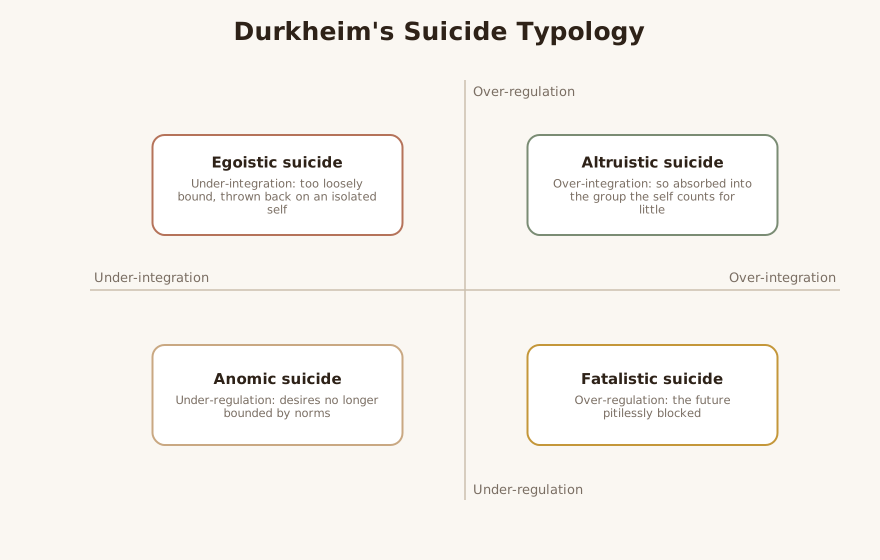
For a clinician the value of the typology is not that one delivers it in session, but that it supplies a vocabulary and a structural map for the social conditions that raise or lower suicide risk across a population LLM. The typology classifies suicide along two axes of the person’s relationship to society: social integration, meaning how strongly the individual is bound into collective life, and social regulation, meaning how firmly social norms structure the individual’s desires and conduct 2. Because it is a population-level descriptive frame rather than a modality, it travels across treatment approaches and informs how a therapist reads the social context of a despairing client, rather than constituting a therapy in itself LLM.
Creators & Lineage
The typology was developed by the French sociologist Émile Durkheim, one of the founders of academic sociology, in Suicide: A Study in Sociology (Le Suicide: Étude de sociologie), first published in 1897 1. The work is regarded as a landmark of sociological method because it sought to demonstrate that sociology was a genuine science with its own subject matter — social facts — by taking a phenomenon usually claimed by psychology and medicine and showing it to be governed by social structure 1. Durkheim built his argument from official statistics, comparing suicide rates across countries, religions, marital and family statuses, military and civilian populations, and periods of economic upheaval, and reading the stable differences between groups as evidence of social causation 1.
The lineage of the typology runs through the broader functionalist program, in which Durkheim treated society as a system whose parts contribute to a working whole, and in which excessive or deficient amounts of social integration and regulation are read as dysfunctions that surface in the suicide rate 2. The concept most strongly associated with Durkheim’s name, anomie — a condition of normlessness in which the regulating force of shared norms breaks down — was elaborated in Suicide and became one of the most generative ideas in the social sciences, later extended in criminological strain theory and the study of deviance 2. The theory has remained continuously taught and re-examined; a 2025 sociological reappraisal revisits Durkheim’s framework and argues for its enduring relevance to contemporary patterns of social disconnection while noting where it must be updated 4.
Within the clinical and population-health world, Durkheim’s emphasis on belonging and social bonds is a direct ancestor of later interpersonal and social accounts of suicide and of the “social cure” literature on the protective power of group membership, though these are descendant traditions rather than Durkheim’s own work LLM. That the founding 1897 text and a 2025 reappraisal both remain in active circulation marks the typology as an established, debated classic rather than a settled formula 4.
Core Principles
The first principle is that suicide rates are social facts explained by the structure of the group, not only by individual psychology 1. Durkheim observed that the suicide rate of a given society stays comparatively constant over time and differs reliably between groups — for example, between Protestant and Catholic populations, or between the married and the unmarried — and he treated this stability as proof that a social force, not a sum of private decisions, was at work 1. This is the move that makes the typology useful to anyone thinking about populations rather than only individuals LLM.
The second principle is that suicide varies along two structural dimensions, integration and regulation, and that risk rises at both the deficient and the excessive ends of each 2. Under-integration produces egoistic suicide, the suicide of the person too loosely bound to collective life and thrown back on an isolated self; over-integration produces altruistic suicide, the suicide of the person so absorbed into the group that the self counts for little and death can be experienced as duty or honor 3. Under-regulation produces anomic suicide, the suicide that follows the collapse of the norms that ordinarily contain desire and expectation; over-regulation produces fatalistic suicide, the suicide of the person whose future is so blocked and oppressively controlled that life feels foreclosed 3.
The third principle is that integration and regulation are protective in moderation and dangerous in their extremes, so the model is curvilinear rather than linear LLM. Durkheim held that a healthy society binds its members enough to give life meaning and regulates their aspirations enough to make them attainable, and that suicide rises whenever a society supplies too little or too much of either 2. For the clinician this yields a non-obvious lesson: more belonging and more rules are not always safer, because over-integration and over-regulation carry their own characteristic risks LLM.
Interventions & Techniques
Because the suicide typology is a sociological construct rather than a therapy, there are no “Durkheimian techniques”; the concept works by shaping formulation and is then operationalized through recognized modalities and through the clinician’s standard suicide-risk practice LLM. The first practical move is social-context formulation: asking, alongside the usual risk assessment, which of the four structural conditions best describes a suicidal client’s situation — isolating under-integration, suffocating over-integration, the normlessness of a sudden life rupture, or the airless entrapment of a foreclosed future 3. Naming the structural shape of the despair can widen a clinician’s attention beyond intrapsychic factors to the social bonds and norms that the intervention may need to address LLM.
A second move is targeting the relevant axis. Where the formulation points to egoistic under-integration, the clinical and case-management work bends toward rebuilding belonging and connection; where it points to anomic under-regulation after a job loss, divorce, or other rupture, the work bends toward restoring structure, predictability, and a renegotiated sense of expectation 2. Where it points to fatalistic over-regulation — the trapped adolescent, the inmate, the person whose life feels totally controlled — the work attends to restoring agency and a sense of possible futures, and where it points to altruistic over-integration the work may need to loosen a fused identification with a group’s demands 3. These moves are delivered through the clinician’s primary modality and within standard safety planning; the typology supplies the why and where to look, while the modality supplies the how LLM.
LLM-generated illustrative example (not a guideline): A 58-year-old client presents with passive suicidal ideation three months after an involuntary layoff that ended a 30-year career. Alongside formal risk assessment and safety planning, the clinician uses the typology to read the despair as partly anomic — the sudden loss of the norms, routines, and status that had ordered the client’s desires — and orients early sessions toward rebuilding structure and a livable sense of expectation, while also screening for the under-integration of lost workplace ties LLM.
Evidence Base
The honest appraisal is that Durkheim’s suicide typology is an established and foundational sociological theory — continuously taught, cited, and re-tested since 1897 — but it is a population-level explanatory framework, not a clinical intervention with its own outcome trials LLM. Suicide is treated as a methodological landmark precisely because it demonstrated that suicide rates could be studied as social facts, and its standing rests on conceptual reach and durability rather than on randomized efficacy data, which is the form “evidence” takes for a theory of this kind 1. Its original empirical base was the comparative analysis of official suicide statistics across groups, a powerful design for revealing population patterns but one constrained by the quality of nineteenth-century records and by the ecological level at which it operates 1.
The framework’s continued standing also rests on the fact that it has been seriously contested and revised within its own discipline, which is the mark of a live rather than a dead idea LLM. A 2025 reappraisal argues that Durkheim’s account of integration and regulation remains analytically valuable for understanding modern loneliness and social fragmentation, while also pressing the need to update it for contemporary social conditions 4. For the clinician two implications follow LLM. First, the typology should be used as a map of the social conditions that shape suicide risk across populations, not as a validated treatment or as a predictive instrument for any individual LLM. Second, the model carries a well-known ecological caution: it explains differences in group rates, and inferring an individual’s motive directly from a population pattern is a logical overreach the framework does not license LLM.
Populations & Indications
The typology’s natural relevance is to anyone whose suicide risk is bound up with their social integration and regulation, which is, in Durkheim’s reading, everyone, but it is especially illuminating for groups defined by a sharp change in social bonds or norms 2. People living with chronic suicidality or a settled wish to die can be read, in part, through the egoistic axis when their despair is organized around profound isolation and a self cut off from sustaining collective life 3. Older adults and the geriatric population fit this picture when retirement, widowhood, and the attrition of a social world strip away integration, and recently unemployed or laid-off workers fit the anomic picture when a rupture dissolves the norms and expectations that had structured their lives 2.
Military veterans and active-duty service members are a population where the typology is unusually instructive, because military life can carry both over-integration — the kind of fused identification with the group that Durkheim linked to altruistic suicide — and, on transition to civilian life, an abrupt loss of integration and regulation that resembles the egoistic and anomic conditions at once 3. Religious leavers and faith deconverts can experience the loss of a dense regulating and integrating community, and socially excluded or rejected individuals sit squarely in the under-integration zone 2. Adolescents and emerging adults are indicated both because identity and belonging are in flux and because the fatalistic, over-regulated condition of a life that feels totally controlled and foreclosed can be acute in young people who see no possible future 3.
Problems-for-Work
Durkheim’s typology maps onto a recognizable cluster of problems centered on the social conditions of despair and the wish to die 2. Suicidal ideation, suicidal behavior, and suicide attempt are the central targets the framework was built to illuminate, read here not only as symptoms of an individual disorder but as outcomes shaped by where a person sits on the integration and regulation axes 1. Loneliness, social isolation, and social withdrawal sit at the egoistic, under-integration pole, and the model gives clinician and client a shared way to name how the thinning of social bonds feeds the wish to die 3.
Belonging deficits are the direct conceptual target of the integration axis, and the sense of being trapped or entrapped is the lived experience of the fatalistic, over-regulated condition in which the future feels foreclosed 3. Loss of meaning or purpose, hopelessness, and demoralization are read through anomie, the normlessness in which desires lose their bearings and life loses its felt structure after a rupture 2. Major depressive disorder and prolonged grief disorder frequently co-travel with these social conditions, and the typology adds a layer of social formulation on top of — never instead of — their indicated clinical care LLM.
LLM-generated illustrative example (not a guideline): A 19-year-old reports feeling “trapped with no way out” under intense, controlling family expectations about their future. Alongside formal risk assessment, the clinician recognizes a fatalistic, over-regulated pattern — risk arising not from too little structure but from too much, with the future experienced as foreclosed — and orients the work toward restoring a sense of agency and imaginable alternatives, while collaborating on safety planning LLM.
Contraindications, Cautions & Cultural Humility
The foremost caution is the ecological fallacy: the typology explains differences in suicide rates between groups, and a clinician must never read off an individual client’s risk or motive directly from a population pattern LLM. A theory about why one society’s rate exceeds another’s does not tell you whether the person in front of you will act, and it can never substitute for individualized, structured suicide-risk assessment, collaborative safety planning, and the indicated standard of care LLM. The typology is a lens for understanding social context, not a risk-stratification tool, and treating it as one would be a serious clinical error LLM.
A second caution is that the typology, especially the altruistic category, can be misused to romanticize or rationalize a death as honorable or meaningful, which is dangerous in a clinical setting where the task is to preserve life LLM. Durkheim described altruistic suicide as the suicide of intense over-integration, in which the self is so subordinate to the group that death can be experienced as duty; for a clinician this is a description of a risk condition to be addressed, not a value to be endorsed 3. Where a client frames self-destruction as obligation, sacrifice, or honor, the clinical response is heightened concern and engagement, not respectful neutrality LLM.
A third caution concerns cultural humility about what integration, regulation, and a “healthy” social bond even mean LLM. Durkheim wrote within nineteenth-century European data and assumptions, and the same density of family, religious, or community ties that reads as protective integration in one cultural frame can be experienced as oppressive over-regulation in another, particularly for clients whose autonomy or identity is constrained by their community 4. Honoring cultural humility means interpreting a client’s social world against their own values rather than a default Western individualism, recognizing that “more belonging” is not uniformly protective, and remaining alert to how social exclusion along lines of race, sexuality, immigration status, or faith concentrates risk in ways Durkheim’s original categories only partly capture LLM.
Treatment-Plan Suggestions & SMART Objectives
| Goal | SMART objective (example) | Mechanism |
|---|---|---|
| Maintain safety alongside social formulation | Within 1 session, client and clinician will complete a collaborative safety plan with means-restriction steps and at least 2 contactable supports | Keeps risk management primary while the social frame informs, never replaces, indicated care LLM |
| Name the structural shape of the despair | Within 3 sessions, client will identify which condition best fits their situation — isolation, over-fusion, normlessness, or entrapment — in their own words | Locates the work on the integration/regulation axes so the intervention targets the right axis 3 |
| Rebuild social integration | Over 8 weeks, client will initiate or re-establish 2 value-aligned social connections or group activities | Counters egoistic under-integration by strengthening belonging 2 |
| Restore structure after a rupture | Over 6 weeks, client will construct a daily routine and 3 realistic near-term goals following the loss | Counters anomic under-regulation by rebuilding norms and attainable expectations 2 |
| Restore agency under entrapment | Within 6 sessions, client will identify 2 domains where they hold real choice and take one concrete step in each | Counters fatalistic over-regulation by opening a sense of possible futures 3 |
| Loosen over-fused identification | Over 8 weeks, client will articulate 3 personal values distinct from the demands of the group they feel bound to | Addresses altruistic over-integration by recovering a self apart from the collective 3 |
| Address co-occurring grief or depression | Over 10 sessions, client will engage indicated treatment for prolonged grief or depression while tracking mood and ideation | Treats the clinical disorder that co-travels with the social condition LLM |
Common Misconceptions
A frequent error is reading the typology as a tool for predicting an individual’s suicide, when it is a population-level account of why group rates differ and says nothing certain about any one person 1. A second misconception is assuming the four types are mutually exclusive boxes; in lived cases a client’s despair often blends conditions — egoistic isolation alongside anomic rupture after the same loss — and the categories are better used as overlapping descriptions than as discrete diagnoses LLM. A third is treating integration and regulation as purely protective, missing Durkheim’s central insight that their excess is also dangerous, which is precisely what the altruistic and fatalistic categories capture 3.
A fourth misconception is conflating Durkheim’s anomie with simple stress or sadness; anomie specifically names the breakdown of the norms that ordinarily contain and order desire, a structural condition rather than a mood 2. A fifth is assuming the theory is a historical relic; contemporary reappraisals argue that integration and regulation remain analytically alive for understanding modern loneliness and disconnection, even as the framework needs updating 4. Finally, the typology is sometimes mistaken for a therapy one “does,” when it is a sociological frame that informs formulation while the actual treatment is delivered through recognized clinical modalities and risk-management practice LLM.
Training & Certification
There is no certification in “Durkheim’s suicide typology”; the concept is foundational theory studied within sociology rather than a credentialed clinical technique LLM. Clinicians typically encounter it through coursework in sociology, social theory, and the social determinants of health, where Suicide is the standard primary text and where free university materials such as the Open Yale Courses lecture on Durkheim’s Suicide offer an accessible orientation 5. Reading the primary 1897 work, or a careful summary of it, remains the most direct route to understanding the typology in its original terms, and the encyclopedia treatment of anomie and suicide offers a compact scholarly entry point 2.
For applied clinical competence, the relevant training lives elsewhere: in evidence-based suicide-risk assessment and safety planning, and in the recognized modalities through which the social formulation is operationalized — interpersonal and relational approaches for rebuilding integration, structured and behavioral approaches for restoring regulation after a rupture, and the general competencies of working with social isolation, grief, and entrapment LLM. Generalist therapists can legitimately use the typology for social formulation provided they represent its evidentiary status honestly, never substitute it for individualized risk assessment, and deliver care through modalities in which they are trained LLM.
Key Terms
Social fact — a patterned, measurable property of a group, external to and constraining on the individual, which Durkheim argued the suicide rate to be 1. Social integration — the degree to which an individual is bound into collective life; too little produces egoistic and too much produces altruistic suicide 2. Social regulation — the degree to which shared norms structure an individual’s desires and conduct; too little produces anomic and too much produces fatalistic suicide 2. Egoistic suicide — the suicide of under-integration, of the person isolated and thrown back on an insufficient self 3. Altruistic suicide — the suicide of over-integration, in which the self is so absorbed into the group that death can be experienced as duty or honor 3. Anomic suicide — the suicide of under-regulation, following the collapse of the norms that ordinarily contain desire, often after sudden upheaval 2. Fatalistic suicide — the suicide of over-regulation, of the person whose future is so blocked and oppressively controlled that life feels foreclosed 3. Anomie — the condition of normlessness in which the regulating force of shared norms breaks down 2.
Resources & Further Reading
▶ Watch — a video introduction to this concept:
- Suicide: A Study in Sociology — overview of Durkheim’s book (Wikipedia)
- Durkheim, Émile: Anomie and Suicide — Encyclopedia of Criminological Theory (Sage)
- Altruistic and Fatalistic Suicide: Definition & Lesson (Study.com)
- Revisiting Durkheim’s Theory of Suicide: A Sociological Analysis (IJFMR, 2025)
- SOCY 151 Lecture 24 — Durkheim on Suicide (Open Yale Courses)
Reflective / Supervision Questions
- When I formulate a client’s suicidality, am I attending only to intrapsychic factors, or have I also asked where they sit on the integration and regulation axes — isolated, over-fused, in normless rupture, or trapped 3?
- Have I kept structured, individualized risk assessment and safety planning primary, and held the typology strictly as a frame for understanding social context rather than as a tool for predicting this person’s risk LLM?
- When a client describes belonging or strong family and community ties, am I assuming integration is protective, or have I checked whether it is experienced as oppressive over-regulation in their own frame 4?
- If a client frames self-destruction as duty, sacrifice, or honor, am I responding with heightened clinical concern rather than mistaking respect for the “altruistic” type for clinical neutrality 3?
- Am I presenting Durkheim’s typology to myself and the team as a useful population-level map of the social conditions of despair, or am I overstating it as a validated individual predictor it was never built to be 1?